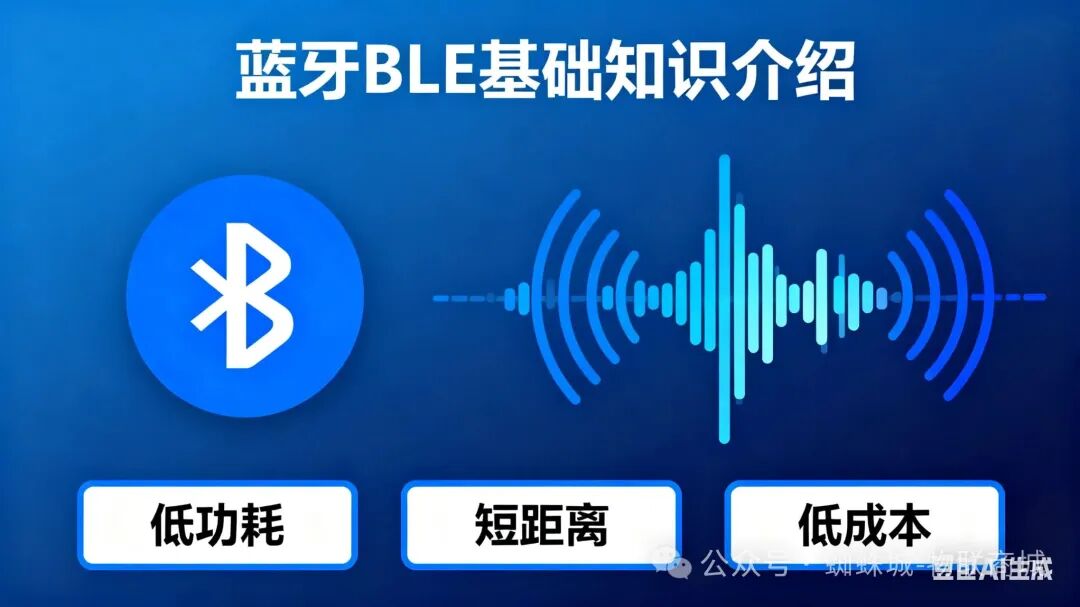
Bluetooth Low Energy (BLE) is a low-power, short-range wireless communication technology introduced with Bluetooth version 4.0. It is now widely used in fields such as the Internet of Things (IoT), smart homes, health monitoring, and wearable devices. Compared to traditional Bluetooth (BR/EDR), BLE significantly reduces power consumption while maintaining a similar communication range, making it an ideal choice for battery-powered devices.
1. Basic Characteristics of BLE
-
Low Power Consumption
The core advantage of BLE lies in its extremely low energy consumption. By optimizing the connection mechanism and data transmission methods, BLE devices consume very little current (in microamps) in standby mode, while also maintaining low power consumption during data transmission, making them suitable for long-term operation powered by button batteries.
-
Short-Range Communication
The typical communication range of BLE is 1-10 meters (depending on transmission power), with a maximum range of up to 100 meters (using high power mode). This short-range characteristic makes it more suitable for direct communication between personal devices, reducing signal interference and enhancing security.
-
Fast Connection
BLE has a very short connection establishment time (usually within 3 milliseconds), which is much faster than traditional Bluetooth (about 100 milliseconds). This allows devices to pair quickly and transmit data, making it suitable for applications that require immediate response.
-
Low Cost
Due to the simplicity of the BLE protocol stack, the hardware implementation cost is low, and the prices of chips and modules are relatively affordable, making it suitable for large-scale deployment in consumer and industrial devices.
2. Working Principle of BLE
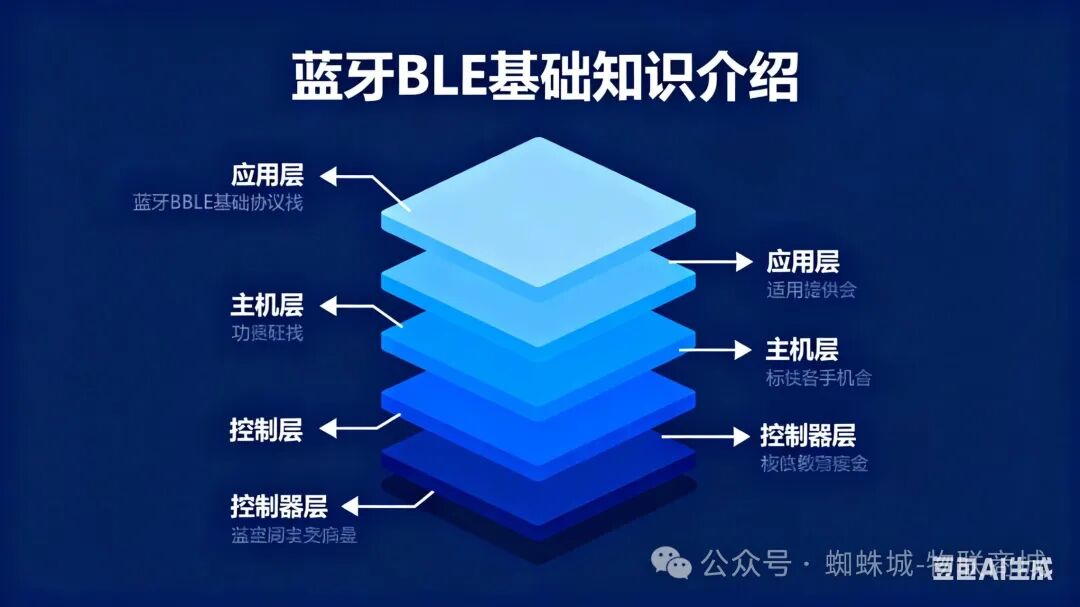
BLE adopts a Master-Slave architecture, where a master device (such as a smartphone) can connect to multiple slave devices (such as smartwatches, sensors, etc.) simultaneously. Its workflow mainly includes the following stages:
-
Advertising
Slave devices periodically send advertising packets through advertising channels (3 fixed frequencies: channels 37, 38, 39), and the master device scans these advertising messages to discover devices. Advertising can be directed (only specific devices can receive) or undirected (any device can receive).
-
Scanning
The master device listens to the advertising channels, receives the advertising information from slave devices, and decides whether to initiate a connection. Scanning can be active (requesting additional data) or passive (only receiving advertising packets).
-
Connection
When the master device chooses to connect with a slave device, both parties negotiate connection parameters (such as connection interval, latency, etc.) and enter the data exchange phase. BLE supports various connection modes, such as Notification, Read, Write, etc.
-
Data Exchange
Data transmission in BLE is based on the GATT (Generic Attribute Profile) protocol, where data is organized in the form of “Services” and “Characteristics.” For example, a heart rate monitoring device may provide a “Heart Rate Service,” which includes a “Current Heart Rate Value” characteristic for the master device to read.
3. Key Technical Concepts of BLE
-
GATT (Generic Attribute Profile)
GATT defines how BLE devices organize and exchange data, including Services, Characteristics, and Descriptors. Each service contains multiple characteristics, and characteristics are the actual data storage units that the master device can interact with by reading and writing.
-
ATT (Attribute Protocol)
ATT is the foundation of GATT, responsible for transmitting attributes (such as data values) between devices and managing read/write permissions.
-
Advertising Types
BLE supports various advertising types, such as:
-
Connectable Undirected Advertising: Allows other devices to connect.
-
Non-connectable Undirected Advertising: Used only for broadcasting information, does not accept connections.
-
Scannable Undirected Advertising: Allows other devices to request more data.
Connection Parameters
The performance of BLE connections is influenced by the following parameters:
-
Connection Interval: The time interval for communication between master and slave devices (7.5ms~4s).
-
Slave Latency: The number of connection events that the slave device can skip without responding.
-
Supervision Timeout: The maximum time of no response before the connection is terminated.
4. Application Scenarios of BLE
-
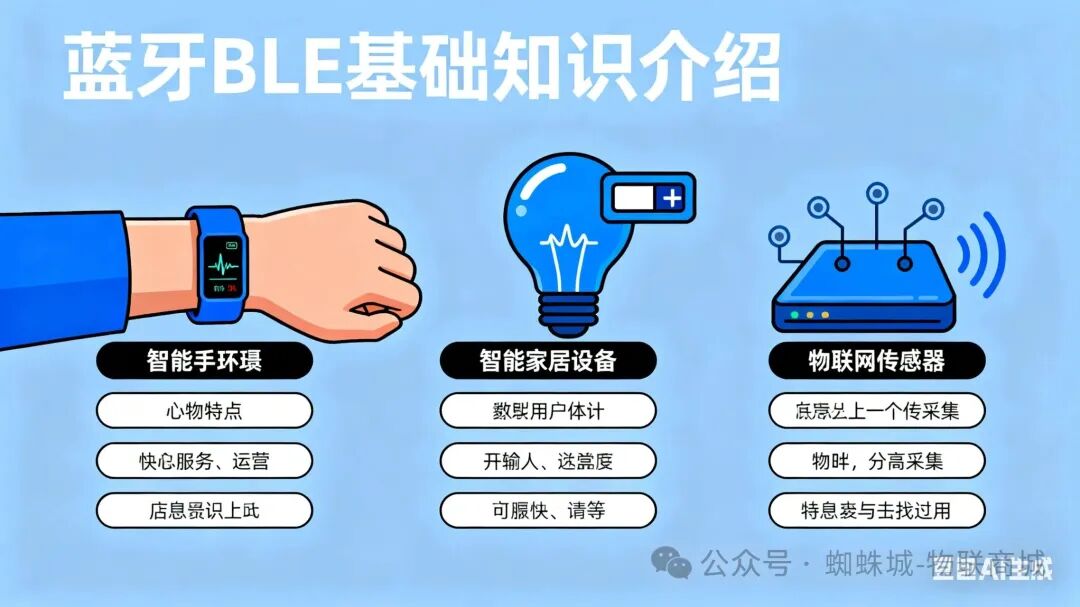
Healthcare
Such as smart wristbands, blood glucose meters, heart rate monitoring devices, etc., which transmit data to smartphones or the cloud via BLE.
-
Smart Home
Smart bulbs, thermostats, door locks, and other devices can interact with smartphones or voice assistants (such as Alexa, Google Assistant) via BLE.
-
Beacons
Such as iBeacon, Eddystone, and other BLE-based beacon technologies used for indoor positioning, advertising push, etc.
-
Wearable Devices
Smartwatches, fitness trackers, etc., rely on BLE to synchronize data with smartphones.
-
Industrial IoT (IIoT)
Low-power sensor networks collect and monitor data via BLE.
5. Conclusion
Bluetooth BLE, with its low power consumption, low cost, short-range communication, and fast connection characteristics, has become an important part of modern wireless communication technology. With the rapid development of the Internet of Things, the application scenarios of BLE will continue to expand, playing a greater role in smart homes, healthcare, and industrial automation in the future. For developers, understanding the basic principles and key technologies of BLE will help design low-power wireless devices more efficiently.