Article Overview
Article Information
Title: Atomically Dispersed Pt-N₃C₁ Sites Enabling Efficient and Selective Electrocatalytic C-C Bond Cleavage in Lignin Models under Ambient Conditions
Authors: Tingting Cui, Lina Ma, Shibin Wang, Dingsheng Wang, Yadong Li et al.
Journal: Journal of the American Chemical Society (2021)
DOI: 10.1021/jacs.1c02328
Citations: 189 (as of September 2025)
Statement: This interpretation is for research communication and sharing purposes only, and the copyright belongs to the original authors and publishers. If there is any infringement, please contact for removal.
Introduction
Lignin is the most abundant renewable aromatic polymer resource on Earth, and its efficient utilization is of great significance for replacing fossil resources. However, the complex structure of lignin presents a significant challenge, particularly the precise and selective cleavage of stable C-C bonds, which is a key bottleneck in degrading it into high-value aromatic compounds. Traditional catalytic oxidation methods often require harsh conditions such as high temperature and pressure, and they generally exhibit poor product selectivity. Electrocatalytic oxidation technology has gained attention due to its mild conditions and the ability to utilize renewable electrical energy, but existing electrode materials (such as bulk metals and metal oxides) typically suffer from low yields and poor selectivity in C-C bond cleavage.
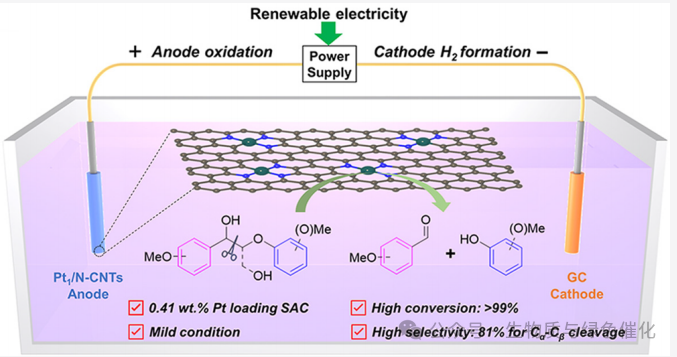
To address this challenge, Professor Dingsheng Wang, Professor Haohong Duan from Tsinghua University, and Researcher Jiangwei Zhang from the Dalian Institute of Chemical Physics, Chinese Academy of Sciences, have pioneeringly reported an atomically dispersed Pt-N₃C₁ site catalyst (Pt₁/N-CNTs). This catalyst is the first to achieve efficient and highly selective electrocatalytic oxidation cleavage of the Cα-Cβ bond in lignin β-O-4 model compounds under mild conditions at room temperature and pressure, opening up new pathways for the green valorization of lignin.
Key Points Analysis
Key Point 1: Precise Construction and Characterization of Atomically Dispersed Pt-N₃C₁ Sites
The research team successfully constructed well-defined atomically dispersed Pt-N₃C₁ active sites on nitrogen-doped carbon nanotubes (N-CNTs) through a three-step method of “polymerization-carbonization-adsorption”. First, using MnO₂ nanowires as a template, a hollow polymer precursor was obtained through the copolymerization of pyrrole and aniline; then, carbonization at high temperature formed N-CNTs with abundant defects and high nitrogen content; finally, Pt atoms were precisely anchored onto the support through electrostatic adsorption and mild reduction.
Various advanced characterization techniques, such as spherical aberration-corrected electron microscopy and X-ray absorption spectroscopy (XAS), confirmed the atomic-level structure of the catalyst. HAADF-STEM images (original Figure 2d) clearly show that Pt species are uniformly dispersed as single atoms (highlighted white points in the image) on the carbon support, with no nanoparticles or clusters present. EXAFS and XANES fitting analysis further revealed that each Pt atom is coordinated with one carbon atom and three nitrogen atoms, forming a unique Pt-N₃C₁ configuration (original Figure 3g), which lays the structural foundation for subsequent high catalytic performance.
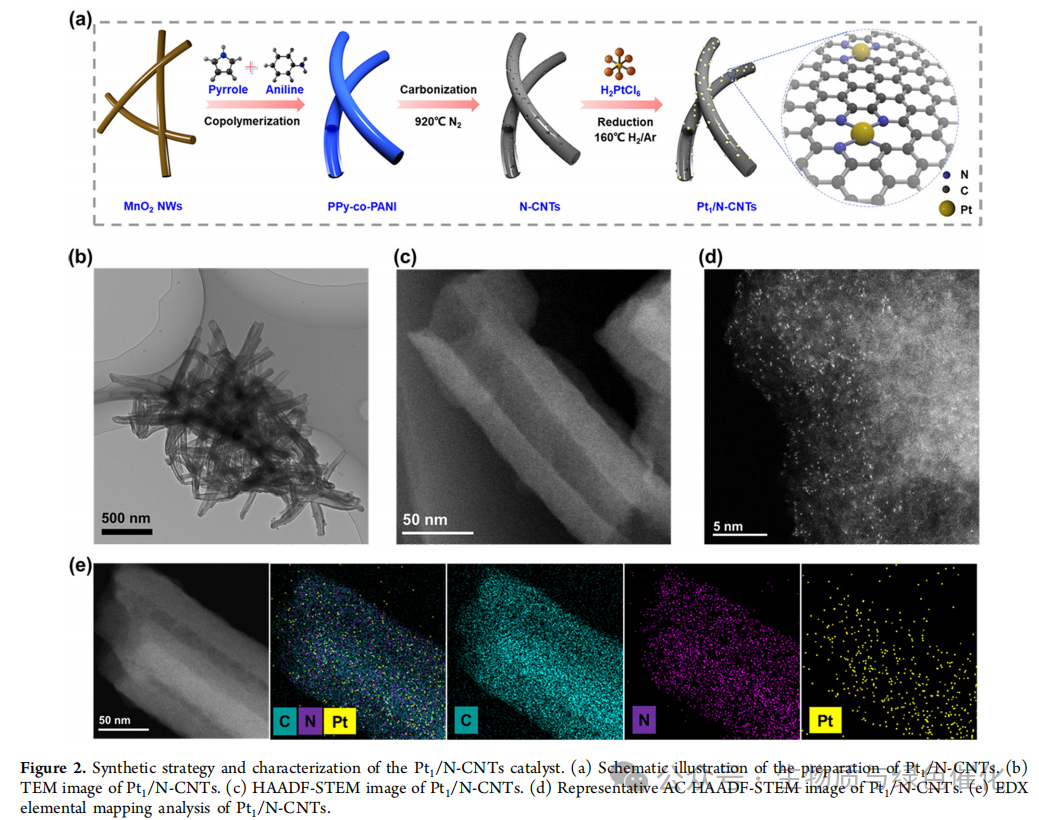
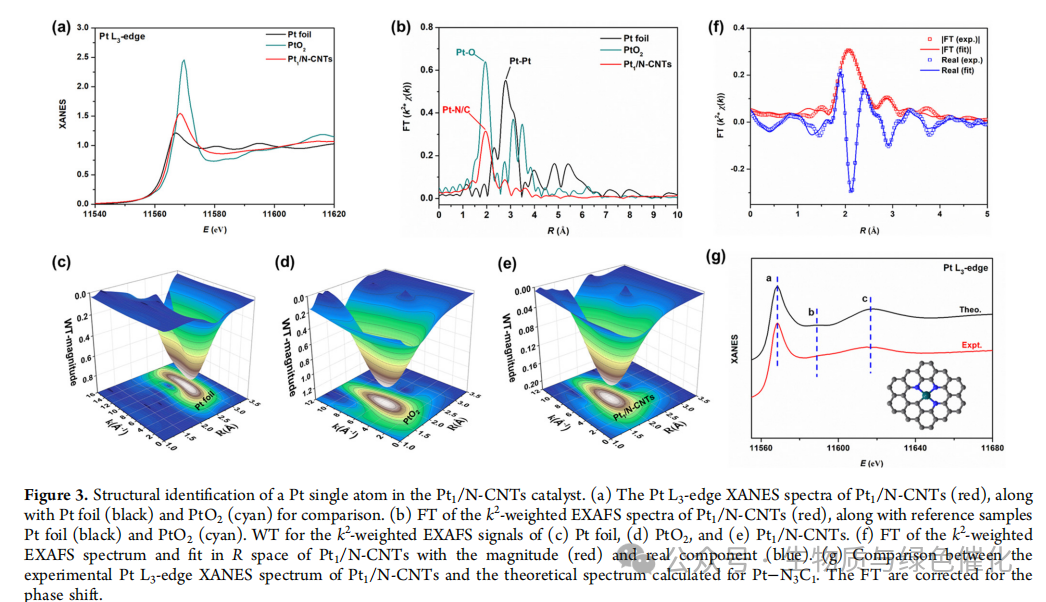
Figure 1. Synthesis and Structural Characterization of Pt₁/N-CNTs Catalyst (original Figures 2, 3). (a) Schematic diagram of the preparation process of Pt₁/N-CNTs. (d) Atomic resolution HAADF-STEM image of Pt₁/N-CNTs, with bright spots indicating Pt single atoms. (g) Comparison of experimental (Expt) and theoretical Pt L₃ edge XANES spectra based on the Pt-N₃C₁ model, showing a high degree of agreement, confirming the existence of the Pt-N₃C₁ coordination structure.
Key Point 2: Unprecedented Cα-Cβ Bond Cleavage Performance under Mild Conditions
The Pt-N₃C₁ single-atom catalyst exhibited exceptional performance in the electrocatalytic C-C bond cleavage reaction of lignin model compounds, far exceeding that of traditional catalysts. Under ambient conditions, using the β-O-4 model compound as the substrate and Pt₁/N-CNTs as the anode catalyst, a substrate conversion rate of up to 99% and an 81% yield of benzaldehyde (Cα-Cβ bond cleavage product) were achieved. As shown in Figure 2, this performance not only far surpasses previously reported bulk Ni electrodes (20.9% yield), Pt foil electrodes (30% yield), and other systems, but also significantly exceeds commercial Pt/C catalysts (55% yield) and pure Pt electrodes (55% yield), with a Pt loading of only 0.41 wt.%, maximizing the utilization of precious metal atoms.
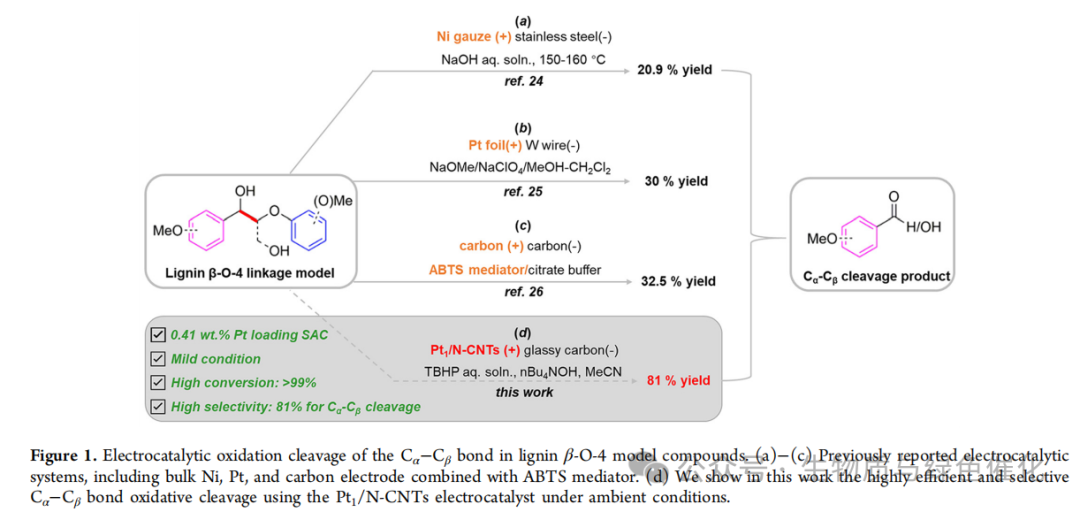
Figure 2. Comparison of Electrocatalytic Performance of Different Systems for Oxidative Cleavage of Cα-Cβ Bond in Lignin β-O-4 Model Compound (original Figure 1). (a-c) Previously reported bulk metal electrodes or indirect oxidation systems had yields below 33%. (d) The Pt₁/N-CNTs single-atom catalyst system in this work achieved an 81% target product yield under mild conditions at room temperature and pressure, demonstrating a significant advantage.
Key Point 3: Unique Cβ Radical Mechanism Reveals Source of High Selectivity
Through a series of mechanistic experiments and DFT theoretical calculations, the research team revealed a unique reaction pathway for the selective cleavage of the Cα-Cβ bond driven by the Pt-N₃C₁ site. Traditional thermal or photocatalytic systems typically undergo the process of oxidizing Cα-OH to Cα=O, which enhances the reactivity of the Cβ-O bond but inhibits the cleavage of the Cα-Cβ bond. In contrast, the electrocatalytic system in this work is entirely different: the reaction does not attack from the Cα position, but rather generates active radicals (tBuO·) at the Pt-N₃C₁ site through the oxidant TBHP, which selectively abstracts the hydrogen atom from the Cβ position of the substrate, forming a key Cβ carbon-centered radical intermediate (species B·).
Subsequently, this highly reactive Cβ radical couples with the tBuO· radical to generate an unstable intermediate (species C₁), which undergoes rapid electron transfer and rearrangement, ultimately leading to the precise cleavage of the Cα-Cβ chemical bond, generating products such as benzaldehyde and phenol. DFT calculations (original Figure 4b) confirm that compared to other possible pathways, this Cβ-H abstraction pathway initiated by tBuO· has a significant energy advantage, with an apparent activation energy (1.57 eV) much lower than that of other pathways, thus perfectly explaining the source of the catalyst’s high selectivity.
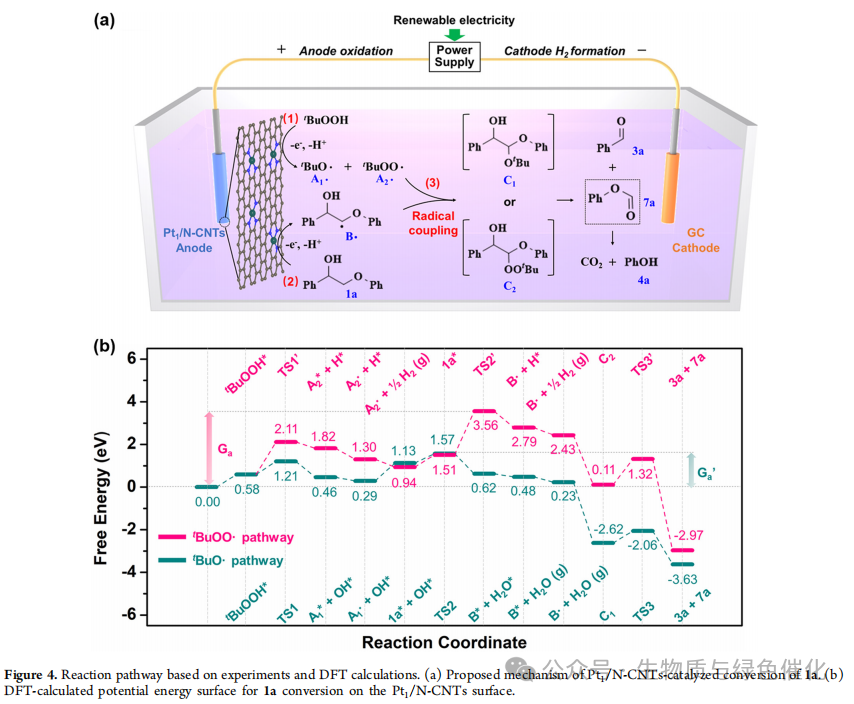
Figure 3. Reaction Pathway for the Conversion of Lignin Model Compounds Catalyzed by Pt₁/N-CNTs (original Figure 4). (a) Schematic diagram of the proposed reaction mechanism: the catalyst first activates the oxidant TBHP to generate tBuO· radical, which then selectively attacks the Cβ-H of the substrate, forming a Cβ radical, and ultimately leads to the cleavage of the Cα-Cβ bond through radical coupling and rearrangement. (b) DFT calculated reaction potential energy profile, showing that the ‘BuO· pathway (pink line) has a significantly lower energy barrier than the ‘BuOO· pathway (green line), making it the dominant mechanism for this reaction.
Conclusion
This article reports an atomically dispersed Pt-N₃C₁ site electrocatalyst supported on nitrogen-doped carbon nanotubes, successfully addressing the challenge of selective cleavage of C-C bonds in lignin degradation. This catalyst, with its well-defined single-atom active center, achieves unprecedented efficiency (>99% conversion rate) and high selectivity (81% yield) for the cleavage of Cα-Cβ bonds in lignin model compounds under green conditions at room temperature and pressure.
Mechanistic studies profoundly reveal that its excellence stems from a unique Cβ radical-mediated reaction pathway, which is entirely different from the traditional Cα oxidation mechanism. This work not only provides a new approach for designing next-generation efficient and low-cost catalysts for biomass conversion but also demonstrates broad application prospects for achieving high-value utilization of lignin through green and sustainable electrochemical methods.