
This article is included in “Agricultural Engineering Technology – Agricultural Informatization” 2023, Issue 9, Table of Contents 02
Abstract:Facility agriculture in the development of smart agriculture is a labor-intensive agricultural production mode that integrates cloud computing, sensor networks, the Internet of Things, engineering, and information technology. It relies on sensor nodes (environmental temperature and humidity, soil moisture, CO2, images, etc.) and wireless communication networks to achieve intelligent management of facility agricultural production. This article analyzes the advantages and technical applications of IoT technology in facility agriculture to improve the unit output rate of facility agriculture and further enhance the standardization, facilitation, intensification, and intelligence of agricultural production.
Keywords: Smart; IoT; Technology; Facility Agriculture; Application
Traditional agriculture mainly relies on human labor, animal power, machinery, etc., for collaborative work, which is time-consuming and labor-intensive and cannot form large-scale production. Facility agriculture is the foundation of China’s smart agriculture development. The application of the Internet of Things in facility agriculture can quickly, accurately, and in real-time obtain agricultural production data, and after analysis by the backend processing center, automatically adjust indoor light and temperature conditions using information perception and hardware equipment to optimize the crop growth environment.
1
Advantages of IoT Technology Application
1.1 Labor Saving
In facility agricultural production, the use of IoT and GPRS technology allows for the identification, data collection, transmission, and management of equipment such as curtain machines, drip irrigation pipes, ventilation fans, electric irrigation systems, and warm air stoves through sensors measuring air temperature and humidity, light intensity, rainfall, soil temperature and humidity, soil pH, etc. Remote control can be achieved by logging into a mobile phone or PC client. For example, when the CO2 concentration in the greenhouse exceeds the safety value, the sensors at the top window, side window, and curtain door can automatically recognize the safety threshold and open automatically. Once the concentration returns to the safe range, the curtain door automatically closes. Additionally, indoor shading systems, heating and supplementary lighting systems, insulation systems, heating systems, humid window curtain fans, drip irrigation systems, or mobile seedbeds can all achieve automatic opening and closing, effectively saving labor and improving production efficiency.
1.2 Real-time Monitoring
In facility agriculture, soil monitoring, cultivation management, environmental monitoring, and agricultural product quality safety traceability are essential. Setting upper and lower limits for growth parameters of crops under different growth periods and environmental factors, real-time monitoring of facility crop growth information, water and fertilizer integrated irrigation, pesticide application, and growth conditions can be achieved using IoT and sensors. Relevant data can be analyzed online, and targeted adjustments and optimizations can be made for factors affecting soil (or substrate) temperature and humidity, nitrogen, phosphorus, potassium content, pH value, as well as air temperature and humidity, and CO2 concentration to improve crop yield and quality.
1.3 Scalable Production Management
Only with scale can industries achieve increased efficiency. Facility agriculture combines local environmental and land resources, adapts to local conditions, reasonably layouts, integrates IoT informatization and mechanization technology, and transforms traditional agricultural cultivation and management modes, simplifying field management. The processes of land preparation, pesticide application (variable, targeted, electrostatic spraying), and fertilization have largely achieved mechanization or semi-mechanization, while the environmental monitoring system is automated and intelligent, addressing the seasonal shortage of labor.
2
Application of IoT Technology in Facility Agriculture under Smart Agriculture
2.1 Safety Traceability Function
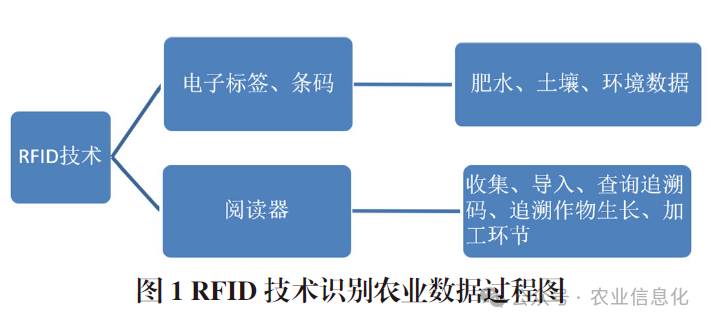
With the support of IoT technology, the RFID system consists of electronic tags, readers, and antennas (Figure 1), which is a non-contact automatic identification technology. Electronic tags are attached to the surface or inside of the identified object. Through radio signals, the target is monitored, and data is accurately recorded and collected regarding fertilizer and water, soil, and environmental conditions to achieve the automatic collection of object information data and ensure traceability of the entire supply chain quality. At the same time, the agricultural product traceability system is an information management platform that achieves full traceability from “farm to table” and serves as a release and inquiry platform for regional agricultural product quality safety information. It follows the principle of “one item, one code” for agricultural products, allowing users to scan QR codes or barcodes to accurately understand the entire process information of agricultural products from production, processing, logistics, storage, to sales.
2.2 Crop Breeding Management
Establish a breeding management and digital service platform to achieve full-process information management of breeding, develop standards for data collection on crop breeding traits, and provide data support for breeding big data resource construction through data analysis. For example, RFID technology breeding electronic tags can achieve data interoperability, improve collection rates, and realize large-scale breeding models, providing a one-stop card marking environment for accurate and efficient breeding.
2.3 Sensor Network Technology
Smart agriculture uses sensors and software to reasonably control the environment, crops, water, fertilizer, and pest information in agricultural production through mobile platforms, making traditional agriculture more “intelligent.” Sensor network technology is the foundational support for achieving agricultural informatization, fully applying modern information technology in smart agriculture, interconnecting a large number of micro-sensor nodes wirelessly, and integrating IoT, audio and video, 3S, computers, and wireless communication. Through information perception, data resource interconnection, and intelligent control, it enables visualized remote diagnosis, remote control, disaster warning, and other intelligent management in agriculture.
2.4 Agricultural Intelligent Management
The agricultural IoT management system monitors environmental changes in real-time. Facility agriculture uses IoT technology to monitor environmental control equipment, climate, crop growth information, growth factors, irrigation control, and greenhouse climate with frequency-synchronized irrigation fertilization machines (video and images), collecting, recording, storing, counting, and analyzing data to display monitoring information in real-time. Relevant parameters are uploaded to the server through wireless transmission, and after setting reasonable system parameter values, automatic control and adjustment of various agricultural facilities and equipment can be achieved to create suitable growth conditions.
2.5 Online Expert Support
Through the online agricultural expert system, experts can remotely diagnose common pests and diseases of crops, providing full technical guidance and services for farmers’ cooperatives and large-scale growers. Growers can also consult online via video, providing timely feedback on issues. At the same time, this system can connect with the smart agriculture client, pushing agricultural technology knowledge to growers through smartphones or smart terminals.
2.6 Automated Drip Irrigation Technology
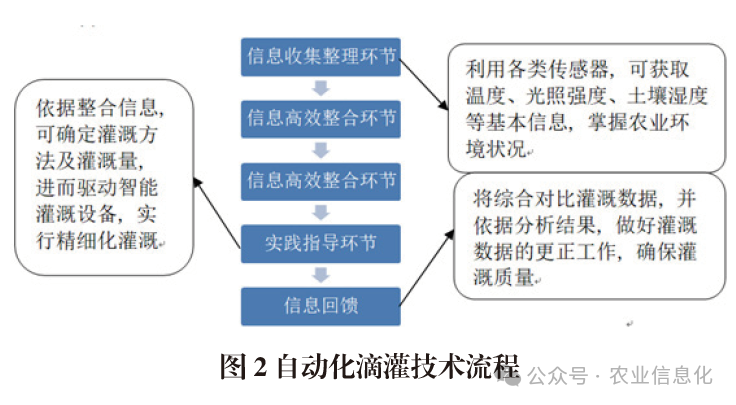
Automated drip irrigation has advantages over traditional irrigation methods, including simple installation, lightweight pipes, time and land savings, reduced field labor, high precision, and the integration of fertilizer and water to avoid fertilizer waste. By integrating with IoT technology, scientific irrigation plans can be developed, creating a high-efficiency, low-consumption, multi-functional, scientifically managed agricultural irrigation water-saving platform. Based on soil moisture sensors monitoring soil moisture content and plant water usage, the sensors transmit the data to the controller, which issues commands to automatically adjust irrigation timing. For example, when outdoor temperatures rise or rainfall decreases, the automated drip irrigation equipment will automatically adjust the irrigation timing and amount, achieving full operational control.
2.7 WIFI Technology
With the popularization of the internet, WIFI technology and IoT technology are applied in facility agriculture for intelligent agricultural management, collecting various data affecting crop production, building a complete sensor transmission network, and configuring sensors, spraying devices, fans, and PLC control devices to collect data such as air temperature and humidity, soil temperature and humidity, light intensity, and CO2 concentration. Data collection and transmission are realized, and commands are issued to devices through the WIFI network, providing precise planting and visual management for facility agricultural production, promoting the deep integration of IoT technology with agriculture. Based on its wireless network transmission, data transmission between network endpoints and user endpoints is achieved (with an indoor coverage distance of 100 m and an open area coverage distance of approximately 200 m), enabling real-time transmission of information data.
3
Conclusion
Facility agriculture breaks through the limitations of natural conditions, characterized by high technology content, high investment, high output, and high efficiency. It is a modern agricultural production mode without seasonal and regional restrictions. Through quality safety traceability RFID technology, automated drip irrigation technology, sensor network technology, and WIFI technology, remote and intelligent control is achieved, maximizing monitoring functions, improving crop yield, optimizing crop quality, and achieving production scalability. This addresses the contradictions between supply and demand in multiple dimensions, enabling precise, large-scale, and automated management of agriculture, thereby increasing agricultural planting yields and improving the output efficiency of facility cultivation, filling the gaps in agricultural development.