With the widespread application of Internet of Things (IoT) technology, the number of IoT devices and users has surged, leading to immense pressure on network transmission bandwidth, task processing delays, and cloud computing loads. Traditional cloud computing center network architectures cannot meet the heterogeneous, low-latency, and densely packed network access and diverse service demands. In response, the industry has introduced the concept of fog computing, deploying fog computing nodes at the network edge as an intermediate layer between the perception layer and the cloud layer, forming an integrated cloud-fog IoT architecture. Fog computing complements cloud computing centers, being closer to the perception layer and capable of offloading cloud computing tasks, reducing network latency and bandwidth load, while also providing more flexibility for deploying IoT system components.
Introduction to Fog Computing
The Internet of Things (IoT) is a self-configuring and self-adaptive network that connects real-world objects to the internet, allowing them to communicate with connected entities and enabling a range of corresponding services. This definition of IoT is not exhaustive, as it has various interpretations. The term IoT originated from the Massachusetts Institute of Technology’s Auto-ID Lab, coined by Kevin Ashton in 1999. In 1982, a group of students at Carnegie Mellon University first proposed the concept of remotely monitoring the status of devices connected to the internet, successfully connecting a vending machine to the internet to monitor its status remotely. Advances in science and technology have made computing devices smaller, cheaper, and faster, capable of sensing the environment, communicating remotely, and operating, leading to increased attention on applying IoT in various aspects of life, such as smart cities, healthcare, and smart homes.
The IoT is already around us, connecting wearable devices, smart cars, and smart home systems. In 2020, over 50 billion devices were connected to the internet. Introducing such a large number of connected devices requires a scalable architecture to accommodate them, while ensuring that the quality of service demanded by applications is not compromised. Furthermore, most devices that constitute the IoT face resource constraints, such as computing power, energy, bandwidth, and storage. These constraints limit the deployment solutions for applications using such IoT devices. For example, directly connecting battery-powered sensors to the internet to continuously publish information about their surrounding environment or storing readings in local memory for extended periods are impractical. These limiting factors present design challenges that are shaping the architecture of IoT in various ways. These challenges can be alleviated by extending cloud computing capabilities to IoT devices through fog computing, also known as edge computing, which serves as an intermediate layer extending down from the cloud.
The fog computing layer brings computing, networking, and storage services closer to the end nodes in the IoT. Compared to cloud computing, this computing layer is highly distributed and introduces additional services for endpoint devices located in the perception layer. This bridging layer is referred to by various names, but the purpose remains similar. For example, edge computing, micro-cloud, and cloudlet are some related terms. Regardless of the name, introducing an intermediate computing layer in IoT can help address some issues. Additionally, the set of services integrated into the fog computing layer can be substantial. Some of these services are extended versions of services provided by cloud computing, while most are newly emerging to tackle IoT challenges.
Background and Uses of Fog Computing
The architecture of IoT is a hot research area. Architecture plays a crucial role in determining the success of a system. Therefore, research is being conducted across public projects, industrial standards associations, and academic institutions to establish a viable IoT architecture. Regardless of the specific application domain or implementation method, most architectural solutions are based on a general IoT model. The most well-known IoT architecture (IoT-A) provides a general IoT domain model as a foundational reference architecture. In the functional view of the model, IoT-A identifies components of an IoT system, such as communication, security, management, and IoT services as key elements. These modular classifications of IoT are divided according to the functionality of each unit. Some of these units can reside within a single device. However, by definition, IoT systems are distributed systems. Thus, the components identified earlier are geographically distributed, with communication components responsible for connecting them. In its simplest form, two groups can be formed: the first group includes identification and sensing, while the second group includes computing, services, and semantics (which can also achieve a similar separation in the IoT-A model). To find the optimal level of functional classification and physical separation, researchers have provided various alternatives.
A straightforward way to make IoT devices visible via the internet is to provide them access to cloud servers, allowing them to upload data and receive notifications or commands. In this configuration, the client processes data read from the environment, while most other functionalities operate in the cloud. This traditional client-server approach to building IoT components is still used by many vendors. Moreover, this architecture has many variants that can divide certain logical components of the system into three or five layers. The separation of these components is primarily based on the functionality of the modules. In a three-layer architecture, sensors appear in the lower perception layer. The network layer, located above the perception layer, connects sensors to the top application layer. In this approach, the functionality of each layer is distinct. Sensors and actuators in the perception layer collect data transmitted through the network and relay it to application logic. Different types of logical separation of IoT components exist. Another scheme for this architecture divides these layers into five, with some variants viewing the middleware layer and object abstraction as separate layers. These additional layers help provide integrated services and encapsulate devices within the perception layer. Although logically separated component layers can achieve modularity and convenience, they do not meet the requirements of the perception layer, such as low-latency communication and high mobility.
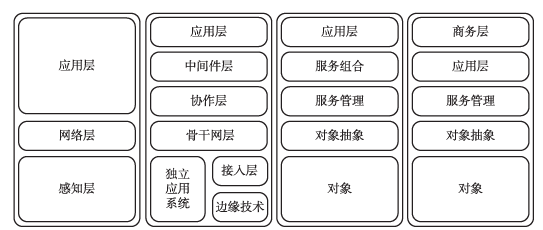
The perception layer or sensor layer can consist of millions of devices. Most devices are small, battery-powered, with limited memory and processing capabilities. These resource constraints necessitate innovative design approaches for resolution. Furthermore, various wireless communication protocols are widely applied in networks, such as Wi-Fi, Low Energy Bluetooth (BLE), NFC, ZigBee, RFID, and 6LoWPAN. Besides different versions of the aforementioned network protocols, application layer protocols also differ even among devices using the same underlying network protocol. For instance, CoAP, MQTT, DDS, and XMPP are several commonly used protocols. These protocols utilize various data formats, but the organizational structure within applications is specific. The aforementioned resource constraints, protocol, platform, and data format heterogeneity require the design of more efficient and IoT-friendly architectures.
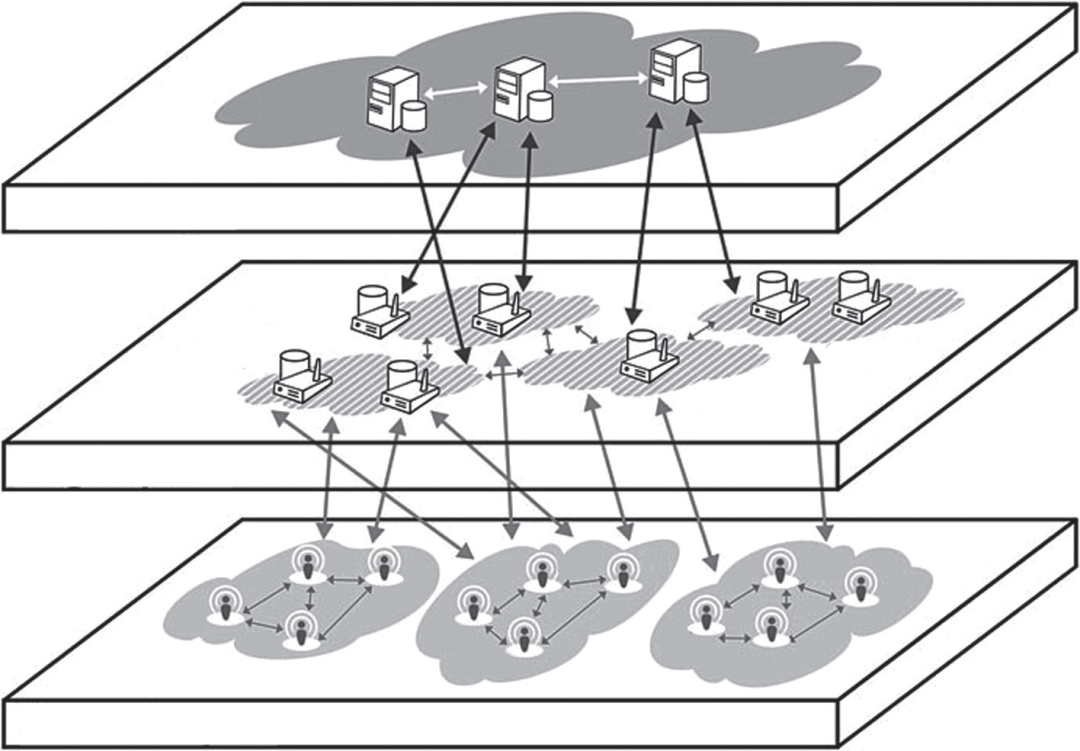
The specific architectural design process of the system depends on the attributes of the specific application. However, based on the previously emphasized IoT issues and requirements, a reasonable general architecture needs to be designed. After generating a logical separation of functional components into three or five layers, we can map the logical components to the physical computing layer. As mentioned earlier, in the client-server approach, most components will run on cloud servers. However, this approach does not address the aforementioned issues. This necessitates research into another computing hierarchy suitable for IoT. Fog computing, introduced as an intermediate layer between the perception layer and the cloud layer, provides more flexibility for deploying components of IoT system architectures.
This article is excerpted from “Fog Computing – The Edge Energy of IoT“
[USA] Amir M. Rahmani [Finland] Pasi Liljeberg [USA] Jürgo-Sören Preden [Austria] Axel Jantsch, edited by Li Feng and Zhang Lei
Published by China Science and Technology Press
Book Recommendations

Highlights
1. Why is the USA able to attract international students to study here?
2. Do you think facial recognition only sees faces? Beware of being exposed!
3. Hurry! Keep up with the media wave

This issue is edited by: Li Xinpei