Click the top left corner “MDPI Chemical Materials” to follow us for more latest news.
Article Overview
The detection of toxic gases is an indispensable part of modern industrial and environmental monitoring. Common toxic gases, such as carbon monoxide (CO), nitrogen oxides (NOx), and hydrogen sulfide (H₂S), pose threats not only to human health but also significantly impact the ecological environment and industrial safety. Traditional gas detection methods, such as metal oxide sensors, electrochemical sensors, and catalytic sensors, while capable of providing effective monitoring data, have certain limitations in sensitivity, response time, and device size. With the rapid development of integrated photonic sensing technology, photonic sensors have become an important technology in the field of gas detection. Integrated photonic sensors significantly reduce the size of sensors by integrating photonic components (such as optical waveguides, optical resonators, etc.) onto a single chip, while improving detection sensitivity and selectivity. The core advantages of photonic sensors lie in their extremely high sensitivity, fast response time, and real-time monitoring capabilities, making them particularly suitable for applications requiring precise identification of trace gas concentrations, such as environmental monitoring, industrial safety, and medical diagnostics.
This article, written by the team of Professor Muhammad A. Butt from the Institute of Microelectronics and Optoelectronics at the Warsaw University of Technology in Poland, reviews the latest advancements of integrated photonic sensors in toxic gas detection, focusing on applications based on mechanisms such as evanescent field absorption (EFA) and wavelength interference. It analyzes the principles, advantages, and challenges faced by these sensing technologies. Additionally, the article discusses relevant materials and fabrication processes and looks forward to future development directions, highlighting the great potential of integrated photonic sensors in improving selectivity, reducing costs, and achieving multi-gas detection.
Research Process and Results
With the acceleration of industrialization, the concentration of toxic gases in indoor and outdoor environments is increasing, posing serious threats to human health. Indoor air pollution includes carbon monoxide, volatile organic compounds (VOCs), and radon, which can cause headaches, dizziness, respiratory issues, and even cancer at low concentrations. Effective gas detection technology is crucial for ensuring public health and safety (Figure 1). Traditional gas sensor technologies, including metal oxide sensors (MOX), catalytic sensors, and electrochemical sensors, while providing certain sensitivity and stability, still have limitations in detection sensitivity, response speed, cost, and device size. Therefore, integrated photonic sensors, as an emerging technology, offer higher sensitivity, rapid response, and real-time monitoring capabilities by integrating optical components onto a microchip, making them particularly suitable for detecting trace toxic gases.

Figure 1. Illustration of indoor and outdoor air pollution.
1. Basic Principles of Integrated Photonic Sensors
Integrated photonic sensors utilize the principle of interaction between light and gas molecules, guiding light to the gas sample through optical elements such as optical waveguides and resonators, and monitoring gas concentration through the absorption or scattering of light in gas molecules. The working principles of these sensors mainly include evanescent field absorption (EFA) and wavelength interference methods (Figure 2).
Evanescent Field Absorption (EFA) is based on the interaction between the evanescent field near the surface of the optical waveguide and gas molecules. When gas molecules approach the surface of the optical waveguide, they interact with the evanescent field, resulting in changes in the absorption of light at specific wavelengths, thereby generating signal changes proportional to the gas concentration.
Wavelength Interference Method detects the presence of gas by monitoring changes in the propagation wavelength of light waves in the waveguide. Gas molecules alter the refractive index of the sensing material, affecting the interference pattern of the light waves, thus achieving gas detection.
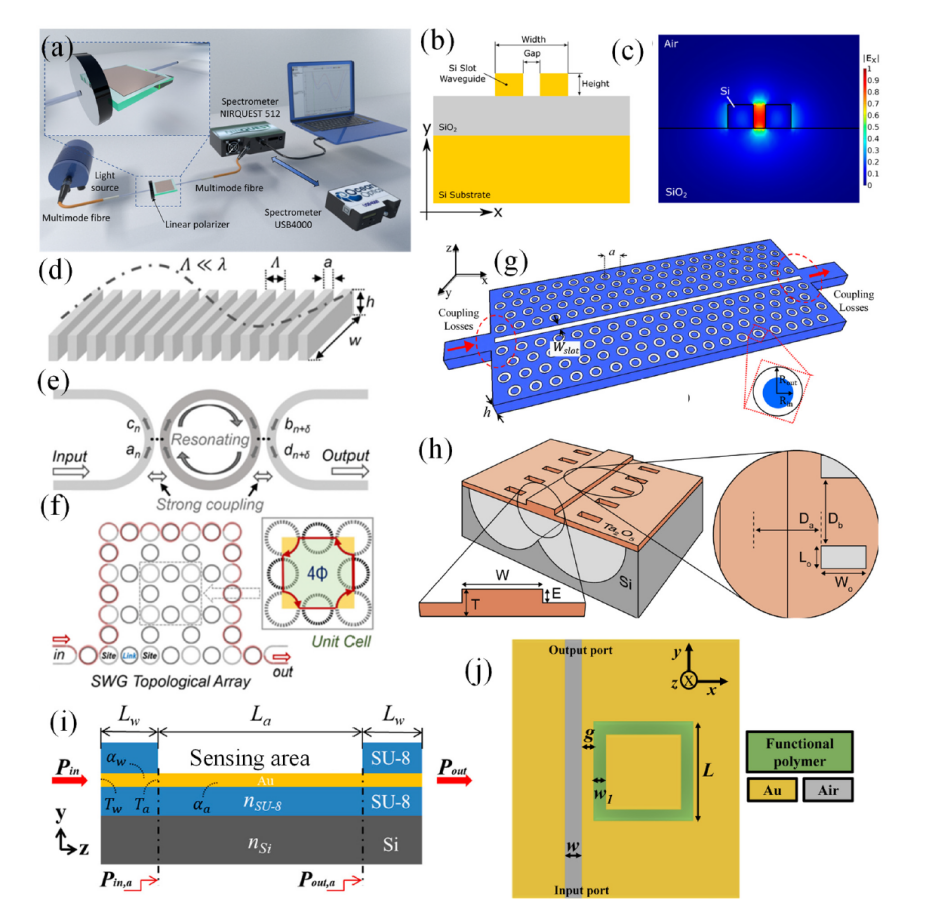
Figure 2. Different WG configurations for sensing purposes: (a) planar WG; (b) slot WG and e-field distribution (c); (d) SWG WG; (e) coupled ring resonator; (f) ring resonator structure based on SWG WG; (g) photonic crystal WG; (h) suspended membrane WG; (i) surface plasmon WG; (j) MIM WG.
2. Applications of Photonic Sensors
Integrated photonic sensors, characterized by extremely high sensitivity and rapid response, are widely used in various fields such as environmental monitoring, industrial safety, and medical diagnostics. In industrial environments, integrated photonic sensors can detect toxic gas leaks in real-time, ensuring workplace safety. In environmental monitoring, photonic sensors can accurately track pollutants in the air, assisting governments and enterprises in formulating effective pollution control measures. Furthermore, the application of photonic sensors in medical diagnostics is also increasingly widespread, especially in non-invasive detection, where analyzing trace gas concentrations in exhaled breath can be used for early disease diagnosis, such as respiratory diseases and certain cancers.
3. Main Photonic Sensor Architectures and Materials
Waveguide Structures: Waveguide structures enhance the interaction between light and gas molecules by confining the light beam in a small area. These sensors can be designed in various forms, such as planar waveguides, slot waveguides, and sub-wavelength grating waveguides, to improve sensitivity and selectivity.
Material Selection: To enhance the performance of photonic sensors, researchers have explored various materials, including silicon photonic technology, silicon nitride materials, and lead selenide, which not only possess excellent optical properties but also are compatible with existing manufacturing technologies, facilitating large-scale production of sensors (Figure 3).
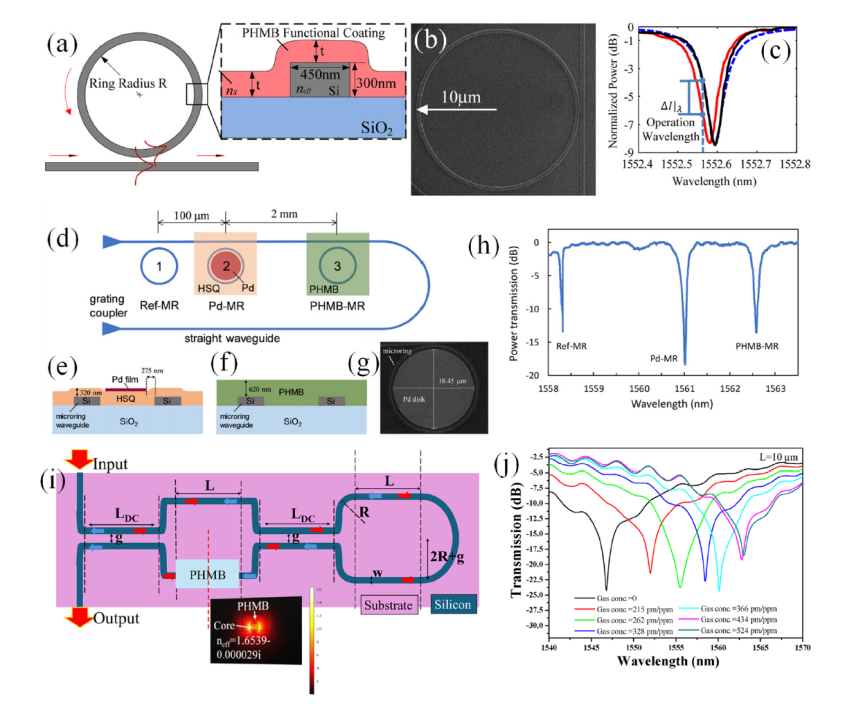
Figure 3. (a) Schematic diagram of a Si MRR CO₂ gas sensor with a PHMB functional layer coating. The coating is located on the MRR waveguide. (b) Scanning electron microscope image of Si MRR. (c) Measured resonance spectrum of the functionalized MRR. The black curve represents the initial spectrum in pure N₂ gas, while the red curve shows the spectrum at a 0.5% CO₂ gas concentration. The blue dashed line indicates the resonance curve fitting, used to correlate the transmitted power with the relative wavelength shift. (d) Schematic diagram of a dual gas sensor. An array consisting of three MRRs: Ref-MR for reference, Pd-MR for H₂ detection, and PHMB-MR for CO₂ detection. Cross-sectional images show (e) the Pd functional layer and (f) the PHMB coating. (g) Scanning electron microscope image of Pd-MR. (h) Spectral response of the dual gas sensor measured under N₂ flow conditions. (i) LT-MZI structure. (j) Transmission spectrum of the LT-MZI structure at different CO₂ concentrations.
4. Ongoing Challenges and Prospects
Despite the strong potential of integrated photonic sensors in gas detection, they still face several challenges. The first is the selectivity issue of the sensors; in practical applications, effectively distinguishing between different gases and reducing environmental interference remains a challenge. Secondly, the stability and long-term reliability of the sensors need further optimization, especially for applications in extreme conditions such as high temperature and humidity. In the future, with the development of nanotechnology and photonic integration technology, the performance of photonic sensors is expected to be further enhanced. By improving waveguide design, using new functional materials, and developing intelligent signal processing algorithms, integrated photonic sensors are expected to find broader applications in environmental monitoring, industrial safety, and health diagnostics.
Article Summary
This review provides a detailed introduction to the latest advancements of integrated photonic sensors in toxic gas detection. Integrated photonic sensors utilize photonic principles to achieve precise measurement of gas concentrations through optical elements such as optical waveguides and resonators. Compared to traditional sensors, photonic sensors offer higher sensitivity, faster response times, and real-time monitoring capabilities, making them particularly suitable for environmental monitoring, industrial safety, and medical diagnostics. Nevertheless, integrated photonic sensors still face challenges in selectivity, sensitivity enhancement, and environmental adaptability. Future research needs to focus on improving sensor performance, addressing multi-gas detection, environmental adaptability, and cost control issues. By combining new materials and advanced manufacturing technologies, integrated photonic sensors are expected to play a more significant role in gas detection, promoting the widespread application of related technologies.

Scan the QR code to read the original English text.
Butt, M.A.; Piramidowicz, R. Integrated Photonic Sensors for the Detection of Toxic Gasses—A Review. Chemosensors 2024, 12, 143.

Chemosensors Journal Introduction
Editors-in-Chief: Nicole Jaffrezic-Renault, CNRS/University of Franche-Comté, France; Jin-Ming Lin, Tsinghua University, China
The journal covers the scope of chemical sensing theory; mechanisms and detection principles; development and manufacturing technologies; and applications of chemical analytical methods in food, environmental monitoring, medicine, pharmaceuticals, industry, and agriculture.
|
2024 Impact Factor |
3.7 |
|
2024 CiteScore |
7.3 |
|
Time to First Decision |
20.5 Days |
|
Acceptance to Publication |
2.8 Days |

Scan the QR code to subscribe to the latest news from Chemosensors journal.

Scan the QR code to add the assistant on WeChat, note: school + name + research direction, inviting you to join the Chemosensors scholar exchange group.
Featured Videos
Related Articles Recommended
Detection of Opioids and Their Analogues: Applications of Electrochemical Sensors, Biosensors, and Optical Sensors in Pharmaceuticals, Clinical, etc. | MDPI Chemosensors
Recommended MDPI Official Accounts
MDPI Recruitment
MDPI Recruitment official account, the latest recruitment information awaits you.
Copyright Statement:
* The content of this article is edited by the MDPI China office. The translation of the papers involved in the article is a summary and conveyance based on the translator’s personal understanding. For details and accurate information of the papers, please refer to the original English text. This article complies with the CC BY 4.0 license (https://creativecommons.org/licenses/by/4.0/). For reprints, please leave a message in the official account.
Due to updates in WeChat subscription account push rules, it is recommended that you set “MDPI Chemical Materials” as a star to easily find us in the message bar and stay updated on the latest open publishing dynamics!
Click the bottom left “Read the original text” to read the original English text.

Looking forward to your “three hits” ☞[Share, Like, Forward]