


1. Founding Time and Authors
-
Founding Time:The concept of UUID (Universally Unique Identifier) was first proposed by Apollo Computer in the 1980s, and the standardized version of UUID was formally defined in RFC 4122 published by Paul J. Leach and Rich Salz in July 1998.
-
Core Designers:
-
Paul J. Leach:Microsoft engineer, expert in distributed systems
-
Rich Salz:Open source software developer, expert in cryptography and security
-
Apollo Computer:The company that originally proposed the GUID concept
-
Project Positioning:A standard mechanism for generating globally unique identifiers
2. Official Resources
-
Python Official Documentation:https://docs.python.org/3/library/uuid.html
-
RFC 4122 Standard Document:https://tools.ietf.org/html/rfc4122
-
UUID Standard Official Website:https://www.ietf.org/rfc/rfc4122.txt
3. Core Functions

4. Application Scenarios
1. Database Primary Key
import uuid
import sqlite3

# Generate UUID as primary key
user_id = uuid.uuid4()
conn = sqlite3.connect('users.db')
cursor = conn.cursor()

cursor.execute('''
    CREATE TABLE IF NOT EXISTS users (
        id TEXT PRIMARY KEY,
        name TEXT,
        email TEXT
    )
''')

cursor.execute(
    'INSERT INTO users (id, name, email) VALUES (?, ?, ?)',
    (str(user_id), 'Zhang San', '[email protected]')
)
conn.commit()
2. Distributed System Identification
import uuid
from datetime import datetime

class DistributedSystem:
    def __init__(self, node_name):
        self.node_id = uuid.uuid4()
        self.node_name = node_name

    def generate_request_id(self):
        """Generate a unique ID for each request"""
        timestamp = datetime.now().isoformat()
        return uuid.uuid5(self.node_id, timestamp)

    def process_request(self, data):
        request_id = self.generate_request_id()
        print(f"Node {self.node_name} processing request {request_id}")
        return {"request_id": request_id, "data": data}

# Simulate multiple nodes
node1 = DistributedSystem("Node A")
node2 = DistributedSystem("Node B")

print(node1.process_request({"action": "create"}))
print(node2.process_request({"action": "update"}))
3. File Naming
import uuid
import os

def save_uploaded_file(file_content, file_extension):
    """Generate a unique filename for uploaded files"""
    unique_filename = f"{uuid.uuid4()}{file_extension}"

    with open(f"uploads/{unique_filename}", 'wb') as f:
        f.write(file_content)

    return unique_filename

# Example usage
file_content = b"File content..."
saved_name = save_uploaded_file(file_content, ".txt")
print(f"File saved as: {saved_name}")
4. Session Management
import uuid
from datetime import datetime, timedelta

class SessionManager:
    def __init__(self):
        self.sessions = {}

    def create_session(self, user_data):
        """Create a new session"""
        session_id = uuid.uuid4()
        session_data = {
            'session_id': session_id,
            'user_data': user_data,
            'created_at': datetime.now(),
            'expires_at': datetime.now() +timedelta(hours=24)
        }
        self.sessions[str(session_id)] = session_data
        return session_id

    def validate_session(self, session_id):
        """Validate session validity"""
        session = self.sessions.get(str(session_id))
        if session and session['expires_at'] > datetime.now():
            return session
        return None

# Example usage
manager = SessionManager()
user_session = manager.create_session({"user_id": 123, "username": "john"})
print(f"Created session: {user_session}")
5. Underlying Logic and Technical Principles
UUID Version Comparison
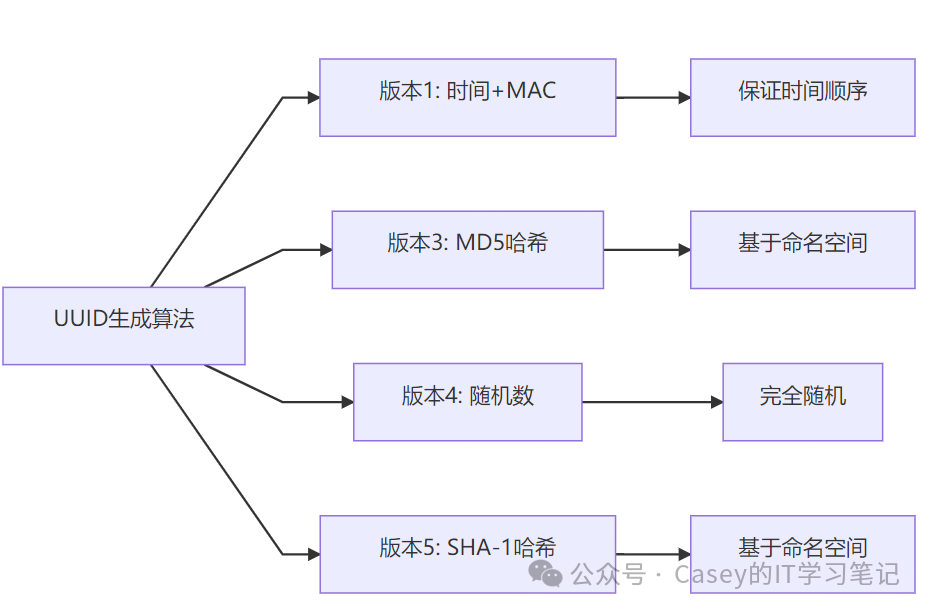
UUID Structure Analysis
# UUID Example: 12345678-1234-5678-1234-567812345678
# Structure Breakdown:
#   time_low: 12345678
#   time_mid: 1234
#   time_hi_version: 5678 (version encoded in the highest 4 bits)
#   clock_seq_hi_variant: 12 (variant encoded in the highest 2 bits)
#   clock_seq_low: 34
#   node: 567812345678

import uuid

def analyze_uuid(uuid_obj):
    """Analyze the components of a UUID"""
    print(f"Original UUID: {uuid_obj}")
    print(f"Version: {uuid_obj.version}")
    print(f"Variant: {uuid_obj.variant}")
    print(f"16-byte representation: {uuid_obj.bytes}")
    print(f"Hexadecimal representation: {uuid_obj.hex}")
    print(f"Integer representation: {uuid_obj.int}")

# Analyze different versions of UUID
analyze_uuid(uuid.uuid1())
analyze_uuid(uuid.uuid4())
Technical Principle Details
-
Version 1 (Time-based):
-
Uses MAC address + 60-bit timestamp
-
Timestamp starts from October 15, 1582 (Gregorian calendar)
-
Ensures uniqueness in time and space
Version 3/5 (Namespace-based):
-
Version 3 uses MD5 hash, version 5 uses SHA-1 hash
-
Requires namespace UUID and name
-
Same namespace and name always generate the same UUID
Version 4 (Random):
-
122 bits of random number
-
6 bits for version and variant identification
-
Collision probability is extremely low
6. Installation and Configuration
Basic Installation
# UUID is part of the Python standard library and does not require separate installation
# Built-in support since Python 2.5
python -c"import uuid; print(uuid.uuid4())"
Version Compatibility
| Python Version | UUID Support | Key Features |
|---|---|---|
| Python 2.5+ | Basic support | uuid1, uuid3, uuid4, uuid5 |
| Python 3.7+ | Full support | All features, performance optimizations |
| Python 3.10+ | Enhanced support | Better type annotations |
Dependency Check
import uuid
import sys

print(f"Python Version: {sys.version}")
print(f"UUID Module Version: {uuid.__version__ if hasattr(uuid, '__version__') else 'Built-in module'}")

# Test all UUID version functionalities
test_uuid1 = uuid.uuid1()
test_uuid3 = uuid.uuid3(uuid.NAMESPACE_DNS, 'python.org')
test_uuid4 = uuid.uuid4()
test_uuid5 = uuid.uuid5(uuid.NAMESPACE_DNS, 'python.org')

print("All UUID version functionalities are working")
7. Performance Metrics
Generation Speed Test
import uuid
import time

def benchmark_uuid_generation():
    versions = {
        'uuid1': lambda: uuid.uuid1(),
        'uuid4': lambda: uuid.uuid4(),
        'uuid3': lambda: uuid.uuid3(uuid.NAMESPACE_DNS, 'test'),
        'uuid5': lambda: uuid.uuid5(uuid.NAMESPACE_DNS, 'test')
    }

    results = {}
    for name, generator in versions.items():
        start_time = time.time()
        for _ in range(10000):
            generator()
        end_time = time.time()
        results[name] = end_time-start_time

    return results

# Run performance test
performance = benchmark_uuid_generation()
for version, time_taken in performance.items():
    print(f"{version}: {time_taken:.4f} seconds (10000 times)")
Collision Probability Analysis
| UUID Version | Uniqueness Guarantee | Collision Probability | Applicable Scenarios |
|---|---|---|---|
| uuid1 | Time-space unique | Almost zero | Requires time sorting |
| uuid3 | Unique within namespace | Hash collision probability | Deterministic generation |
| uuid4 | Randomly unique | 1 in 2^122 | General scenarios |
| uuid5 | Unique within namespace | 1 in 2^160 | High security requirements |
8. Advanced Feature Usage
1. Custom UUID Generation
import uuid
import random

class CustomUUIDGenerator:
    @staticmethod
    def uuid1_with_prefix(prefix=""):
        """Generate UUID1 with a prefix"""
        base_uuid = uuid.uuid1()
        return f"{prefix}{base_uuid}" if prefix else base_uuid

    @staticmethod
    def batch_uuid4(count=10):
        """Batch generate UUID4"""
        return [uuid.uuid4() for _ in range(count)]

    @staticmethod
    def short_uuid(length=8):
        """Generate short UUID (first N digits based on UUID4)"""
        full_uuid = uuid.uuid4().hex
        return full_uuid[:length]

# Example usage
generator = CustomUUIDGenerator()
print(f"Prefixed UUID: {generator.uuid1_with_prefix('USER_')}")
print(f"Batch UUID: {generator.batch_uuid4(3)}")
print(f"Short UUID: {generator.short_uuid(12)}")
2. UUID Validation and Conversion
def validate_and_convert_uuid(uuid_string):
    """Validate UUID string and convert to different formats"""
    try:
        uuid_obj = uuid.UUID(uuid_string)
        return {
            'is_valid': True,
            'uuid_object': uuid_obj,
            'bytes': uuid_obj.bytes,
            'hex': uuid_obj.hex,
            'int': uuid_obj.int,
            'urn': uuid_obj.urn,
            'version': uuid_obj.version
        }
    except ValueError as e:
        return {
            'is_valid': False,
            'error': str(e)
        }

# Test validation functionality
test_cases = [
    "12345678-1234-5678-1234-567812345678",
    "invalid-uuid-string",
    str(uuid.uuid4())
]

for test_case in test_cases:
    result = validate_and_convert_uuid(test_case)
    print(f"Input: {test_case}")
    print(f"Result: {result}\n")
3. Namespaced UUID Application
class NamespacedUUID:
    """Namespace-based UUID generator"""

    def __init__(self, base_namespace):
        self.base_namespace = uuid.uuid5(uuid.NAMESPACE_DNS, base_namespace)

    def generate_for_user(self, username):
        """Generate UUID for user"""
        return uuid.uuid5(self.base_namespace, f"user:{username}")

    def generate_for_resource(self, resource_type, resource_id):
        """Generate UUID for resource"""
        return uuid.uuid5(self.base_namespace, f"{resource_type}:{resource_id}")

    def generate_for_file(self, filename, user_id):
        """Generate UUID for file"""
        return uuid.uuid5(self.base_namespace, f"file:{filename}:{user_id}")

# Example usage
ns_generator = NamespacedUUID("myapp.example.com")
user_uuid = ns_generator.generate_for_user("john_doe")
file_uuid = ns_generator.generate_for_file("document.pdf", "user123")

print(f"User UUID: {user_uuid}")
print(f"File UUID: {file_uuid}")
9. Comparison with Similar Technologies
| Feature | UUID | Auto-increment ID | Snowflake | ULID |
|---|---|---|---|---|
| Uniqueness | Globally unique | Unique within database | Distributed unique | Time-sorted unique |
| Predictability | Version 4 unpredictable | Predictable | Partially predictable | Unpredictable |
| Sorting Capability | Version 1 time-sortable | Natural sorting | Time-sorted | Time-sorted |
| Distributed Support | ✅ | ❌ | ✅ | ✅ |
| Storage Size | 16 bytes | 4-8 bytes | 8 bytes | 16 bytes |
| Python Support | Built-in | Database dependent | Requires installation | Requires installation |
10. Security Considerations
Security Best Practices
import uuid
import hashlib

class SecureUUIDUsage:
    @staticmethod
    def safe_uuid1():
        """Safely use UUID1, hiding MAC address"""
        # UUID1 exposes MAC address, which needs to be handled in certain scenarios
        import random
        uuid_obj = uuid.uuid1()
        # Additional security handling may be needed in actual applications
        return uuid_obj

    @staticmethod
    def non_guessable_identifier():
        """Generate unpredictable identifiers"""
        # Combine UUID4 and random number to increase unpredictability
        base_uuid = uuid.uuid4()
        random_suffix = hashlib.sha256(str(base_uuid).encode()).hexdigest()[:8]
        return f"{base_uuid}_{random_suffix}"

    @staticmethod
    def validate_uuid_security(uuid_string):
        """Validate the security of a UUID"""
        try:
            uuid_obj = uuid.UUID(uuid_string)
            if uuid_obj.version == 1:
                return "Warning: UUID1 may contain MAC address information"
            elif uuid_obj.version == 4:
                return "Safe: UUID4 is randomly generated"
            else:
                return "Info: Hash-based UUID"
        except ValueError:
            return "Error: Invalid UUID"

# Example of secure usage
secure_gen = SecureUUIDUsage()
print(f"Secure identifier: {secure_gen.non_guessable_identifier()}")
print(f"Security analysis: {secure_gen.validate_uuid_security(str(uuid.uuid4()))}")
11. Enterprise Application Cases
1. Microservices Architecture
import uuid
from datetime import datetime

class MicroserviceFramework:
    def __init__(self, service_name):
        self.service_id = uuid.uuid4()
        self.service_name = service_name

    def generate_correlation_id(self):
        """Generate request correlation ID for distributed tracing"""
        timestamp = datetime.now().strftime("%Y%m%d%H%M%S")
        return f"{self.service_name}_{timestamp}_{uuid.uuid4().hex[:8]}"

    def process_request(self, request_data):
        correlation_id = self.generate_correlation_id()
        request_id = uuid.uuid4()

        print(f"[{correlation_id}] Processing request {request_id}")
        # Business logic processing...

        return {
            "request_id": request_id,
            "correlation_id": correlation_id,
            "processed_by": self.service_name,
            "data": request_data
        }

# Microservice instances
user_service = MicroserviceFramework("user-service")
order_service = MicroserviceFramework("order-service")

print(user_service.process_request({"action": "create_user"}))
print(order_service.process_request({"action": "create_order"}))
2. Data Pipeline
import uuid
import json

class DataPipeline:
    def __init__(self):
        self.pipeline_id = uuid.uuid4()

    def process_data_record(self, raw_data):
        """Process data record and add tracking information"""
        record_id = uuid.uuid4()
        processing_time = datetime.now().isoformat()

        processed_record = {
            "record_id": str(record_id),
            "pipeline_id": str(self.pipeline_id),
            "processing_time": processing_time,
            "data": raw_data,
            "checksum": hash(json.dumps(raw_data, sort_keys=True))
        }

        return processed_record

    def batch_process(self, data_list):
        """Batch process data"""
        batch_id = uuid.uuid4()
        results = []

        for data in data_list:
            result = self.process_data_record(data)
            result["batch_id"] = str(batch_id)
            results.append(result)

        return results

# Data pipeline usage
pipeline = DataPipeline()
sample_data = [{"name": "Product A", "value": 100}, {"name": "Product B", "value": 200}]
processed = pipeline.batch_process(sample_data)

for record in processed:
    print(f"Processed record: {record['record_id']}")
Summary
UUID is the standard solution for generating unique identifiers in distributed systems, with core values including:
-
Global Uniqueness:Ensures ID uniqueness in distributed systems
-
No Coordination Required:Each node can generate independently without central coordination
-
Standardization:Follows the international standard RFC 4122
-
Multi-version Support:Adapts to different scenario needs
Technical Highlights:
-
Version 1: Time + MAC based, ensures chronological order
-
Version 3/5: Namespace-based, deterministic generation
-
Version 4: Completely random, high security
-
Built-in Python standard library, ready to use
Applicable Scenarios:
-
Database primary keys and unique identifiers
-
Distributed system tracing
-
File naming and resource identification
-
Session management and security tokens
-
Message queues and event IDs
Usage Example:
import uuid

# Most commonly used random UUID
unique_id = uuid.uuid4()
Learning Resources:
-
RFC 4122 Standard Document:https://tools.ietf.org/html/rfc4122
-
Python Official Documentation:https://docs.python.org/3/library/uuid.html
-
UUID Best Practices Guide
Since its standardization in 1998, UUID has become the de facto standard for generating unique identifiers, widely used in various software systems.