
·Focus: Artificial Intelligence, Chips, and Other Industries
Welcome everyone to follow and share
 Introduction: When Subaru’s EyeSight autonomous driving system relies on binocular vision to recognize road conditions in real-time, when Nova Star’s 8K display controller supports the virtual filming scenes of the movie “Avatar”, and when Microsoft’s Azure data center processes millions of user network requests with microsecond-level latency, they all hide behind the same kind of [universal chip] FPGA.Today, with AMD restarting Xilinx, Intel planning to make Altera independent, and domestic manufacturers breaking through in 14/16nm processes, the FPGA industry stands at a new crossroads after forty years.Author | Fang WensanImage Source | Network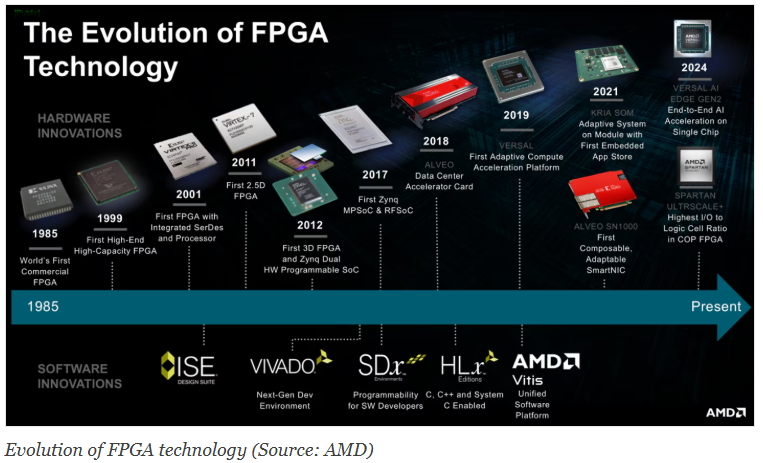
Not a [Jack of All Trades] but an [Irreplaceable]
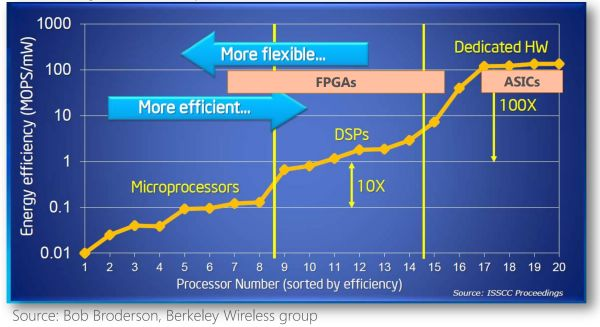
To understand the value of FPGA, one must first step out of the single dimension of [which has stronger computing power]—its core competitiveness lies precisely in the balance of [flexibility] and [efficiency].
FPGA stands for [Field Programmable Gate Array], essentially a [chip with customizable circuits].
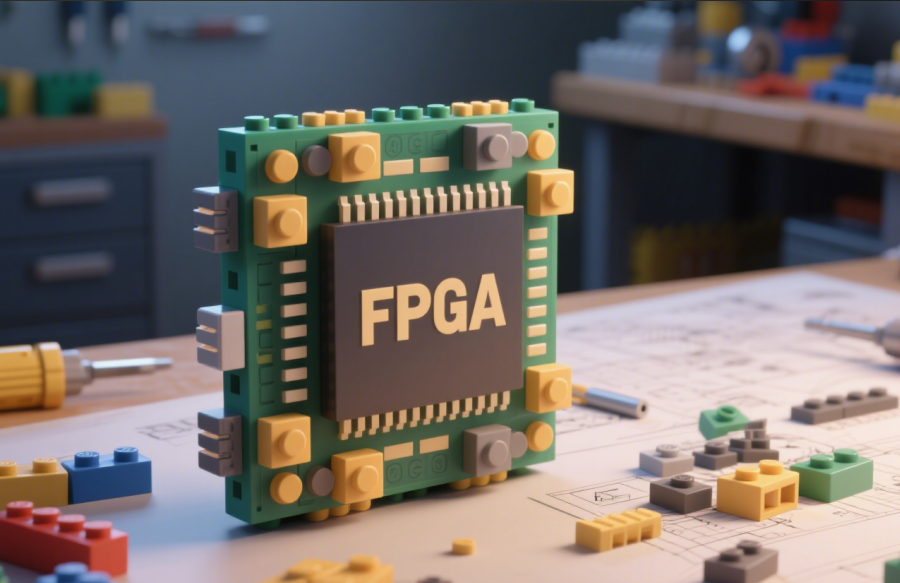
If we compare CPUs and GPUs to [finished toys], and ASICs to [custom building block sets], then FPGAs are like [universal Legos].
With its basic modules, one can build castles, race cars, or even robots, and if assembled incorrectly, it can be disassembled and reassembled.
FPGA’s core competitiveness is its hardware reconfigurability, enabling low-latency processing and flexible parallel computing capabilities, allowing hardware logic to be adjusted according to scene requirements.
Due to the reliance on resource redundancy for hardware reconfigurability, the die size of the chip is relatively large, leading to higher costs, while its design must consider both hardware architecture and algorithms, making the threshold relatively high.
In typical application scenarios, FPGAs play a key role in 5G base station baseband processing, AI edge inference, and industrial servo drive control, where both flexibility and real-time performance are required, and they are also a core tool for early prototype verification in IC design.
In terms of key evaluation metrics, the critical metrics for FPGAs are latency and latency determinism. Once the hardware logic is fixed, the data processing latency is stable, without fluctuations caused by operating system scheduling, which is also an important reason for its irreplaceability in real-time scenarios.
In Bing search ranking, after Microsoft replaced GPUs with FPGAs, latency dropped from milliseconds to microseconds because FPGAs can implement [pipeline parallelism], while GPUs can only achieve [data parallelism].
FPGAs can complete closed-loop control of current, position, and speed loops within fixed clock cycles, with latency stable at tens of nanoseconds;
while CPUs experience latency fluctuations due to operating system scheduling, making it impossible to meet the precise control requirements of motors.
It is this combination of [low latency + high flexibility] that makes FPGAs irreplaceable in scenarios where [requirements are variable and real-time sensitivity is high], surpassing CPUs, GPUs, and ASICs.
 From [Glue Logic] to a Battleground for Giants
The history of FPGA development is a story of [rising from supporting roles to leading roles]. In 1985, Xilinx launched the world’s first commercial FPGA, the XC2064, which had only 1800 logic gates and was initially designed to solve the [glue logic] problem.
In an era when circuits were built using 74 series TTL chips, designers needed dozens of chips to implement simple decoders or state machines, while FPGAs could [replace a multitude], and could be modified repeatedly, quickly becoming the [prototype verification tool] for IC design.
During the same period, Altera launched CPLD (Complex Programmable Logic Device), forming the early competition of [FPGA vs CPLD] with Xilinx.
At that time, FPGAs were still a [niche player] in the semiconductor industry, with a market size of less than $100 million.
After 2000, the explosion of 3G/4G communication brought the first [takeoff] for FPGAs.
Baseband processing for base stations required flexible adaptation to different communication protocols, while the R&D cycle of ASICs could not keep up with the speed of protocol iteration.
With the advantages of [rapid iteration + multi-protocol compatibility], FPGAs quickly became core components of base stations, with Huawei and ZTE once occupying over 90% of domestic FPGA demand.
During this period, Xilinx and Altera also completed a technological leap. From LUT4 to LUT6, integrating high-speed SerDes and DDR controllers, they launched SoC FPGAs.
By 2015, the global FPGA market size exceeded $5 billion, with Xilinx and Altera collectively holding nearly 90% of the market share.
In 2015, Intel acquired Altera for $16.7 billion, attempting to complete the heterogeneous computing landscape of [CPU + GPU + FPGA];
in 2022, AMD acquired Xilinx for $49 billion, targeting the data center and AI acceleration markets.
The two major FPGA giants changing hands seems to be a case of being absorbed by CPU giants, but in fact, it reflects the strategic value of FPGAs.
In the era of AI and 5G, [reconfigurable computing power] has become a key battleground for giants.
Ironically, 2025 marks the 40th anniversary of FPGA’s birth, and AMD announced that Xilinx will operate as an independent department, while Intel also plans to promote Altera’s independent listing.
This reversal is rooted in the core logic of the FPGA industry: it requires flexible decision-making and focused R&D, rather than being [tied down] by the CPU business of giants.
As AMD’s Adaptive Computing VP Kirk Saban said: [The value of FPGA lies in adaptability, not in becoming an accessory to a product line.]
In the future, Chiplet technology can integrate FPGA logic blocks, CPUs, and memory through advanced packaging, reducing costs;
eFPGA will integrate FPGA cores into SoCs, providing programmability for ASICs.
Both technologies will allow FPGAs to integrate more flexibly into the existing chip ecosystem.
 Breaking Through from Low-End Replacement to High-End Impact
In the highly technical field of FPGA, domestic manufacturers started 30 years late, but in the past decade, they have accelerated breakthroughs as [followers].
Today, the domestic FPGA camp has formed a pattern of [first-tier leaders and second-tier supporters].
Unisoc is the [leader] of domestic FPGAs, with its Titan series being the first high-performance FPGA in China with tens of millions of gates, using 28nm technology, with 174K logic units, supporting 6.25Gbps SerDes and PCIe Gen3, already applied in 5G base stations and data centers.
Its newly launched Titan-3 series, based on 14nm FinFET technology, is performance-matched with AMD Versal, focusing on AI inference and high-speed computing scenarios, and has completed small batch trial production.
Fudan Microelectronics stands out in the [high reliability] field, with its 28nm billion-gate FPGA (700K logic units) being the first product in China to pass aerospace certification, widely used in military applications such as satellites and radars.
Its 14/16nm billion-gate FPGA has completed user trials, becoming one of the few domestic manufacturers to reach advanced processes, and its self-developed EDA tool Procise has also broken the monopoly of foreign tools.
Andes Technology focuses on the [high cost-performance] market, with its 28nm PHOENIX series FPGA, logic units covering 100K-500K, integrating DDR4 and PCIe hard cores, achieving domestic substitution in industrial control and LED display driving.
GaoYun Semiconductor is the only domestic FPGA manufacturer to obtain automotive certification, with its 22nm Aurora V series (138K logic units) applied in vehicle surround view and intelligent cockpit, meeting the automotive electronics demand for [low power + high reliability].
Meanwhile, the Little Bee series has secured a place in consumer electronics and edge computing due to its non-volatile advantages.
Yiling Technology has made breakthroughs in [ultra-low power], with its 16nm titanium series FPGA consuming only 1/4 of the power of similar performance products, suitable for scenarios such as robotics and portable medical devices.
Currently, the 16nm FPGA trial production has been successful, with 500K logic units, filling the gap in domestic mid-to-high capacity FPGAs.
Despite significant progress, domestic FPGAs still have a [two-generation gap] compared to international giants:
AMD Xilinx has mass-produced the 7nm Versal series, and Intel Altera’s Agilex 7 integrates HBM2E memory, while the highest level of domestic technology remains at 14/16nm, with high-end markets such as data centers and AI acceleration almost monopolized.
Xilinx Vivado and Intel Quartus have formed a complete ecosystem of [design tools + IP libraries + development boards], while domestic EDA tools still lag in layout and routing efficiency and IP richness, with many high-end IPs relying on third parties.
The die size of FPGAs is 3-5 times that of ASICs with the same functionality, keeping costs high. International giants can dilute costs through economies of scale, while domestic manufacturers have small production scales, making it difficult to compete on price.
FPGA’s [Sweet Troubles] and Future Pathways
Despite its wide applications, FPGA still faces [growing pains], and these troubles also hide future breakthrough directions.
① The programmability of FPGA relies on resource redundancy, with die sizes being 3-5 times that of ASICs with the same functionality, leading to high unit prices.
Altera once launched HardCopy to try to solve this, but it failed due to high production costs and insufficient flexibility.
This also indicates that the cost issue of FPGAs cannot be solved by [compromising flexibility].
② FPGA design still remains at the RTL level, requiring engineers to understand both hardware architecture and algorithms, while the resource utilization of high-level synthesis is only 50% of RTL, making large-scale popularization difficult.
In contrast, the CUDA ecosystem of GPUs allows software engineers to easily access computing power.
③ The IP library and toolchain of FPGAs depend on the manufacturers themselves, while Xilinx and Intel have accumulated decades of IP resources, domestic manufacturers need to build from scratch, making it difficult to catch up in the short term.
 Conclusion:
As Laozi said: [Water benefits all things without contention, thus it is close to the Dao.] FPGA is like water, without a fixed form, yet it can permeate every corner of the digital world, becoming the [invisible cornerstone] that supports technological innovation.
In the future, when we talk about AI edge computing, autonomous driving, and industrial intelligence, we may find that the unassuming [transformer] has long become an indispensable core.
Some references: Electronic Engineering Magazine: [Why FPGA Technology is Getting Stronger, There is a Reason], Semiconductor Industry Review: [Domestic FPGA, Breaking into the High-End Market], Electronic Circuit Development Learning: [Discussing Domestic FPGA Chip Selection, For Reference Only], Electronic Enthusiasts Network: [The Two Giants are Going to [Fly Solo], FPGA’s 40 Years Welcome New Changes], Wu Chuanbin’s Blog: [Getting to Know FPGA], SSDFans: [FPGA 40 Years: From Logic Optimization to AI Acceleration], Lao Shi Talks: [In this Field, GPU is FPGA’s Younger Brother]
This public account publishes articles and images sourced from the internet for communication purposes. If there is any infringement, please contact us, and we will handle it within 24 hours.
END
Recommended Reading:



For business cooperation, please add WeChat:18948782064
Please be sure to indicate:
[Name + Company + Cooperation Needs]