Click “Smart Agriculture Lounge” for quick follow-up
Introduction
Globally, agricultural fields waste a massive amount of pesticides each year, and NVIDIA’s “Edge AI” is tackling this issue! It equips sprayers and robots with “eyes” to accurately identify weeds using cameras and sensors, applying pesticides only where necessary, or even directly pulling out the weeds. The underlying Jetson module is powerful and durable, designed to withstand dusty and wet agricultural environments.
Edge Artificial Intelligence:
NVIDIA-based Embedded Systems for Agricultural Technology
Edge AI: NVIDIA based Embedded Systems for Agricultural Technology
Source:NVIDIA News
Globally, 3 million tons of pesticides are sprayed on agricultural fields each year, yet only a small fraction of these chemicals is actually necessary. Now is the time to take action! Many suppliers of sprayers, tractors, and agricultural robots have recognized this issue and are taking various approaches to address it. For example, some sprayers are equipped with cameras and sensors that capture ground images and identify weeds, applying pesticides only in necessary areas; another solution, which operates on a similar principle, completely avoids using pesticides—agricultural robots pull out the identified weeds. Both methods help reduce pesticide usage while increasing crop yields.
This example illustrates the immense potential of machines equipped with “vision” and “understanding”—for instance, in ensuring global food supply. But the question is, how can we teach machines to recognize weeds?
Pre-trained AI Algorithms
Empowering Edge Intelligence
Edge intelligence is a hot technology today. With the help of AI algorithms, data can be processed directly at the point of generation (i.e., near the sensors). Commonly used sensors include 2D and 3D stereo cameras, LiDAR, and radar. The generated data is processed through pre-trained neural networks during the inference process. The so-called “inference process” is essentially the process by which software autonomously draws conclusions from the collected data: sensor data is analyzed and evaluated at the edge, while the neural network continues to learn from new data—such as identifying new components in the production process.

Sensors, Software
and Embedded Computers with AI Capabilities
Achieving edge intelligence requires three core components: software, sensors, and embedded systems with AI capabilities. Among them, the embedded system serves as the hardware core, capable of processing data in real-time and making intelligent decisions based on it. Today, chip manufacturer NVIDIA’s technology is often used for such inference tasks. The NVIDIA Jetson product line offers system-on-modules (SoM) with varying performance levels, integrating CPU and GPU technologies. With a parallel processing architecture, these system-on-modules can quickly and efficiently run software for autonomous machines and devices, especially capable of processing data from multiple high-resolution sensors with virtually no latency.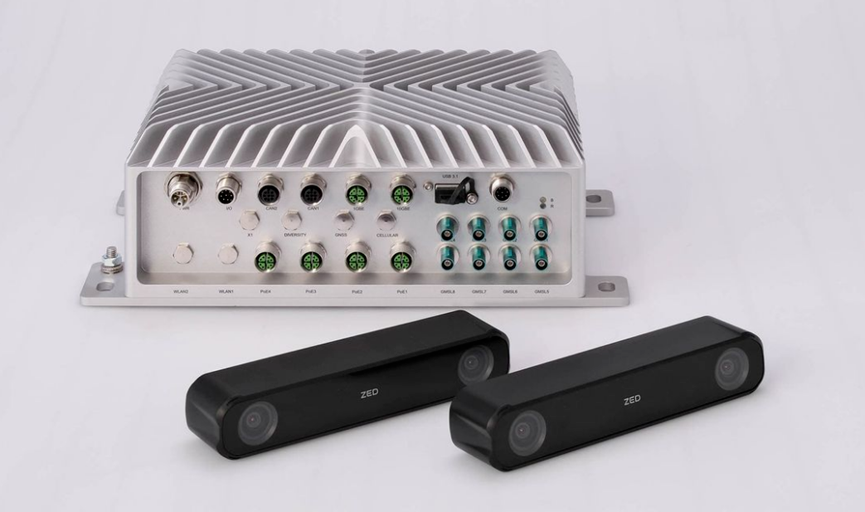
Another major reason for choosing the NVIDIA Jetson platform is its development kits. Companies can leverage the development kits to kickstart software development early and then seamlessly complete the development process on production equipment. The platform also provides a wealth of libraries and specific application frameworks, effectively reducing development costs. Additionally, this series of system-on-modules is compatible with the Robot Operating System 2 (ROS2) middleware—ROS2 has become an ideal tool for computer vision applications, used for controlling and coordinating numerous nodes. This middleware features a modular structure, not only capable of processing and evaluating sensor data but also enabling actuator control..
NVIDIA’s latest system-on-module is the Jetson AGX Orin, which boasts an AI computing power of 275 TOPS (trillions of operations per second), 64GB of memory, and flexible power consumption ranging from 15 to 60 watts. The powerful CPU combined with the NVIDIA Ampere architecture GPU creates a unique combination, enabling new computer vision applications across various industries, with typical applications including hazard detection, environmental perception, intelligent video analysis, and autonomous system control.
Embedded Computers Can Be Dustproof and Waterproof
To ensure NVIDIA’s AI technology operates normally in harsh environments (such as those encountered by production equipment or agricultural robots), specially designed hardware is required. A few global suppliers have taken on the task of “adapting NVIDIA technology to harsh environments,” launching embedded computers based on NVIDIA Jetson with an IP67 protection rating. For example, Syslogic combines system-on-modules (SoM) with self-developed carrier boards, high-durability enclosures, and sophisticated connector technology; their rugged computers utilize a passive cooling design, suitable for a broader temperature range. The company has also collaborated with sensor manufacturers who share the same requirements for durability and reliability.Thus, even in harsh industrial application scenarios, the potential of AI can be fully unleashed. Through Power over Ethernet (PoE) or Gigabit Multimedia Serial Link (GMSL) interfaces, sensors such as LiDAR, radar, and cameras can be connected to embedded systems, enabling complex computer vision applications—opening new opportunities for global enterprises.
Join Us
 ⬆️ Click the image to read the full article
 Welcome to join“Smart Agriculture Industry-Education Integration Committee”👇
Scan the QR code below to download:
Basic Conditions and Membership Application Form for Council Units
(pdf version + word version)

 ▍Copyright StatementThis article is reproduced from the public account“Bilingual Smart Agriculture LearnSomeAgtech”All rights belong to the original authorPlease indicate the source when reprintingIf there is any infringement, please leave a message in the background, and we will handle it promptly!
THE END