This article often discusses the market share of mobile manufacturers; today, we will talk about the market share of mobile SoC chips and the proportion of advanced processes in mobile SoC chips.
1: Current Market Share of Mobile SoC Chips
| Brand | 2024Q1 | 2024Q2 | 2024Q4 | 2025Q1 | 2025Q2 |
|---|---|---|---|---|---|
| MediaTek | 41% | 34% | 31% | 38% | 37% |
| Qualcomm | 27% | 30% | 25% | 27% | 26% |
| Apple | 16% | 15% | 21% | 15% | 14% |
| UNISOC | 9% | 14% | 14% | 10% | 13% |
| Samsung | 5% | 4% | 4% | 5% | 6% |
| Others | 1% | 1% | 1% | 1% | 1% |
MediaTek’s current market share has surpassed Qualcomm, mainly due to its larger share in low-end mobile SoC chips, especially driven by demand from domestic manufacturers.
Additionally, do not underestimate UNISOC, as it has a significant market share, especially in mid-range and low-end mobile devices.
Samsung’s flagship SoC chip, Exynos 2500, is currently not used in the Galaxy S25 series, which exclusively uses Qualcomm’s Snapdragon 8 Elite. However, the Exynos 2600 is progressing well and is expected to be used in half of the Galaxy S26 series, with the other half using the Snapdragon 8 Elite Gen 5.
2: Advanced Processes in Mobile SoC Chips
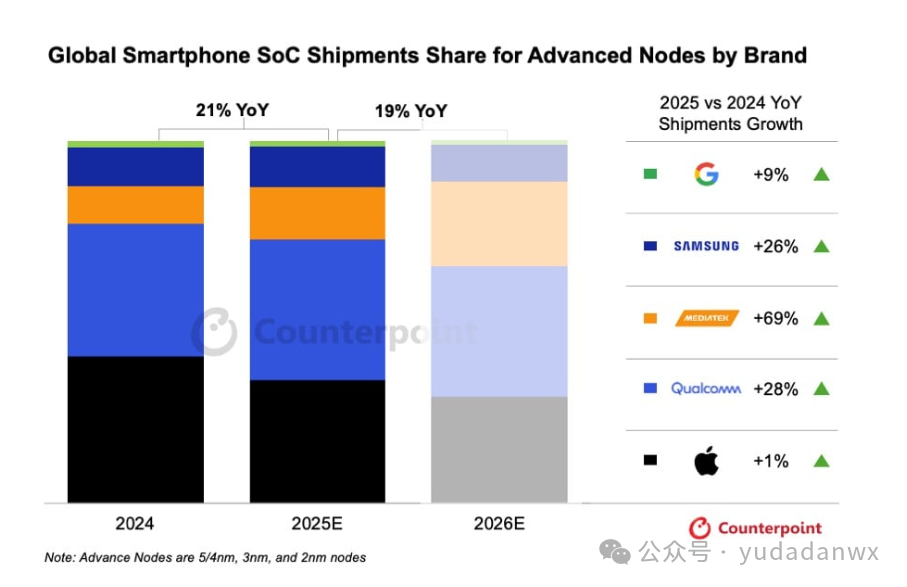
The so-called advanced processes for mobile SoC chips refer to the use of 3nm, 4nm, and 5nm processes in mid to high-end mobile SoCs. By 2026, flagship mobile SoC chips from various manufacturers will adopt 2nm processes.
In 2025, the proportion of advanced processes in mobile chips will exceed 50%, and next year this proportion will reach 60%.
In terms of shipment volume for advanced process SoC chips, Qualcomm’s shipments have increased by 28% this year, while MediaTek has seen a remarkable growth of 69%, as shown in the image below:
Moreover, 3/4 of these advanced processes are manufactured by TSMC, while Samsung is struggling to manage its own production, currently holding only 8% of the mobile foundry market.
The reason for adopting advanced processes is also easy to understand; it allows for greater transistor density, further enhancing performance and improving energy efficiency, enabling mobile OEM manufacturers to integrate powerful CPUs, GPUs, and NPUs.
To be frank, improving mobile performance through software without utilizing advanced processes is inherently contradictory.
By the way, I have created a WeChat group:

To share and discuss technology! If the group image expires, you can check the latest article.