
Abstract
Strengthening the construction of intelligent consumer infrastructure must balance forward-looking functionality and convenient applicability.
Especially in important scenarios related to people’s livelihoods, such as eating, dressing, living, and traveling, intelligent terminal products represented by service robots should “jump” out of the “show-off” logic to provide convenience and warmth in serving the public.
Recently, the State Council issued the “Opinions on Deepening the Implementation of the ‘Artificial Intelligence+’ Action” (hereinafter referred to as the “Opinions”).
The “Opinions” clearly propose the development goal of “by 2035, our country will fully enter a new stage of intelligent economy and intelligent social development, providing strong support for the basic realization of socialist modernization,” while emphasizing the need to “expand new scenarios for service consumption,” strengthen the construction of intelligent consumer infrastructure, improve the quality of life services such as cultural entertainment, e-commerce, housekeeping, property management, transportation, elderly care, and childcare, and expand new scenarios for experiential consumption, personalized consumption, cognitive and emotional consumption.

“Currently, the core driving force for the development of the service robot industry mainly lies in two aspects: economic viability and technological maturity;
However, it is worth noting that many products are launched with the intention of competing on price, and how far such products can go remains to be seen.”
Yang Jiancheng, founder and chairman of Xianglu Robot, stated.

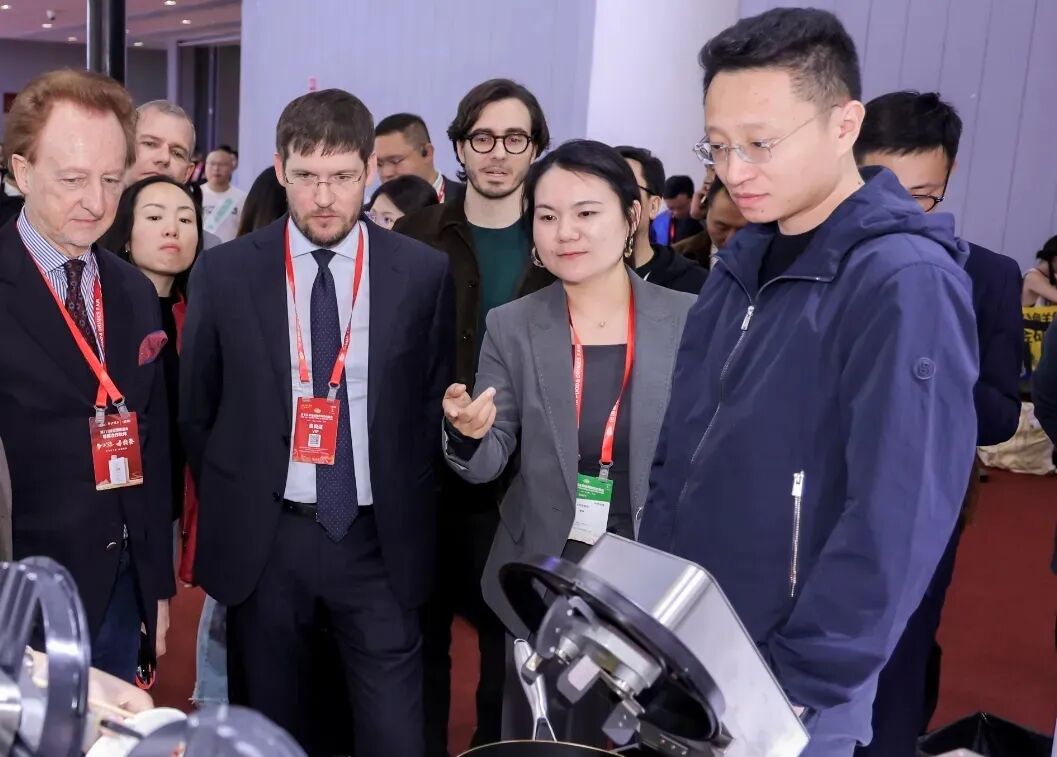
↑ Yang Jiancheng (far right) introduces the application steps of the cooking robot to guests from home and abroad.

What is the current supply-demand relationship in the service robot industry?
What demands still need rapid coverage by product technology?
Yang Jiancheng stated that, in terms of supply-demand relationship, from my observation, the current industry supply-demand situation is characterized by a coexistence of high-end shortages and low-end oversupply.
Taking the service robot industry as an example, the structural contradictions in the industry are quite evident— in high-end fields, such as medical surgical assistance and precision manufacturing, there is a significant supply-demand gap, with insufficient global companies capable of mass production. The core bottleneck lies in breakthroughs in micron-level motion control algorithms and multimodal perception systems, leading to shortages in the high-end market;
While in the mid-to-low-end fields, some basic robots that undertake cleaning, meal delivery, and other services have insufficient capacity utilization, resulting in homogeneous competition that triggers price wars and compresses the average profit margins in the industry.
From the demand side, Yang Jiancheng believes that the AI-driven service robot industry urgently needs to cover some high-frequency demand scenarios while enhancing market vigilance against “pseudo-demand”.

“Real demand often stems from technological gaps and the incremental space of products;
For example, in the silver economy sector, the markets for rehabilitation care robots and emotional companionship robots are surging. According to our understanding, although some single-function service robots only assist bedridden individuals in turning over, they still have a market;
Similarly, the accuracy of emotional interaction robots is also increasing, as they are adept at capturing the instantaneous changes in human emotions and providing emotional value. From the market demand perspective, such products have significant growth potential in both quantity and functionality.” Yang Jiancheng stated.

It is worth mentioning that due to the numerous uncontrollable factors and high costs involved in the process from product development to commercialization, many industry insiders believe that the romanticism of technology, which deviates from the essence of commerce, should be regarded as a pseudo-proposition.
For example, if the price of a nursing robot equals the salary of a caregiver for ten years, the demanders will certainly be very cost-conscious. Similarly, some say that cooking robots should simulate chefs flipping in the kitchen, while the actual product demand scenario is precisely the narrow kitchen space, and customers choose to purchase service robots due to difficulties that traditional methods cannot solve.

“Therefore, we believe that technology needs to return to the essence of commerce, which is ‘cost reduction, efficiency increase, and scalability’;
For example, Xianglu Robot, as a gazelle enterprise dedicated to developing various AI cooking robots, aims to make the restaurant businesses, consumers, and chefs all better off, focusing on real demand to achieve a balance in the quality of supply in the catering industry;
With AI temperature control sensors achieving ±0.5℃ dynamic temperature control, we have overcome the challenge of replicating Chinese cuisine, with a flavor restoration rate close to 98%. Two machines plus one operator can replace three chefs, effectively alleviating the chef shortage issue in the catering industry, and through flavor replication, allow Kung Pao Chicken to emit the aroma of Chengdu-style cooking in American restaurants.” Yang Jiancheng said.

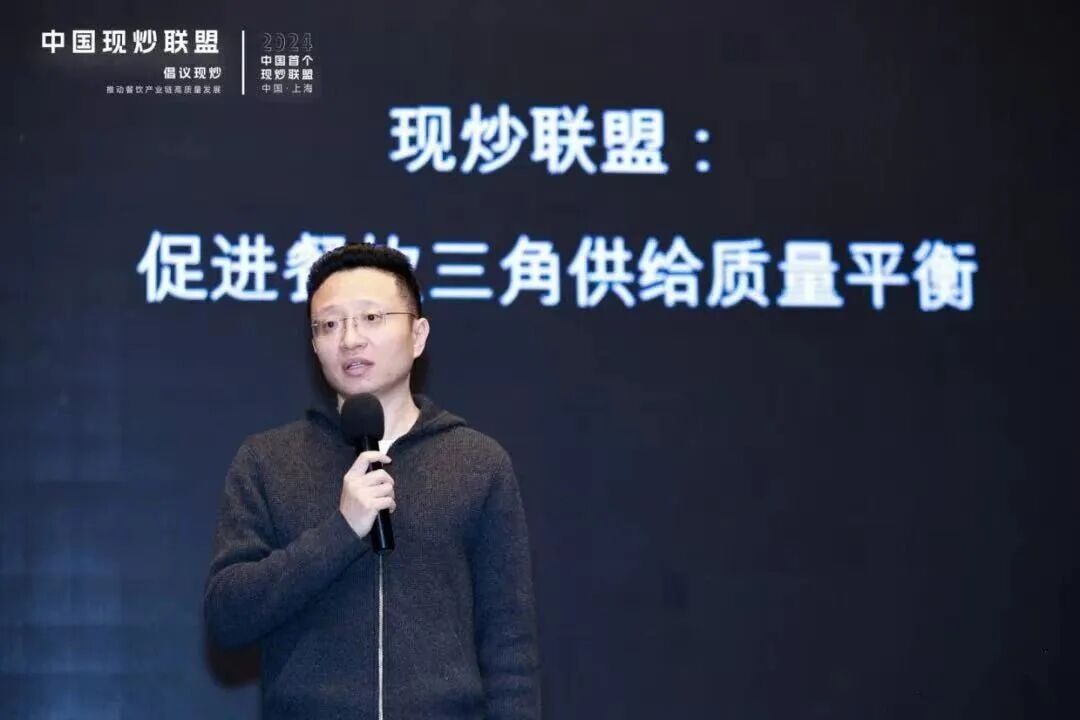
↑ Yang Jiancheng explains the concept of fresh cooking at the establishment ceremony of the Chinese Fresh Cooking Alliance, highlighting the new opportunities it brings to the catering supply chain.

Are AI cooking robots the leaders or assistants in practical scenarios?
Is this industry track still straight at present?
What determines the maturity speed of the industrial chain?
In this regard, Yang Jiancheng stated that currently, AI cooking robots are gradually shifting from the role of