TRAVEL
Click the blue text to follow us


Overview

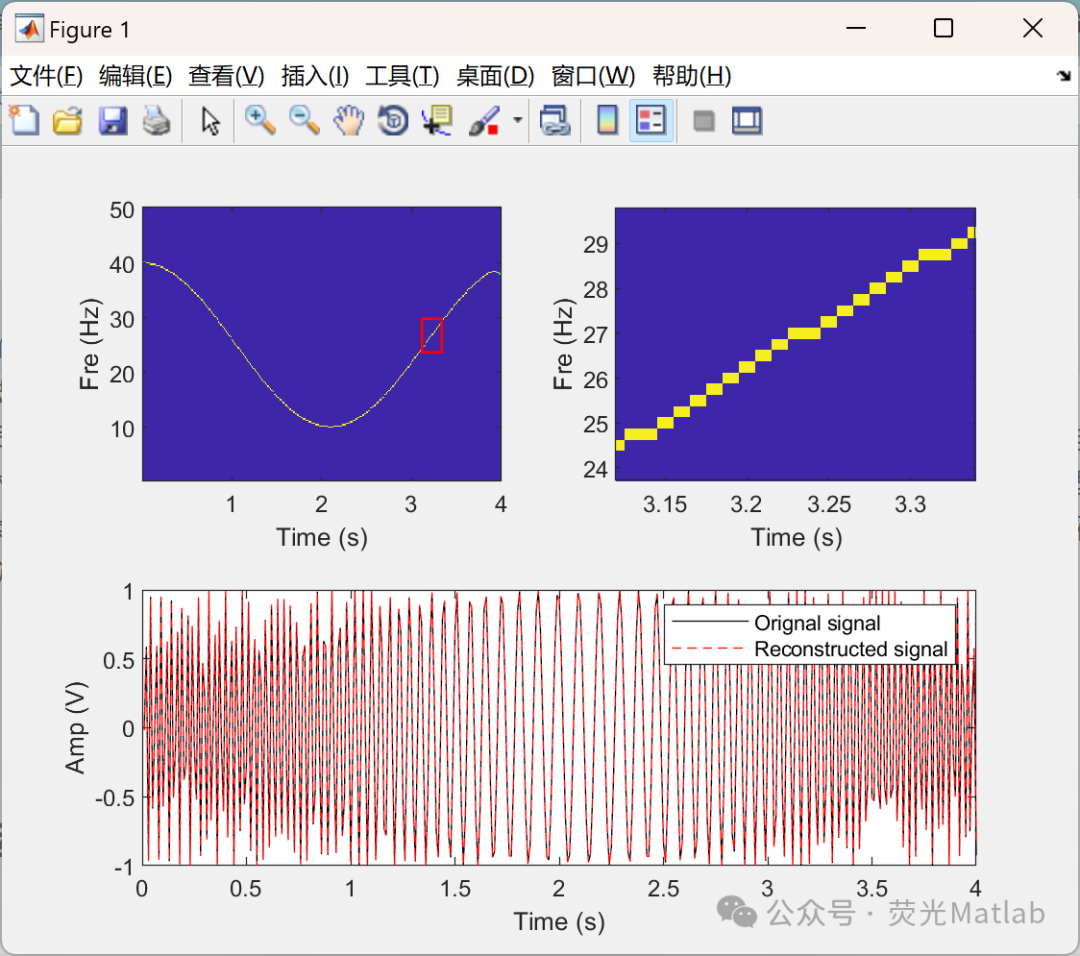
The time-frequency representation generated by traditional methods is often too vague to provide precise features for such signals. A recently proposed method called the Multiple Synchronous Squeezing Transform (MSST) overcomes most of the issues present in traditional methods and appears to be a promising tool. However, the MSST still has a major problem known as the reassignment point issue, which can lead to energy blurring at certain specific time-frequency points. This paper primarily focuses on addressing this issue. Our research finds that this problem in the MSST is caused by the rounding operation during the discretization process of the reassignment step. Subsequently, an effective method is adopted to resolve this issue through a simple strategy. Additionally, this study provides a discretization implementation. Numerical analysis shows that our proposed method can effectively improve energy concentration compared to the MSST. Comparisons with other advanced methods also demonstrate that the proposed method performs better in handling strong non-stationary signals and noisy signals. In the analysis of experimental signals, we conducted three experiments to verify the effectiveness of the proposed method in analyzing actual signals.
1
Principle Basis

It is rooted in time-frequency analysis theory and expands upon the classical Synchronous Squeezing Transform (SST). The SST reallocates the time-frequency energy of the signal’s wavelet transform results to concentrate it into more precise areas, enhancing time-frequency resolution. The improved Multiple Synchronous Squeezing Transform further optimizes this process by employing multiple analysis windows or multi-scale transformation strategies to decompose and reconstruct the signal from different dimensions and granularities. For example, using multiple wavelet functions with different center frequencies or bandwidths simultaneously on the signal captures the characteristics of the signal across different frequency bands and time scales. Then, based on specific squeezing rules, the dispersed time-frequency information is aggregated, making the signal’s presentation in the time-frequency domain clearer and more accurate, effectively highlighting key information such as instantaneous frequency changes and modal components.
2
Advantages and Features

1. High Resolution: Compared to traditional Fourier transforms and their derived methods, IMST exhibits outstanding resolution in the time-frequency domain. Whether analyzing impulsive signals with abrupt characteristics or frequency-modulated signals containing multiple frequency components that change over time, it can accurately locate the time intervals of each frequency component and their dynamic changes, providing strong support for the fine interpretation of signals. 2. Strong Modal Separation Capability: When processing multi-component complex signals, IMST can clearly separate different modal signals mixed together due to its unique multi-transform mechanism. This is significant in the field of mechanical fault diagnosis; for example, when analyzing the vibration signals of rotating machinery, it can accurately distinguish vibration modes caused by different reasons such as bearing faults or rotor imbalance, thus precisely locating the fault source. 3. Good Noise Resistance: Through clever multi-scale analysis and information fusion, IMST has a certain resistance to noise interference. In practical application scenarios, signals are often accompanied by a large amount of background noise. IMST can disperse and weaken noise components during the decomposition process, ensuring that the characteristics of useful signals remain prominent in the time-frequency map, thus guaranteeing the accuracy of subsequent analysis and diagnosis.
3
Application Fields

1. Biomedical Engineering: In the analysis of electroencephalograms (EEG) and electrocardiograms (ECG), IMST can be used to separate signal components corresponding to different physiological rhythms, assisting doctors in diagnosing neurological and cardiovascular diseases. For example, it can accurately isolate abnormal brain waves representing epileptic seizures from the background of normal brain activity in EEG, providing a basis for early detection and precise treatment of diseases. 2. Mechanical Engineering and Fault Diagnosis: For vibration and noise signals from large machinery and vehicle engines, IMST can quickly and accurately determine the operating status of the equipment, detect potential fault hazards, and arrange maintenance in advance, reducing equipment failure rates and improving production safety and reliability. 3. Geophysical Exploration: In the processing of seismic exploration data, IMST helps extract weak effective signals hidden in complex geological data, analyze changes in stratigraphic structure, and provide more accurate underground information for the exploration and development of resources such as oil and natural gas. 4. Communication and Radar Signal Processing: In the field of communication, IMST can be used for channel estimation, signal demodulation, etc., improving communication quality and data transmission rates; in radar signal processing, it can enhance the analysis capability of target echo signals, improving radar detection accuracy and recognition ability, playing a key role in military defense, aerospace, and other fields.
4
Development Prospects

With continuous technological advancements, the improved Multiple Synchronous Squeezing Transform is expected to continue optimizing and upgrading. On one hand, researchers will focus on reducing computational costs to enable more efficient applications in scenarios with high real-time requirements; on the other hand, the integration with emerging technologies such as artificial intelligence and big data will become a trend. By using machine learning algorithms to automatically adjust the parameters of IMST to meet the processing needs of different types of signals, or utilizing big data to mine more signal feature patterns, it will further expand its breadth and depth of application, injecting strong momentum into the development of various disciplines and helping to solve more complex real-world problems. We hope the above overview is helpful to you. If you have further requirements regarding the depth and breadth of the content, please feel free to contact us for deletion.

Running Results



1
2

5
Main Function Code

clear;
SampFreq = 100;
t = 0 : 1/SampFreq : 4-1/SampFreq;
Sig = [sin(2*pi*(25*t + 10*sin(1.5*t)))];
[m,n]=size(Sig);
time=(1:n)/SampFreq;
fre=(SampFreq/2)/(n/2):(SampFreq/2)/(n/2):(SampFreq/2);

[Ts] = IMSST_Z(Sig',40,10);


x1=3.12; x2=3.34;
y1=23.7;   y2=29.8;

figure;
ha=subplot(221);
imagesc(time,fre,abs(Ts));
xlabel('Time (s)');
ylabel('Fre (Hz)');
axis xy
rectangle('Position',[x1 y1 x2-x1 y2-y1],'EdgeColor','red','Linewidth',1);
ha=subplot(222);
imagesc(time,fre,abs(Ts));
xlabel('Time (s)');
ylabel('Fre (Hz)');
axis xy
set(ha,'xlim',[x1 x2],'ylim',[y1 y2]);

subplot(2,2,[3 4]);
plot(time,Sig,'k-');hold on;
plot(time,sum(real(Ts)),'r--');
axis([0 4 -1 1]);
xlabel('Time (s)');
ylabel('Amp (V)');
legend('Orignal signal','Reconstructed signal');

References

[1] Yuan Pingping, Zhao Zhoujie, Su Huilin, et al. Structure instantaneous frequency identification based on improved multiple synchronous squeezing spline Chirplet transform. Journal of Vibration and Shock, 2024, 43(17):145-153. DOI:10.13465/j.cnki.jvs.2024.17.016.
[2] Yuan Pingping, Cheng Xueli, Wang Hanghang, et al. Research on structure instantaneous frequency identification based on improved multiple synchronous squeezing generalized S transform. Journal of Vibration and Shock, 2022, 41(08):193-198+237. DOI:10.13465/j.cnki.jvs.2022.08.023.
Some content in this article is sourced from the internet, and references will be noted or cited as references. If there are any inaccuracies, please feel free to contact us for deletion.




Follow us for more information




Recommended Articles

[Signal Processing] MUSIC Multi-Signal Classification Algorithm (Matlab Implementation)
2024-12-27
[Signal Processing] Underwater Acoustic and Sonar Signal Processing (Matlab Implementation)
2024-12-26
[Signal Processing] LQ/QR Noise Estimator (Matlab Implementation)
2024-09-10