In the reliability assessment of printed circuit board assembly (PCBA), the microstructure of solder joints, particularly the intermetallic compound (IMC) layer, is crucial for determining long-term performance. The IMC layer, as a product of the metallurgical bonding between solder and pad, directly affects the mechanical strength and electrical connection stability of the solder joint. Under ideal soldering processes, we expect to observe a uniform and continuous IMC at the solder and pad interface.
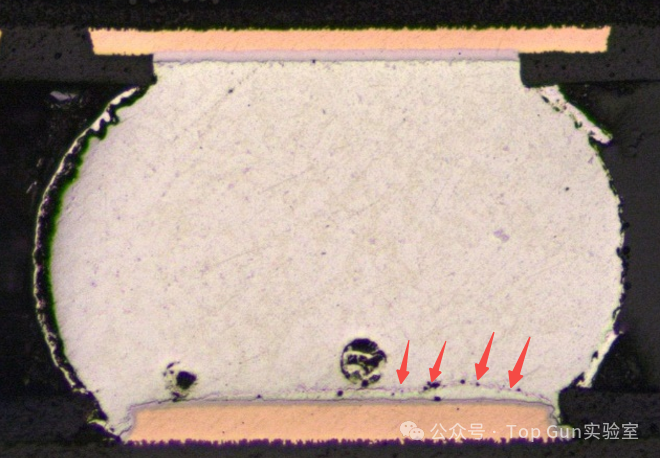
However, during a routine PCBA cross-section analysis, we encountered a puzzling phenomenon. As shown in the figure below, the metallographic section of the solder joint revealed an unprecedented microstructure: two distinct layers of IMC clearly present within the solder joint. Even more intriguingly, one layer of IMC appears to be “suspended” within the solder ball, significantly deviating from its usual position at the pad interface.
EDS Testing:
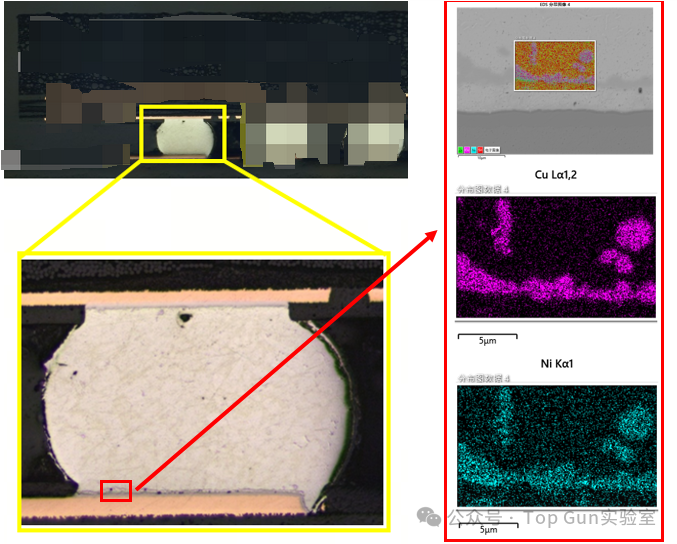 This dual-layer and elevated IMC structure poses multiple potential threats to the long-term reliability of the solder joint. It not only visually represents a process anomaly but also serves as a weak point that may lead to future failures. The potential impacts are as follows:
- Introduction of brittle fracture interfaces:The IMC layer itself is hard and brittle. When one layer of IMC is “suspended” within the relatively soft solder matrix, it acts like an internal “crack precursor.” Under thermal cycling, vibration, or mechanical shock, stress will concentrate around this suspended IMC layer, easily triggering the initiation and propagation of cracks, leading to premature brittle fracture of the solder joint.
- Segmentation of solder joint structure: A complete solder joint should be a continuous whole. This internal IMC layer effectively divides the solder ball into two parts, disrupting its structural continuity and overall load-bearing capacity. It is akin to introducing a piece of glass into a concrete structure, significantly compromising its overall strength.
In summary, this abnormal IMC structure is a “ticking time bomb” for solder joint reliability. It fundamentally alters the ideal structure of the solder joint, introducing multiple potential sources of failure.
Discussion: How did this dual-layer and “elevated” IMC structure form?What physical or chemical processes led to the separation of the IMC layer from its original interface, ultimately forming a new layer within the solder ball?—We welcome everyone to engage in discussion, with answers revealed next Tuesday.。