I greatly benefited from a conversation with a chip expert. One key idea he conveyed to me is that when discussing chips, one must first consider the application scenarios. When talking about GPUs, SoCs, and various chips, it is essential to discuss them in the context of their usage scenarios. For instance, the sudden popularity of Bluetooth chips was due to the emergence of a killer application: Bluetooth headsets. Similarly, the current surge in GPUs is driven by killer applications like ChatGPT and the application of AI across multiple domains. When discussing which chips will become popular in the future, it is crucial to consider the corresponding killer applications or scenarios. I believe this is the core viewpoint of my article. Below, I will analyze the applications of FPGAs in several popular scenarios and provide a forecast for the future of FPGAs.
FPGA Applications in Ultra-Low Latency Financial Trading Systems
In financial trading systems, ultra-low latency is a critical requirement, especially in high-frequency trading (HFT), where differences of a few microseconds or nanoseconds can lead to significant profit variations. To achieve such extreme performance, FPGAs (Field Programmable Gate Arrays) have become the core technology for achieving near-light-speed data processing. The core idea is to “burn” traditional software algorithms into hardware circuits, allowing data to bypass traditional operating systems and protocol stacks, significantly reducing processing latency.
MCUs/CPUs may require delays ranging from tens of microseconds to milliseconds, and cannot avoid unpredictable latencies caused by operating system scheduling and context switching. In contrast, FPGAs can control processing latency to within a few hundred nanoseconds. FPGA systems leverage pipelined structures and the advantages of hardware parallel processing to achieve much lower latencies than traditional MCUs and CPUs, which is crucial for high-frequency trading systems.
By “burning” trading algorithms into hardware, FPGAs can process vast amounts of market data at nearly zero latency, greatly enhancing the speed and accuracy of trading decisions. With high-performance FPGA models and well-designed core modules, data decoding, order book updates, trading strategy execution, and order generation can be completed within nanoseconds, far surpassing traditional MCU/CPU architectures. For this reason, top quantitative trading firms and financial institutions worldwide invest heavily in developing FPGA-based trading acceleration cards to gain a competitive edge in an extremely competitive market.
The killer application in the financial sector, FPGA-based trading acceleration cards are specialized hardware solutions designed for high-frequency trading. Their core principle is to utilize the parallel architecture and hardware programmability of FPGAs to solidify key algorithms such as market data parsing, order book management, and strategy decision-making into dedicated hardware circuits, thereby bypassing the latency of traditional CPU operating systems and software protocol stacks. They process network data streams directly through high-speed interfaces (such as 10 Gigabit Ethernet), achieving nanosecond-level market data processing and order generation latency, and leveraging their deterministic timing performance to capture minute market price discrepancies in a very short time, a speed advantage that no software-based sequential processing solution (like MCUs or CPUs) can match. The mainstream chips used here include: Xilinx UltraScale+ series, Xilinx Versal series, and Intel Agilex series.
FPGA as the Core of “Hardware Acceleration” in Modern Military Equipment
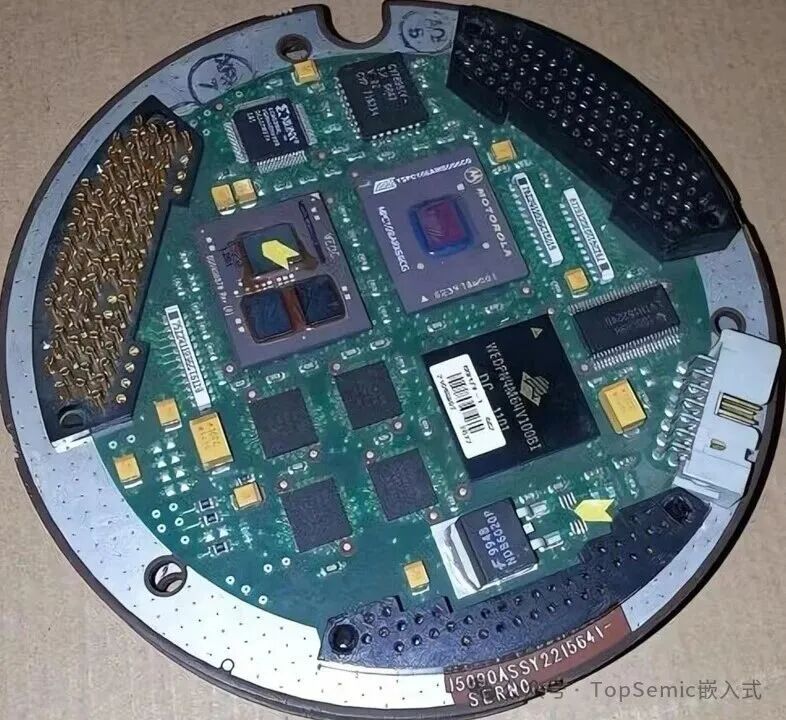 (The guidance system of the U.S. military AIM-9X “Sidewinder” missile, image source: internet)
The Xilinx XC4VFX60-10FFG1152 FPGA (Virtex-4 FX series) shown in the image plays a critical role in the guidance system of the AIM-9X “Sidewinder” missile, primarily used for processing infrared imaging data and executing real-time algorithms. This aligns closely with the advanced features of the AIM-9X, such as infrared imaging seekers, 50G maneuverability, shoulder-launched capability, and “look-back” capability.
The core role of FPGAs in infrared imaging seekers includes real-time image processing: FPGAs can process large amounts of pixel data in parallel, extracting features (such as target outlines and thermal signatures) from thermal images captured by infrared sensors, and running algorithms to filter out interference (such as solar reflections or decoys). This is faster and more efficient than traditional microprocessors, as FPGAs support hardware-level acceleration, avoiding software bottlenecks. Their built-in PowerPC processors can also embed custom software for image enhancement and multi-target differentiation. Target tracking and maneuver control: Under 50G overload, FPGAs compute missile trajectory adjustments, combining datalink instructions from aircraft to achieve shoulder launches or reverse attacks. Compared to Soviet missiles that heavily relied on transistors (which are bulky and power-hungry), FPGA’s integrated design makes circuits more streamlined, reducing component count and improving reliability against shocks and extreme environments (such as high temperatures and high G-forces). Flexible updates: Military designs emphasize “maturity, stability, and reliability under extreme conditions”; the programmability of FPGAs allows for algorithm upgrades via software without hardware replacement. Military products are not about competing with the “latest concepts and gimmicks” but optimizing the entire lifecycle (manufacturing, maintenance, storage, and use). For example, the iterations of the AIM-9 series during the Vietnam War, Falklands War, or Gulf War relied on this integrated circuit simplification, rather than the complex maintenance required by the Soviet’s extensive use of transistors.
In defense applications, FPGAs are often used for high-speed data processing when ASICs (Application-Specific Integrated Circuits) are not cost-effective due to low production volumes, or when microprocessors are too slow. This aligns with the operational demands of the AIM-9X: used by over 50 countries, emphasizing mission success rather than precision gimmicks. Compared to Soviet designs, FPGAs reduce maintenance risks (such as damage from reverse polarity connections), making them suitable for lifecycle management.
FPGAs have become core components in advanced military equipment such as missile guidance, electronic warfare, and phased array radars due to their hardware-level parallel processing, nanosecond-level deterministic latency, and field-programmable flexibility. They achieve complex signal processing and real-time control through direct hardware processing, and their radiation-hardening characteristics and high reliability fully meet the stringent requirements of military applications for extreme performance, safety, and environmental adaptability, which cannot be replaced by any software-based sequential execution MCUs.
FPGA as a Reconfigurable Engine for Edge AI Computing
Recently, a long-time entrepreneurial alumnus mentioned that the lack of movement capabilities in robots is akin to having an underdeveloped cerebellum. This metaphor struck me like a lightning bolt, resonating with my previous thoughts. Today’s AI resembles a disproportionately large-headed child, where the brain responsible for language is overly developed, while the system dominated by CPUs continues to expand the GPU components. This adds many language-related brain parts to the original brain structure, but the cerebellum responsible for movement has not kept pace. In such a system, the overall AI machine is like a big-headed child, with almost no cerebellum for movement. While writing this article, I pondered whether FPGAs could be the cerebellum of AI machines. In the era of AI, it is essential to proportionally expand the role and technological iteration of FPGAs according to the demands of different scenarios.
Through continuous technological innovation and application exploration, FPGAs are playing an increasingly important role in the field of artificial intelligence, providing efficient and reliable computing platform support for various intelligent systems, especially demonstrating irreplaceable value in edge computing and real-time processing scenarios.
From a biological perspective, the cerebellum coordinates unconscious motor control, timing control, and reflex regulation through parallel processing of neural signals; correspondingly, FPGAs perfectly undertake the underlying, high-frequency real-time processing tasks in intelligent machines due to their hardware-level parallel architecture, nanosecond-level deterministic latency, and dynamically reconfigurable characteristics. In autonomous driving, FPGAs coordinate multi-sensor data fusion like a cerebellum, achieving millisecond-level obstacle avoidance decisions; in industrial robots, they precisely control motion joints, ensuring smoothness and accuracy of actions.
Compared to CPUs (“cerebral cortex”) that handle high-level decisions and GPUs (“visual cortex”) that excel in large-scale parallel computing, the unique “reflex arc” processing mechanism of FPGAs does not rely on operating system scheduling, directly implementing sensor fusion and motion control through hardware logic. Their programmability corresponds to the plasticity of the cerebellum, allowing them to adapt to new task requirements through reconfiguration; while their low power consumption and high reliability characteristics perfectly meet the requirements for continuous operation in biological systems. This architecture enables FPGAs to play an irreplaceable bridging role in the “perception-decision-execution” closed loop, liberating the advanced computing power of the main processor while ensuring real-time responses for critical tasks, making them a key enabling component for intelligent machines to achieve autonomous behavior.
As a key acceleration platform in the field of artificial intelligence computing, FPGAs demonstrate unique value in AI acceleration due to their hardware reconfigurability and parallel architecture advantages. Their core advantages are reflected in three aspects: first, achieving instruction-level, data-level, and task-level multiple optimizations through hardware-level parallel architecture, significantly improving neural network inference efficiency; second, outstanding energy efficiency performance, with INT8 quantization schemes saving over 40% energy compared to GPUs with similar performance in typical image classification tasks like ResNet-50; third, programmable I/O interfaces that connect directly to sensors, significantly reducing data transfer overhead.
At the hardware architecture level, modern FPGAs adopt innovative heterogeneous computing designs. Taking the Xilinx Versal ACAP as an example, it integrates programmable logic units, scalar processing engines, adaptive engines, and intelligent engines, supporting multiple data precisions such as INT4/INT8/FP16, with single-chip computing power exceeding 100 TOPS. Its distributed storage architecture utilizes Block RAM and UltraRAM for near-end data storage of computing units, effectively alleviating the “memory wall” problem, with convolution operation data reuse rates reaching 90%, while supporting high-speed storage interfaces like DDR4/5 and HBM2e.
In practical applications, FPGAs excel in the field of computer vision. In industrial inspection, they achieve processing speeds of 1000 frames per second at 4K resolution, with defect detection accuracy reaching 99.9%; in intelligent transportation systems, they can simultaneously track over 200 targets, with latency controlled within 3 milliseconds, making them the preferred solution for emergency obstacle avoidance in autonomous driving. Edge AI inference, through model quantization and hardware-aware training techniques, compresses models like ResNet-50 to one-fourth of their original size while maintaining over 98% accuracy. In federated learning scenarios, the reconfigurable characteristics of FPGAs support rapid switching of encryption algorithms and machine learning models, enabling real-time diagnosis in medical imaging joint analysis under data security.
The improvement of development toolchains further promotes FPGA applications. The Xilinx Vitis platform supports the entire development process from C++/Python to hardware, while Intel’s OpenVINO excels in INT8 quantization. The open-source ecosystem is rapidly developing, with the FINN framework supporting the automatic generation of customized data flow architectures, and the HLS4ML tool enabling direct conversion of TensorFlow/PyTorch models to hardware, significantly lowering the development threshold.
Performance comparisons show that FPGAs consume only one-third the power of GPUs in 1080p video stream object detection tasks, with latency reduced by an order of magnitude; in inference scenarios with a batch size of 1, the energy efficiency ratio can exceed five times that of GPUs. Future development trends include technologies such as 3D stacked packaging, heterogeneous integration, and optical interconnects, with AMD’s Xilinx Versal ACAP and Intel’s optical I/O FPGA products set to break performance bottlenecks. Domestic FPGA technology is advancing rapidly, with Unisoc’s Logos series and Fudan Microelectronics’ FM series achieving 28nm mass production and developing 16nm process products, providing important hardware support for the domestic AI industry.
Domestic FPGA Development
The domestic FPGA development board market has formed a multi-layered, all-scenario product ecosystem, comprehensively covering different needs from beginners to industrial applications. In the entry-level field, high-cost-performance development boards represented by the HighCloud Tang Nano series (priced as low as 79 yuan) and the ZhiDian Atom New Starting Point, with complete tutorial resources and rich interface configurations, provide an ideal learning platform for beginners. In project development, domestic development boards exhibit significant characteristics of specialization: Unisoc’s Pangu series supports high-speed interfaces and industrial control applications; Anlu Technology’s Feilong series innovatively integrates NPU units, providing 0.4 TOPS computing power, specifically targeting AI edge computing scenarios; Zhongke Yihai Microelectronics adopts an FPGA+RISC-V heterogeneous architecture, excelling in high-precision signal processing; while ALINX and Yilingsi provide fully domestic solutions to meet the stringent supply chain security requirements of aerospace, military, and other fields. These development boards generally adopt a modular design of core board + baseboard, supporting high-speed interfaces such as PCIe, Gigabit Ethernet, and MIPI, and are building an increasingly complete development ecosystem through continuously optimized toolchains (such as the Pango Design Suite) and adaptations to domestic operating systems like OpenHarmony. As domestic FPGA processes continue to advance towards 16nm and heterogeneous integration architectures mature, domestic development boards are becoming an important hardware cornerstone for promoting industrial intelligent upgrades and achieving independent control of key technologies.
Video processing development boards on e-commerce platforms like Taobao exhibit diverse and highly specialized characteristics, capable of meeting different needs from entry-level learning to industrial applications. Currently, popular development boards on the market can be divided into three main types: first, development boards using dedicated video processing chips such as Hisilicon Hi3516/Hi3518, which are highly integrated, with built-in H.264/H.265 hardware encoders and complete SDKs, suitable for scenarios requiring rapid productization like network cameras and video surveillance; second, development boards based on Unisoc’s Logos series or Xilinx Spartan-7 FPGAs, which, due to their hardware programmability, support multi-channel video acquisition and custom image algorithm processing, excelling in fields with high real-time requirements such as industrial vision and medical imaging; the third type features development boards equipped with high-performance processors like Allwinner H616 or Rockchip RK3568, which not only possess powerful video encoding and decoding capabilities but can also run complete Linux systems, suitable for applications like smart display devices and video conferencing systems.
Scan the code to join the embedded development group: Reply “King” in the background to get the author’s contact information.