

With the popularity of aerial photography drones, drones are no longer just photographic equipment known only to model enthusiasts. More and more photographers and travel enthusiasts are picking up drones to record their cities and lives. However, the flight thresholds for drones have not completely disappeared; the airspace above our familiar cities is actually fraught with dangers.
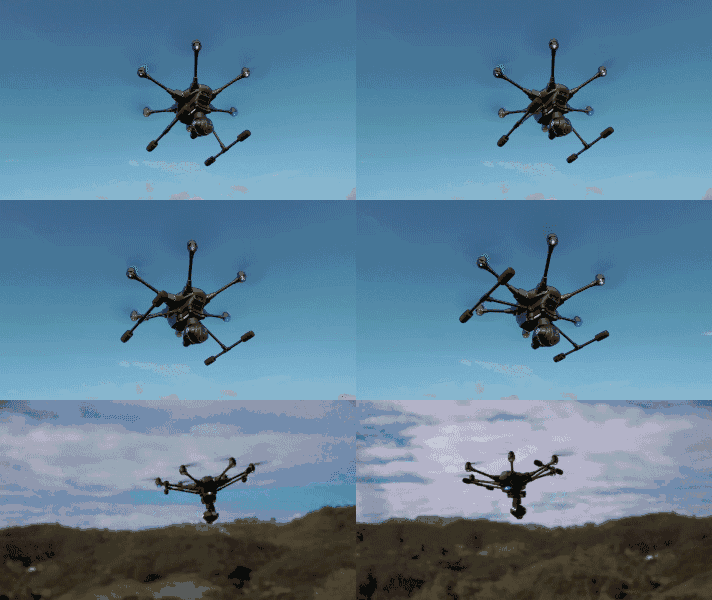
 Drone Safety Flight
What needs to be noted?
Let’s take a look.
↓↓↓

Civilian Drone Classification
Civilian drones refer to drones used for non-military, customs, police, or other flight tasks.
Civilian drones are divided into five categories: micro, light, small, medium, and large.
Micro Drones refer to those with an empty weight of less than 0.25 kilograms, equipped with altitude hold or position hold flight functions, designed to meet performance requirements of a true flight altitude not exceeding 50 meters, a maximum horizontal flight speed not exceeding 40 kilometers per hour, and radio transmission equipment that complies with the technical requirements for low-power short-range radio transmission devices.
Light Drones refer to those with an empty weight not exceeding 4 kilograms, a maximum takeoff weight not exceeding 7 kilograms, a maximum horizontal flight speed not exceeding 100 kilometers per hour, and equipped with airspace management capabilities and reliable monitoring capabilities, but do not include micro drones.
Small Drones refer to remote-controlled or autonomous aircraft with an empty weight not exceeding 15 kilograms or a maximum takeoff weight not exceeding 25 kilograms, but do not include micro or light drones.
Medium Drones refer to remote-controlled or autonomous aircraft with a maximum takeoff weight exceeding 25 kilograms but not exceeding 150 kilograms, and an empty weight exceeding 15 kilograms.
Large Drones refer to remote-controlled or autonomous aircraft with a maximum takeoff weight exceeding 150 kilograms.
All civilian drones, except for micro drones, must be registered in the real-name registration system of the civil aviation management department as required.
It is encouraged to guide individuals or units engaged in small, medium, and large drone flight activities, as well as using micro and light drones for commercial activities, to purchase third-party liability insurance.
Flight Airspace
Except for the airspace controlled for micro drones, all other airspace is designated as suitable airspace for micro drones under normal circumstances. The following airspace is designated as controlled airspace for micro drones, and flight must be approved by the flight control department:
(1) Airspace above a true altitude of 50 meters;
(2) Airspace restricted and the surrounding area within 2000 meters;
(3) Airspace danger zone and the surrounding area within 1000 meters;
(4) Above the boundary of airports or temporary takeoff and landing points and the surrounding area within 3000 meters;
(5) Above the border line or actual control line within 3000 meters on our side;
(6) Above military restricted zones and the surrounding area within 500 meters, military management areas, nuclear power plants, municipal and county party and government agencies, regulatory sites, and the surrounding area within 200 meters;
(7) Above radio astronomy observatories and the surrounding area within 3000 meters, satellite ground stations (including measurement and control, measurement, reception, navigation stations) that require special electromagnetic environment protection and the surrounding area within 1000 meters, meteorological radar stations and the surrounding area within 500 meters;
(8) Above important research, production, testing, and storage facility protection zones and the surrounding area within 500 meters, nuclear facility control zones with level I and II physical protection and the surrounding area within 100 meters, large enterprises producing or storing flammable and explosive hazardous materials and large warehouses, bases for storing important combustible materials, and the surrounding area within 100 meters, power plants, substations, gas stations, and large stations, docks, ports and the surrounding area within 50 meters, high-speed railways and the surrounding area within 100 meters on both sides, ordinary railways, provincial roads, national roads and the surrounding area within 50 meters on both sides;
(9) Military aviation ultra-low altitude flight airspace.
Except for the controlled airspace for light drones, all other airspace is designated as suitable airspace for light drones under normal circumstances. The following airspace is designated as controlled airspace for light drones, and flight must be approved by the flight control department:
(1) Airspace above a true altitude of 120 meters;
(2) Airspace restricted and the surrounding area within 5000 meters;
(3) Airspace danger zone and the surrounding area within 2000 meters;
(4) Above the net protection zone of military airports and the horizontal projection range of obstacle restriction surfaces of civil airports;
(5) Above temporary takeoff and landing points for manned aircraft and the surrounding area within 3000 meters;
(6) Above the border line or actual control line within 5000 meters on our side;
(7) Above military restricted zones and the surrounding area within 2000 meters, military management areas, nuclear power plants, municipal and county party and government agencies, regulatory sites, and the surrounding area within 500 meters;
(8) Above radio astronomy observatories and the surrounding area within 5000 meters, satellite ground stations (including measurement and control, measurement, reception, navigation stations) that require special electromagnetic environment protection and the surrounding area within 2000 meters, meteorological radar stations and the surrounding area within 1000 meters;
(9) Above important research, production, testing, and storage facility protection zones and the surrounding area within 1000 meters, nuclear facility control zones with level I and II physical protection and the surrounding area within 200 meters, large enterprises producing or storing flammable and explosive hazardous materials and large warehouses, bases for storing important combustible materials, and the surrounding area within 150 meters, power plants, substations, gas stations, and medium to large stations, docks, ports, and the surrounding area within 100 meters, high-speed railways and the surrounding area within 200 meters on both sides, ordinary railways and the surrounding area within 100 meters on both sides, highways and the surrounding area within 50 meters on both sides;
(10) Military aviation low altitude and ultra-low altitude flight airspace.
Plant protection drones are suitable for flying within the light drone suitable airspace, with a true altitude not exceeding 30 meters, and over agricultural, forestry, and pastoral areas.
The airspace for drones is designated according to national laws and regulations, and the Hainan Provincial People’s Government regularly announces relevant information about the designation of civilian drone airspace to the public. Civilian drone pilots can query airspace-related information on the Hainan Drone Comprehensive Supervision Test Platform.
Drone Flight Declaration
Micro drones, light drones, and plant protection drones flying in controlled airspace, as well as small, medium, and large drones, must declare their flight plans.
Units or individuals required to declare flight plans must submit a flight plan application through the Hainan Drone Comprehensive Supervision Test Platform 15 hours before the flight is conducted, and may implement it only after approval. The supervision test platform must provide feedback on the approval results by 21:00 the day before the flight.
The contents of the civilian drone flight plan usually include:
(1) The unit or individual organizing the flight activity and their contact information;
(2) Nature of the flight task;
(3) Type and number of civilian drones;
(4) Takeoff, landing, and backup airport (site);
(5) Estimated flight start and end times;
(6) Flight airspace, flight route, altitude, speed, and scope, methods of entering and exiting the airspace;
(7) Other special support requirements.
For more related information, click to view.
↓↓
Hainan Provincial Department of Transportation issued
《Hainan Province Civilian Drone Management Measures (Interim)》

Good news! The Central Civilization Committee has awarded! Jiyang District has made the list with the highest award of 2 million yuan! Sanya has introduced measures to reward and accelerate social investment. Today is the minor snow festival. Time is shallow, may your years be peaceful and warm.
END
Editor-in-chief丨Sun Linghui
Review丨Fu Cong
Editor丨Huang Manli
Design丨Guan Wanxing

If you like this article, click “Like“ to encourage the editor!