Follow for updates on hardcore articles.
✎ Combat Report Highlights
Continuing from the previous article ‘Eight Applications of Drones in Combat – Part 1’, here are the remaining six types of drones, mainly used in two mission areas: first, low-cost face-to-face combat, involving land (or anti-ship) operations, decoy maneuvers, and electronic jamming drones; second, air superiority operations, involving air combat, signal relay, and aerial refueling drones. This article will focus on face-to-face combat scenarios.
Low-cost face-to-face combat involves land (or anti-ship) operations, decoy maneuvers, and electronic jamming drones. In this scenario, the target being attacked moves at a speed far lower than the drone’s flight speed, making it difficult for the target to escape once it is located. The combat process can be summarized as ‘Reconnaissance – Direct Strike/Guided Strike/Decoy Maneuver – Effect Assessment.’
Land (Anti-Ship) Operations
The primary objective of land (anti-ship) operations is to destroy/injure targets, with drone operations summarized into three types: integrated reconnaissance and strike, guided strike, and suicide attack. The situation of drones attacking ships is special and will be discussed separately later.
1. Integrated Reconnaissance and Strike
During the Nagorno-Karabakh conflict, Turkey’s TB-2 drones gained significant attention. Azerbaijan used TB-2 integrated reconnaissance and strike drones to destroy many Armenian ground combat units, including the S-300 air defense system.
The article ‘Knowledge of Weapons Series | Explanation of Typical Integrated Reconnaissance and Strike’ detailed the process in which Azerbaijan’s TB-2 drones, under the electromagnetic interference cover of the Kral electronic warfare system, launched two MAM-L air-to-ground missiles to strike Armenia’s SA-15 ‘Gauntlet’ air defense system.
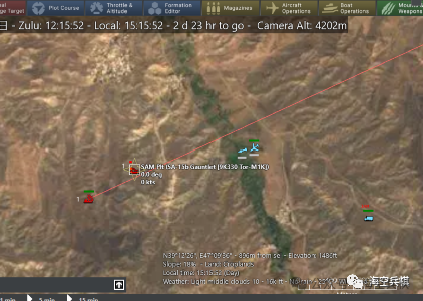
Moment of missile launch from TB-2 drone in CMO simulation
2. Guided Strike
This is the most commonly used tactic in the Russia-Ukraine conflict. Similar to battlefield surveillance, but the mission objective is primarily to destroy enemy units, so drones must not only monitor dynamically but also relay enemy location information. After other platforms strike the target, drones are also responsible for relaying the strike effect footage, facilitating command assessment for potential follow-up attacks. The article ‘CMO Simulation: Tactical Actions of Guided Strikes on Tank Groups by Drones’ discusses the guided strike process.
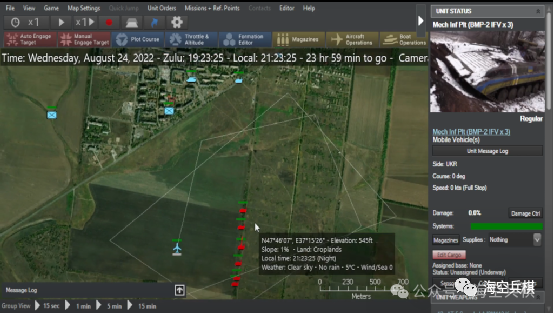
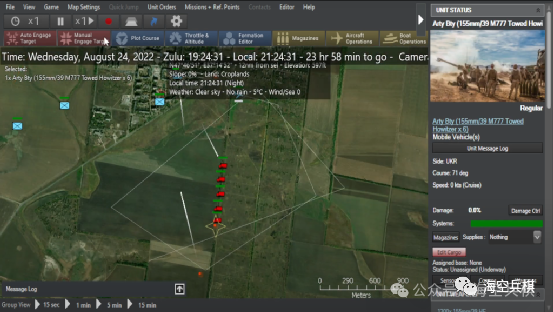
Similar applications can also be referenced in CMO simulations: ‘Drone-Guided Ground Attack Operations on Submarines’
3. Suicide Attack
In the Russia-Ukraine conflict, there are numerous cases of civilian quadcopters being modified into suicide drones to attack enemy armored vehicles. Civilian drone tactics: Using two civilian quadcopters for missions, one is for searching and monitoring targets, while the other executes bombing or suicide attacks. Due to the drones’ low cost and high consumption, according to the CNAS report ‘Evolution Not Revolution: Drone Warfare in Russia’s 2022 Invasion of Ukraine’, Ukraine loses about 10,000 DJI quadcopters each month, with each drone averaging 3 flight missions.
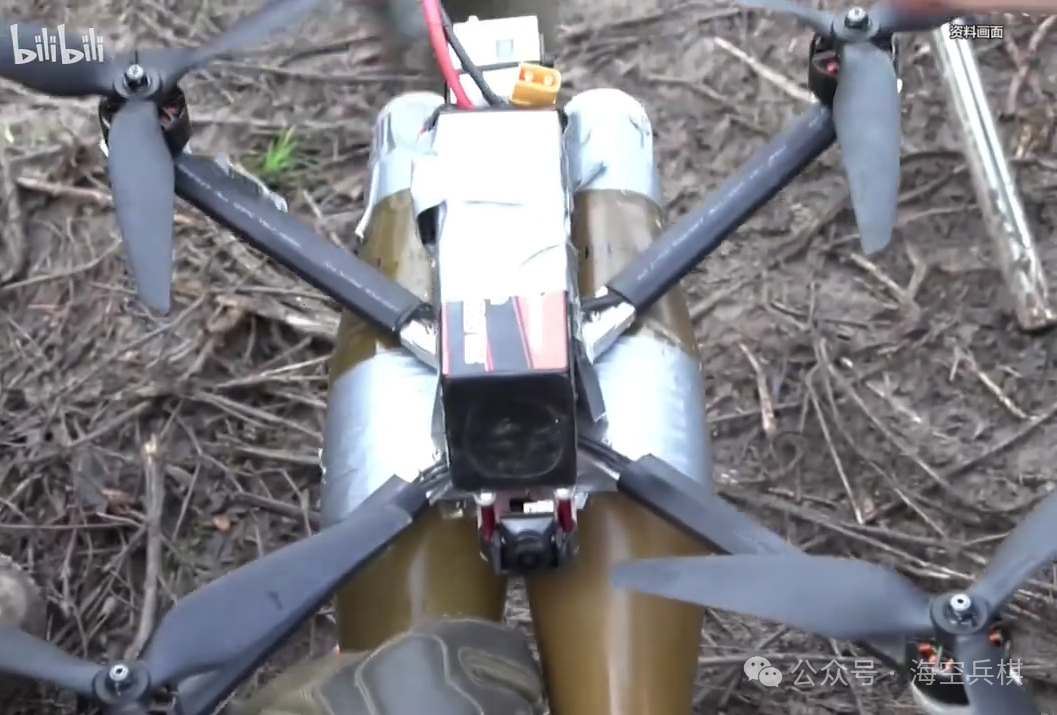
Quadcopter modified with suspected RPG-7 ammunition for suicide attacks
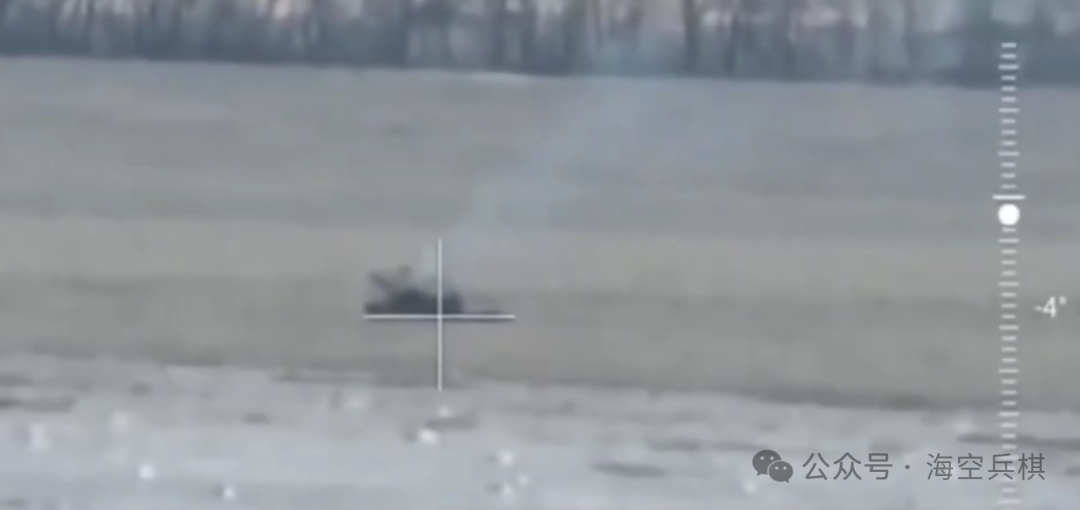
In the kill chain, the drone’s execution of actual attacks against ground/anti-ship targets is just one part of the process (there is also the subsequent video feedback for assessment), but the most important step is how to detect and locate enemy armored vehicles and relay that information to the command center.
Both sides’ countermeasures against commercial drones: one is electronic jamming against commercial drones, which proves effective, but it can easily cause self-jamming since both sides are using the same model of commercial drones, and managing the electromagnetic spectrum on the battlefield is difficult, as jamming can affect other friendly targets in the vicinity. Another method is to locate the drone control signals, such as the DJI AeroScope system and WintalkerX used by both Russia and Ukraine, which can track drones and operators from 20 miles away, directly locking onto the personnel operating the drone. Attacking the operators is akin to cutting off the source of the problem.
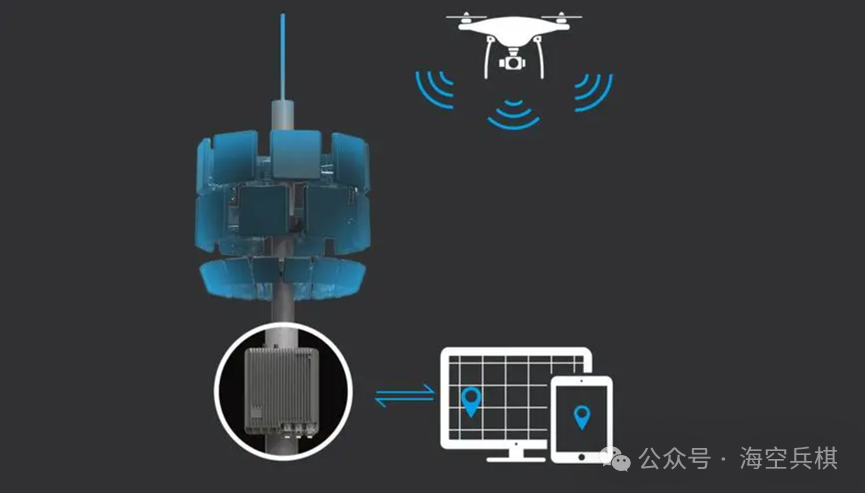
DJI AeroScope System
-
Drone Attacks on Ships
Attacking ships is significantly more challenging than attacking land targets due to the strong air defense and missile defense capabilities of ships. The US military has used SM-2 anti-aircraft missiles to intercept drones from Houthi forces.
Given that the current mainstream drones penetrate at a speed slower than missiles, and the amount of suicide ammunition they carry is limited, a small number of drones find it difficult to pose a significant threat against the ship’s air defense firepower, armor, and damage control measures. Therefore, drones generally need to cooperate with anti-ship missiles for penetration, with the drones’ role being more to jam the ship’s radar and cover the missile’s penetration (for example, refer to CMO simulations: the three conditions that must be met to sink the ‘Moskva’ ship). We previously published how to use CMO LUA to achieve automatic tracking of ships by drones, and interested friends can explore drone anti-ship strategies based on this.
It is worth mentioning that recently, Ukraine has used unmanned boats carrying a large amount of ammunition to attack Russian frigates, solving the problems of penetrating enemy ship early warning networks and carrying sufficient ammunition, providing a new idea for unmanned anti-ship operations.
Decoy and Deception
Next, let’s talk about using drones as decoys for tactical deception. This method is not uncommon; for example, in the classic Israeli Bekaa Valley battle, the 1991 Gulf War, and the recent 2020 Nagorno-Karabakh conflict, decoy drones were used in conjunction with long-range precision-guided weapons to execute SEAD missions. The principle is based on the difficulty of identifying battlefield targets, where air defense commanders, under the tense and high-pressure battlefield environment, adhere to the principle of ‘better to mistakenly kill than to miss’, making them vulnerable to deception and exposing their positions.
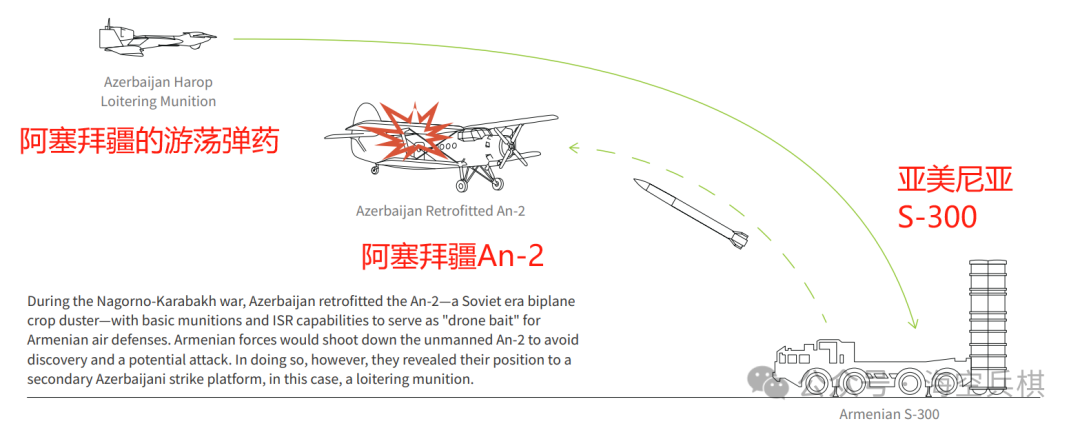
During the Nagorno-Karabakh conflict, Azerbaijan modified an outdated An-2 aircraft (equipped with basic ISR devices and a small amount of suicide attack ammunition) as a decoy drone to deceive Armenia’s S-300 into activating.
Earlier, we reviewed and discussed Azerbaijan’s snake-hunting tactics in Command simulations, with detailed references in the article ‘Knowledge of Weapons Series | Explanation of Typical Integrated Reconnaissance and Strike [Drones] Operational Methods’.
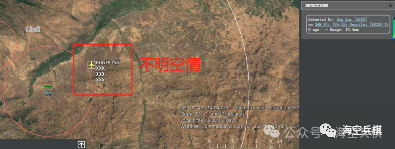
Old drones lure enemy radars to activate
Integrated reconnaissance or suicide drones attacking exposed radars
Electronic Jamming
Generally, the electronic jamming pods on drones have low power, suitable for close-range jamming tasks. Reports indicate that the US Marine Corps has equipped the RQ-7B drone with the ‘Tiger’ II electronic warfare pod, capable of providing wideband electromagnetic suppression capabilities. The US Air Force plans to deploy a ‘penetrating electronic attack’ (PEA) platform within the 2030-2035 timeframe to perform high-risk jamming tasks within the defense zone, considering deploying jamming pods to unmanned platforms. Theoretically, close-range jamming by drones has an additional advantage: the jamming energy can enter the radar receiver not only from the main beam of the radar wave but also from the side lobes, thereby expanding the jamming coverage.
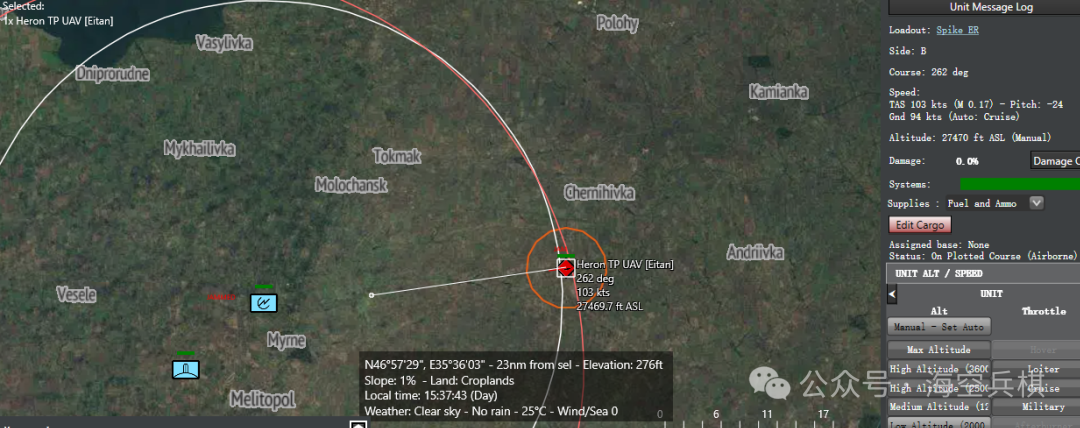
However, based on our verification in CMO simulations, using drones for close-range jamming, high-RCS drones are easily shot down once they enter the enemy’s air defense firepower zone. Moreover, in actual combat, it is very challenging to assess the jamming effects, and there are currently few reports online regarding the jamming effectiveness of drones.
In conclusion, whether it is land, anti-ship, decoy, jamming, or other combat tasks involving drones, the effectiveness relies on having a robust reconnaissance network and communication coordination network to accurately and quickly relay enemy targets back to the drone control platform. Only by establishing such a land/anti-ship battlefield ecosystem can unmanned operations be precise. In the future, with AI control, we may also see the emergence of a ‘swarm’ effect, achieving dimensionality reduction strikes.
Materials referenced in this article have been shared with the military simulation community, and relevant simulation experience conclusions have been incorporated into the CMO AI Assistant (offline version). For inquiries about deployment, please feel free to consult.
 Screenshot of CMO AI Assistant
Submission Email: [email protected] Consulting QQ: 3323766959
Reply with keywords in the public account backend for precise article delivery


Content published on this public account platform (including text, images, videos, and other materials) is sourced from the internet, and the content does not represent the views of this platform. If any rights are infringed, please notify us in time, and we will delete the information within 24 hours after verification, without assuming any legal responsibility.