Metal core multilayer printed circuit boards, as the name suggests, are multilayer boards with an embedded0.1mm~1.5mm thick metal core (such as Cu,Al,Cu-Invar-Cu etc.), widely used inLED lighting, high-performance computing, automotive electronics, and other fields.
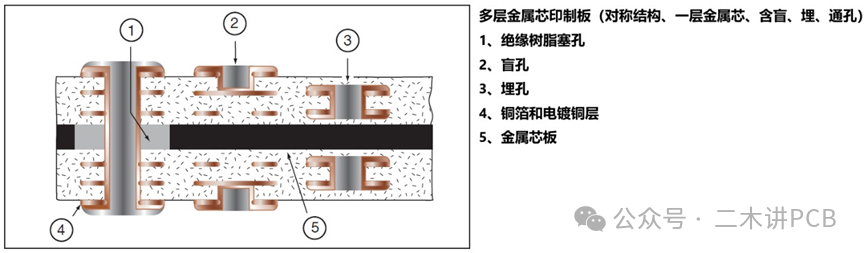
Metal core multilayer boards
have the following specific functions:
l High Power Heat Dissipation
The core components of ordinary printed circuit boards are copper-clad laminates and prepregs, whose thermal conductivity mainly depends on the resin, generally less than1W/(m·K), which cannot meet the heat dissipation requirements of high-power components. By embedding high thermal conductivity metals in the printed circuit board, heat generated by the internal board and electronic components can be quickly conducted away, lowering the board temperature and ensuring stable operation of electronic devices. Common metal core materials are copper (the thermal conductivity of oxygen-free copper is401 W/(m·K)) and aluminum (the thermal conductivity of high-purity aluminum is230W/(m·K)).Al has a density of 2.7 g/cm³ which is much lower than that of copper (8.9 g/cm³), thusAl has significant application advantages in lightweight electronic devices.
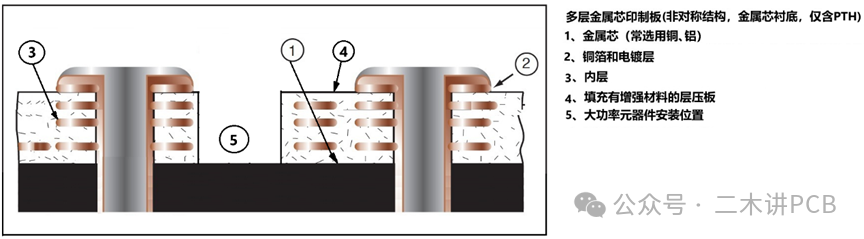
Metal cores in asymmetrical structure multilayer boards
l ControlCTE
Multilayer printed circuit boards may have asymmetric structures containing various resin systems, and there can be some degree of mismatch inCTE which can lead to warping after high-temperature soldering, causing quality issues such as cold solder joints, cracked solder points, and pad delamination. Embedding metal cores can reduce stress and deformation caused by differences in thermal expansion coefficients of materials at different temperatures, enhancing the reliability of the printed circuit board. Common metal core materials includeCu (CTE is16.5ppm/℃) andCu-invar-Cu (CTE is4~8 ppm/℃, which is related to the thickness ratio ofCu and invar).Due to theCTE ofCu-invar-Cu being adjustable to be close to that of the chip, it has unique advantages in the application field of packaging substrates.
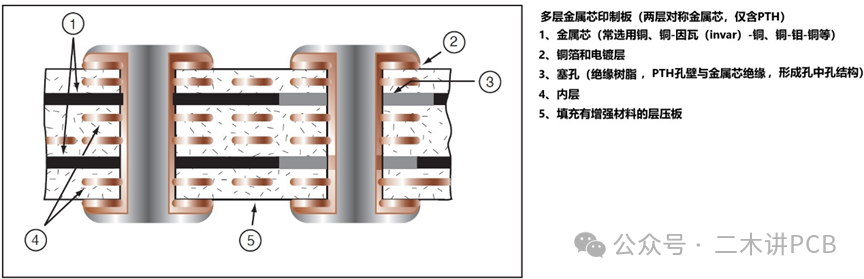
Asymmetrical multilayer boards embedded with a layer of metal core
Symmetrical multilayer boards embedded with two layers of metal core
l Increase Mechanical Strength
The elastic modulus characterizes a material’s resistance to elastic deformation and is directly related to atomic structure and chemical bond types. Metal materials generally have a higher elastic modulus, while polymer materials have a relatively lower elastic modulus (the elastic modulus of pure copper is about110 – 128 GPa, and the elastic modulus of copper-clad laminates is less than40GPa).Therefore, embedding metal core plates inside or on the surface of multilayer boards can improve the overall elastic modulus of the board, reducing the reliability risks associated with deformation or fracture, especially suitable for automotive electronics, aerospace, and other devices with high mechanical stability requirements.
l Enhance Electrical Performance
Metal cores can serve as grounding or power layers, providing low-impedance current paths, reducing power noise and signal interference, helping to improve the integrity and stability of signal transmission, and lowering losses and delays during signal transmission. Metal cores can also act as electromagnetic shielding layers, effectively blocking and absorbing electromagnetic interference generated by internal and external circuits of the printed circuit board, improving the electromagnetic compatibility of electronic devices, suitable for high-speed and high-frequency signal transmission printed circuit boards.