 Source: Drone Technology CircleAuthor: Drone
A drone swarm refers to a collection of multiple drones that are commanded uniformly to execute a specific task. Drone swarms can achieve interconnectivity through network technology, forming a centralized and unified whole, thereby enabling collaborative operations or completing other specific tasks. The control technologies for drone swarms include communication technology, path planning technology, collision avoidance technology, distributed control technology, centralized control structures, hybrid control structures, task and resource allocation, and real-time data processing. These technologies are flexibly adjusted and optimized according to specific scenarios and task requirements to ensure that the drone swarm can operate collaboratively in a stable and efficient manner.
The technology of drone swarm control is a complex technology involving multiple fields, aiming to achieve coordination, formation, path planning, collision avoidance, and other tasks among multiple drones. Below is a detailed explanation of drone swarm control technology:
1. Control Structures

Centralized Control Structure:This structure has a main control unit responsible for global information and all robots’ information, performing centralized task and resource allocation. Each robot only needs to handle data input and output, with data storage and control processing executed by the main control unit. The structure is relatively simple, and system management is convenient. However, it faces issues such as increased computational complexity, slower response speed, and reduced efficiency of robots, and if the main control unit fails, the entire system may become paralyzed.
Distributed Control Structure: In this structure, there is no control and controlled relationship among the robots, they are equal, exchange information with each other, autonomously process real-time data, and plan a path based on the data. This structure allows for an increase in the number of robots, offering high flexibility, and is suitable for working in dynamic environments. However, it lacks global clock synchronization, making coordination and cooperation among robots difficult, and limited information acquisition hinders the realization of a global optimal solution.
Hybrid Structure: This structure combines the advantages of centralized and distributed control, incorporating a centralized management module for global coordination while also adopting the communication methods of individual robots within the distributed structure.
2. Key Technologies
Communication Technology:Real-time data transmission and sharing between drones are achieved to ensure the accuracy and stability of swarm control.
Path Planning Technology:By modeling and analyzing the task area, optimal path planning schemes are determined, allowing drones to efficiently complete tasks. Common path planning algorithms include A* algorithm, Dijkstra’s algorithm, and genetic algorithms.
Collision Avoidance Technology:Using communication and sensor technology between drones, awareness of the surrounding environment and other drones is achieved to avoid collision events. Common collision avoidance algorithms include nearest neighbor algorithm, virtual potential field algorithm, and obstacle avoidance path planning algorithms.
Distributed Control Technology:Tasks are decomposed into multiple sub-tasks, which are assigned to different drones for execution, thus achieving collaborative work on the tasks. Common distributed control algorithms include distributed coordination algorithms, distributed optimization algorithms, and distributed consensus algorithms.
3. Swarm Formation Control
Formation flying is the basis and fundamental form of task execution for a drone swarm. Formation control refers to the technology that controls the drones in the swarm to form and maintain a certain geometric configuration while executing tasks, adapting to platform performance, battlefield environment, tactical tasks, and other requirements.
Distributed formation control can be achieved by designing individual behavior rules for the drones and local control schemes. Coordination among drones relies on shared information such as their positions and state input values.
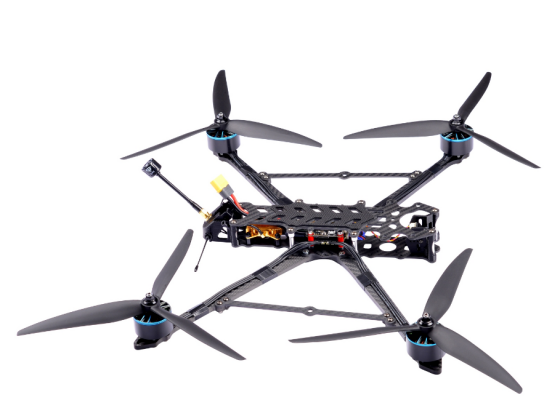
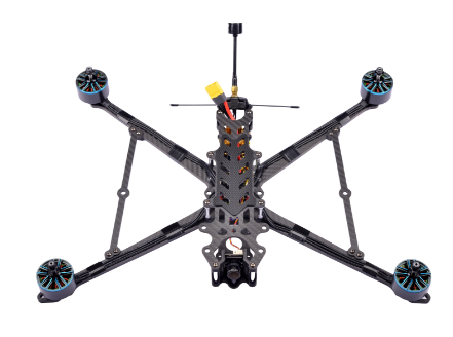
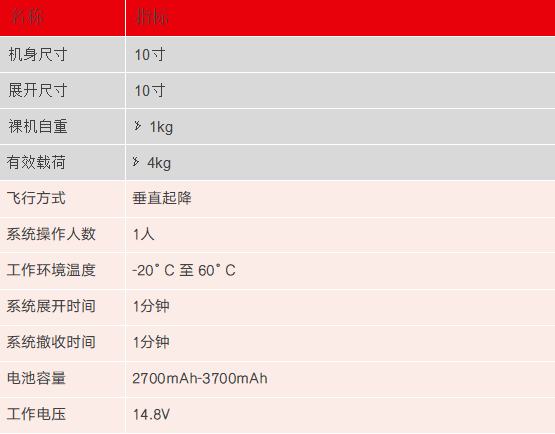
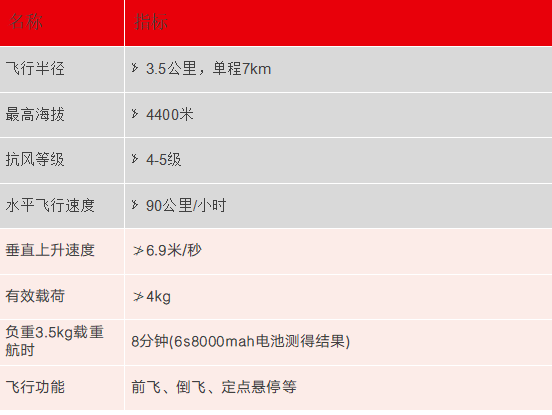
Racing drone swarms are suitable for high-speed saturation attacks, where a single remote controller can uniformly control 6-8 drones or individually control any one, performing coordinated strikes on single or multiple fixed or moving targets, with a payload of 4kg and a flight distance of 7km.
Recommended Parameters:
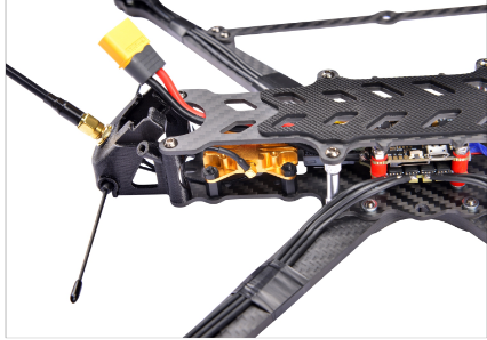
As an application of drone swarm control technology, racing drone swarm technology possesses high flexibility and adaptability, capable of completing various tasks in complex and dynamic environments. However, this technology also faces technical challenges such as communication delays, data synchronization, dynamic obstacle avoidance, and swarm stability. Therefore, advanced control algorithms and technologies need to be further researched and developed to enhance the performance and stability of racing drone swarms.
In summary, drone swarm control technology is a complex and challenging field that involves multiple disciplines and technologies. With the continuous development and advancement of technology, drone swarm control technology will play an increasingly important role in military, civilian, and other fields.

Follow the public account for more information
Membership application: Please reply “Individual Member” or “Unit Member” in the public account
Welcome to follow the media matrix of the China Command and Control Society

CICC Official Website

CICC Official WeChat Account

Journal of Command and Control Official Website

International Unmanned Systems Conference Official Website

China Command and Control Conference Official Website

National Wargaming Competition

National Aerial Intelligent Game Competition

Sohu Account

Yidian Account