The Role of Distributed Sensors is Becoming Increasingly Important
As modern systems increasingly rely on data, dynamic AI and ML models, the demand for real-time processing at the network edge is becoming more urgent. Various network edge components and devices, including routers, gateways, and scanners, require stronger interconnectivity and performance. This is particularly crucial for various sensors deployed close to data sources to measure and process data.
Many system developers operate multiple sensors simultaneously, such as combining LiDAR and camera functionalities, which necessitates a sensor fusion approach: integrating data from multiple sensors to produce more complete and reliable information.
As sensors and network edge AI models become increasingly complex, sensor fusion provides a method to enhance perception accuracy and complexity. Whether used individually or in combination, sensors are fundamental components of any distributed operational network. To deploy sensors in these systems, developers need to understand their functionalities, the barriers to deployment, and the role of FPGAs in supporting their operation.
Sensor Functions and Implementation Challenges
Sensors serve multiple functions in interconnected systems. They can be used to measure and monitor physical parameters (such as temperature, motion, and pressure) or to input data from Internet of Things (IoT) devices and other system components. The real-time data provided by these devices aids in implementing quality control measures, inventory management, technological automation, and other core functions.
However, deploying sensors at the network edge is not without challenges. Common barriers to sensor applications include:
- High Costs. Any new technology incurs costs, and a quarter of respondents (25%) consider cost to be the primary challenge in adopting sensors. Given the varying roles of sensors in distributed systems, their total costs can escalate quickly.
- Integration and Interoperability Issues. Whether in automotive design or industrial production lines, adding new components to existing infrastructure can involve integration challenges. In fact, over a third (37.5%) of respondents believe that integration difficulties are a significant barrier. New sensors may not directly interoperate with existing components, and the extent of upgrades required varies by system.
- Power and Space Limitations. Like other devices, sensors need to be installed within the available space of existing infrastructure and powered by the system’s available energy. In situations with limited space and energy (such as in vehicle manufacturing), this can be quite challenging, necessitating small sizes and low power consumption for sensors and auxiliary devices.
- Processing Limitations. While network edge processing is gaining popularity, computational power remains a challenge. Can these sensors capture and analyze the data required by the system without consuming excessive energy or hardware resources? Does the system have sufficient I/O for processing without causing high latency?
Overcoming these challenges and integrating qualified, reliable sensors requires developers to adopt a prudent approach supported by reliable hardware.
How FPGAs Address These Challenges
This is where FPGAs shine. These flexible semiconductors can act as a “bridge” between sensors and other system components (such as actuators and central processors), handling underlying tasks specific to sensors, alleviating the burden on edge components, and supporting streamlined system operations.
Key FPGA functionalities that support sensor integration and sensor fusion include:
- Parallel Processing. FPGAs do not process data sequentially but can perform processing tasks simultaneously. This is crucial for sensor fusion applications, where multiple sensors generate and aggregate data concurrently. Parallel processing can significantly enhance task speed and reduce latency, helping teams overcome common performance and processing limitations.
- Low Power Consumption. Parallel processing not only simplifies computational capabilities but also allows data to be processed close to the data source, helping to reduce overall system power consumption.
- Customization and Reprogrammability. FPGAs offer a wealth of I/O options for customized designs, helping teams ensure successful sensor integration and updates when necessary. This helps overcome interoperability challenges at the front end and keeps hardware up to date through field programmability.
Lattice provides semiconductor devices that support sensor fusion applications, including a range of FPGAs based on the Lattice Avant™, Nexus™ 2, and Nexus™ FPGA platforms. Lattice Avant-based FPGAs are well-suited for efficient network edge processing use cases, while Lattice Nexus 2 and Nexus-based FPGAs provide advanced processing capabilities for visual processing of cameras and similar sensors.
Sensor Functions and Implementation Challenges
The Avant-E FPGA is a key component of the Lattice Sensor Hub solution, specifically designed to support preprocessing and interface interconnects in sensor fusion applications. By combining cameras, rotating LiDAR, solid-state LiDAR, and radar sensors, developers can collect a range of critical environmental data and combine them into a unified output. The Avant-E FPGA and the input/output and parallel processing capabilities of Lattice development boards support the fusion of this data, combining various signals to provide a single real-time output stream.
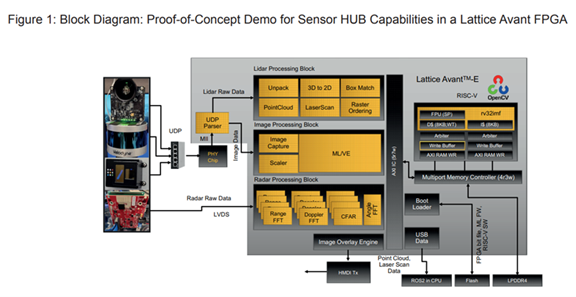
Sensor fusion can be combined with AI/ML personnel detection models for applications in autonomous vehicles and robotics. These applications require a comprehensive real-time understanding of the surrounding environment, including pedestrians, factory workers, other vehicles, machines, etc., to operate autonomously. The system must understand the distance of each obstacle from the respective sensors, depth of field, and their positions in the coordinate plane to respond accordingly.
The Avant-E FPGA acts as a “bridge” between various input sensors and the central processor, synchronously receiving and preprocessing raw radar, LiDAR, and camera data, and only outputting the scaled data required for the personnel detection model to identify potential obstacles. This reduces the burden on the CPU, the power required to process this data, and the potential latency between data ingestion and system response, all of which can be easily integrated into existing automotive infrastructure through a compact component.
When latency processing becomes critical for avoiding pedestrians, speed and low latency are essential. With the Lattice Sensor Hub solution supported by the Avant-E FPGA, manufacturers can confidently ensure that their systems operate with high reliability and performance stability.
Sensor Functions and Implementation Challenges
Although the applications of sensor fusion have far exceeded the automotive sector (also covering smart industrial robots, automated monitoring and security systems, etc.), they always require high-performance, highly interoperable, and efficient hardware support.
For more information on the Lattice Sensor Hub solution and to explore the potential of FPGA-based sensor fusion applications, feel free to contact our team.
Share + Like + Follow, let’s arrange it.
This article is authorized for reprint from: Latticesemi. If there is any infringement, please contact for removal.