Author:Peng Zhao (Founder of Zhici Fang and Co-founder of Yunhe Capital)IoT Think Tank Original
This is my 387th column article.
In the era of rapid development of AI technology, when will “edge intelligence” truly mature and be implemented? This is a question that many developers, enterprises, and industry observers have repeatedly pondered.
In the past, the main battlefield of AI was always in the cloud, where large models, massive computing power, and data centers became almost the only outlet for intelligent applications. However, with the increasing emphasis on data privacy, real-time response, and cost-effectiveness, Edge AI has become a new focus. But how should we observe the maturity of Edge AI? What standards should the industry use to evaluate the true “usability” of edge AI?
At this critical juncture, Google recently released EmbeddingGemma, a lightweight universal embedding model with 308 million parameters, supporting multiple languages and flexible output trimming. It not only possesses the core capabilities of cloud models but can also run efficiently on edge devices, fully compatible with mainstream AI toolchains, significantly lowering the threshold for large-scale development and application.
The release of EmbeddingGemma may mark a watershed moment, indicating that the lightweight AI technology stack is entering an industrial maturity stage, and the edge AI ecosystem is accelerating its transition from “laboratory validation” to “industrial-scale implementation.”
This milestone progress not only brings new opportunities for enterprises and developers but also provides a sample for us to rethink the maturity of edge AI and the “co-innovation of edge and cloud”. The emergence of EmbeddingGemma may be a turning point for the large-scale popularization of edge AI, making the synergy of perception and cognition a reality.
Dual Circulation of Edge and Cloud: The Edge AI Landscape Driven by Data
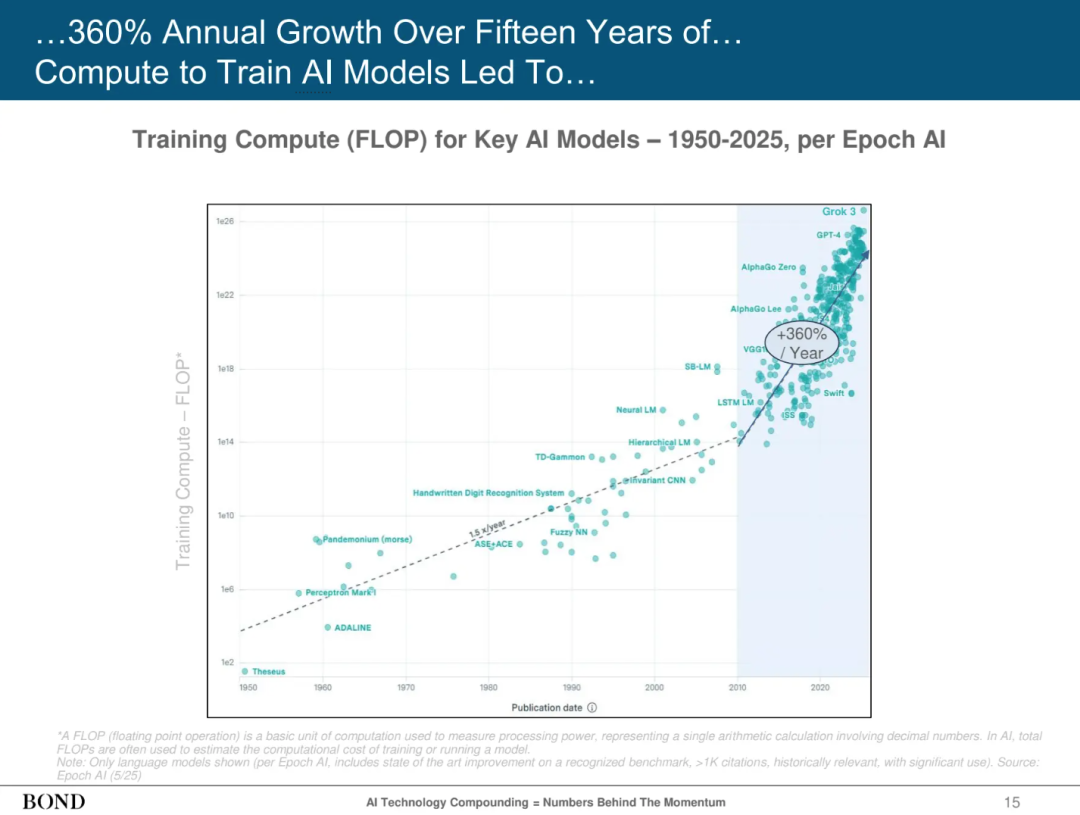
In recent years, the advancement of AI technology has been firmly dominated by the logic of “computing power is king.” Each generation of breakthroughs in AI models has been closely linked to the explosive growth of parameter scales and the expansion of cloud supercomputing resources.
According to estimates by Bond Capital (as shown in the figure above), over the past 15 years, the computational requirements for AI model training have increased by approximately 360% annually, driving the current era of large models. However, this money-burning growth trend is clearly unsustainable.
With the deepening of industrial digitization and the popularization of intelligent terminals, the paradigm of Edge AI is quietly shifting, with the technical focus moving from purely pursuing the limits of computing power to a track that emphasizes data-driven approaches, model lightweighting, and ecological openness.
The release of EmbeddingGemma is a reflection of this transformation. Unlike traditional large models that rely on high computing power, EmbeddingGemma, with its lightweight 308 million parameters, is compatible with mainstream AI toolchains like TensorFlow and PyTorch, achieving efficient operation on diverse edge devices.
This not only provides a foundation for developers to deploy AI applications on a large scale but also signifies that the lightweight AI technology stack has entered an industrial maturity stage, and the edge AI ecosystem has the foundational conditions to “create AI like software.”
In the future, the core competitiveness of Edge AI will no longer be the accumulation of model parameters but the ability to acquire, govern, and utilize high-quality data.
Driven by the data-driven philosophy, the industry is gradually recognizing: no matter how large the model, if the data is not clean, the intelligence is not trustworthy; even if the model is small, as long as the data is of high quality, the value can be sustainable.
The flexibility of EmbeddingGemma is not only reflected in its model structure and deployment methods but also in its adaptability to data flow and governance systems. “Data-centric” is becoming a common belief in the edge AI ecosystem.
More importantly, the trend of native AI applications at the edge is now irreversible. The industrial implementation of EmbeddingGemma means that AI is accelerating its “downward” movement from the cloud to the terminal, and the past single model of “cloud training, edge inference” is evolving into a pattern of “dual circulation of edge and cloud” collaborative innovation.
In this landscape where both edge and cloud are equally important, data is produced, governed, and fed back at the edge, models are efficiently inferred and continuously evolved at the edge, while the cloud takes on a larger role in model training and data integration. Data-driven approaches, model lightweighting, and ecological openness are collectively building the iron triangle of edge AI.
The Division and Integration of Perception and Cognition: The Synergy of Edge AI and TinyML
Under the combined effects of data-driven approaches, model lightweighting, and open ecosystems, Edge AI has entered a new stage of large-scale application. However, to truly embed intelligence into every corner of production and life, the challenge of “the last mile of AI” must be addressed.
TinyML precisely fills this gap, embedding capabilities such as sensing, monitoring, and event detection into every physical node, achieving “AI everywhere.” Meanwhile, Edge AI brings cloud-level cognitive capabilities to local terminals, enabling devices not only to perceive the world but also to achieve high-level decision-making with semantic understanding, knowledge enhancement, and privacy security locally.
In the future, the development trend of edge intelligence will no longer be about single-point breakthroughs but rather a deep collaboration of “perception (TinyML) + cognition (Edge AI).” This end-to-end intelligent link brings new possibilities to various AIoT scenarios with the lowest energy consumption, highest privacy protection, and stronger local intelligence.
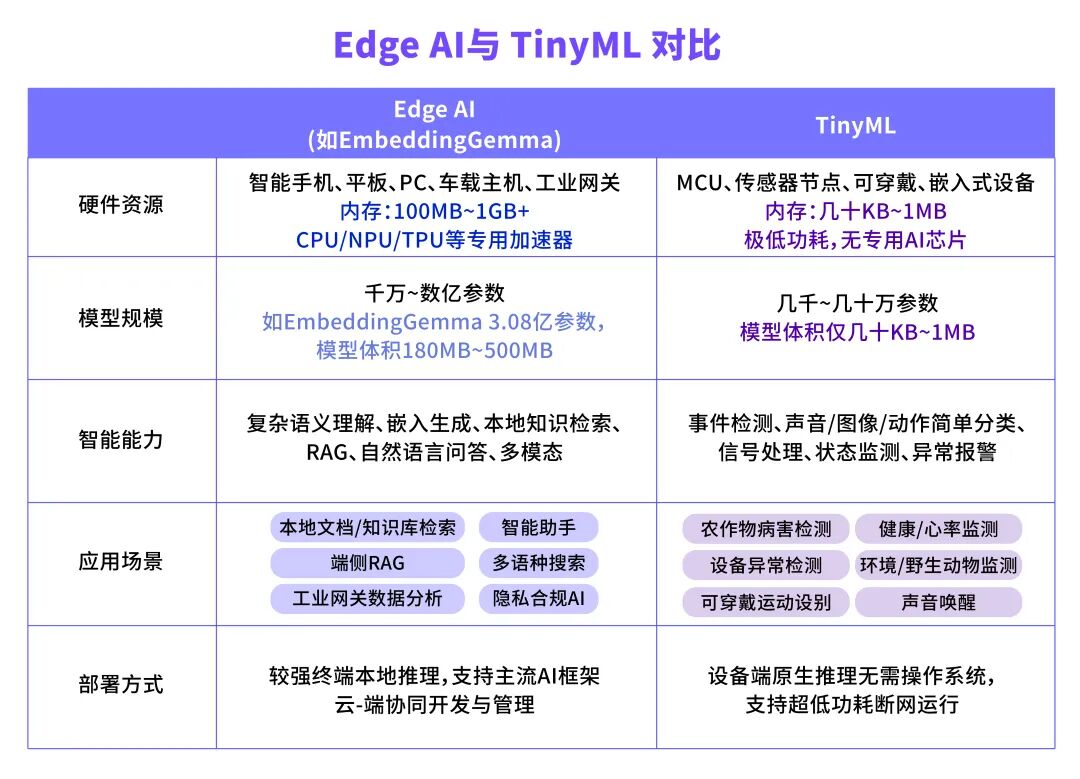
In this context, carefully sorting out the essential differences, scenario differences, and collaborative paths between Edge AI and TinyML becomes key to understanding the upgrade of the edge intelligence industry ecosystem (as shown in the figure above).
In edge intelligence systems, Edge AI and TinyML represent the collaborative division of two technical routes.
Edge AI focuses on complex semantic understanding, knowledge retrieval, and multimodal reasoning. Although the model size has been significantly lightweighted, it still possesses some cognitive capabilities of cloud models.These models typically run on terminal devices with strong computing power and storage, such as smartphones, edge gateways, and in-vehicle hosts, capable of processing multilingual text, achieving local RAG, and high-level semantic search.
In contrast, TinyML pursues extreme lightweighting and low power consumption, often running KB-level models in microcontrollers, sensor nodes, and wearable devices in extremely resource-constrained scenarios. TinyML models are mainly used for real-time event detection, signal processing, and simple classification, achieving intelligence at the “perception layer.”
Edge AI and TinyML also play irreplaceable roles in practical applications.
TinyML’s advantage lies in its ability to penetrate distributed, low-power front-end nodes, achieving large-scale, low-cost intelligent perception. Whether in disease detection in vast farmlands or ecological monitoring in extreme environments, TinyML can provide 24/7 local intelligent analysis.
On the other hand, Edge AI is more suitable for edge terminals that require complex semantic understanding and decision-making, such as local multilingual search, intelligent Q&A, knowledge base retrieval, and personalized assistants. The differences between the two are not only reflected in computing power and model scale but also in the business needs and user experiences they face.
In fact, the combination of Edge AI and TinyML is becoming the key to the maturity of edge intelligence systems.
It is expected that the collaborative development of Edge AI and TinyML will drive edge intelligence into a higher-level era of “perception + cognition.” Perception is responsible for discovering the world, while cognition is responsible for understanding it, and together they drive the deep implementation of AI in industries and society.
From Device Intelligence to Human-Centric Intelligence: The Self-Evolution of Edge AI
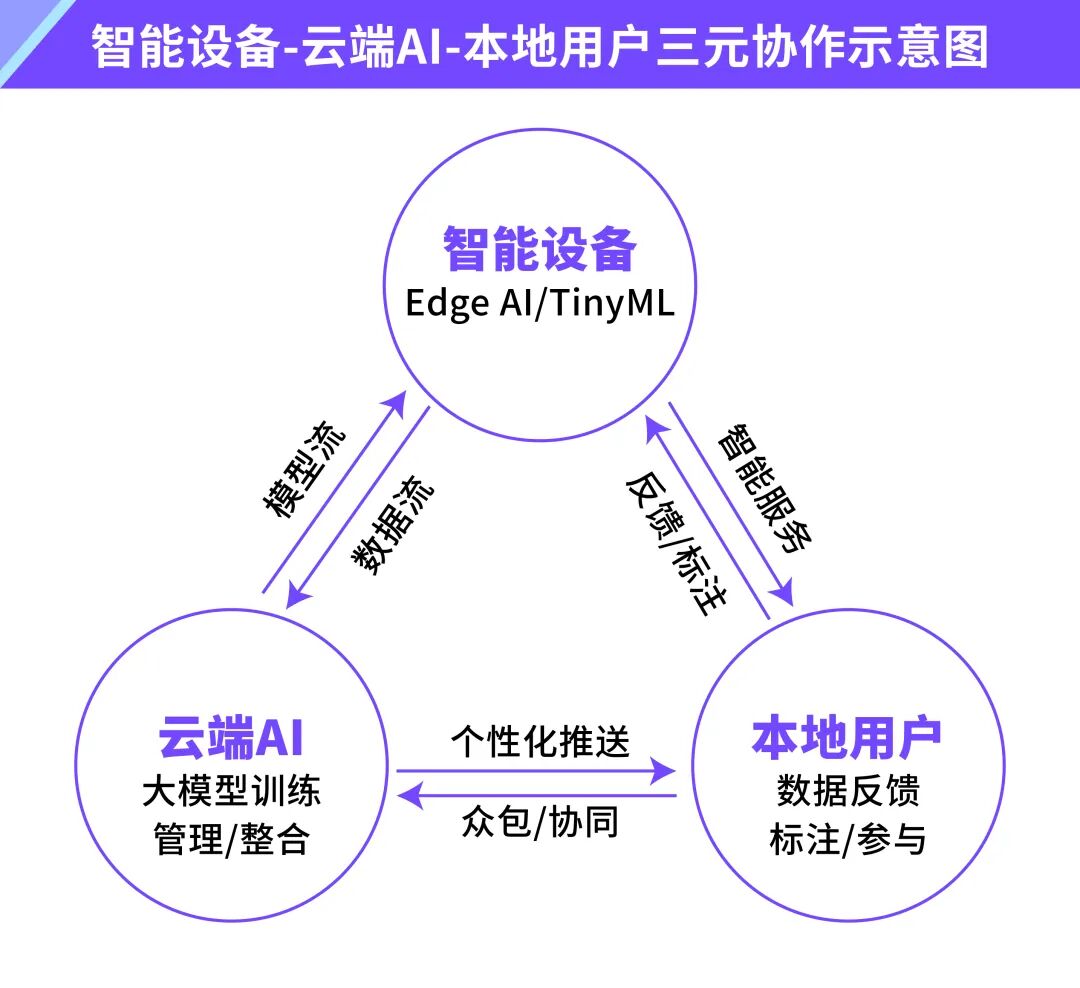
In the wave of technological iteration of edge AI, the classic model of cloud training and edge inference is quietly being broken through. The true future of intelligence is not just about collaboration between devices but also about the continuous symbiosis and evolution of humans, devices, and cloud systems.
With the popularization of models like EmbeddingGemma, AI is achieving stronger reasoning and understanding capabilities at local terminals, but this is just the starting point of evolution.
The new stage of edge intelligence is moving towards a comprehensive approach of “local-cloud-human-centric.”
This means that AI not only undergoes large-scale training in the cloud and inference on local devices but also actively absorbs experiences and knowledge from “humans.” User feedback, community annotations, and corrections from industry experts all become indispensable “nutrients” for AI’s self-evolution.
For example, in agricultural applications, edge devices use TinyML or EmbeddingGemma models to initially identify disease information, and farmers can directly correct results and add annotations on local terminals, allowing devices to automatically adapt to local features in subsequent inferences.
This human-machine co-creation data closed loop allows AI capabilities to continuously approach the real world, achieving a triadic self-evolution of models, data, and humans.
“Humans” are becoming the intrinsic driving force for sustainable innovation in edge AI.For instance, in smart healthcare, wearable devices monitor physiological signals such as heart rate and blood oxygen through TinyML, while patients provide feedback on their physical condition and mark abnormalities on the edge app. This real feedback, after being encrypted and summarized locally or in the cloud, feeds back into the AI model for personalized fine-tuning and continuous optimization.
Future edge devices will not only perform local inference but will also achieve continuous evolution for each user and scenario through small-scale adaptive fine-tuning.
“Device + Cloud + Human-centric” will become the most vibrant innovation engine in the era of edge AI.On this evolutionary path, the boundaries of AI systems are constantly being expanded, with humans and devices jointly leading the self-growth of the intelligent ecosystem, driving edge intelligence towards sustainability and inclusivity.
Final Thoughts
Edge AI is in the midst of an unprecedented wave of innovation. With the implementation of lightweight universal models like EmbeddingGemma and the popularization of TinyML at the extreme front end, the “perception + cognition” closed loop of AI intelligence is gradually penetrating into every corner of society and industry. This not only signifies a further descent of computing power and intelligence but also represents a transformation of the AI paradigm from “cloud-centric” to “edge-inclusive” and “human-centric collaboration.”
The true dividends of edge AI will belong to those industries and organizations that can continuously evolve with high-quality data, efficient models, and open ecosystems.Future intelligent systems will no longer rely solely on cloud supercomputing, nor will they be isolated “black box decisions,” but rather a collaborative entity that can deeply couple with human data, experiences, and feedback, evolving autonomously.
In this wave, the future of AI is no longer a victory of a single technology but a result of the joint evolution of “models, data, ecosystems, people, and society.” The next wave of innovation in edge intelligence is already on the way.
References:
1. Introducing EmbeddingGemma: The Best-in-Class Open Model for On-Device Embeddings, Source: Google2. Cutting AI down to size, Source: Science