In recent years, artificial intelligence (AI) technology has developed rapidly, but the high power consumption and cost associated with high-performance hardware have limited its application on edge devices. TinyML has emerged, bringing the powerful capabilities of machine learning to resource-constrained microcontrollers like the ESP32. This article will take you deep into the tinyml-esp project, allowing you to experience the fun of implementing TinyML on the ESP32 using MicroPython!
What is tinyml-esp?
tinyml-esp is an exciting open-source project that utilizes the ESP32 microcontroller and MicroPython to achieve posture recognition based on standard machine learning algorithms. This means you only need a simple ESP32 development board to build an intelligent system capable of recognizing different actions! Imagine: a smart home system that can recognize gestures to control appliances, or a health monitoring device that can track specific movements—these possibilities become achievable. tinyml-esp simplifies complex machine learning algorithms, allowing you to easily get started without a deep background in machine learning.
Core Functionality: Posture Recognition
The core functionality of tinyml-esp is posture recognition based on data from accelerometers and gyroscopes. It collects time-series data through the MPU6500 sensor and then uses a Random Forest Classifier for training and prediction. Currently, it can recognize three different postures:
- Movement Along the X-Axis: Detects motion of the device along the X-axis.
- Movement Along the Y-Axis: Detects motion of the device along the Y-axis.
- Circular Motion: Detects circular rotation of the device.
Hardware Preparation: Simple and Easy to Use
You will need the following hardware:
- ESP32-devkitC development board (or other ESP32-compatible boards)
- MPU6500 six-axis sensor (accelerometer and gyroscope)
- Breadboard
- Jumper wires
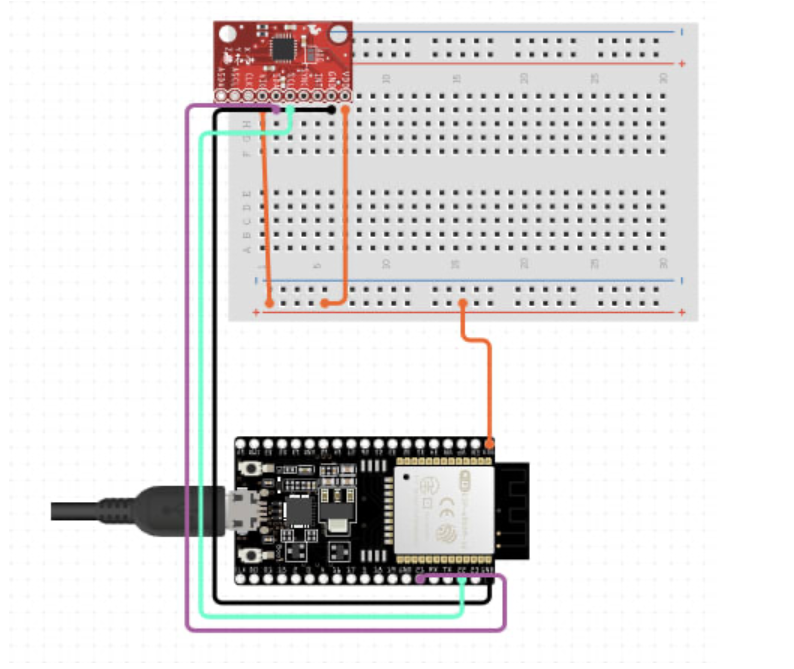
The circuit connection is very simple; just connect the MPU6500’s SCL to pin 22 of the ESP32 and SDA to pin 21. (You can find the specific circuit diagram at the project address.)
Software Preparation: The Charm of MicroPython
tinyml-esp uses MicroPython for programming. MicroPython is a lean implementation of Python 3 designed for microcontrollers, offering the ease and simplicity of Python while maintaining high efficiency, making it ideal for TinyML applications. You just need to download the MicroPython firmware suitable for ESP32 and upload the Python script to the ESP32 using the Pymakr VSCode extension.
Installation and Configuration: Easy Three Steps
-
Check Serial Port: First, you need to ensure that your computer can correctly recognize the serial port of the ESP32. The methods vary slightly depending on the operating system, and detailed instructions are provided in the project documentation to help you quickly find the correct serial port.
-
Flash Firmware: Download the MicroPython firmware for ESP32 and follow the instructions in the project documentation to flash it onto your ESP32 development board.
-
Upload Code: Use the Pymakr VSCode extension to conveniently upload the Python scripts from the project to the ESP32. Pymakr provides a user-friendly interface, making the code upload process simple and quick.
Data Transmission and Storage: Backend Support
tinyml-esp not only performs posture recognition on the ESP32 but also sends the collected raw data and recognition results to a backend server for storage and analysis. This allows you to conveniently process the collected data further, such as building more complex machine learning models or performing data visualization.
Expansion and Applications: Infinite Possibilities
tinyml-esp is just a starting point; you can expand and improve it according to your needs. For example, you can add more types of posture recognition or use different machine learning algorithms. You can also integrate it into various applications, such as smart homes, sports tracking, healthcare, and more.
Conclusion
The tinyml-esp project provides a simple and easy-to-use platform for implementing TinyML on the ESP32. With the simplicity of MicroPython and the powerful capabilities of the Random Forest Classifier, you can quickly build an intelligent system capable of recognizing different postures. Its simple hardware configuration, detailed documentation, and convenient software tools lower the threshold for TinyML development, allowing more developers to participate in this exciting field. Get started and give it a try!
Project Address:https://github.com/tkeyo/tinyml-esp