
To further improve the training system for “chief engineer” type talents, focusing on the characteristics of being “low-key and pragmatic, inclusive, accumulating knowledge and making breakthroughs, and forging weapons for the country,” our school integrates the “chief engineer education culture” into the entire talent training process, comprehensively enhancing international vision, global competence, and international influence. Our school continues to send outstanding graduate students abroad for exchange and study, and the students who received assistance have all reported significant benefits. The WeChat public account of “Northwestern Polytechnical University Graduate Education” will share their wonderful stories of academic visits.
Academic Exploration Journey at the University of Auckland, New Zealand
Self-Introduction
Kang Meilin, a PhD student in Control Science and Engineering at the School of Automation, Northwestern Polytechnical University, under the supervision of Professor Yuan Chaohui. From April 29, 2024, to April 30, 2025, I received funding from the Graduate School to conduct a 12-month study and research at the University of Auckland in New Zealand.
Scientific Research
During my visit to the University of Auckland, I was fortunate to join the Industrial AI Group led by Dr. Yuqian Lu in the Department of Mechanical and Mechatronic Engineering, actively participating in their research projects in intelligent manufacturing and human-robot collaboration. Dr. Yuqian Lu is a well-known scholar in this field, focusing on core technologies such as cognitive sensing, semantic reasoning, intelligent control, and human-robot interaction, dedicated to applying transferable and deployable intelligent systems in industrial scenarios such as manufacturing and construction to enhance workplace efficiency, flexibility, and sustainability.
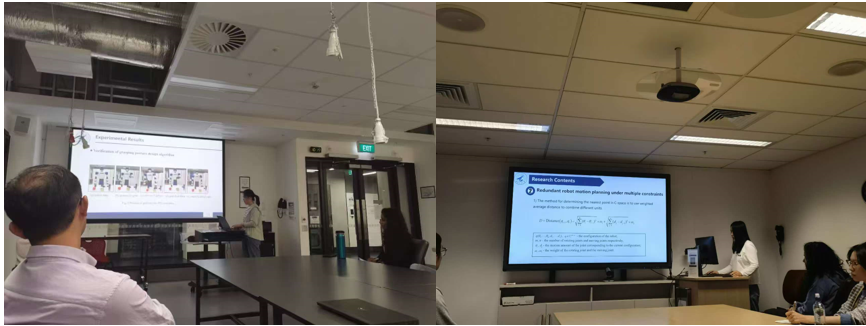
Under Dr. Lu’s guidance and with the support of the team, I further developed the motion planning and control model for dual-arm robots based on my previous research work. The research goal was to develop an efficient path planning and collision avoidance strategy to support autonomous operations in complex workspaces. To achieve this, I systematically studied key theories such as motion planning, trajectory optimization, obstacle avoidance algorithms, and controller design, and completed the entire process from modeling, simulation to algorithm verification using the simulation platform provided by the University of Auckland. This project enhanced my comprehensive abilities in theoretical analysis, system development, and data processing, and deepened my understanding of intelligent decision-making mechanisms in robotics.
During my visit, I also participated in collaborative exchange meetings between the Industrial AI team and several local enterprises, discussing how collaborative robots can improve productivity across departments while addressing cultural, ethical, and social issues. This experience made me realize how research results can align with actual industrial needs, enhancing my understanding of the value of technology implementation and application. In addition to learning and research, I actively participated in several thematic academic lectures, doctoral forums, and international academic days hosted by the University of Auckland, covering fields such as artificial intelligence and sustainable engineering. Through interactions with students and faculty from diverse academic backgrounds, I broadened my academic horizons and improved my communication and collaboration skills in a multicultural environment.
Daily Life
Life in Auckland was very memorable; this city blends modern urban atmosphere with natural scenery, featuring a bustling city center as well as beautiful bays, parks, and volcanic trails. The public transportation system is quite convenient, and the pace of life is relatively calm, with people maintaining a respectful distance yet being very friendly, and daily communication is filled with respect and kindness. Overall, living in Auckland broadened my international perspective and taught me a more open and diverse way of cultural communication, adding valuable experience to my future studies and life.
Conclusion
This exchange not only enhanced my professional skills but also improved my ability to live independently and communicate across cultures. This year-long visit to the University of Auckland was an extremely valuable experience in my academic career. Overall, this visit significantly improved my academic capabilities and international literacy, and also strengthened my confidence and ability to conduct independent research. In the future, I will continue to leverage the results and experiences accumulated from this visit, actively engaging in research and innovation in the fields of control science and intelligent systems.
University Overview
The University of Auckland is the largest and most comprehensive research university in New Zealand, established in 1883, located in the center of Auckland, the country’s largest city. As New Zealand’s largest higher education institution, the university has eight faculties covering a wide range of fields including engineering, medicine, business, arts, education, and law, with over 45,000 students, including international students from more than 100 countries. The University of Auckland enjoys a good reputation globally, consistently ranking first in New Zealand in the QS World University Rankings, with several disciplines entering the top 50 worldwide, and has strong research capabilities. The university emphasizes interdisciplinary collaboration, practice-oriented education, and academic innovation, hosting world-class research institutions such as the Auckland Bioengineering Institute, with outstanding capabilities in research results transformation. Previous Highlights:【Return from Academic Visit】 Issue 50: Guo Xiang: Study Trip to the Helmholtz Center for Ocean Research Kiel, GermanySource | Graduate School (International Exchange Office) School of AutomationCopywriting | Kang Meilin Zhang YujiaoDesign | Chen Duan
Editors | Zhang Xin Liu Che
Review | Li Weilin Liu Zhungang