Produced by Zhongtou ConsultingFollow the blue text above
Introduction
Reconstructing the “Nerve Endings” of the Physical World
Huawei’s automotive-grade LiDAR scans obstacles over a hundred meters away with a resolution of 0.05°; GoerTek’s MEMS acoustic sensors achieve 40dB active noise cancellation in TWS headphones; and SMIC’s 12-inch MEMS production line achieves a production accuracy of 0.1 microns for pressure-sensitive chips— the global smart sensor industry is tearing apart traditional perception boundaries with a compound annual growth rate of 18.6%.
The global market size will exceed 78.5 billion USD by 2025, with China contributing 155.12 billion CNY (30% of the global total), a growth of 116% compared to 2021. This revolution driven by integrated sensing and computing chips and neuromorphic computing is transforming atomic vibrations of the physical world into a torrent of digital civilization.
The “15th Five-Year Plan” report on the trends and investment opportunities in the smart sensor industry released by Zhongtou Industry Research Institute consists of thirteen chapters. It first introduces the concept of smart sensors; then analyzes the development environment of the smart sensor industry, the development of the sensor industry, the development of the smart sensor industry, and the downstream application market and case studies of smart sensors; followed by an analysis of the MEMS sensor industry, related industries, and key domestic and international enterprises in the smart sensor field; finally, it analyzes the investment situation of smart sensors and provides a scientific analysis and forecast of their development.
1.Market Explosion: The “Perception Equation” of Three Growth Engines
1. Scale Fission: The Exponential Curve from Hundreds of Billions to Trillions
Chart: Global Smart Sensor Market Growth Matrix (2021-2029)

Data Source:Zhongtou Industry Research Institute
Explosion Logic: The number of sensors in a single smart vehicle has increased from 100 to 300 (BYD Han is equipped with 28 sets of LiDAR + millimeter-wave radar + cameras), and the demand for machine vision sensors in the industrial internet has surged by 300%.
2. Technological Leap: The “Nano Revolution” of MEMS Technology
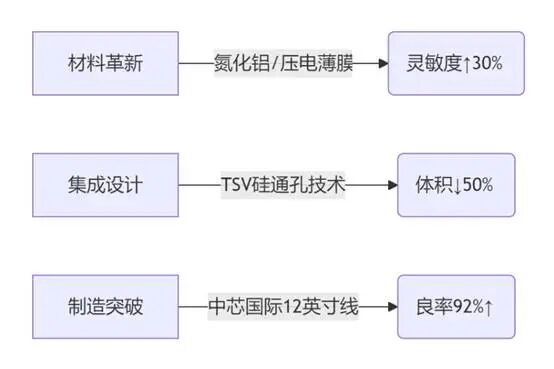
Chart: Technological Leap: The “Nano Revolution” of MEMS Technology
Data Source:Zhongtou Industry Research Institute
HuaGong Technology’s integrated sensing and computing chip reduces data processing latency to 0.1 milliseconds and decreases power consumption by 60%
Pain Point Tackling:
-
Thermal Drift Problem: Sensirion’s temperature compensation algorithm controls zero drift within ±0.02%FS
-
Heterogeneous Integration: GoerTek’s wafer-level bonding achieves MEMS-ASIC integrated packaging
-
Edge Intelligence: Huawei’s Ascend 310 chip empowers AI inference at the sensor side
2.Technological Race: The “Life-and-Death Breakthrough” of Three Major Routes
1. MEMS Mainstreaming: The Dimensionality Reduction Attack from “Microns” to “Nanos”
Chart: Technology Duel Matrix

Data Source: Corporate Annual Reports/Industry White Papers, Zhongtou Industry Research Institute
Choke Point Areas: High-purity germanium detectors (US embargo on China), MEMS design software (COMSOL domesticization rate < 5%).
2. New Sensors: The “Singularity Approaches” of Disruptive Technologies
-
Quantum Sensing: National Instruments’ quantum diamond NV center magnetometer achieves a precision of 0.1nT, with exploration depth increased by 300 meters
-
Flexible Electronics: BOE’s printed strain sensors have a stretchability of 200%, conforming to human curves
-
Neuromorphic: Tsinghua University’s brain-like chip has a power consumption of only milliwatt level, with image recognition energy efficiency increased by 1000 times
3. Integrated Sensing and Computing: Ending the “Von Neumann Bottleneck”
Efficiency Formula:
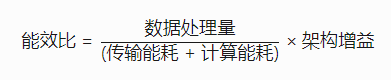
Empirical Case: Huawei’s optical sensing-computing chip reduces latency in security scenarios from 50ms to 1ms, with bandwidth demand decreased by 90%.
3.Regional Game: The “Three Kingdoms Kill” of China, the US, and Europe
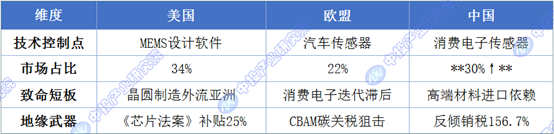
1. Global Power Map: The “Double Strangulation” of Patents and Production Capacity
Chart: The Triangular Structure of the Smart Sensor Industry in 2025
Data Source:Zhongtou Industry Research Institute
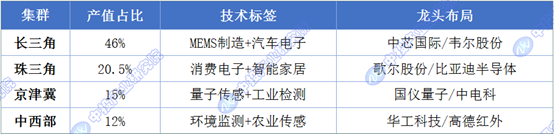
2. China’s Cluster Operations: The “Absolute Hegemony” of the Yangtze River Delta
Chart: Regional Hierarchy of China’s Smart Sensors (2025)
Data Source:Zhongtou Industry Research Institute
The Suzhou MEMS pilot platform has incubated 83 companies, with a patent conversion rate of 68%.
4.Application Revolution: The “Scene Fission” from Automobiles to the Moon
1. Automotive Electronics: The “Perceptual Organs” of Autonomous Driving
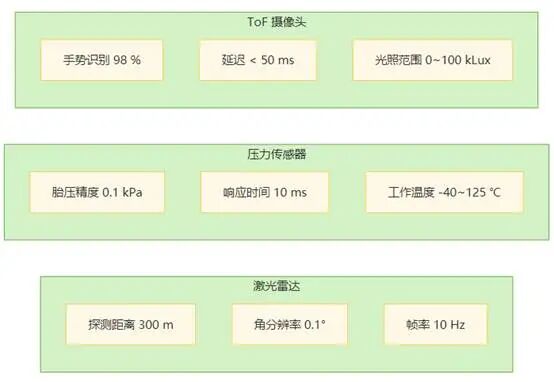
Chart: Automotive Electronics: The “Perceptual Organs” of Autonomous Driving
Data Source:Zhongtou Industry Research Institute
*Tesla HW4.0 is equipped with 42 sensors, while BYD’s “Eye of God” L3 system has a redundant design with triple perception.
2. Industry 4.0: The “Nerve Network” of Smart Factories
-
Predictive Maintenance: SANY Heavy Industry’s vibration sensors have a fault warning rate of 92%, reducing downtime losses by $2 million/year
-
Nano-level Quality Inspection: Hikvision’s machine vision detects PCB solder joint defects with a precision of 5 microns
-
Digital Twin: Siemens’ Xcelerator platform maps production line status in real-time
3. Space Economy: The “Perception Chain” of the Earth-Moon System
-
Moon Base: Chang’e 8 is equipped with radiation sensors, monitoring lunar dust concentration with an error of <3%
-
Deep Space Exploration: Mars sample return capsule temperature control sensors can withstand temperatures of -180℃~500℃
5.Life-and-Death Bottleneck: The “Three Swords of Damocles” Hanging Over
1. Material Cage: The “Supply Crisis” of High-end Materials
-
Germanium Wafer Embargo: The US restricts high-purity germanium detectors, hindering quantum sensor development
-
Organic Film Dilemma: Japan monopolizes polyimide flexible substrates, with prices soaring by 200%
2. Standard Fragmentation: The “Tower of Babel” in Certification Systems
-
US-EU Barriers: ISO/IEC20048 (EU) vs GB/T34069 (China), increasing certification costs by 25%
-
Automotive Standards Chaos: AEC-Q100 (US) and C-V2X (China) mutual recognition progress is lagging
3. Security Black Hole: The “Pandora’s Box” of Data Floods
Risk Formula:
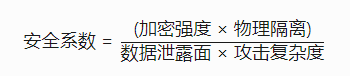
Real Pain Points: 38% of industrial sensors are unencrypted, allowing hackers to reverse control production lines.
6.Future Vision: The “Three Ultimate Forms” of the Perception Revolution by 2030
1. Bio-integrated Sensing: The “Neural Interface” of Human-Machine Symbiosis
Chart: Bio-integrated Sensing: The “Neural Interface” of Human-Machine Symbiosis

Data Source:Zhongtou Industry Research Institute
2. Quantum Sensing Network: Redefining “Measurement Limits”
-
Gravitational Wave Detection: Space quantum magnetometers achieve a precision of 10⁻¹⁸T, revealing dark matter distribution
-
Non-invasive Brain Imaging: Wearable quantum helmets analyze neural signals, providing epilepsy warnings up to 72 hours
3. Interstellar Perception Entities: The “Autonomous Nervous System” of Earth-Moon Factories
-
Moon Resource Exploration: Quantum gravimeters map the distribution of thorium elements in lunar soil with a precision of 0.1ppm
-
Mars Factory Closed Loop: Self-calibrating sensor networks maintain life support systems with an error rate of <0.001%
Conclusion: Rewriting the Physical Laws with the “Perception Equation”
National Technological Sovereignty = (Sensor Density × Integrated Sensing and Computing Degree) / (Material Dependency × Standard Fragmentation)
China’s Path to Breakthrough:
-
Technical Side: Overcoming MEMS-photonics integrated chips (target latency of 1ns) + engineering quantum sensing
-
Institutional Side: Leading the ISO/IEC integrated sensing and computing standard alliance + establishing mutual recognition mechanisms for automotive-grade certification
-
Geopolitical Side: Binding Southeast Asia’s rare earth resources + exporting the “Smart Sensing-Industrial Internet” Chinese solution
As GoerTek’s MEMS microphones capture whispers in Apple’s Vision Pro, and National Instruments’ magnetometers locate oil reservoirs in the Qinghai oil field—this revolution of perception, transforming atomic vibrations of the physical world into a torrent of digital civilization, is expanding the boundaries of human civilization from Earth to interstellar space, rewriting the cosmic laws of perceiving all things.
END
Original Statement: This article is copyrighted by Shenzhen Zhongtou Consulting Co., Ltd. For reprints, please indicate the source as “Zhongtou Consulting”.
For more industry research content, please click“The 15th Five-Year Plan: Trends and Investment Opportunities in the Smart Sensor Industry”to read, or contact Customer Service.


COOPERATIVE CONTACT
Cooperative Contact
Phone
400 008 1522
0755-82571522

Zhongtou Consulting, China’s leading industry research and strategic consulting agency!
Zhongtou Consulting was established20 years ago, focusing on the “industry” field, specializing in industry research, planning, investment attraction, and consulting services.
It is the only professional company in China with a deep industrial research background, focusing solely on industrial investment and development services.
Zhongtou Consulting has been tracking 22 key industries and 81 sub-industries, releasing over 500 new industry research reports annually, and updating over 1000 industry research reports each year.
Zhongtou Consulting has built an industrial development five-force model (i.e., policy-enterprise-capital-technology-user) and innovated research tools such as the “Market Opportunity Matrix”, “Investment Decision Matrix”, and “Investment Timing Curve”.
It has established its own “Zhongtou Industry Big Data”, covering over 1.5 million indicators, with a cumulative data volume of 150 million.
It has served over 200,000 clients, with over 80% of China’s top 500 enterprises being users of our research products.