Past Review
[Unmanned Systems] The US Navy proposes the concept of a ‘Mobile Fire Base’ using armed unmanned vessels for flexible maritime operations
[Unmanned Systems] Israel completes drone interception tests for the improved SPYDER air defense system
Introduction
The US Army recently announced plans to retire the RQ-11B ‘Raven’ drone. However, regardless of platform changes, brigade-level units in the US Army will still require drones to accomplish various combat operations. The purpose of this article is to stimulate creative thinking among US Army soldiers and further refine the standard operating procedures for systems like drones.
The RQ-11B ‘Raven’ small unmanned aerial system (SUAS) serves as an aerial intelligence collection platform for US Army infantry company commanders. The ‘Raven’ drone has a range of approximately 10 kilometers and is equipped with infrared and daytime sensors. Due to issues such as size, user interface, reliability, and the need for dual operators, the ‘Raven’ appears somewhat outdated compared to current commercial drones, leading many Army commanders to have little regard for it. In the global war on terror, US Army infantry battalions and companies are equipped with consistent dedicated manned or unmanned intelligence, surveillance, and reconnaissance (ISR) platforms, such as the AH-64 ‘Apache’ attack helicopter, MQ-1 ‘Predator,’ or MQ-9 ‘Reaper’ drones, forming a multi-layered ISR system.
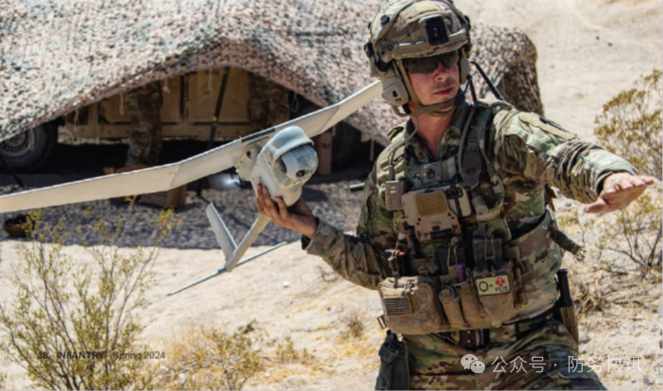
Figure 1 Soldiers of the 1st Security Force Assistance Brigade of the US Army launching the RQ-11B ‘Raven’ drone during training
The operational costs and lack of demand for the ‘Raven’ have led many commanders to give poor evaluations of its cost-benefit ratio, resulting in many of these drones being left in shipping containers (CONEX). However, in future large-scale combat operations (LSCO), brigade-level combat units in the US Army are unlikely to receive routine AWT or unmanned ISR support. Self-sufficient maneuver units should leverage all their organic capabilities to maximize their (and battalion and brigade) understanding of the operational environment, creating decision space for commanders at all echelons.
Other articles have excellently described the use of the ‘Raven’ at the brigade level and its potential added value to all combat functions. This article will provide technical guidance on the ‘Raven’ personnel configuration and deploying a real-time viewer for commanders inside the ‘Striker’ or MaxxPro Mine-Resistant Ambush Protected (MRAP) vehicles, and discuss the mobile launch technology of the ‘Raven’ drone and its advantages Training personnel to operate the ‘Raven’ drone from within the vehicle can shorten the setup time for each flight, maintain operator mobility, and allow the sensor coverage to dynamically match the vehicle formation. The real-time viewer enables commanders to instantly view the imagery captured by the ‘Raven’ sensors from inside the vehicle without having to look over the operator’s shoulder as in the past, which can narrow the performance gap between the ‘Raven’ and other commercial drone technologies. By utilizing these technologies, US Army infantry commanders can better adapt to the use of the ‘Raven’ and maximize the advantages of the brigade’s organic drone equipment in intelligence operations.
1
Required Equipment
-
Complete flight kit for the RQ-11B ‘Raven’ drone (preferably with omnidirectional antennas), equipped with a Panasonic Toughbook rugged laptop;
-
2 trained ‘Raven’ drone operators;
-
Vehicles equipped with operational 12V or 24V inverters;
-
81mm mortar ammunition box/PV S-14 basic items (BII) box;
-
1 lightweight ratchet strap/other securing equipment;
-
Packing filler (4-6 empty water bottles);
-
Standard office computer monitor, as small as possible to ensure it fits in the ammunition box or basic items box (if equipped with a tablet that can be configured to display video feeds from the Panasonic Toughbook, it may be a better choice);
-
Monitor AC power cable, 3-5 feet;
-
Digital Video Interface (DVI) cable, 3-5 feet;
-
550 cord, 5 feet;
-
100 mph tape (i.e., duct tape), 2 feet;
-
Optional: Depending on the monitor/tablet used, additional DVI to HDMI cables may be required.
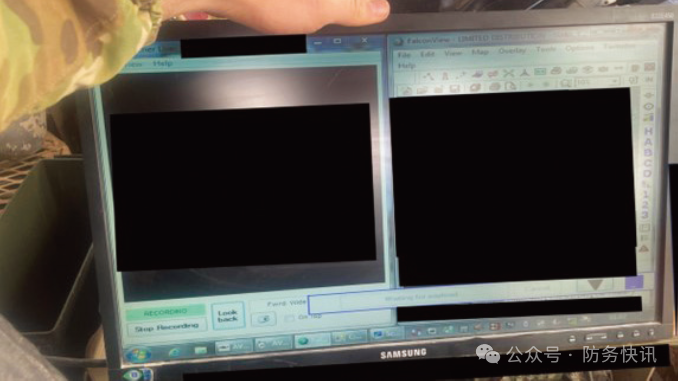
Figure 2 Example of a commander’s real-time viewer equipped inside a MaxxPro vehicle (the left side of the image shows the ammunition box storing the monitor, with cables connecting the monitor from below to the Panasonic Toughbook and inverter)
2
Personnel Configuration
In this article, ‘commander’ refers to the leader currently using the ‘Raven’ drone for intelligence collection, which can be a company commander, sergeant major, executive officer (XO), platoon leader, squad leader, or other leaders within the company. The standard personnel configuration for the ‘Raven’ drone is 2 people: 1 pilot and 1 backup operator; in mobile launch situations, a 3rd operator can be added on different vehicles.
The ‘Raven’ drone’s pilot and backup operator should be deployed in the vehicle where the commander is located. The seating configuration of the MaxxPro or ‘Striker’ armored vehicle supports this arrangement. Some articles suggest placing the ‘Raven’ operators in the vehicle with the executive officer; this article believes this arrangement should be approached with caution in many cases.
3
Hardware Assembly
To effectively use the ‘Raven’ drone, the first step is to install the omnidirectional antenna on the ‘Striker’ or MaxxPro armored vehicle and then connect the antenna to a coaxial cable as a backup. Tie a bottle knot with the 550 cord on the omnidirectional antenna and secure it with tape. Next, adhere the omnidirectional antenna to the highest point on the vehicle’s roof. For the ‘Striker,’ a wire cutter in front of the commander’s hatch can be used. Then, tie the free end of the 550 cord to the vehicle’s roof antenna or another fixed object using a bottle knot or bowline knot. If necessary, a mast for static operations of the ‘Raven’ can be fixed to the vehicle’s top, at which point the antenna can be secured to that mast. The knotting method ensures that even if the antenna falls off in some way, it will not be lost. Run the cable connecting the antenna through the top of the vehicle, parallel to the cables of other antennas. Once inside, this cable needs to have 2-3 feet of free running end reserved for the ‘Raven’ drone operator to use.
The inverter’s role is to convert the 24V DC from the MaxxPro battery into standard 110V AC in the US. Insert the Panasonic Toughbook laptop that comes with the ‘Raven’ drone into the 110V AC outlet connected to the inverter and turn on the inverter. From this point on, the ‘Raven’ operator can complete the remaining configuration as they would in a static position.
The commander’s real-time viewer is a simple on-site solution that allows the commander to view the output from the Panasonic Toughbook associated with the ‘Raven’ drone using a standard computer monitor. The computer monitor connects to the Toughbook via a DVI or HDMI cable and plugs into the inverter through the AC adapter cable. This will mirror the image from the Toughbook onto the monitor. Due to limited space in most vehicles, smaller monitors often work best.
A 81mm mortar ammunition box can be installed on the radio console of the MaxxPro for storage when the screen is not in use. Packing materials or empty water bottles can be placed around the screen to prevent damage from bumps during vehicle movement, and it should be ensured that the ammunition box is properly secured. It is not necessary to use the commander’s real-time viewer in all application scenarios; it merely provides a suitable solution when the commander needs to view the real-time video feeds from the ‘Raven’ drone.
4
Mobile Launch and Operations
Launching the ‘Raven’ in motion can provide more flexibility for combat operations. Operators should learn how to launch the ‘Raven’ drone in a mobile state alongside the unit’s ‘Raven’ trainer, then refine this technique during combat training center rotations. Vehicles should possess both static and dynamic launch capabilities simultaneously. When operating the ‘Raven’ drone in motion, the vehicle the operator is in is positioned at the center of the omnidirectional antenna coverage, so the operational area of the ‘Raven’ moves with the vehicle. During mobile missions, the ‘Raven’ can fly ahead of the combat unit or fly on the flanks as needed.
5
Challenges
When stationed, selecting ‘Raven’ drone operators and prioritizing ‘Raven’ training can be challenging, but these tasks are crucial for maximizing the capabilities of the ‘Raven’ drone.
-
Understanding the overall aerial picture and establishing a Restricted Operating Zone (ROZ) for the ‘Raven’ drone is essential for minimizing the risk of manned aircraft and drones.
-
ROZ procedures and the standard operating procedures of troop units may complicate the temporary training of the ‘Raven,’ as many military bases require 72 hours’ notice in advance. The live-fire and situational training exercise planners at the US Army battalion and brigade staff can request early planning through the Range Facility Management Support System (RFMSS) and incorporate the ‘Raven’ deployment plan into training scenarios with general notices (NOTAM) issued to pilots through brigade aviation units (BAE). This allows commanders to use the ‘Raven’ drone as needed based on specific operational requirements.
-
Since vehicles frequently change direction while moving, omnidirectional antennas seem most suitable for operating the ‘Raven’ drone in a mobile state, but omnidirectional antennas can shorten the range of the ‘Raven.’
-
The inverter consumes a lot of power when converting DC to AC, and vehicles already need to power various systems like radios and the 21st-century brigade and below command systems (FBCB2-JCR), adding an inverter will put an extra load on the vehicle’s electrical system. It is not recommended to run the inverter for long periods with the vehicle’s AC generator off, as this may cause the battery to deplete faster than expected.
-
‘Raven’ drone operators should pre-plan lost link (LOL) rally points, ensuring that the LOL rally points in the ‘Raven’ system align with the route checkpoints set inside the vehicle, aimed at quickly restoring operations in a mobile state. If the LOL rally points are not changed after launch, the ‘Raven’ may fly a great distance back to the initially set LOL point when the connection is lost.
6
Practice
It is advisable to conduct rehearsals before using the ‘Raven’ drone for operations. The National Training Center located at Fort Irwin, California, provides several scenarios for rehearsing the mobile launch and in-vehicle flight operations of the ‘Raven’ drone:
-
Manipulating the ‘Raven’ to contact points from within the vehicle;
-
Advancing forward through the Whale Gap to Siberia;
-
Reconnoitering and occupying fire support positions around Razish (a virtual town within the National Training Center);
-
Approaching potential contact lines to confirm the presence of enemy combat forces, thereby determining the optimal dismount point relative to enemy positions.
Through practice, these techniques can significantly enhance the value of the RQ-11B ‘Raven’ drone while reducing issues during use. This will overall improve the cost-benefit ratio of employing the ‘Raven’ drone and increase infantry company commanders’ understanding of the operational environment. The ongoing war in Ukraine has demonstrated that small drones can have an incredible impact on the modern battlefield, thus it is essential to maximize the training and practice of small drones.