 1. Overview
To optimize energy consumption levels in the cement industry and respond to the national low-carbon and environmentally-friendly requirements for energy conservation, we actively promote energy-saving and carbon-reducing upgrades. The roller press grinding system has become one of the key energy-saving technologies promoted by the state. The bed crushing technology is currently recognized as the most advanced grinding technology, and enhancing the efficiency of the roller press can significantly tap into the potential of the ball mill. However, the energy-saving effects of roller presses vary from company to company, mainly reflected in poor squeezing effects, low fine powder production, and failure to achieve ideal results. The reasons vary, including issues such as valve failures, inability to control warehouse positions, poor cake quality, caving, dust emission, vibration, and skewed rollers, all of which affect the operational efficiency of the roller press.
When system conditions fluctuate greatly, it increases the operational difficulty of the equipment. In the face of increasingly fierce industry competition, the role of the feeding device becomes particularly critical as cement companies pursue refined operations.
2. Development Background of the DAC Arc-Shaped Hyperbolic Feeding Device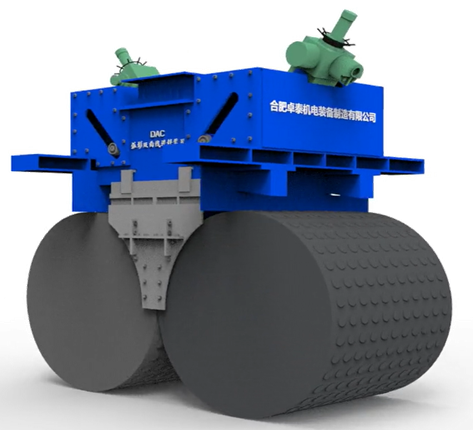
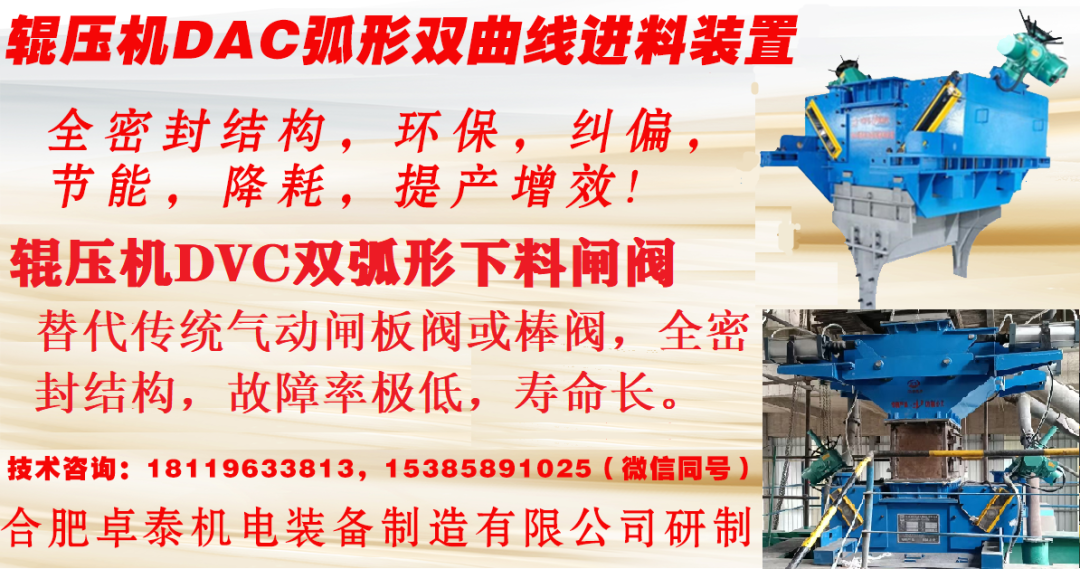
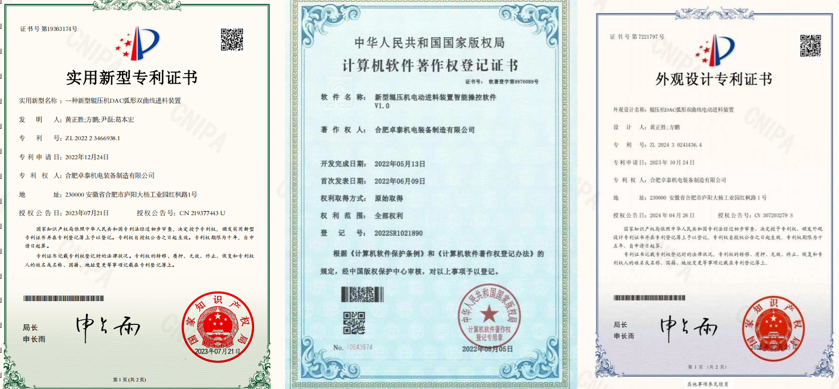
To address the issues mentioned above and achieve the energy-saving and emission-reduction goals for the roller press, our expert team conducted in-depth research and learning at various plants. Through repeated discussions with on-site technical personnel, we studied advanced feeding technologies from certain plants. Combining our years of equipment R&D experience in the grinding industry, we actively explored the research of grinding industrial equipment and developed the sixth-generation DAC arc-shaped hyperbolic feeding device with independent intellectual property rights. This fundamentally solves prominent problems such as dust pollution during the feeding process, material flipping on the roller surface, material leakage from the roller sides, high failure rates of the feeding device, and the need for maintenance and disassembly of the feeding device during roller surface hardfacing. It maximizes the squeezing efficiency and operational stability of the roller press, reduces electrical consumption in the cement grinding system, and lowers maintenance costs.
Characteristics of the DAC Arc-Shaped Hyperbolic Feeding Device
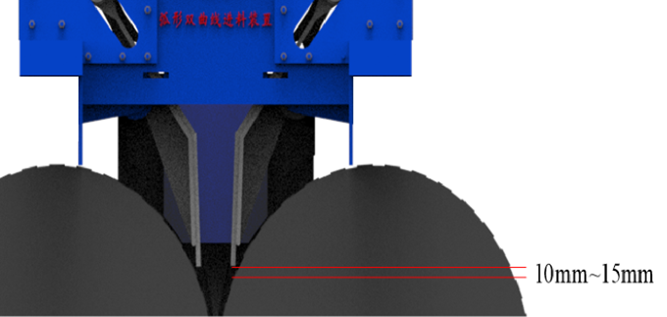
1. The adjustment valve plates move in an equidistant arc shape closely adhering to the roller surface, maintaining a constant distance of 10-15mm during the working stroke to effectively prevent material flipping on the roller surface.
2. The feeding inlet features a unique valley settlement-style full-seal design, promoting the formation of a stable material column and effectively preventing roller skew.
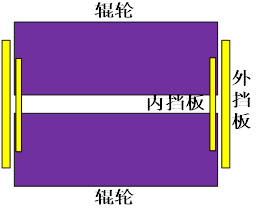
3. The side baffles are designed to be adjustable in separate sections, effectively reducing material leakage from the roller sides, enhancing material crushing efficiency, and lowering the circulating load.
4. The entire machine is designed to be integrated and compact, fully enclosed for safety and environmental protection. Maintenance of the roller surface hardfacing does not require disassembly of the equipment or any components, improving maintenance efficiency.
5. It features a material gas separation structure and a four-sided sealing design, with a reserved dust collection interface, ensuring no material leakage or pressure loss around the discharge port, preventing dust pollution.
6. Equipped with an intelligent integrated drive device, simple wiring, and an LED display screen for on-site visual operation, it allows for electric/manual control on-site or remotely, with mechanical and electrical protection devices for upper and lower limit settings of the adjustment valve plates, providing double protection to avoid equipment damage due to electrical faults.
Design Features
Dynamic Torque Real-Time Display
When the output shaft experiences a certain torque, the worm not only rotates but also generates axial displacement, driving the cam, which causes the impact block to produce angular displacement, thus pressing the cam and lifting the support. As the torque on the output shaft increases, the micro switch controlling the output torque operates, protecting the electric valve and displaying the valve opening in real-time, allowing for monitoring of the adjustment valve plate’s working status.
Curve Fitting/Gap Control
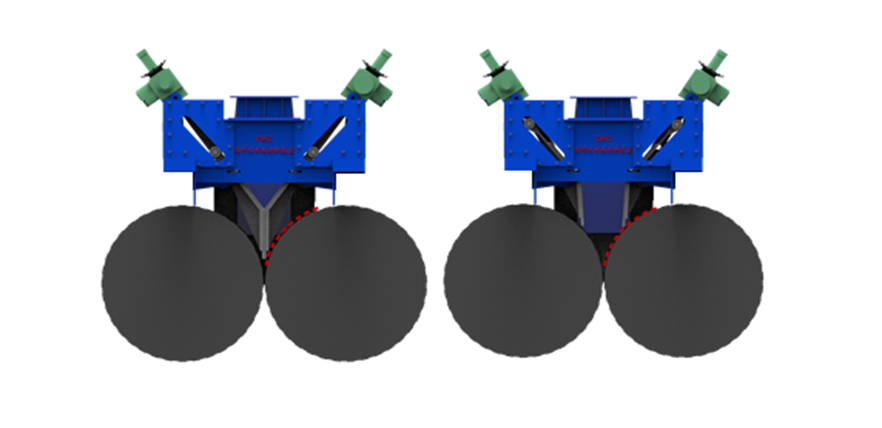
The adjustment valve plate follows the boundary arc of the roller press throughout its entire stroke, maintaining a distance of 10-15mm between the lower edge of the adjustment valve plate and the roller surface, ensuring the stability of the material column and pressure, thereby stabilizing the bed squeezing. The adjustment valve plate is a global characteristic variable affected by dynamic loads, so its homogenization design ensures the stability of the plate surface during motion.
High-Efficiency Energy-Saving Full-Spectrum Protection
The side baffles are designed to be adjustable in separate sections, allowing for adjustment of the distance from the roller end face according to roller width changes, minimizing the gap between the roller end face and the side baffles, reducing material leakage and improving sealing.
 The DAC Arc-Shaped Hyperbolic Feeding Device for Roller Press: Environmental Protection, Energy Saving, Consumption Reduction, and Production Efficiency Improvement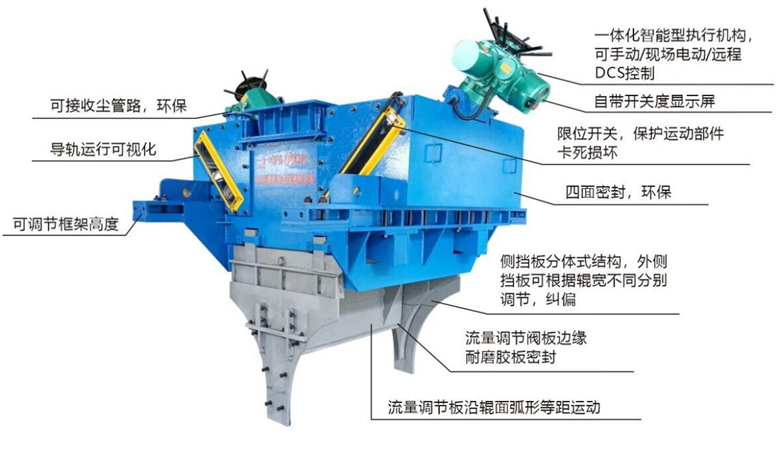
Expected Goals After Upgrading to the DAC Arc-Shaped Hyperbolic Feeding Device
1. Improve the working efficiency of the roller press and stabilize operating conditions, thereby increasing hourly output or reducing circulating load to achieve energy-saving and consumption-reducing objectives.
2. Flexible control: Central control operators can flexibly adjust the feeding amount of the roller press in real-time according to changes in the process system, ensuring stable operation of the system.
3. High degree of automation: The opening of the adjustment valve plates can be displayed both centrally and on-site, with an integrated intelligent actuator capable of manual/on-site electric/remote DCS control in various operational modes.
4. The combination of a discharge pipe and specially designed side baffles achieves a double-layer seal between the rollers, solving the problems of material leakage from the feeding device and material flipping on the roller surface.
5. Solve the problem of material surging in the roller press system, avoiding failures of the elevator caused by material surging, improving system operation rates, and reducing unnecessary downtime and workload for personnel caused by unnecessary failures.
6. Excellent environmental protection effects: The machine features a four-sided sealing structure with a built-in dust collection interface, eliminating dust emission on the roller press platform.
7. The integrated electromechanical design of the entire machine simplifies maintenance, lowers costs, reduces wear parts, and eliminates the need to disassemble the feeding device during roller surface hardfacing, reducing maintenance time and lowering the labor intensity of personnel.
3. Application of the DAC Arc-Shaped Hyperbolic Feeding Device
A company in Conch Cement upgraded its original G160-140 roller press feeding device to the DAC arc-shaped hyperbolic feeding device. Observations after loading showed reduced fluctuations in working pressure/current of the roller press, fewer repairs of the roller surface, leading to smoother operation. Under the same roller press indicators, the output of the upgraded combined system increased by 12.8%, and electrical consumption decreased by over 1 kWh/t. It has been running stably for a year and a half without replacing any components, achieving highly satisfactory results.
In June 2024, a company in Southwest Cement faced issues with low squeezing efficiency, severe material leakage on both sides of the roller, and significant fluctuations in roller current in the original G180-140 feeding device, severely affecting production efficiency. After market research, the customer ultimately chose our DAC1814 arc-shaped hyperbolic feeding device. After the upgrade, material leakage on both sides of the roller decreased, roller current stabilized, output significantly increased, and process electrical consumption decreased by 1.2 kWh/t.
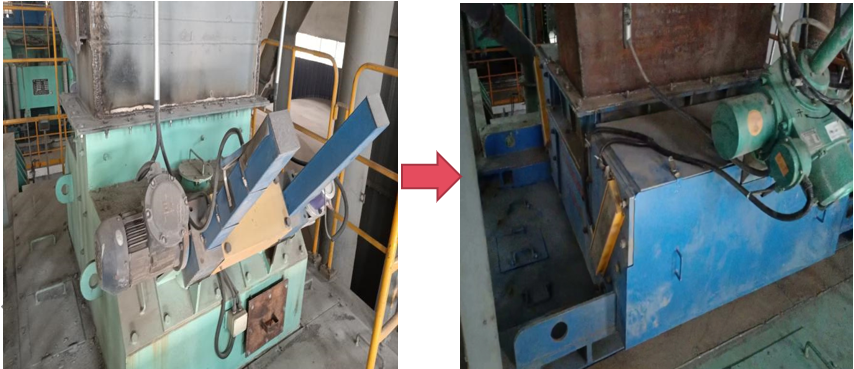
A cement company in Anhui replaced its original four-sided adjustable feeding device for the G180-160 roller press with the DAC1816 arc-shaped hyperbolic feeding device in January 2024. Observations showed that under the same roller press indicators, the output of the upgraded combined system increased from 270t/h to 310t/h, an increase of 14.9%, and electrical consumption decreased by over 1 kWh/t, achieving highly satisfactory results.
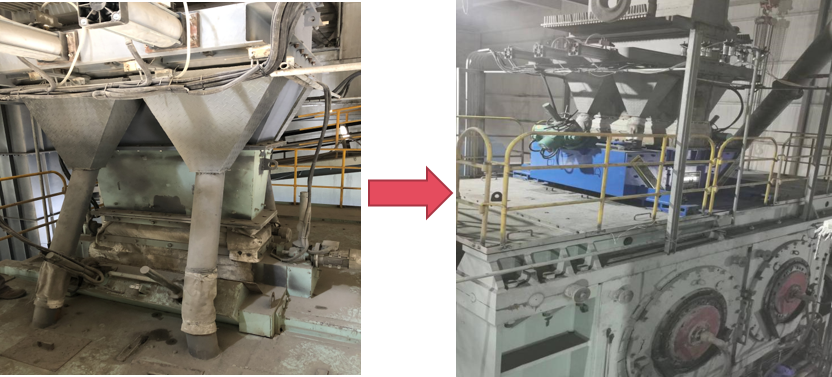
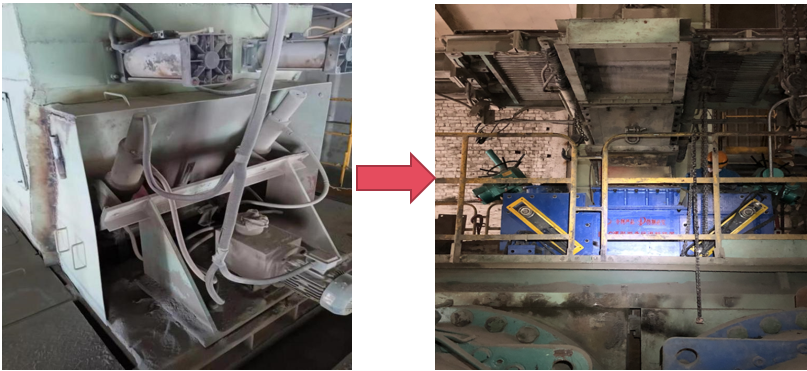
A company in Conch Cement experienced severe dust emission, significant material leakage on both sides of the roller, and low squeezing efficiency in its original feeding device for the G180-160 roller press, severely affecting production efficiency. A dust shelter was constructed on the roller press platform, affecting aesthetics. In early 2024, it was upgraded to our DAC1816 arc-shaped hyperbolic feeding device. After the upgrade, material leakage on both sides of the roller decreased, operation stabilized, dust emission issues improved significantly, and the dust shelter was removed, resulting in a noticeable increase in output and a decrease in process electrical consumption by over 0.5 kWh/t.
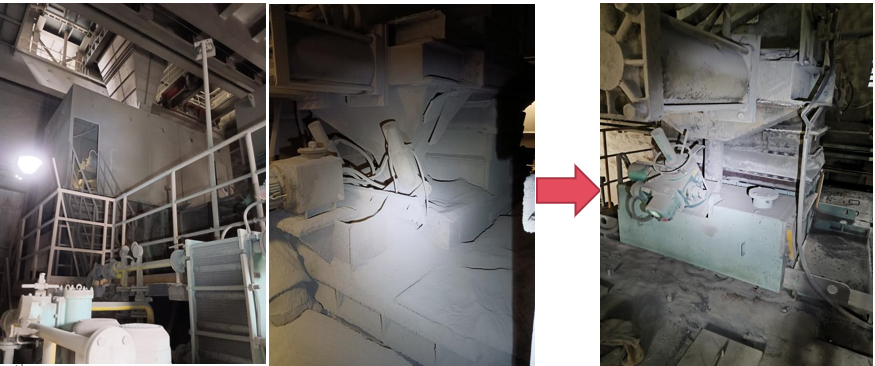 A company in Jinglan Cement Group faced prominent issues with the pneumatic gate valve in its raw material roller press G200-180, such as failure to close tightly and dust leakage, as well as severe material leakage from the original feeding device, resulting in low squeezing efficiency, high electrical consumption, and rapid wear of the side baffles, requiring frequent replacements. After extensive comparisons, the company ultimately chose our DAC2018 arc-shaped hyperbolic feeding device and DVC arc-shaped discharge valve. After the upgrade, the roller press operated smoothly, electrical consumption decreased by about 2 kWh/t, and the working platform environment improved significantly, achieving good results and receiving positive feedback from users.
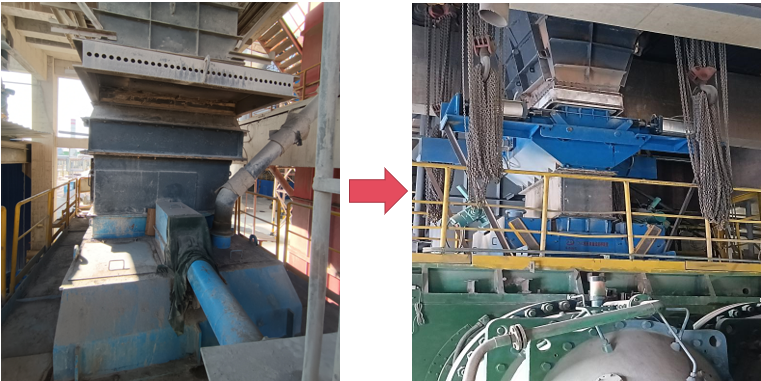 A cement company in Yunnan, with a roller press specification of G170-100, had been using a pneumatic gate valve for many years, which had poor sealing performance and frequently jammed, leading to significant dust emission on the roller press platform and low working efficiency of the roller press. The high electrical consumption was detrimental to the company’s overall requirements for environmental protection and energy saving, as well as the management of factory automation levels. In 2024, it upgraded to the DAC1710 arc-shaped hyperbolic feeding device and DVC arc-shaped discharge valve, resulting in stable operation of the roller press, significantly reduced circulating load, increased output, and decreased process electrical consumption, leading to high customer satisfaction.
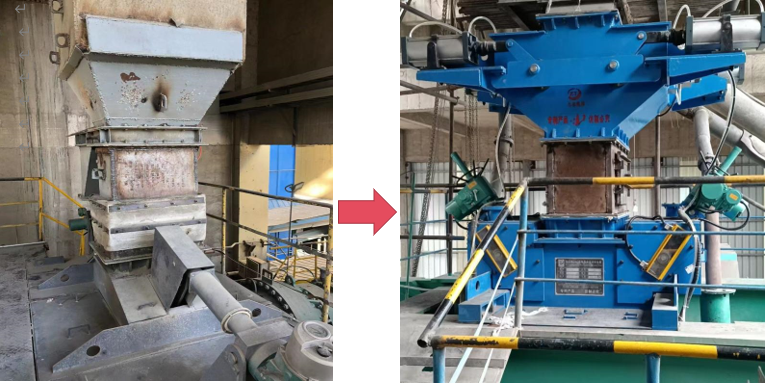 4. Future Development of the Roller Press Feeding Device — High-Efficiency, Energy-Saving, Clean, and Easy to Control
Intelligent Recognition
1. Precisely and intelligently recognize based on installation boundary dimensions, personalized construction of 3D models, and intelligent processing and production.2. Intelligent fine control of protective gaps based on dynamic parameters such as material descent speed and weight.Remote Terminal1. Specialized remote terminal control of the roller press feeding device, providing rapid solutions for technical issues.2. Remote control for cleaning residual materials inside the device, enhancing the environmental friendliness of the workspace.Company Introduction
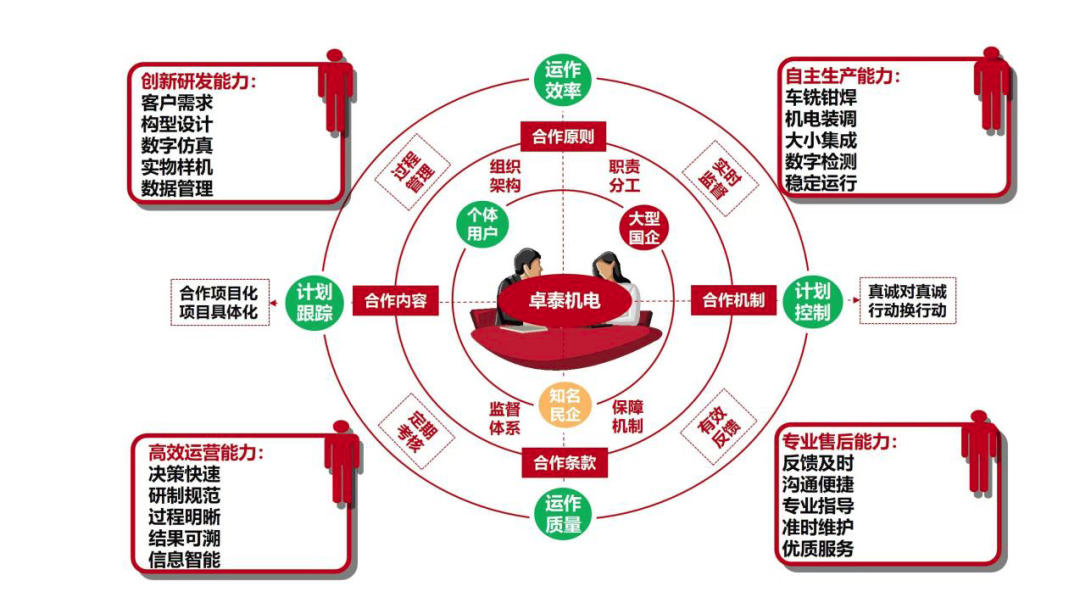
Hefei Zhuotai Electromechanical Equipment Manufacturing Co., Ltd. is a well-known enterprise in the building materials industry, a national high-tech enterprise, a state-supported small and medium-sized technology enterprise, a specialized, refined, distinctive, and innovative small and medium-sized enterprise in Anhui Province, and a technology center in Hefei City. The company has established a powder engineering technology research center and specializes in the technical research, development, design, manufacturing, engineering services, and sales of electromechanical equipment and components for cement production lines, as well as material metering and quantitative feeding equipment, with independent import and export rights. The company has a high-quality professional talent team, including industry research design experts and scholars, senior engineers at the professor level, and master’s and doctoral students with years of experience in equipment design and research and rich engineering practice and theoretical foundations.
Main products of the company include powder metering rotary scales, cement bulk metering scales, SMF vertical mill lock wind feeders, roller press DAC arc-shaped hyperbolic feeding devices, DVC arc-shaped discharge valves, and cement equipment accessories (roller press accessories, steel wire belt elevator accessories, vertical mill accessories, and Feiste coal powder rotary scale accessories) among others, as well as related technical modifications.
Looking to the future, we will continue to strive to take our work to a new level.
Technical Consultation Phone:18119633813 (WeChat same number)15385891025 (WeChat same number)