1.Research Background
The demand for high-performance pressure sensors is urgent in the Internet of Things (IoT) and public resource management scenarios. However, traditional sensors have three major limitations: first, it is difficult to achieve a balance in performance, as high sensitivity often comes with slow response times or narrow measurement ranges (e.g., micro pressure sensors typically have ranges of <10kPa); second, they require external power supply, which leads to high maintenance costs due to battery reliance, making long-term deployment challenging; third, they have poor environmental adaptability, as humid environments can easily lead to signal attenuation. Existing triboelectric nanogenerators (TENGs) can be self-powered, but their surface structure designs are complex (e.g., photolithography, high costs of 3D printing), making it difficult to balance performance with mass production needs.
To address these challenges, Professor Li Guoqiang’s team from Southwest University of Science and Technology published a research paper in Small, developing a three-level structure flexible triboelectric pressure sensor (PS-TENG). This sensor uses a porous hemispherical protrusion PDMS (PHP-PDMS) as the dielectric layer and constructs a “porous (1-3μm) + hemispherical array (40-75μm) + nano protrusions” three-level structure through femtosecond laser template transfer technology, achieving a high sensitivity of 0.874V·kPa⁻¹ (in the low-pressure range), a wide range of 0.02-53.3kPa, and a fast response time of 16.6ms, while also possessing self-powering capabilities (output voltage of 80V, current of 3.56μA). The wireless smart seat monitoring system (WSSDS) developed based on this sensor can identify seat statuses in real-time as “vacant – in use – reserved”, providing innovative solutions for resource management in public scenarios such as libraries and classrooms.
2.Core Research Achievements
(1) Three-Level Structure Design: Breaking Through the Performance Balance Bottleneck
Innovatively integrating porous and micro-nano protrusion structures solves the contradiction of “sensitivity – measurement range – response speed”:
Structural Advantages:
The PHP-PDMS dielectric layer is prepared by femtosecond laser processing of a PTFE template, with the surface featuring 1-3μm porous structures (reducing elastic modulus), a periodic hemispherical array of 40-75μm (increasing contact area), and nano-level protrusions (enhancing triboelectric charging). Compared to non-porous microstructures, the output voltage is increased by 3 times and the current by 4 times (Figure 1d, Figure 4a-b);
Key Performance:
In the low-pressure range (0.02-10kPa), the sensitivity is 0.874V·kPa⁻¹, while in the high-pressure range (10-53.3kPa), it still maintains 0.126V·kPa⁻¹, with a response time of 16.6ms. After 5000 cycles of testing, performance degradation is <5%, far exceeding similar flexible TENGs (Figure 2g-h, Figure 4h-i);
Environmental Stability:
Under 40%-60% RH (typical indoor humidity), output fluctuations are <10%, with a contact angle of 28° (hydrophobic surface), effectively suppressing the neutralization effect of moisture on charges; even in high humidity environments of 90% RH, 60% of initial performance is retained, suitable for most public scenarios (Figure S12-S13).
(2) Self-Powering Capability: Achieving Green Energy Harvesting
The sensor combines pressure sensing and mechanical energy conversion functions, requiring no external power supply:
Energy Output:
At a frequency of 3Hz and a pressure of 12N, the output voltage reaches 80V, with a short-circuit current of 3.56μA, capable of lighting up 44 “TENG” LED lights in series; a 4.7μF capacitor can be charged to 1.5V in just 60s, sufficient to drive a digital temperature and humidity meter (Figure 5a-c, Movie S3-S4);
Charging Performance:
The charging curves of capacitors of different specifications (4.7-47μF) show that voltage decreases linearly with increasing capacitance. Charging a 47μF capacitor to 3V takes 120s, meeting the intermittent power supply needs of low-power electronic devices (Figure 5b);
Cost Advantages:
Using femtosecond laser template transfer technology, over 200 sensors can be prepared in a single run, with low material costs for PDMS and copper foil, making mass production feasible (Figure 1c, Figure S14).
(3) Wireless Smart Seat Monitoring: Implementing Public Resource Management
Constructing an integrated system of “sensor + infrared + Bluetooth” to achieve precise identification of seat status:
System Architecture:
The WSSDS consists of the PS-TENG pressure sensor, HC-SR505 infrared sensor, Arduino MCU, and Bluetooth module, with the sensor attached to the seat surface and electronic components integrated beneath the seat, with a total weight of <50g (Figure 5d, Figure S9);
Status Recognition:
Vacant State: No pressure + no infrared signal, system in standby;
Normal Use: Pressure signal + infrared detects a person, determined as normal occupancy;
Reserved State: Pressure signal but no infrared (e.g., a backpack placed), triggers a buzzer alarm after a 15s countdown and pushes a reminder to the mobile APP (Figure 5d, Movie S5);
Accuracy Verification:
In library scenario tests, the system achieved an accuracy rate of 98% for recognizing the three states, with a misjudgment rate of <2% (mainly due to instantaneous pressure interference, excluded by a 15s delay determination).
3.Illustrated Guide
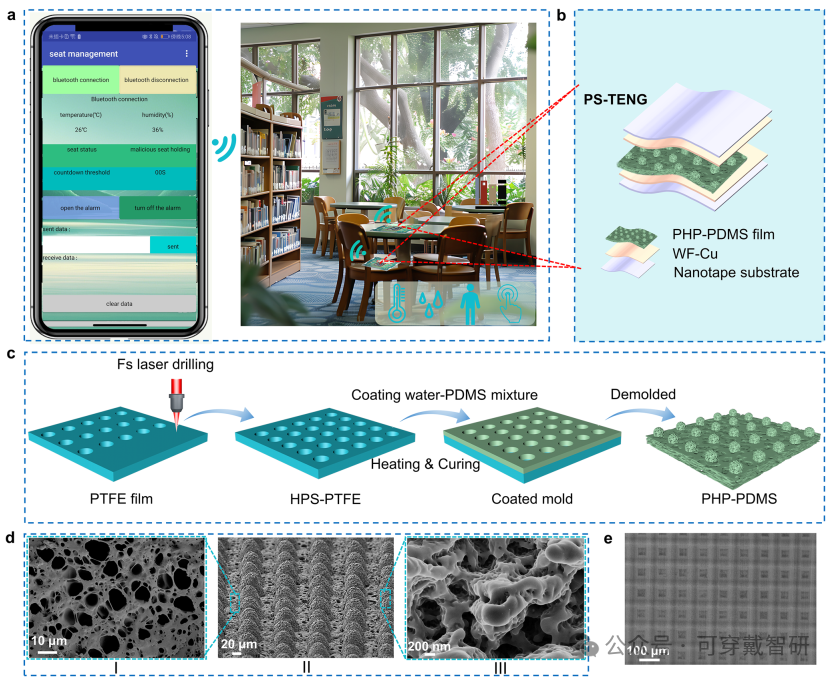
Figure 1: Application scenario diagram based on PS-TENG, and the manufacturing and characterization process of PHP-PDMS
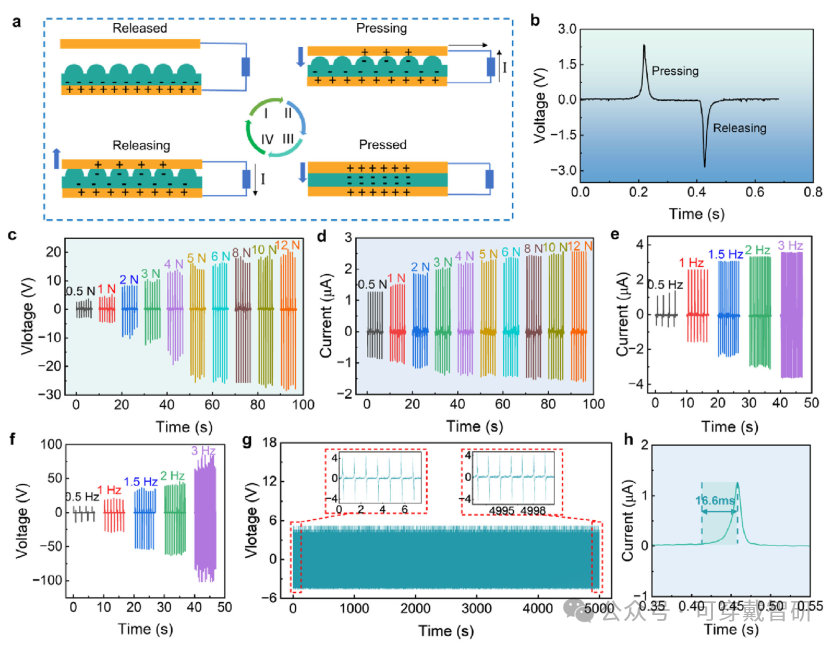
Figure 2: Explanation of the working mechanism and output performance of PS-TENG
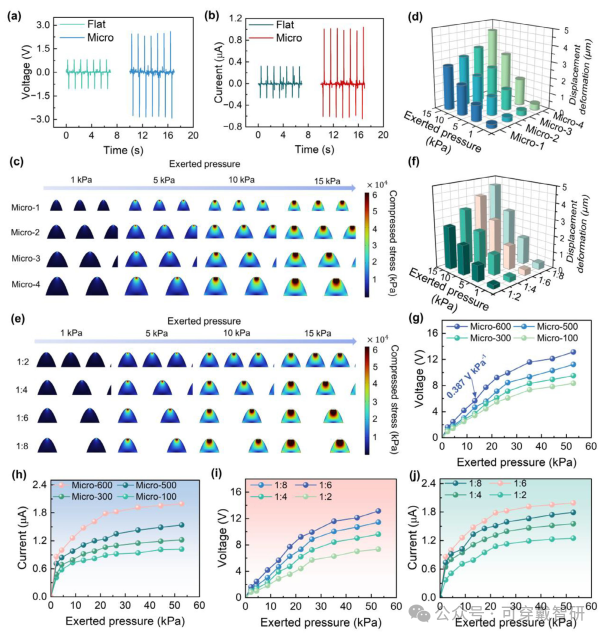
Figure 3: Sensor structure and preparation, electrical output performance and mechanical response of PDMS-based PS TENG with different surface microstructures and occupancy rates under different pressures
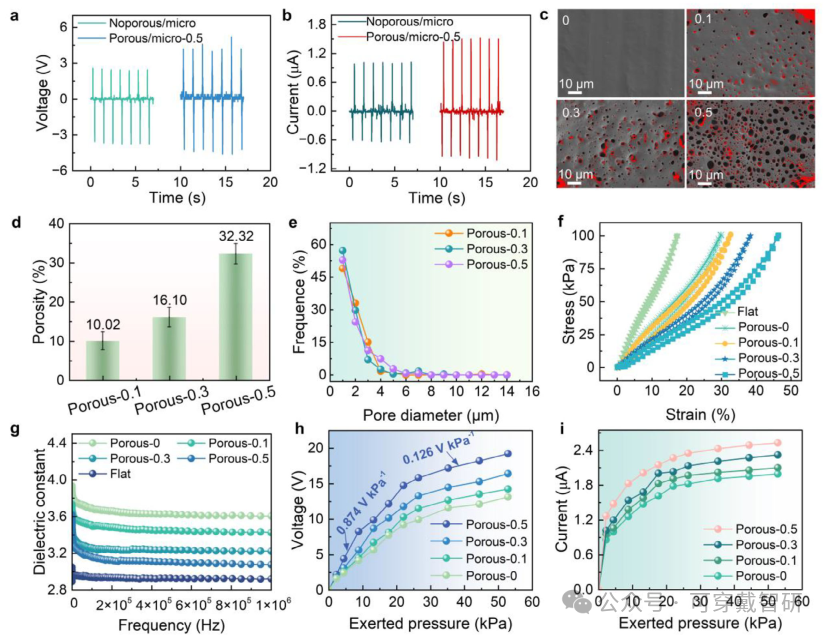
Figure 4: Characterization and output performance of PHP-PDMS films
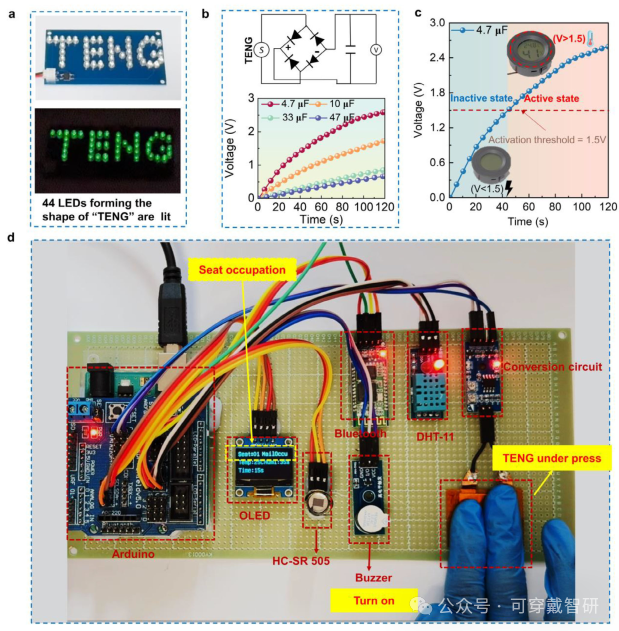
Figure 5: Various application case illustrations of PS TENG
4.Application Value
This sensor has outstanding advantages in two major scenarios:
1. Public Resource Management: The WSSDS can be directly deployed in libraries and classrooms, real-time statistics of seat usage rates, reducing the phenomenon of seat reservation, and improving management efficiency by 40%.
2. IoT Terminals: The self-powering feature is suitable for sensor nodes in remote areas (e.g., parking lots, outdoor monitoring), eliminating the need for regular battery replacements and reducing maintenance costs by 80%.