


[Title]
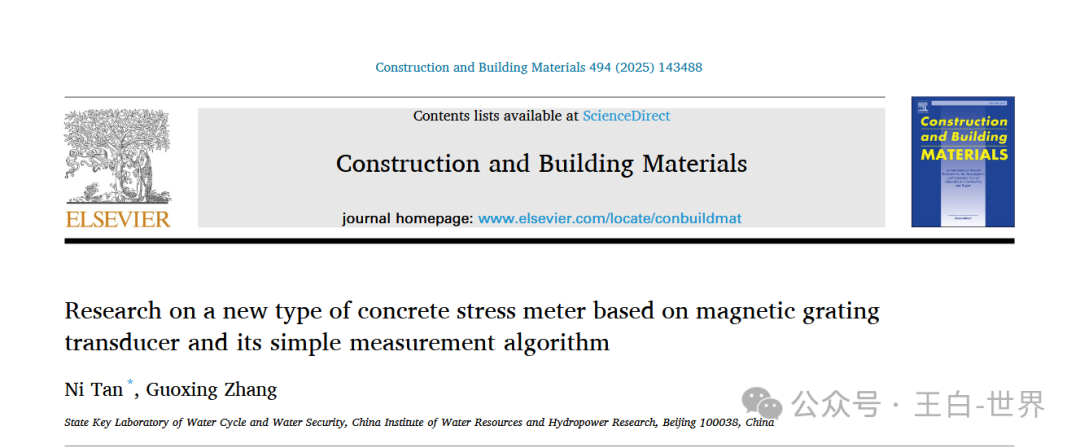
Research on a new type of concrete stress meter based on magnetic grating transducer and its simple measurement algorithm
[Journal]
“Construction and Building Materials”——Volume 494, 10 October 2025, 143488
[Research Team]
State Key Laboratory of Basin Water Cycle and Water Security, China Institute of Water Resources and Hydropower ResearchNi Tan *, Guoxing Zhang
Impact Factor: 8.0
[Abstract]
This paper proposes a new type of concrete stress meter (CSM) based on a magnetic grating sensor, which can directly measure concrete stress and verifies the accuracy of the testing precision and the accompanying algorithm. The device is designed based on Hooke’s law and achieves high-precision monitoring of concrete stress through a special structure, particularly suitable for real-time tracking of temperature stress. The research first derives the stress calculation theory from the perspective of deformation coordination and composite material mechanics; secondly, it introduces the calibration method of CSM, including the determination of device stiffness, equivalent elastic modulus, and temperature deformation compensation coefficient; subsequently, it uses the finite element method (FEM) to simulate the stress distribution of concrete under different working conditions, verifying the test results and conducting parameter sensitivity analysis to ensure algorithm accuracy; finally, it utilizes a temperature-stress testing machine (TSTM) to test the early stress, temperature stress, and tensile-compression process of two strength grades of concrete. The results show that when the elastic modulus of concrete is 21.8 GPa, the maximum difference between the stress measured by CSM and TSTM is 0.380 MPa; when the elastic modulus is 36.6 GPa, the maximum difference is 0.385 MPa; the maximum average difference of the tensile-compression loading results is 0.174 MPa. Statistical indicators show that CSM has high prediction accuracy for stress results, with a coefficient of determination R² exceeding 0.944.
[Research Conclusions]
(1)The measurement principle of the device proposed in this paper is simple, designed based on Hooke’s law, developed with high-precision magnetic grating sensors at its core, deriving the concrete stress calculation method through deformation coordination theory, and verifying the correctness of the calculation method using finite element simulation.
(2)Using finite element simulation to conduct sensitivity analysis, the effectiveness of the algorithm is verified: under external load, the maximum deviation rate between the algorithm-calculated stress and simulated stress is 3.806%; under temperature load, the maximum deviation rate is 11.806%.
(3)Using TSTM to monitor the early stress, temperature fluctuations, and stress development under tensile-compression loads of concrete, the results show that CSM can accurately capture the early, temperature, tensile, and compressive stress changes of concrete under various constraint conditions; during the constant temperature phase of C35CMS02, stress relaxation occurs in the concrete, yet CSM can still accurately reflect the stress changes of the specimen, maintaining high overall measurement accuracy.
(4)The measurement results indicate that the maximum difference between early CSM and TSTM stress values for C35 concrete is 0.265 MPa, with a maximum difference of 0.380 MPa during temperature variation; for C60 concrete, the maximum difference in the early stage is 0.385 MPa, with a maximum difference of 0.107 MPa during temperature variation; the maximum average difference in tensile-compression loading tests is 0.174 MPa.
(5)The predicted values of CSM and the measured stress of TSTM have an error within ±20%; using statistical prediction accuracy evaluation indicators to assess CSM’s predictive capability under various working conditions, MAE, MSE, and RMSE are all low, with the coefficient of determination R² ranging from 0.944 to 0.977, indicating that CSM has high prediction performance.
[Images]
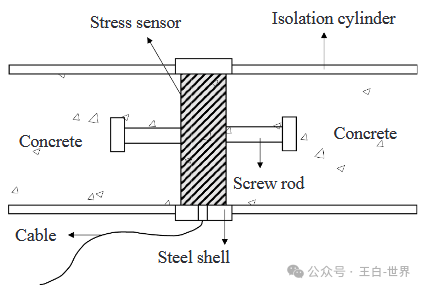
Structure of CSM
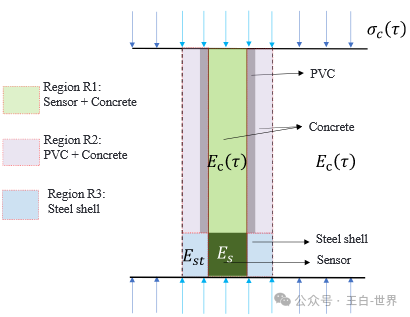
Simplified stress diagram of CSM structure
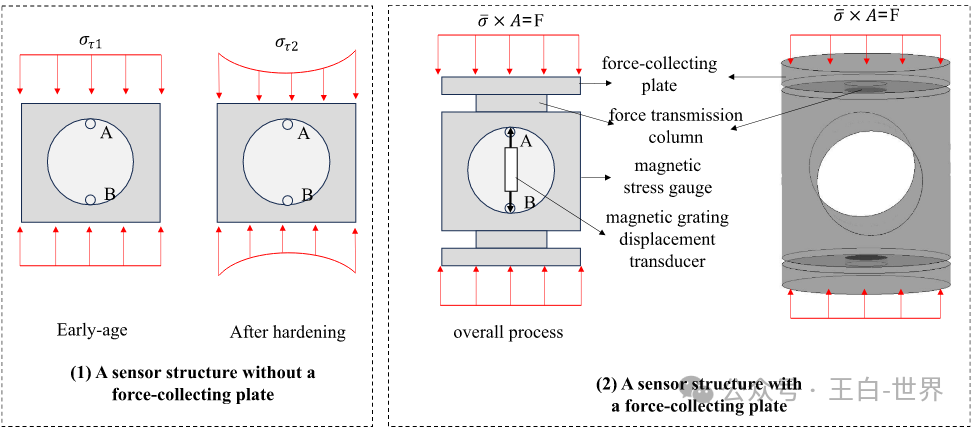
Stress distribution of the sensor under different structural designs
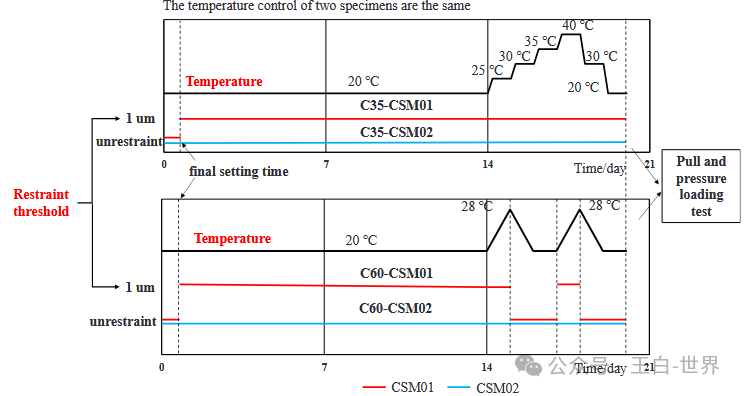
Testing temperature and constraint control process
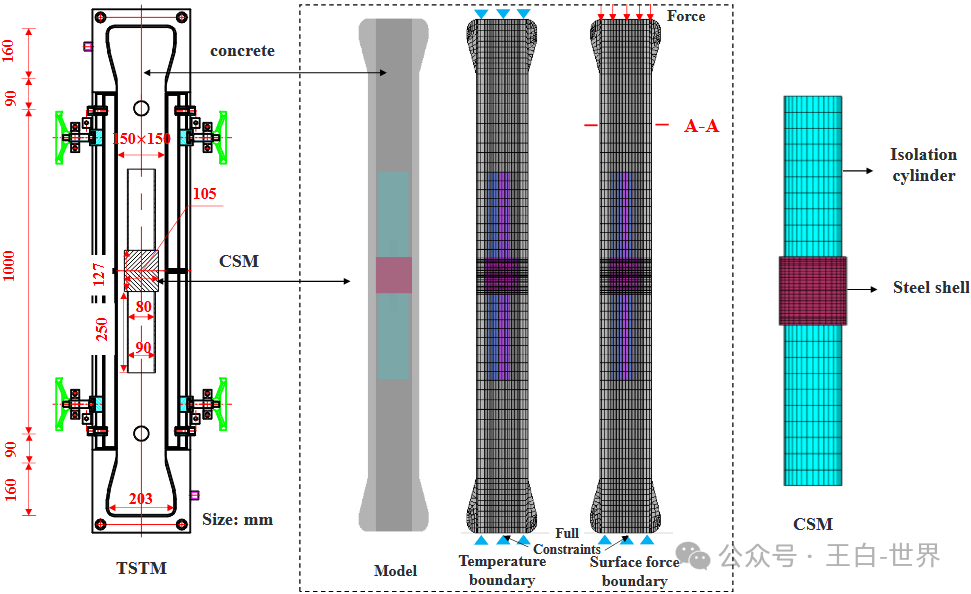
Simulation model and its mesh
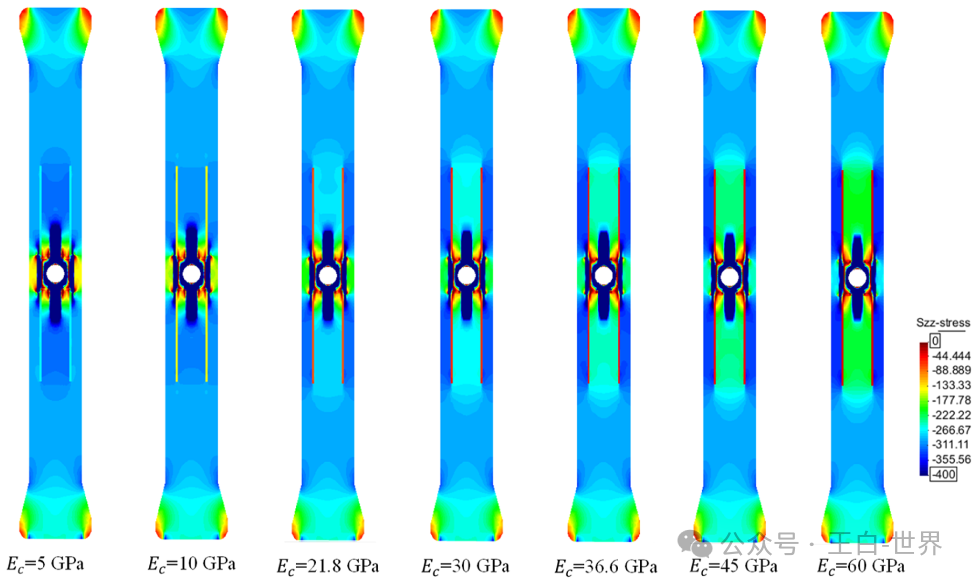
Concrete stress distribution diagram
Source: Wang Bai – World Public Account
Editor: Deng Zhichuan
Reviewer: Wang Chunrong
Recommended Reading↓
Landing difficulties! Why is UHPC hard to apply on a large scale?
How to reduce the application cost of UHPC?
Costing ten times that of ordinary concrete, why is UHPC still a future trend?
The “stimulant” of concrete revealed! A spoonful of “white powder” can increase strength by 50%?
Innovative directions for ultra-high-performance concrete (UHPC): breakthroughs in lightweight and sprayable technology

Statement:All original works of this public account are copyrighted by this magazine. Without the authorization of this magazine, no industry, website, or media (including but not limited to newspapers, Weibo, WeChat public accounts, etc.) may reproduce, excerpt, or use the original articles of this public account in any other way. If you need to reproduce, excerpt, or use in any other way, you must obtain the consent of this magazine and pay remuneration, and must indicate “Source: Construction and Cement Products Magazine” (personal WeChat forwarding and sharing are not restricted but may not be used for commercial purposes). Those who violate the above statement will be held legally responsible by this magazine. In the interest of timely dissemination, this public account will reprint some exciting content. The copyright of the reprinted content belongs to the original author, and some content may not have been able to contact the original author when pushed, or the original author could not be contacted, please forgive us, and the original author is requested to contact this public account in a timely manner, and this public account will pay remuneration according to relevant regulations.