
Recently, Lukas, head of the “Automation and Robotics” research department at a German research institution, joined a delegation from the Baden-Württemberg government to visit a robotics company’s testing workshop in Beijing.
The scene before him made him stop in his tracks—dozens of humanoid robots were running side by side on treadmills:
Some had expressionless faces, mechanically swinging their arms; some stumbled but tried hard to maintain balance; others had slightly stiff knees but gradually became smoother after repeated adjustments.
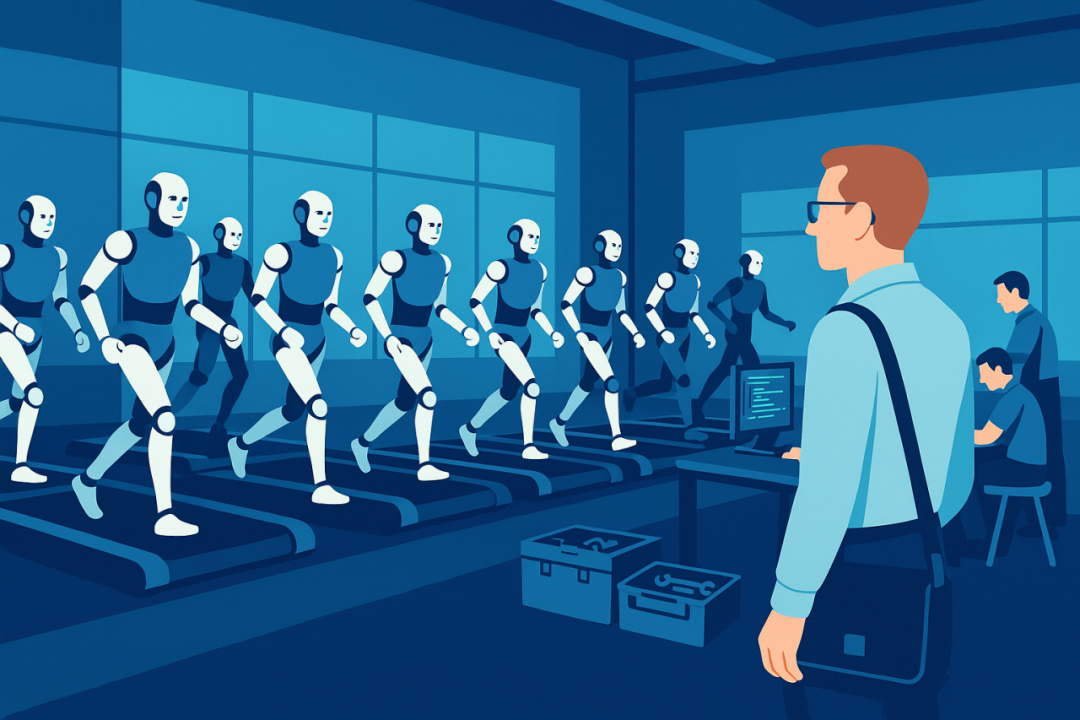
In the workshop, technicians surrounded computers and toolboxes, constantly replacing parts, updating algorithms, and restarting tests.
This was his first close encounter with the Chinese-style R&D pace—quick trials, quick failures, quick corrections.
In just two years, a startup in Beijing has launched the sixth generation humanoid robot; another newly established company has developed a prototype that can walk steadily in just two years.
“More failures lead to faster progress”, seems to be the unspoken rule here.
A few days later, back in his office in Stuttgart, he remarked to his colleagues:
“Germany has a world-leading engineering system, but in terms of iteration speed, we are likely two to three times behind China.”
“There, failure is part of the progress; every fall is a step towards the next breakthrough.”
This trip to China made him truly feel a power rarely seen in Germany: in China, he experienced incredible iteration speed, a culture of daring to experiment, almost limitless application scenarios, and the ability to execute from experimentation to implementation often in just weeks.
Companies here are accustomed to simultaneously launching multiple projects, quickly filtering out the most promising solutions; once a market pain point is identified, resources will gather at an astonishing speed to push technology to the forefront of commercialization.
If China’s speed and scenarios are the “accelerators” for technology implementation, what are Germany’s advantages in the field of robotics and artificial intelligence? Where are the shortcomings?
In recent years, German industrial think tanks have facilitated over 50 cooperation matches between Chinese and German companies in the field of robotics and AI, covering various application scenarios from core components to complete systems, from industrial production to service robots.
Through the repeated promotion and implementation of projects, we clearly see: although Germany has a globally leading advantage in technical foundation and quality standards, to maintain competitiveness in a global market with weekly iterations, it must confront its structural weaknesses.
Based on these frontline experiences, we have summarized five key shortcomings that restrict the development of Germany’s AI and robotics industry.
01
Slow innovation pace
Lack of a “do first, modify later” action culture
German companies are known for their rigor in engineering. Whether in new product development or technology iteration, projects often undergo long periods of verification and risk assessment before initiation, detailing the technical feasibility, compliance risks, market forecasts, and even precise budget allocations for each step.
This approach ensures high standards in quality, reliability, and safety, maintaining the credibility and long-term stability of German manufacturing globally.
However, this “seek perfection before execution” mindset can become an invisible speed disadvantage in the fast-paced, competitive arena of “AI and robotics.”
Market opportunities often slip away quickly; while German teams are still perfecting the details of their plans and preparing verification processes, competitors have already launched their first-generation products, rapidly upgrading and iterating through user feedback, gaining first-mover advantage.
A typical contrasting case is the global proliferation of 3D printing technology. It spread worldwide in a short time not because all application scenarios were planned from the start, but because countless teams and individuals “did it first and then talked about it,” continuously optimizing through trial and error.
This “learn by doing” mentality allowed 3D printing to quickly transition from laboratory technology to commercial tools, while Germany’s long-cycle planning appears significantly lagging in such scenarios.
For AI and robotics, this pace difference is even more pronounced. Algorithms, hardware, and scene demands are rapidly changing; the market does not wait for perfect solutions but rewards those who land first and improve later. Germany’s challenge lies in how to introduce more “small steps, quick runs” experimental projects while maintaining quality and safety standards, allowing technology to enter real application environments earlier, accumulating market feedback and commercialization experience.
02
High project advancement thresholds
Approval and regulation extend implementation cycles
In Germany, as long as a robot application pilot involves a real production environment or direct interaction with people, it may require multiple approvals and compliance checks—from work safety to privacy protection, from labor regulations to industry standards, every step requires documented explanations and multiple rounds of reviews.
These processes effectively prevent low-quality products and potential risks from entering the market, but they also make the deployment of new technologies slower and more expensive.
A common situation is: a German robotics company collaborates with universities and enterprises to develop a humanoid robot, originally planning to conduct early tests in local manufacturing workshops.
However, to complete factory safety assessments, data protection explanations, and industry standard compliance declarations, they need to wait for reviews and feedback from multiple agencies, which can take months.
To expedite verification, they chose to first showcase the robot at a technology exhibition in the United States and test it on a local experimental production line—where initial compliance requirements are relatively relaxed, allowing them to verify functionality, collect user feedback, and gradually improve safety and standardization.
The result is that this German company obtained real usage data and potential customers overseas earlier than in their home country.
When the global new technology iteration cycle is measured in months or even weeks, such differences in implementation speed can easily cause German companies to miss out on “first launch dividends”. In the fiercely competitive field of AI and robotics, how to find a more flexible balance between regulation and innovation will directly affect whether German technology can seize market opportunities.
03
Insufficient market presence
Lack of efficient outreach to the public and decision-makers
The importance of robotics and artificial intelligence has already formed a consensus within Germany’s industry and research circles, but extending this consensus to public opinion, mainstream media, and policy levels still shows significant gaps.
Even with national-level plans like the “High-Tech Agenda,” it is challenging to elevate AI and robotics to a core topic of social discussion in a short time.
Lukas specifically cited an example when discussing China. In April this year, Beijing hosted a visually striking “humanoid robot half marathon.” Over 20 humanoid robots from enterprises and research institutions completed long-distance walking on the city’s main roads.
Although long-distance running is not a real application scenario for humanoid robots, such events instantly attracted public attention and quickly made this field a focus for media and decision-makers. After the event, investments, policies, and talent resources quickly gravitated towards humanoid robots.
In contrast, Germany’s technology showcases are more concentrated in professional exhibitions or closed industry events, with audiences primarily consisting of industry insiders, making it difficult for information to effectively spread to a broader social level.
The result is that even if Germany maintains a global lead in certain robotic technologies, it may miss opportunities to seize public recognition and policy priority due to a lack of social and media “amplification effects.”
For AI and robotics, which require large-scale market investment and policy support, public awareness and decision-maker attention often directly influence the speed of industry advancement.

04
Insufficient execution power for the “last mile” implementation
Difficulty in quickly finding market fit
In terms of R&D, funding, and policy, Germany’s robotics and AI projects are not lacking in resources; what is lacking is the execution power to smoothly advance technology from the laboratory to actual production scenarios.
After leaving the consumer market, few robots can achieve “plug and play.” Most projects require professional system integrators to conduct extensive scene adaptation, debugging, and personnel training before deployment, significantly extending the cycle and increasing costs.
An industry insider provided a specific situation: a German R&D team collaborated with universities and industry partners to develop an industrial robot, originally planning to pilot it in a medium-sized manufacturing enterprise.
However, during project advancement, they not only had to coordinate with system integrators but also wait for approval from the factory’s internal union (Betriebsrat), and even the training plan for operators needed to be confirmed weeks in advance.
After several rounds of coordination, six months had passed since the first technical demonstration, and the robot had still not been officially put into production.
This pace poses a particular challenge for Germany’s small and medium-sized enterprises. Although they contribute 55% of GDP, they account for less than 10% of the national robot deployment volume. The underlying reason is not that the technology is not advanced, but that there is a lack of solutions that can quickly land and are highly aligned with market demand (Product-Market-Fit).
In this regard, the practices of the Chinese market form a stark contrast—from signing contracts to robots going online, it can sometimes take only weeks or even days. Project teams quickly debug in real working conditions, solve pain points, and then optimize products in reverse.
For Germany’s AI and robotics technology, this not only means leveraging China’s diverse scenarios for accelerated validation but also finding market fit in a short time and feeding back mature experiences to Germany.
05
Slow pace of overseas market layout
Missing first-mover advantage in emerging fields
German robotics companies have a deep accumulation in technology export and international branding, but their pace of entering emerging markets is often slow. Many companies prefer to wait until products have undergone complete R&D, testing, and certification processes in their home market before expanding overseas.
While this ensures stability and quality, it also means that in rapidly developing niche areas, they can easily be overtaken by more agile competitors.
An industry insider involved in the service robot business mentioned a comparison: a German team spent nearly five years refining their product to a high level of stability in the domestic market before considering entering the Asian market.
However, by this time, their target customer base had already been occupied by Chinese companies that had entered overseas markets while their products were still in the early stages, continuously optimizing and iterating through real user feedback.
Some Chinese robotics startups even set their sights on overseas markets from the outset, treating Southeast Asia, Europe, or the Middle East as early testing grounds. Once they find market fit (Product-Market-Fit), they rapidly scale production while also feeding back to the domestic market.
This “develop while going overseas” strategy has allowed them to quickly establish brand and channel advantages globally.
For AI and robotics, where technology updates rapidly and market windows are short, speed is a barrier. If Germany continues to adhere to the traditional pace of “first domestic, then overseas,” even with leading technology, it may be long suppressed by competitors who have positioned themselves earlier in emerging markets.
Germany is not without responses to these shortcomings.
In fact, in recent years, Germany has significantly accelerated its policies and industrial layout in the field of robotics and artificial intelligence—from listing AI and robotics as a national priority in the Hightech Agenda, to establishing the Robotics Institute Germany and the RoX digital ecosystem, to planning the “2026 Multi-Purpose Robot Lighthouse Project,” all indicating Germany’s desire to transform its technological advantages into industrial competitiveness.
At the same time, more and more Reallabore (real scene laboratories) are being established across the country, allowing new technologies to undergo rapid testing and market validation in low-threshold regulatory environments.
In terms of funding mechanisms, they are also beginning to draw on practices from China and the US DARPA, through parallel multi-projects and rapid trial-and-error innovative investment models, aiming to break the inertia of “one large project eats all.”
However, as we have observed while helping Chinese and German companies in the robotics and AI fields collaborate and connect, these reforms, while correct in direction, require time to produce actual results in the industry. From policy to implementation, from institutional building to market transformation, there are many steps that need to be smoothed out.
And the competitive pace of the global market, especially in fields like AI and robotics where technology iterates weekly, often does not wait for system adjustments to be completed.
For this reason, if Germany’s efforts in policy, standards, and R&D systems can be combined with China’s speed advantage, diversity of scenarios, and resource aggregation capabilities, it will form a highly complementary “dual engine.” One side maintains the German quality and standard base, while the other accelerates technology validation and commercialization with the rhythm and capacity of the Chinese market. For both sides, this is not only a cooperation opportunity but also a realistic path to respond to global technological competition.

The “Heat Window” of Complementary Advantages Between China and Germany
Currently, the complementarity between China and Germany in the field of robotics and AI is at a rare high point.
Germany has shown unprecedented interest in China’s market capacity and iteration speed, while Chinese enterprises and investors still highly recognize Germany’s technological accumulation, engineering standards, and international brand influence.
This mutual interest and openness are like two currents converging at this moment, forming a strong driving force for the emergence of cooperative projects.
However, this situation will not last indefinitely. Once Germany establishes more mature pilot mechanisms, accelerates approval processes, and builds more low-threshold real scene laboratories at home, its reliance on China for “rapid validation” will decrease; similarly, as China’s domestic robotics technology gradually achieves substitution in key components, system integration, and even complete machine design, the demand for German technology from Chinese enterprises will also weaken.
This change in the “heat window” often occurs quietly in industrial cooperation. Just like in the field of new energy vehicles in the 2010s, where China and Europe frequently visited each other and conducted joint R&D in the early stages, but a few years later, China had already achieved self-sufficiency in power batteries and vehicle technology, making European technological input no longer scarce, and the cooperative relationship naturally shifted from complementarity to more market competition.
Based on this industrial evolution pattern, it can be judged that the complementary heat window for China and Germany in robotics and AI is likely to last only 3 to 5 years. Three years refer to the synchronization period of policy and market—the complementarity is strongest, and the willingness to cooperate is highest; five years refer to the last buffer period before the complete reshaping of technology and market patterns.
Beyond this time, market and technological changes will lead both sides into a new stage—competition will outweigh complementarity, and cooperation premiums will decrease.
For both China and Germany, this is not only a time-sensitive opportunity but also a strategic binding window—whoever can establish cross-national standards, joint R&D mechanisms, and market linkage networks during this window period is likely to secure a solid position in the global AI and robotics landscape over the next 10 to 15 years.
Source: German Industrial Think Tank
Statement:Unless otherwise specified, the text and images of the forwarded articles are sourced from the internet and major mainstream media.Copyright belongs to the original author.If you believe the content infringes copyright, please contact us for deletion.

 Click“Read the original text” to learn more!