
Haptic technology is expected to introduce a richer tactile experience for touchscreens of electronic devices such as smartphones, tablets, and laptops, thereby opening up new possibilities for digital interaction and information exchange. However, despite significant improvements in the resolution of visual display technologies, the resolution of haptic pixels has lagged significantly, limiting the immersive tactile feedback required for a truly enriched user experience. To address this issue, a team led by Professor Wang Dangxiao from the School of Mechanical Engineering at Beihang University, in collaboration with City University of Hong Kong and Peking University, has proposed a fully transparent high-resolution programmable haptic electronic skin system. This system integrates three-dimensional microfluidic structural design with refractive index matching optical mechanisms, offering advantages such as high resolution, dynamic reconfigurability, and broad compatibility. The overall structure resembles a layer of transparent flexible film that can reversibly adhere to various touchscreen surfaces and generate finely detailed topographical features that are highly consistent with the visual content of the screen, achieving a unified presentation of visual and tactile cross-modal information. This achievement opens up a new path for the development of interaction technology between smart terminals and touchscreens. The related results were published in the internationally renowned journal Advanced Science (IF=14.1, top in the Chinese Academy of Sciences, Zone 1) under the title Fully Transparent Haptic Interface for High-Resolution Tactile Feedback on Touchscreens. The first authors of the paper are doctoral student Shan Boxue from Beihang University, postdoctoral researcher Guo Yuan from City University of Hong Kong, and Associate Professor Wang Yun from Beihang University; the corresponding authors are Professor Wang Dangxiao from Beihang University, Professor Yu Xinge from City University of Hong Kong, and researcher Dai Zhaohua from Peking University, with Beihang University being the primary institution for the paper.
This research proposes a transparent high-resolution programmable haptic electronic skin. By mapping visual pixels to haptic pixels through a three-dimensional microfluidic network, it can reproduce static patterns and dynamic animations in real-time. The device employs a multi-layer PDMS structure, integrating a 7×7 actuator array (49 points/cm2), with a resolution surpassing the two-point discrimination threshold of the fingertip. To maintain transparency, a refractive index matching fluid medium is introduced, achieving a light transmittance of over 93%, combining high-definition display with fine tactile feedback. The overall thickness is 1.5 mm, and it weighs less than 9 g, allowing it to be reversibly attached to the surface of touchscreens.
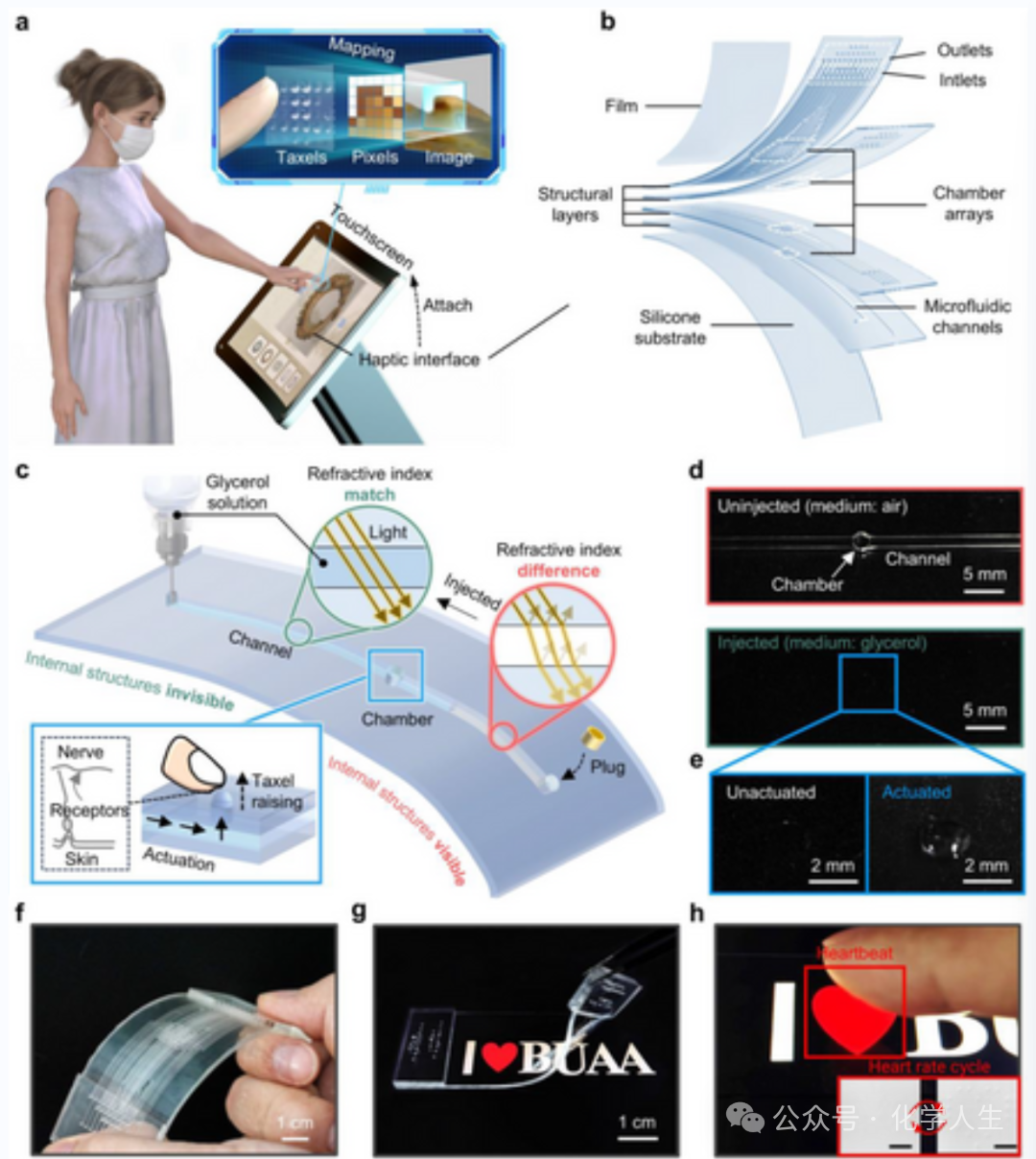
Figure 1: Design and architecture of the optically transparent high spatial resolution haptic electronic skin.
The research team systematically characterized the key performance of the microfluidic haptic actuators. The results indicate that injecting a glycerol solution with a refractive index matching PDMS can significantly reduce scattering and reflection, achieving “optical invisibility” for the chambers and microchannels. Under different pressures, the actuators exhibited good mechanical tunability, balancing deformation amplitude and touch resistance by optimizing chamber diameter and film thickness. Dynamic response and long-term stability tests further demonstrated that the device remains reliable under rapid driving and high-frequency operation, validating its balance between transparency and tactile fidelity, laying the foundation for haptic feedback on touchscreens. The research team showcased the structural design and performance of the transparent haptic electronic skin. To achieve high-density integration of microfluidic actuators, an inverted pyramid chamber and staggered channel layout were employed to construct a 7×7 haptic pixel array, achieving stable driving while maintaining flexibility and ultra-thin characteristics. Finite element analysis and experimental results indicate that the device maintains good output consistency under hierarchical staggering; when introducing refractive index matching liquids, there is almost no optical interference when attached to the display screen, ensuring visual clarity. The results show that this electronic skin achieves a balance between transparency, flexibility, and high-resolution feedback, providing a feasible path for high-fidelity tactile integration into touchscreens.
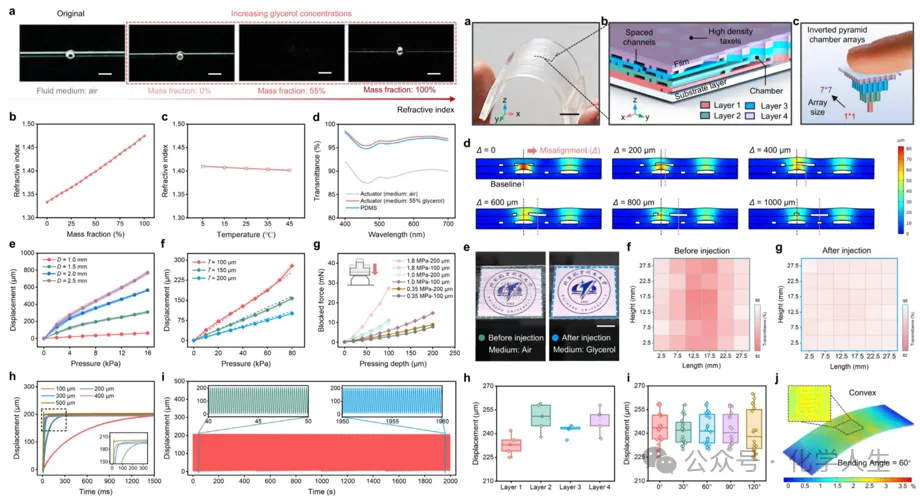
Figure 2: Key performance analysis of microfluidic actuators and design and evaluation of high-resolution actuator arrays.
The research team demonstrated the application potential of the transparent haptic electronic skin in multiple scenarios. In virtual shopping, users can distinguish fabric textures through haptic feedback, and the integration of vision and touch significantly enhances the realism of materials. When applied to racing games, the interface can simulate throttle, brake, and collision feedback, synchronizing in real-time with the visuals to enhance the immersive experience. Furthermore, the researchers integrated it into the car’s central control screen, using different haptic patterns to achieve “blind operation” for playback, volume, and directional control, compensating for visual impairment even in bright light, ensuring the accuracy of fine interactions.
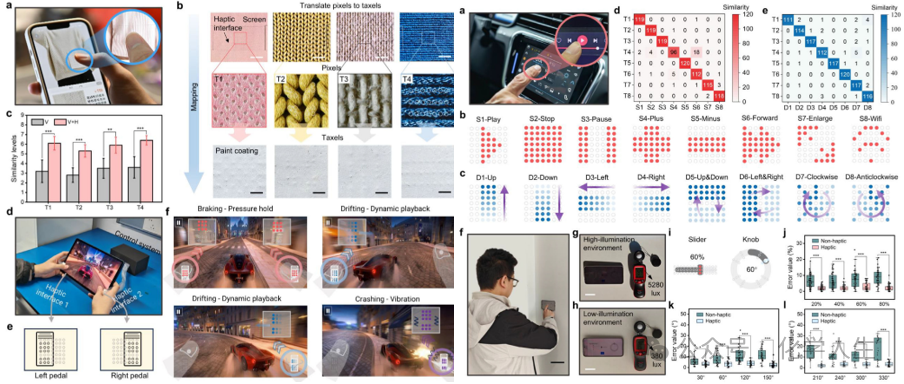
Figure 3: Application examples of haptic electronic skin in highly immersive touchscreen interactions and how high-resolution, programmable haptic feedback can achieve precise interaction guidance.
In summary, this research proposes and realizes a haptic electronic skin that combines optical transparency, high spatial resolution, and programmable characteristics, and systematically verifies its significant advantages in immersive touchscreen experiences and high-precision human-computer interaction through experiments. This novel haptic electronic skin is expected to become an important technology driving the development of next-generation haptic interaction technologies. The related research work was supported by the National Natural Science Foundation (62373021, 12432003) and other projects.
Paper link:
https://doi.org/10.1002/advs.202511874
(Source: Beihang University, copyright belongs to the original author, with sincere gratitude)