Recently, the safety inspection station has innovated the explosive inspection “Smart Discrimination” system, which was independently developed by the special operations department of the safety inspection station in collaboration with the quality control department. It has successfully completed pilot testing and has entered the implementation phase. This innovation not only enhances passenger throughput efficiency but also further strengthens the air defense safety protection network, providing a replicable and promotable “Chongqing model” for technological innovation and iterative upgrades in explosive inspections at domestic airports.
Traditional Security Check Pain Points Highlighted; Technological Innovation Urgent
As the “first line of defense” for air defense, the efficiency of the process and the accuracy of information transmission directly relate to the safe operation of airports and the travel experience of passengers. In the traditional explosive inspection model, detection results rely on security personnel’s manual observation, verbal communication, or manual switching of lights to synchronize information to subsequent positions. This reliance on human-led information flow is easily influenced by human factors, leaving significant room for improvement in information transmission efficiency, response accuracy, and consistency. Faced with the dual demands of safety and efficiency, the limitations of the traditional model are becoming increasingly apparent, making technological innovation an inevitable choice to address industry pain points and enhance the quality and efficiency of explosive inspection work.
The “Smart Discrimination” System Emerges to Break the Deadlock; Pilot Testing Shows Significant Results
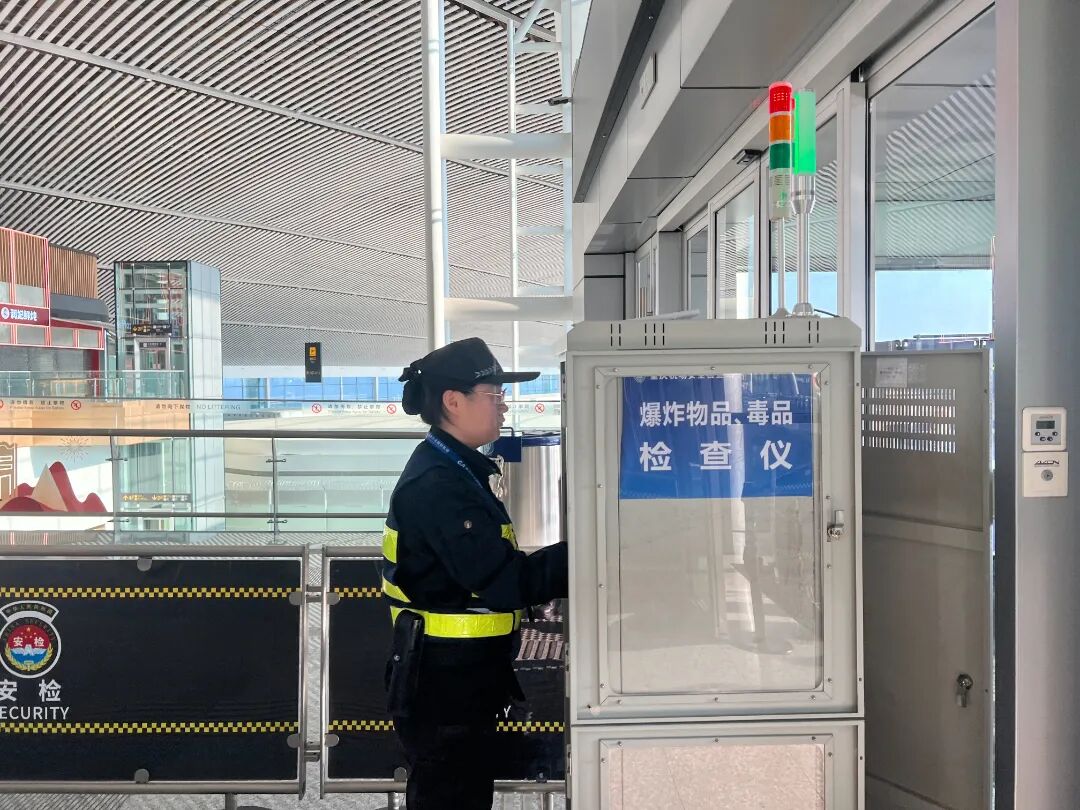
To enhance the efficiency of information transmission and response accuracy in explosive inspections, the special operations department of the safety inspection station leveraged years of practical experience in explosive inspections, collaborating with the quality control department through multiple rounds of technical discussions, program optimizations, and field tests, successfully creating a system that integrates “real-time recognition, automatic linkage, and precise response” – the “Smart Discrimination” system. This system utilizes an embedded color processing recognizer, through a self-made microcontroller, to capture the color feedback results from detection devices in real-time, automatically synchronizing and controlling the light display to the corresponding color. Notably, this system supports color adaptation for multiple brands of explosive detection devices, compatible with all currently used bomb detection equipment models. After 71 days of pilot testing, the system’s overall usability reached 99.68%; color recognition accuracy exceeded 98%, with an average fault-free time of ≥ 500 hours, and all performance indicators fully met the actual needs of the explosive inspection process, laying a foundation for subsequent comprehensive promotion.
 Triple Optimization for Quality and Efficiency; Comprehensive Coverage Progressing Steadily
Compared to traditional systems, the “Smart Discrimination” system achieves a leap in three dimensions: “efficiency, safety, and cost.” In terms of throughput efficiency, it reduces the response time for explosive inspection results from the traditional manual operation of 3-5 seconds to 0.5 seconds, significantly decreasing passenger wait times; in terms of safety control, the system, through high-precision sensors and automation control, completely avoids the risk of errors from manual visual judgment and operations, reducing the operational error rate to below 0.2%, significantly enhancing safety protection accuracy; in terms of cost control, the new system does not rely on battery power, completely eliminating battery consumption costs, achieving the dual goals of “cost reduction and efficiency increase.”Currently, the system has completed all hardware design and software debugging, and optimizations have been made based on operational feedback. The next step is for the safety inspection station to follow the principle of “pilot optimization and steady promotion” to gradually achieve comprehensive coverage of all explosive inspection channels, using technological innovation as the engine to elevate aviation safety service levels to new heights.
Author: Zhou Li
Editor: Mu Xiaoyan
Chief Editor: Zhang Qiao
Reviewer: Zhou Jiping