With the development of intelligent connected technologies such as DSRC and 5G, automotive communication systems known as V2X (vehicle to everything) are becoming increasingly mature. This includes several components such as vehicle-to-vehicle (V2V), vehicle-to-infrastructure (V2I), vehicle-to-pedestrian (V2P), and vehicle-to-network (V2N) communications. Vehicles will communicate with other vehicles, traffic lights, or parking spaces, providing high-precision, low-latency driving assistance. To achieve this, a sufficient number of RSU (Roadside Unit) testing units need to be established. Additionally, to handle emergencies, the vehicle’s OBU (On-Board Unit) will also incorporate a GNSS positioning module as a redundant backup. Considering more complex real-world scenarios, how can vehicles be positioned in environments with weak GNSS signals, such as tunnels? This requires the OBU to have dead reckoning capabilities, which are primarily implemented through inertial sensor modules. This article briefly introduces the application of the XSENS MTi-7 module as an example of inertial navigation modules in vehicle V2X systems.
1. What is an Inertial Navigation Module?
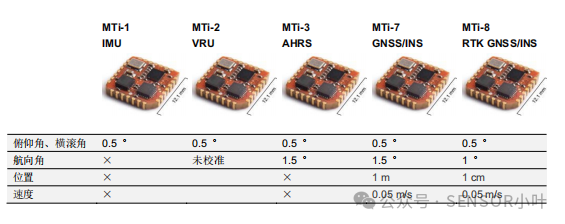
An inertial navigation module does not rely on external positioning information. It detects acceleration, angular velocity, and other information through built-in sensors such as accelerometers, gyroscopes, magnetometers, and barometric altimeters, and calculates the object’s speed, yaw angle, and position in an inertial reference frame through integration. Taking Xsens’s Series 1 products as an example, they are categorized into IMU, VRU, AHRS, and INU products based on their functions. IMU provides calibrated acceleration and angular velocity information, while VRU and AHRS provide roll, pitch, and yaw angle information. INU, in addition to angle information, can output position and speed information when paired with external GNSS and barometric sensors, making it increasingly powerful. The dead reckoning function requires selecting the MTi-7 (INU) product, which is paired with an external GNSS module.
2. Introduction to MTi-7:
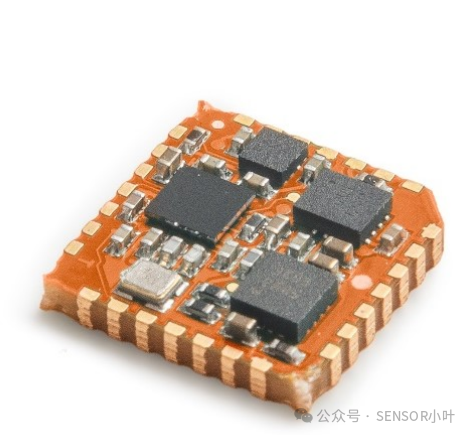
The image below shows the MTi-7 physical module, which uses a chip-on-board (COB) package. It has a small size of 12.1mm x 12.1mm and offers a high cost-performance ratio, making it very suitable for mass production applications.
3. MTi-7 Application Guide:
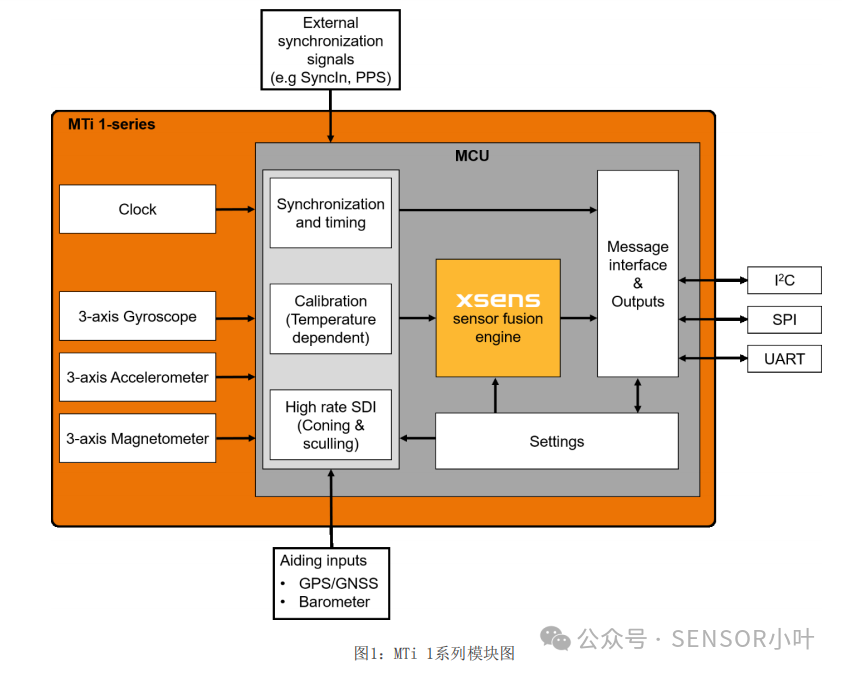
The diagram below illustrates the application framework of the MTi-7. The module provides communication interfaces for external GNSS and barometric altitude sensors. It collects information from both and processes it through fusion algorithms to output unified data to the control unit. It is worth noting that since V2X positioning accuracy requires centimeter-level precision, it should be paired with a GNSS module that supports RTK algorithms.
With the development of autonomous driving technology, various automotive information exchange systems are also maturing. The in-vehicle central control screen has added more functions beyond its original display capabilities. A customer is designing an embedded central control screen for a taxi, powered by a 24V automotive power supply, supporting FM frequency modulation in the 78-118MHz band, and incorporating an inertial navigation module and ultrasonic radar ranging. The inertial navigation module is required to support GPS or BeiDou and have an I2C interface.
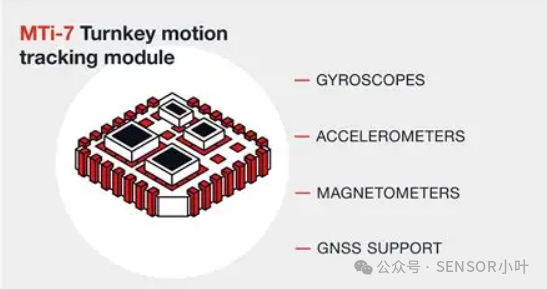
We recommend the XSENS miniature inertial navigation module MTI-7-T, which supports multiple GNSS receivers. Through advanced sensor fusion algorithms, it can synchronize the input information from the built-in accelerometer, gyroscope, and magnetometer to generate a real-time data stream. It offers I2C, SPI, or UART interfaces for application on the main processor. With a miniature SMD form factor (12.1×12.1mm), it features a small package and low power consumption, making it very suitable for applications requiring compact size and high integration.
Advantages of MTI-7-T in Embedded Central Control Screens:
1. It includes a three-axis gyroscope, three-axis accelerometer, three-axis magnetometer, high-precision crystal, and MCU, providing high integration that simplifies customer design;
2. Bandwidth of 255Hz, sensitivity of 0.001deg/s/g, and a range of 2000deg/s, offering high precision for accurate measurements;
3. Static power consumption as low as [email protected], effectively reducing overall system power consumption and improving power efficiency;
In summary, XSENS’s MTI-7-T is very suitable for automotive embedded applications.

Recommended Reading
Best Practices for Xsens MTi AHRS and GNSS/INS Automotive Applications
XSENS’s New Mixed Reality Holographic Projector for Construction Sites
XSENS Motion Capture Applications: Controlling Robots
Xsens MTi-3 Inertial Sensors Supporting Ocean Monitoring and Research