Abstract
This article studies a UAV detection and tracking system based on interference radar, utilizing MATLAB for modeling and simulating the signal processing of the interference radar. By introducing the Kalman filtering algorithm, the motion trajectory of the UAV is estimated and tracked, achieving precise positioning and path prediction of the UAV. Experiments show that the designed system can effectively detect the presence of UAVs and provide stable tracking performance.
Theory
Interference radar is a technology that achieves target positioning by measuring the distance, speed, and angle of the target. Its principle is to receive the echo signals of the target through multiple antennas and calculate the azimuth angle of the target using the phase difference of the echo signals.
The key theories of interference radar are:
- Distance Measurement: The distance to the target is calculated by the time difference between the transmitted and received signals.

Where, 𝑅 is the distance, 𝑐 is the speed of light, and Δ𝑡 is the time delay.
- Speed Measurement: The radial speed of the target is analyzed using the Doppler effect.

Where, Δ𝑓 is the Doppler frequency shift, and 𝜆 is the wavelength.
- Azimuth Angle Calculation: Utilizing the phase difference between multiple antennas.

Where, Δ𝜙 is the phase difference, and 𝑑 is the antenna spacing.
Kalman Filter: The Kalman filter is a recursive filtering algorithm that achieves smooth tracking of the target trajectory by minimizing estimation errors. Its state update formula is:
Experimental Results
The experiments were conducted on the MATLAB platform and mainly included the following steps:
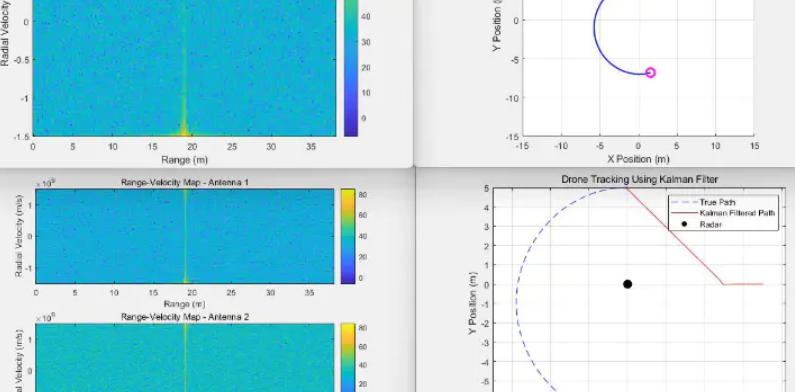
- Simulating the echo data of radar signals to generate distance-speed maps.
- Calculating the azimuth angle of the UAV using the phase difference of the antenna array.
- Applying the Kalman filtering algorithm to smooth the trajectory estimation of the UAV.
Result Analysis:
- Distance-Speed Map: The radar can clearly identify the distance and speed of the target.
- UAV Trajectory Estimation: The Kalman filter significantly reduced the impact of noise on the trajectory, achieving precise path prediction.
- Tracking Performance: In the simulated circular motion trajectory, the path after Kalman filtering closely matched the actual path.
Sample Code
% Parameter settings
c = 3e8; % Speed of light (m/s)
fc = 24e9; % Radar center frequency (Hz)
lambda = c / fc; % Wavelength (m)
d = 0.05; % Antenna spacing (m)

% Simulate UAV motion trajectory
t = 0:0.1:10; % Time series (s)
x_true = 10 * cos(0.2 * t); % UAV X coordinate (m)
y_true = 10 * sin(0.2 * t); % UAV Y coordinate (m)

% Generate echo signal (with noise)
noise = randn(size(t)) * 0.1; % Noise
phi = atan2(y_true, x_true) + noise; % Azimuth angle (radians)

% Interference radar azimuth angle estimation
theta_est = asin((phi * lambda) / (2 * pi * d));

% Kalman filter initialization
x_est = [0; 0]; % Initial state [x, y]
P = eye(2); % State covariance matrix
A = [10; 01]; % State transition matrix
H = [10; 01]; % Observation matrix
Q = 0.01 * eye(2); % Process noise
R = 0.1 * eye(2); % Measurement noise

% Kalman filter trajectory estimation
x_kf = zeros(2, length(t));
for k = 1:length(t)
    % State prediction
    x_pred = A * x_est;
    P_pred = A * P * A' + Q;

    % Kalman gain
    K = P_pred * H' / (H * P_pred * H' + R);

    % State update
    z = [x_true(k); y_true(k)] + randn(2,1)*0.1; % Noisy observation
    x_est = x_pred + K * (z - H * x_pred);
    P = (eye(2) - K * H) * P_pred;

    % Save estimation results
    x_kf(:, k) = x_est;
end

% Plotting
figure;
plot(x_true, y_true, '--b', 'LineWidth', 1.5); hold on;
plot(x_kf(1,:), x_kf(2,:), '-r', 'LineWidth', 1.5);
legend('True Path', 'Kalman Filter Path');
xlabel('X Coordinate (m)');
ylabel('Y Coordinate (m)');
title('UAV Trajectory Tracking');
grid on;
Related Technologies
❝
- Skolnik, M. I. (2008). Introduction to Radar Systems. McGraw-Hill Education.
- Bar-Shalom, Y., Li, X. R., & Kirubarajan, T. (2001). Estimation with Applications to Tracking and Navigation: Theory Algorithms and Software. Wiley-Interscience.
- Li, X., & Jilkov, V. P. (2003). Survey of maneuvering target tracking. Part I: Dynamic models. IEEE Transactions on Aerospace and Electronic Systems, 39(4), 1333–1364.
- Haykin, S. (2001). Kalman Filtering and Neural Networks. Wiley-Interscience.
(The content of this article is for reference only; specific effects are subject to the images.)