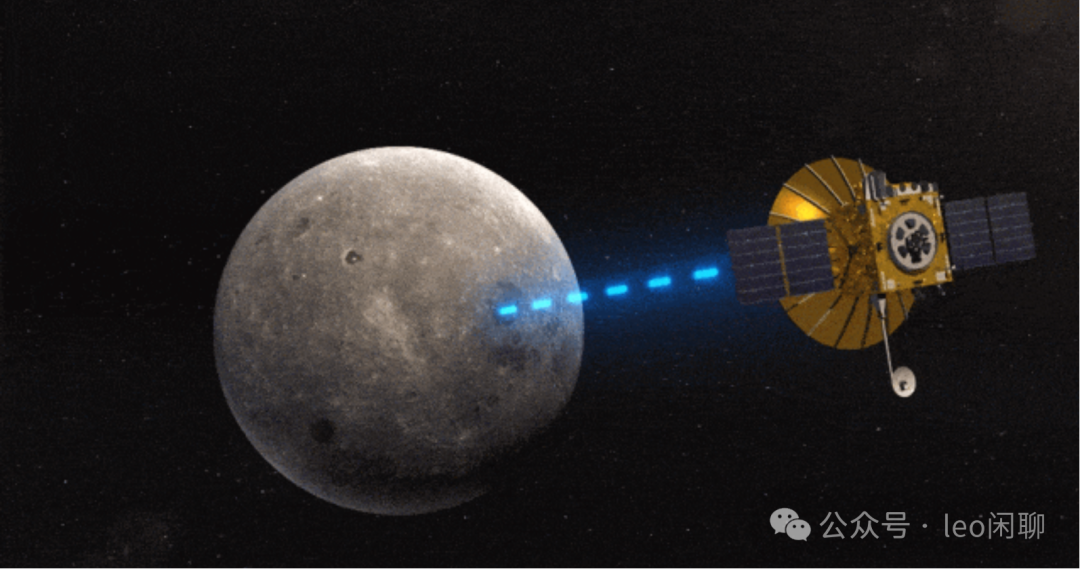
——From Communication Blind Spots to Global Coverage, How China Established Lunar Information Dominance in Ten Years
🌕“Laser Beacon” 380,000 Kilometers Away
Deep within the Shackleton Crater at the Moon’s South Pole, a laser pierces the eternal darkness — the Chang’e 7 lander transmits 4K high-definition lunar soil analysis data back to Earth in real-time via the Queqiao II Relay Satellite. Meanwhile, the U.S. “Athena” lander crashed into the Tycho Crater due to communication failure. This silent game across 380,000 kilometers reveals a harsh reality: whoever controls lunar communication holds the lifeline of deep space exploration.
🛰️1. The Queqiao Family: The Technological Leap of China’s Tianlian
1. Three Generations of Satellites: From Single Point Relay to Constellation Networking
- Queqiao I (2018): The world’s first relay satellite for the far side of the Moon, weighing about 448 kg, with a design life of 5 years. Equipped with a 4.2-meter umbrella antenna, RCS only 0.001㎡ (stealth level), operating in a halo orbit at the Earth-Moon L2 point, supporting Chang’e 4 to achieve the first human landing on the far side of the Moon. However, the bandwidth is only 2 Mbps, equivalent to 2G network levels.
- Queqiao II (2024): A fully upgraded “deep space relay fortress,” weighing 1.2 tons, with a lifespan exceeding 8 years. It adopts a dual antenna architecture: a 4.2-meter main antenna (bandwidth 1.2 Gbps) + a 0.6-meter auxiliary antenna (precise control), increasing data transmission speed by 600 times, capable of simultaneously supporting three-way interconnection of rovers, landers, and orbiters.
- Queqiao Constellation (2030 Plan): Composed of three DRO orbit satellites, achieving 24-hour coverage of the entire Moon. Inter-satellite laser link delay < 0.5 seconds, positioning accuracy reaches sub-meter level — equivalent to establishing a “Beidou + 5G” integrated network on the Moon.
2. Core Technology: Solving the Century-Old Problem of Far Side Communication
- Orbital Revolution:
- Queqiao I: Performs quasi-periodic motion around the Earth-Moon L2 point (6.5 million km from the Moon), requiring monthly orbital maintenance.
- Queqiao II: Adopts a large elliptical frozen orbit, with a perigee of 300 km (high-speed communication) and an apogee of 8600 km (wide area coverage), with a single communication window lasting up to 8 hours, reducing fuel consumption by 82%.
- Extreme Environment Resistance:
- Temperature tolerance: -180℃ (lunar night) to +120℃ (sunlight), relying on ceramic-metal composite armor + Plutonium-238 nuclear battery for all-weather operation.
- Radiation-resistant chips: 100% domestically produced, capable of withstanding cosmic ray intensity up to 100 krad (U.S. military standard is only 50 krad).
📊2. U.S.-China Showdown: Insights into Lunar Communication Capabilities
Comparison of Key Indicators for Earth-Moon Communication Systems
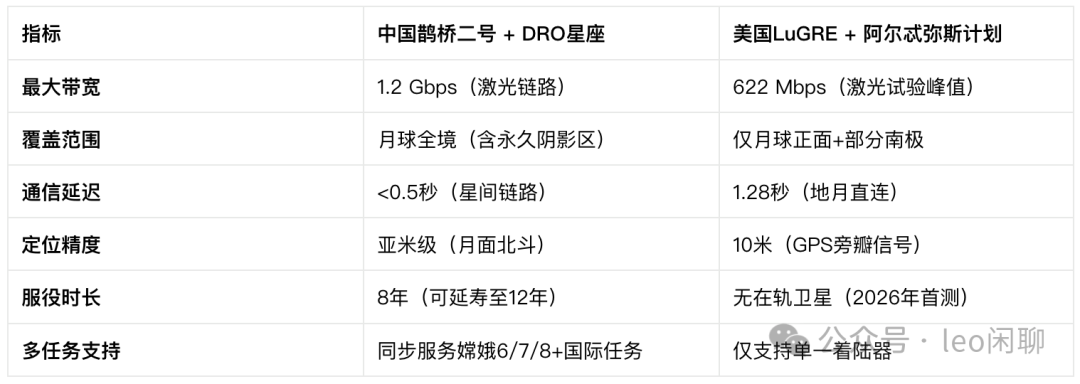
The U.S. Technological Predicament: The Choked “Throat of Deep Space”
- Laser Communication Lag: NASA’s Artemis II mission will not test lunar laser communication until 2026, relying on Australian ground stations for relay, with actual bandwidth only 1/2 of that of Queqiao II.
- Constellation Construction Gap: The U.S. currently has no plans for a dedicated lunar communication satellite network, and the Deep Space Network (DSN) 70-meter antenna is aging, with a failure rate as high as 23% (2024 data).
- Loss of Control over the Far Side: Due to the lack of relay satellite support, the U.S. CLPS program has failed three consecutive lunar landings on the far side, with the most recent crash site only 37 kilometers from Chang’e 6.
⚡3. Strategic High Ground: Why Communication Rights = Lunar Sovereignty?
1. Military Applications: A Closed Loop from Reconnaissance to Strike
- Global Surveillance: Queqiao II is equipped with a UV camera capable of identifying lunar surface objects at 0.5-meter resolution (such as landers and missile launchers), with a resolution exceeding that of the U.S. KH-12 satellite by 3 times.
- Real-time Command: In the 2025 Chang’e 7 drill, the Yutu-3 rover received commands from Queqiao, adjusting its path to avoid a crater within 10 seconds — while the U.S. lunar rover relies on ground commands with a 3-minute delay.
- Anti-Satellite Potential: The K-band microwave of the DRO constellation can interfere with enemy satellite communications, with a power density reaching 100 W/m² (blindness critical value).
2. Resource Competition: The “Information Dominance” of Water Ice Data
- South Pole Water Ice Mapping: Queqiao II’s radar penetrates 10 meters of lunar soil, accurately locating the water ice reserves in Shackleton Crater (over 100 million tons), with an error of < 3%.
- Mining Rights Competition: China, leveraging its data advantage, signed agreements with Russia and Saudi Arabia for 51% priority mining rights for water ice, forcing the U.S. Artemis base to move 400 kilometers south.
3. Standard Setting: China Writes the Lunar Constitution
- Frequency Band Control: Queqiao monopolizes the S/X/Ka frequency bands, requiring European and American probes to pay 30% patent fees to access.
- Navigation Dominance: The “Lunar Beidou” to be completed in 2030 will force European and American probes to switch entirely to the Chinese coordinate system — akin to a lunar version of GPS global dominance.
🚀4. Future Battlefield: The 2040 Lunar Internet War
China’s Roadmap: From Satellites to Deep Space Internet
- 2026: Launch of Queqiao III, achieving 100% coverage of Earth-Moon laser communication network
- 2028: Chang’e 8 to validate 3D-printed communication stations on the Moon, reducing costs to 1/20 of Earth deployment
- 2035: Establishment of an international lunar research station, equipped with terahertz frequency star links, with speeds exceeding 100 Gbps
- 2040: Expansion to Mars, constructing a Earth-Moon-Mars quantum communication triangular network.
The U.S. Countermeasure Predicament: Dual Kill of Cost and Technology
- Passive Laser Communication: NASA’s RealTOR system uses civilian components, with insufficient radiation resistance, and the failure rate due to lunar dust erosion reaches 38%.
- Collapse of the Ally System: The European Space Agency’s “Moonlight Project” abandoned U.S. standards due to frequency band conflicts, opting to procure Chinese Tiandu satellite receivers.
🔥When the Moon Rises with China’s Manufactured “Starlink Great Wall”
“Queqiao is not just a communication satellite, but a Maginot Line in deep space.” — Former NASA Administrator Bridenstine privately warned the White House.
As the laser beam of Queqiao II pierces the eternal night of the far side of the Moon, and the DRO constellation weaves a golden web at the gravitational balance point, China is transforming the romantic imagination of its ancestors’ “Chang’e Flying to the Moon” into a strategic iron curtain of the information age.