Star and follow us ⭐️Don’t miss the exciting content
With the explosive growth of the new energy vehicle and rail transit businesses, Huichuan Technology achieved good performance in the first half of this year, while its general automation business also maintained steady growth. In this issue, we are preparing to disassemble a product from its general automation business – the H3U series PLC.
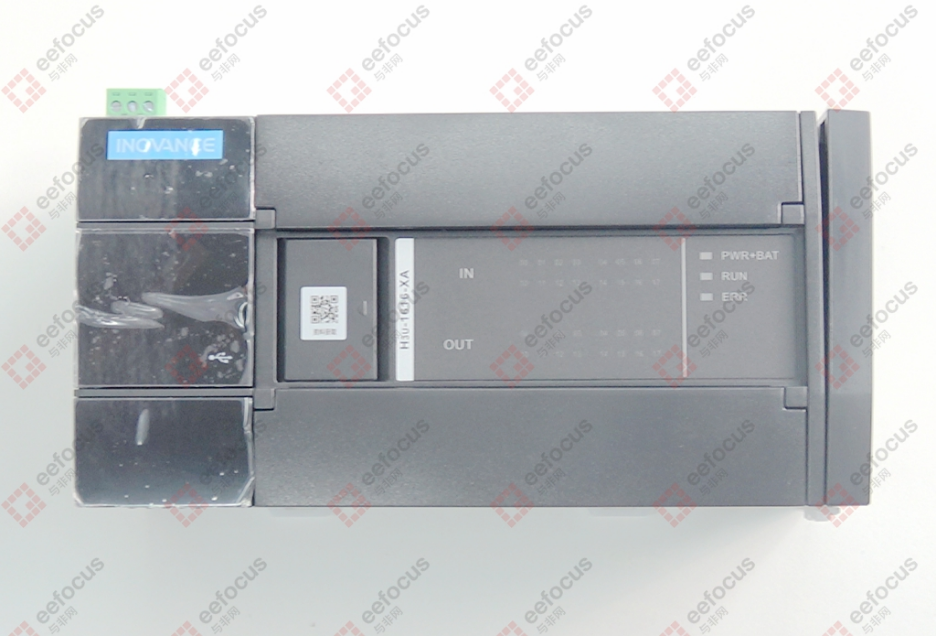
The H3U series PLC is a small PLC with a conventional appearance. The hollow design on the side is for heat dissipation, and all interfaces have plastic protective covers to prevent dust when not in use, which is a thoughtful design.
More exciting disassemblies
Please click to follow and star Eefocus
Scan to reply“Trial” to join the trial group for free trials
Disassembly
After disassembling the PLC, we can see the entire structural layout and internal hardware situation: a standard main control board + I/O interface board + power supply board. These three PCB boards are stacked together through connectors, and some of the main components on the PCB are coated with conformal coating to ensure stable operation.
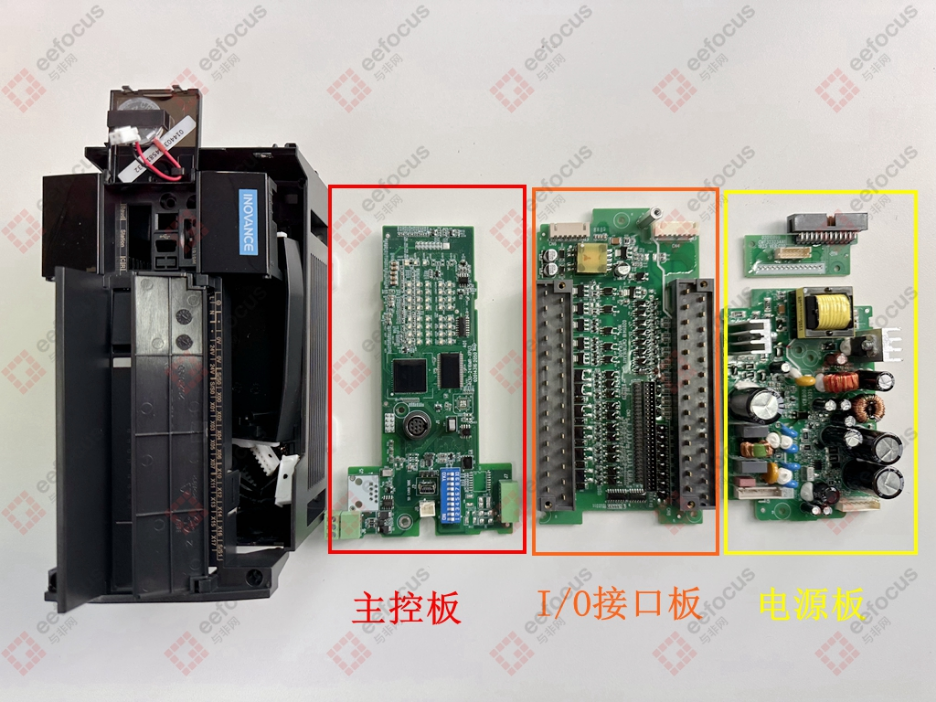
Let’s take a look at the components on each PCB board.
Main Control Board
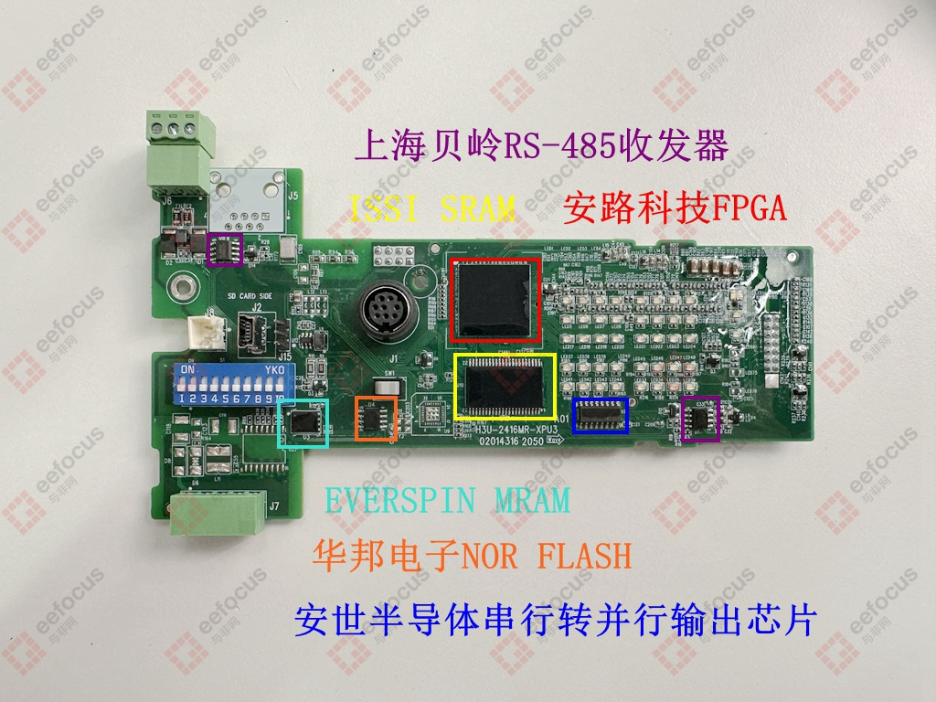
FPGA from Anlogic Technology, model EG4X20BG256;
ISSI’s 2Mbit SRAM, model IS62WV12816FBLL-45TLI;
Ansem Semiconductor’s 74 series 8-bit serial-to-parallel output chip, model 74HC595D, features high speed, low power consumption, and simple operation, used for driving LEDs;
Shanghai Beiling’s RS-485 low-power transceiver, model BL3085B, provides a standard industrial communication interface for communication between PLC and HMI, frequency converters, etc., with significant domestic substitution, comparable to TI SN65HVD or ADI ADM2483;
Winbond Electronics’ 8Mbit SPI NOR FLASH, model W25Q80DVNIG, a mainstream choice for storing PLC operating systems, user programs (ladder diagrams, etc.), configuration data, etc., with data retention after power loss;
EVERSPIN’s serial MRAM chip, also known as magnetic random access memory, model MR25H10CDF;
The selection of components above is particularly notable for the MRAM, which has an almost unlimited write-erase cycle life, making it especially suitable for applications with frequent writes (such as recording real-time status, event logs, and power loss protection data). Additionally, its write speed is very fast, close to SRAM speed, supporting power loss retention; furthermore, it is non-volatile storage, so combined with its fast write speed, it can quickly save critical operational status or log data from SRAM to MRAM during a power loss moment provided by backup capacitors, allowing the system to recover from MRAM upon restart.
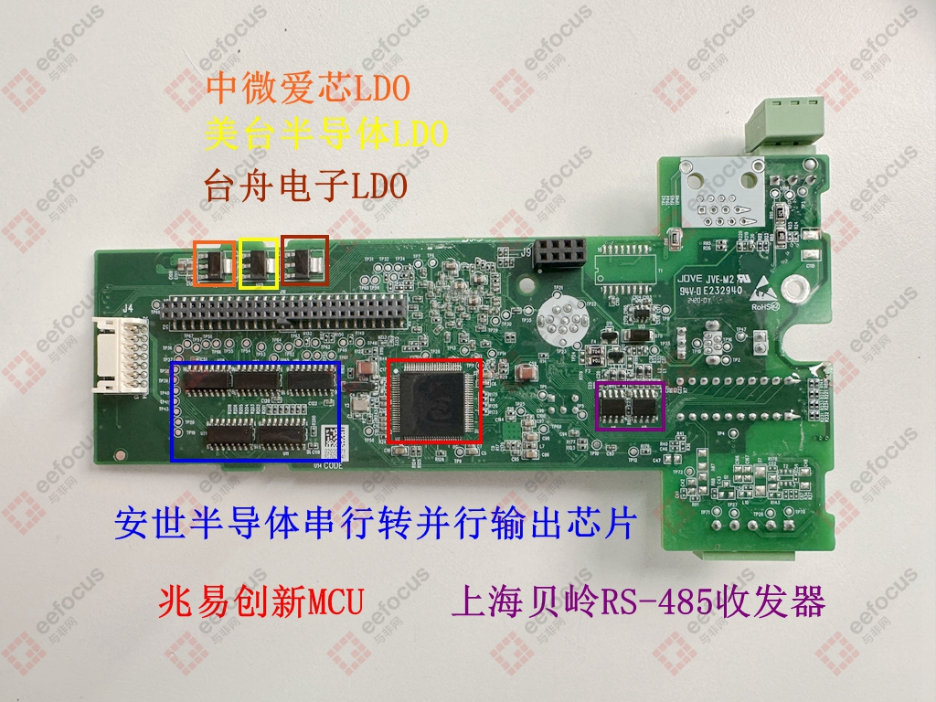
Gigadevice’s 32-bit MCU, model GD32F470VGT, based on the Arm Cortex-M4 processor, supports a maximum frequency of 240MHz, which is quite powerful for a medium-sized PLC;
Shanghai Beiling’s RS-485 communication low-power transceiver product (BL3085B), same model as the front two;
Ansem Semiconductor’s serial-to-parallel output chip (74HC595D), same model as the front;
Taizhou Electronics’ LDO, model LD1117-1.2;
Meitai Semiconductor’s LDO, model EH11A;
Zhongwei Aixin’s LDO, model AiP1117-3.3.
I/O Interface Board
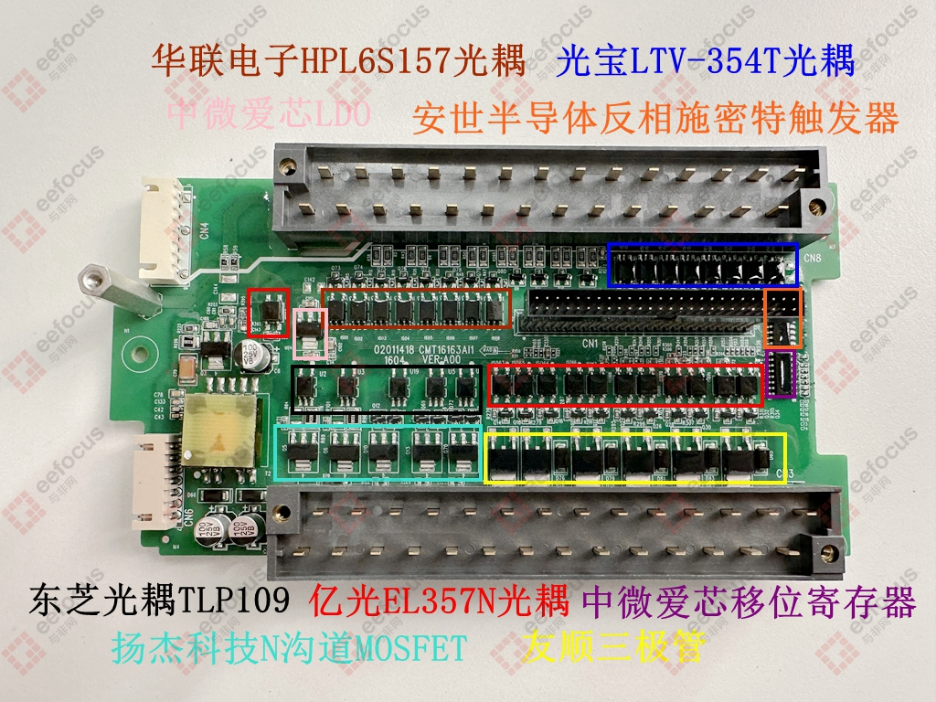
From the circuit layout of the I/O interface board, the top is the input end, and the bottom is the transistor output end, with the following specific components involved:
Zhongwei Aixin’s shift register, model AIP74HC165, an 8-bit parallel input/serial output chip, actually used to expand the number of digital input channels by serializing multiple parallel input signals (such as buttons, sensors) into the MCU.
Ansem Semiconductor’s six-channel inverting Schmitt trigger, model 74HC14D, mainly used for signal shaping, key debounce, or providing inverting logic functions.
Lite-On’s LTV-354T high-speed optocoupler, Hualian Electronics’ HPL6S157 high-speed optocoupler, Everlight’s EL357N optocoupler, Toshiba’s TLP109 optocoupler;
Zhongwei Aixin’s linear regulator, model AiP1117-3.3;
Youshun transistor, model HJ44H11L;
Yangjie Technology’s N-channel enhancement MOSFET, model YJM04N10A.
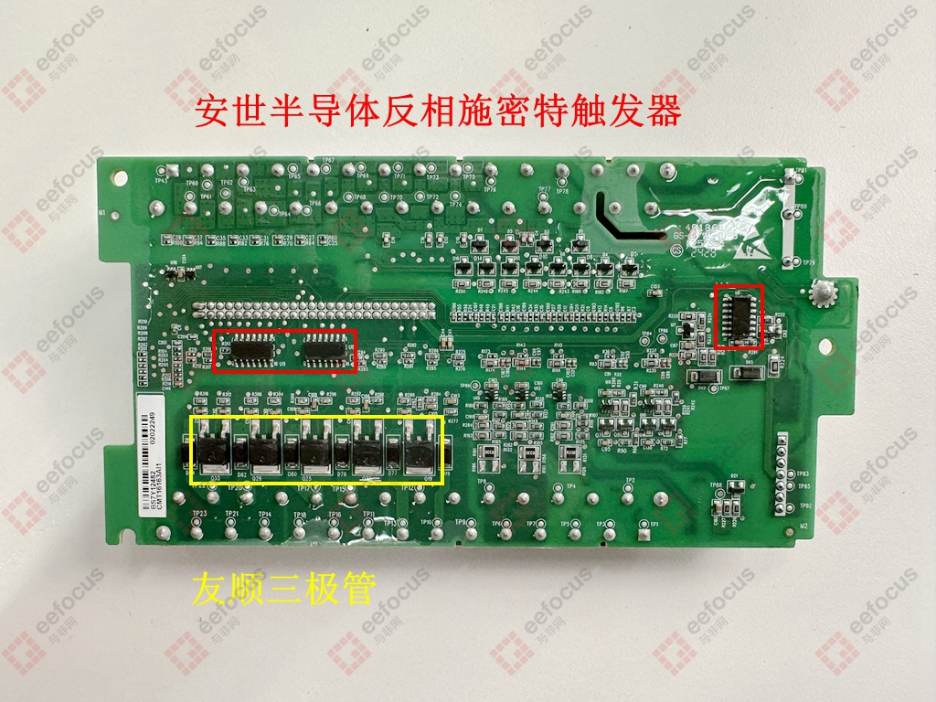
The back of the I/O interface board still contains Youshun transistor (HJ44H11L) and Ansem Semiconductor’s six-channel inverting Schmitt trigger (74HC14D).
Power Supply Board
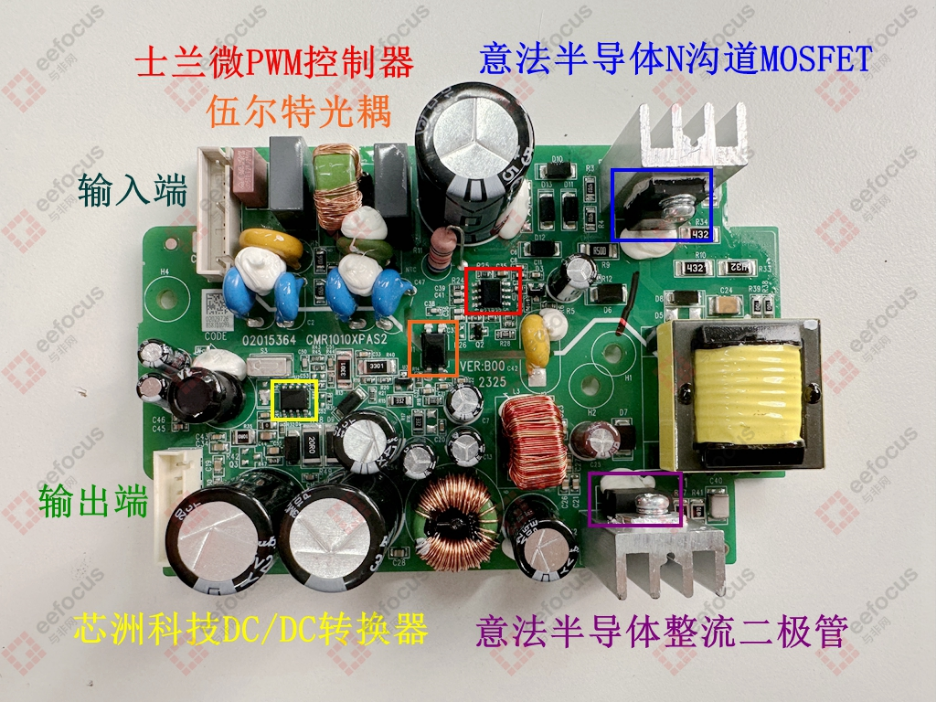
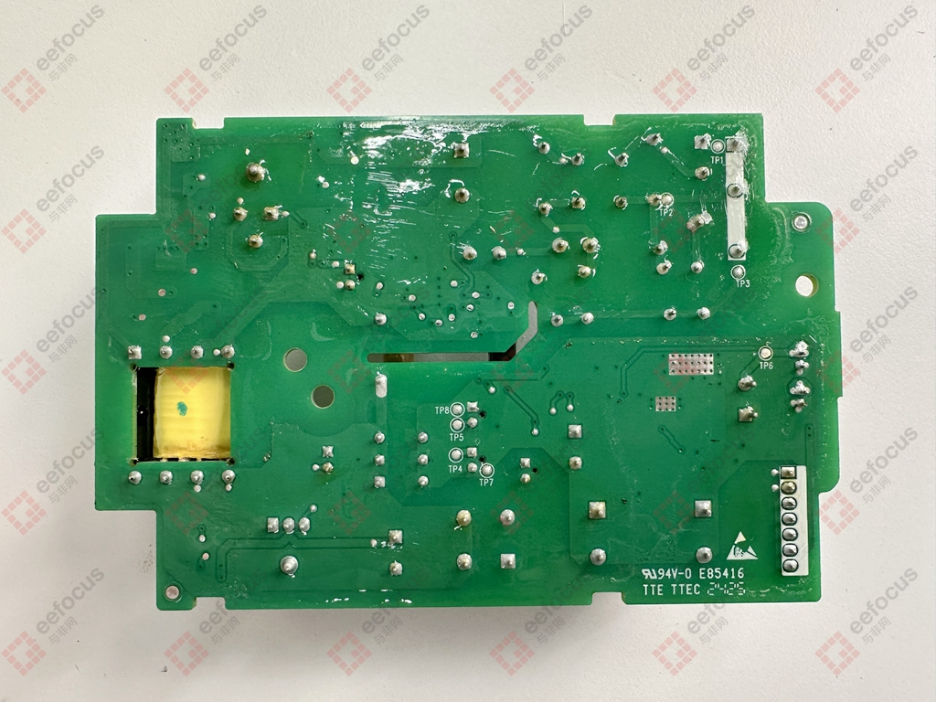
Everyone should be more familiar with the power supply board. The white silk-screened wire coming out of the transformer divides the power supply board into primary and secondary sides:
The primary side is the input end, mainly containing protection circuits and EMI filtering networks;
The secondary side is the output end, basically consisting of filter capacitors.
The input end includes fuses, varistors, thermistors, safety capacitors, common mode inductors, Y capacitors, and large filter aluminum electrolytic capacitors, with rectification achieved through four diodes.
The switch-mode power supply control circuit on the primary side is implemented through Silan Micro’s PWM controller (SAP2844E) and STMicroelectronics’ N-channel MOSFET (STF6N95K5);
The rectification circuit on the secondary side is implemented through STMicroelectronics’ rectifier diode (STTH1002CT). The optocoupler from Würth (model 140816141310) is used to collect the voltage at the output end and feedback to the PWM controller to achieve stable output.
Additionally, there is further step-down conversion at the output end, achieved through Chipsea Technology’s DCDC synchronous buck converter (model SCT2430).
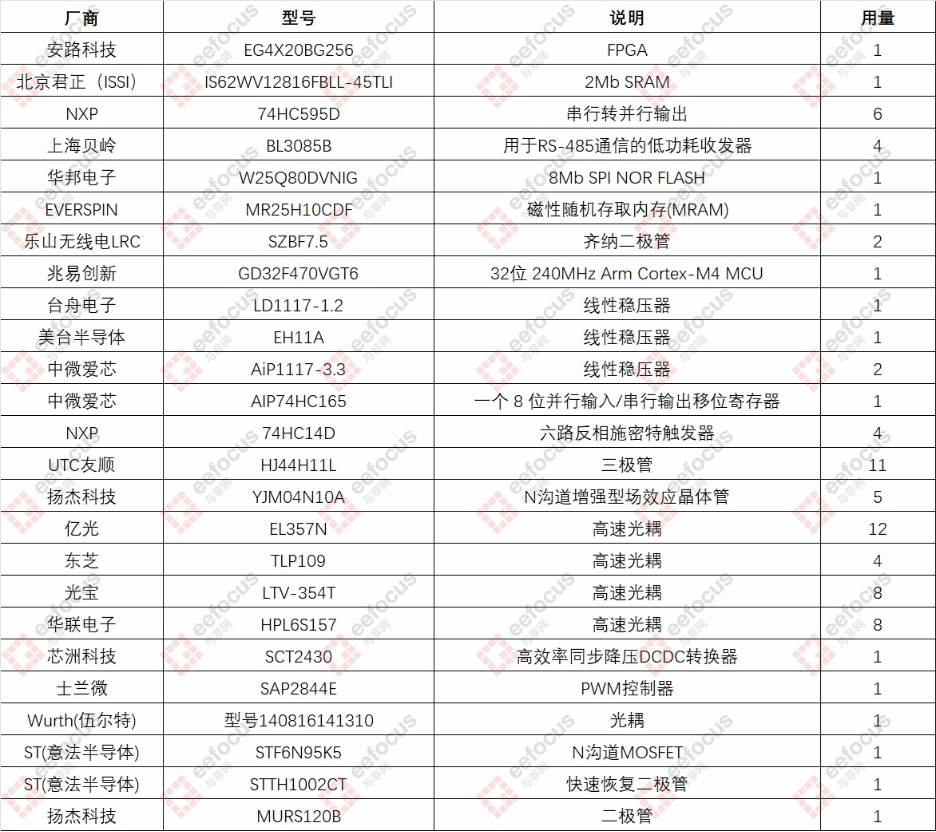
The main component selection situation on Huichuan Technology’s H3U series PLC is as follows (for reference):
Click to play
Summary
Through the disassembly of Huichuan Technology’s H3U series PLC, we clearly understand its internal structure and hardware selection:
Structurally, it adopts a main control board + I/O interface board + power supply board, stacked with 3 PCB boards;
In terms of component selection, domestic chips account for the majority, with the highlight being the practical appearance of domestic FPGA in industrial products.
What do you think of the entire solution? Feel free to leave a comment for discussion!
END
Note: The cover image of this article comes from freepik, self-made by the author, and publicly available media, all authorized.
Industry Community


Related Recommendations

Disassembly of Tesla Model 3 Headlight Driver Board: Unexpected Findings
Disassembly of Huawei Wi-Fi 7 Router: Complete Localization
Tap “Looking”↘ to share your world with friends
 Please click “Read the original text” to see more information