1. Founding Time and Author
-
Founding Time:
<span>hashlib</span>module was first released as part of the Python core library with Python 2.5 in September 2006, replacing the older<span>md5</span>and<span>sha</span>modules. -
Core Developers:
-
Gregory P. Smith: Core Python developer, main implementer of hashlib
-
Python Security Team: Includes cryptography experts like Christian Heimes
-
Open Source Community Contributions: Cryptography researchers from around the world participate in algorithm optimization
-
Design Purpose: To provide a unified interface for secure hash algorithms and message digest functions, ensuring data integrity and cryptographic security
2. Official Resources
-
Python Documentation URL:https://docs.python.org/3/library/hashlib.html
-
Source Code Location:Python Standard Library
<span>/Lib/hashlib.py</span> -
Related Standards:FIPS 180-4 (SHA Standard)RFC 1321 (MD5)
-
Learning Resources:Python hashlib TutorialGuide to Cryptographic Hash Functions
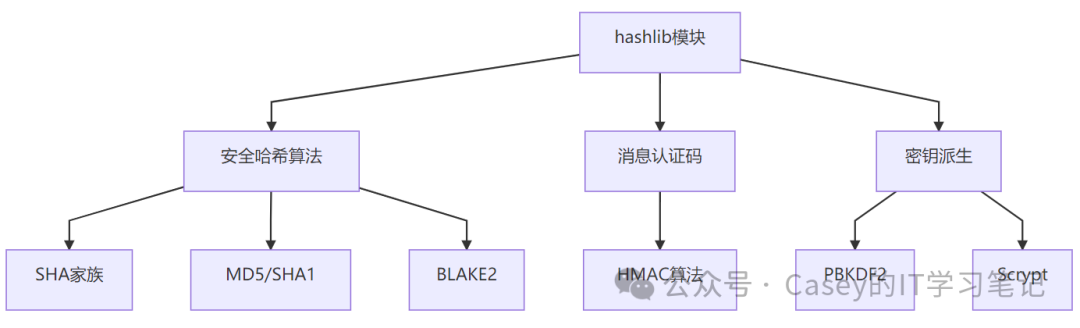
3. Core Functions
4. Application Scenarios
1. Password Storage and Verification
import hashlib
import os
import secrets

def hash_password(password):
    """Securely hash a password"""
    # Generate a random salt
    salt = secrets.token_bytes(32)

    # Use PBKDF2 for key derivation
    password_hash = hashlib.pbkdf2_hmac(
        'sha256',           # Hash algorithm
        password.encode(),  # Password byte string
        salt,               # Salt
        100000              # Iteration count
    )

    return salt+password_hash

def verify_password(password, stored_hash):
    """Verify a password"""
    # Extract salt and hash
    salt = stored_hash[:32]
    original_hash = stored_hash[32:]

    # Recalculate hash
    new_hash = hashlib.pbkdf2_hmac(
        'sha256',
        password.encode(),
        salt,
        100000
    )

    # Use secrets.compare_digest to prevent timing attacks
    return secrets.compare_digest(new_hash, original_hash)

# Example usage
password = "my_secure_password"
hashed = hash_password(password)
print(f"Password hash: {hashed.hex()}")

# Verify password
is_valid = verify_password("my_secure_password", hashed)
print(f"Password verification: {is_valid}")
2. File Integrity Check
import hashlib
import os

def calculate_file_hash(file_path, algorithm='sha256', chunk_size=8192):
    """Calculate file hash"""
    hash_func = hashlib.new(algorithm)

    with open(file_path, 'rb') as f:
        while chunk := f.read(chunk_size):
            hash_func.update(chunk)

    return hash_func.hexdigest()

def verify_file_integrity(file_path, expected_hash, algorithm='sha256'):
    """Verify file integrity"""
    actual_hash = calculate_file_hash(file_path, algorithm)
    return secrets.compare_digest(actual_hash, expected_hash)

# Calculate SHA256 for a large file
file_path = 'large_file.iso'
file_hash = calculate_file_hash(file_path)
print(f"SHA256 of file {file_path}: {file_hash}")

# Verify if the file has been tampered with
expected_hash = "a1b2c3d4e5f6..."
is_valid = verify_file_integrity(file_path, expected_hash)
print(f"File integrity: {'Passed' if is_valid else 'Failed'}")
3. Data Deduplication and Fingerprint Generation
import hashlib
from collections import defaultdict

class DataDeduplicator:
    def __init__(self):
        self.fingerprints = defaultdict(list)

    def generate_fingerprint(self, data):
        """Generate a fingerprint for data"""
        if isinstance(data, str):
            data = data.encode('utf-8')

        # Use BLAKE2b to generate a 64-bit fingerprint
        return hashlib.blake2b(data, digest_size=8).hexdigest()

    def add_data(self, data, metadata=None):
        """Add data and check for duplicates"""
        fingerprint = self.generate_fingerprint(data)

        if fingerprint in self.fingerprints:
            print(f"Duplicate data found: {fingerprint}")
            return False
        else:
            self.fingerprints[fingerprint].append(metadata or {})
            return True

    def find_duplicates(self, data_list):
        """Find duplicates in a list of data"""
        seen = {}
        duplicates = []

        for i, data in enumerate(data_list):
            fingerprint = self.generate_fingerprint(data)
            if fingerprint in seen:
                duplicates.append((seen[fingerprint], i))
            else:
                seen[fingerprint] = i

        return duplicates

# Example usage
dedup = DataDeduplicator()

data_items = [
    "Hello World",
    "Hello World",  # Duplicate
    "Hello Python",
    "Hello World",  # Duplicate
    "Hello Java"
]

for data in data_items:
    dedup.add_data(data)

print(f"Fingerprint database size: {len(dedup.fingerprints)}")
4. Digital Signatures and HMAC
import hashlib
import hmac
import secrets

class MessageAuthenticator:
    def __init__(self, secret_key=None):
        self.secret_key = secret_key or secrets.token_bytes(32)

    def create_hmac(self, message, algorithm='sha256'):
        """Create HMAC signature"""
        if isinstance(message, str):
            message = message.encode('utf-8')

        return hmac.new(
            self.secret_key,
            message,
            algorithm
        ).hexdigest()

    def verify_hmac(self, message, received_hmac, algorithm='sha256'):
        """Verify HMAC signature"""
        expected_hmac = self.create_hmac(message, algorithm)
        return secrets.compare_digest(expected_hmac, received_hmac)

    def sign_data(self, data):
        """Sign data (including timestamp)"""
        import time
        timestamp = str(int(time.time()))
        message = timestamp + '|' + data
        signature = self.create_hmac(message)

        return {
            'data': data,
            'timestamp': timestamp,
            'signature': signature
        }

# Example usage
authenticator = MessageAuthenticator()

# Sign message
signed_msg = authenticator.sign_data("Important transaction data")
print(f"Signed message: {signed_msg}")

# Verify signature
is_valid = authenticator.verify_hmac(
    f"{signed_msg['timestamp']}|{signed_msg['data']}",
    signed_msg['signature']
)
print(f"Signature verification: {is_valid}")
5. Underlying Logic and Technical Principles
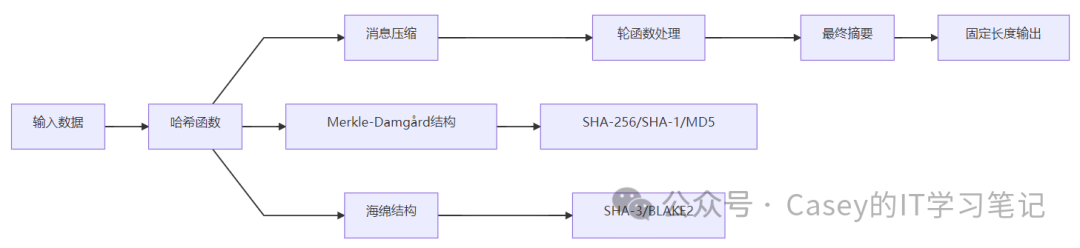
Core Architecture
Key Technologies
-
Hash Algorithm Structure:
-
Merkle-Damgård: Used by SHA-256, SHA-1, MD5
-
Sponge Structure: Used by SHA-3 (Keccak)
-
HAIFA Structure: Used by BLAKE2
Cryptographic Properties:
-
Collision Resistance: Difficult to find two different inputs that produce the same hash value
-
Pre-image Resistance: Difficult to reverse-engineer the original input from the hash value
-
Second Pre-image Resistance: Given an input, difficult to find another input that produces the same hash value
Algorithm Implementation:
-
OpenSSL Backend: Most algorithms use OpenSSL implementation
-
Pure Python Fallback: Used when OpenSSL is not available
-
Hardware Acceleration: Supports hardware acceleration instructions like AES-NI
Security Considerations:
-
Use of Salt: Prevents rainbow table attacks
-
Iteration Count: Increases the cost of brute-force attacks
-
Timing Security: Uses
<span>secrets.compare_digest</span>to prevent timing attacks
6. Core Algorithms and Performance
Supported Hash Algorithms
| Algorithm | Output Length | Security | Performance | Applicable Scenarios |
|---|---|---|---|---|
| MD5 | 128 bits | Broken | Fast | Non-secure scenarios, checksums |
| SHA-1 | 160 bits | Broken | Fast | Non-secure scenarios, version control |
| SHA-256 | 256 bits | Secure | Medium | Digital signatures, certificates |
| SHA-512 | 512 bits | Secure | Medium | High security requirement scenarios |
| SHA-3 | Variable | Secure | Slow | Long-term security, replacement for SHA-2 |
| BLAKE2 | Variable | Secure | Fast | High performance requirements, modern applications |
| BLAKE3 | Variable | Secure | Very fast | Extreme performance requirements |
Performance Benchmarking
import hashlib
import timeit

def benchmark_algorithm(algorithm, data_size=1024*1024):
    """Benchmark hash algorithm performance"""
    data = b'a'*data_size

def hash_operation():
        h = hashlib.new(algorithm)
        h.update(data)
        return h.hexdigest()

    # Execute time test
    time_taken = timeit.timeit(hash_operation, number=100)
    speed = (data_size*100) / time_taken / (1024*1024)  # MB/s

    return speed

# Test performance of different algorithms
algorithms = ['md5', 'sha1', 'sha256', 'sha512', 'blake2b', 'blake2s']
print("Hash algorithm performance comparison (MB/s):")
for algo in algorithms:
    try:
        speed = benchmark_algorithm(algo)
        print(f"{algo:8} : {speed:6.1f} MB/s")
    except ValueError:
        print(f"{algo:8} : Not supported")
7. Installation and Usage
No Installation Required
-
Built-in Module: Part of the Python standard library (Python ≥ 2.5)
-
Import Method:
import hashlib
Optional Algorithm Support
import hashlib

# Check available hash algorithms
available = hashlib.algorithms_available
guaranteed = hashlib.algorithms_guaranteed

print("Available algorithms:", sorted(available))
print("Guaranteed algorithms:", sorted(guaranteed))
Version Compatibility
| Python Version | Important Updates |
|---|---|
| 2.5+ | Basic hashlib functionality |
| 3.4+ | Added <span>hashlib.pbkdf2_hmac()</span> |
| 3.6+ | Added BLAKE2 support |
| 3.9+ | Added <span>hashlib.file_digest()</span> |
| 3.11+ | Performance optimizations, added SHA3 acceleration |
Basic Usage Example
import hashlib

# Basic hash calculation
text = "Hello, World!"
text_hash = hashlib.sha256(text.encode()).hexdigest()
print(f"SHA256: {text_hash}")

# Incrementally update data
hasher = hashlib.sha256()
hasher.update(b"Hello, ")
hasher.update(b"World!")
final_hash = hasher.hexdigest()
print(f"Incremental SHA256: {final_hash}")

# Using different algorithms
algorithms = ['md5', 'sha1', 'sha256', 'sha512']
for algo in algorithms:
    hash_obj = hashlib.new(algo)
    hash_obj.update(text.encode())
    print(f"{algo:6}: {hash_obj.hexdigest()}")
8. Advanced Usage Techniques
1. Secure Password Hashing
import hashlib
import secrets
import base64

class PasswordManager:
    def __init__(self, iterations=100000):
        self.iterations = iterations

    def create_hash(self, password):
        """Create a secure password hash"""
        salt = secrets.token_bytes(32)
        hash_bytes = hashlib.pbkdf2_hmac(
            'sha256',
            password.encode('utf-8'),
            salt,
            self.iterations
        )
        # Combine salt and hash
        combined = salt + hash_bytes
        return base64.b64encode(combined).decode('utf-8')

    def verify_hash(self, password, encoded_hash):
        """Verify password"""
        try:
            # Decode base64
            combined = base64.b64decode(encoded_hash.encode('utf-8'))
            salt = combined[:32]
            original_hash = combined[32:]

            # Calculate new hash
            new_hash = hashlib.pbkdf2_hmac(
                'sha256',
                password.encode('utf-8'),
                salt,
                self.iterations
            )

            return secrets.compare_digest(new_hash, original_hash)
        except Exception:
            return False

    def needs_rehash(self, encoded_hash, new_iterations=None):
        """Check if rehashing is needed"""
        if new_iterations is None:
            new_iterations = self.iterations

        # Simple implementation: check iteration count
        # In actual applications, may need to parse hash string
        return new_iterations > self.iterations

# Example usage
pm = PasswordManager(iterations=150000)
password = "user_password_123"
hashed = pm.create_hash(password)
print(f"Password hash: {hashed}")

# Verify
is_valid = pm.verify_hash("user_password_123", hashed)
print(f"Password correct: {is_valid}")
2. File Integrity Monitoring
import hashlib
import os
import time
from watchdog.observers import Observer
from watchdog.events import FileSystemEventHandler

class FileIntegrityMonitor(FileSystemEventHandler):
    def __init__(self, watch_directory):
        self.watch_directory = watch_directory
        self.file_hashes = {}
        self.load_existing_hashes()

    def load_existing_hashes(self):
        """Load existing file hashes"""
        for root, dirs, files in os.walk(self.watch_directory):
            for file in files:
                file_path = os.path.join(root, file)
                try:
                    file_hash = self.calculate_file_hash(file_path)
                    self.file_hashes[file_path] = file_hash
                except Exception as e:
                    print(f"Cannot calculate hash for {file_path}: {e}")

    def calculate_file_hash(self, file_path):
        """Calculate file hash"""
        hasher = hashlib.sha256()
        with open(file_path, 'rb') as f:
            for chunk in iter(lambda: f.read(4096), b""):
                hasher.update(chunk)
        return hasher.hexdigest()

    def on_modified(self, event):
        """File modification event handler"""
        if not event.is_directory:
            self.check_file_integrity(event.src_path)

    def on_created(self, event):
        """File creation event handler"""
        if not event.is_directory:
            print(f"New file created: {event.src_path}")
            time.sleep(1)  # Wait for file write to complete
            self.check_file_integrity(event.src_path)

    def check_file_integrity(self, file_path):
        """Check file integrity"""
        try:
            current_hash = self.calculate_file_hash(file_path)

            if file_path in self.file_hashes:
                if self.file_hashes[file_path] != current_hash:
                    print(f"⚠️  File modified: {file_path}")
                    # Send alert or perform other actions
                else:
                    print(f"File unchanged: {file_path}")
            else:
                print(f"New file hash: {file_path} -> {current_hash}")

            # Update hash value
            self.file_hashes[file_path] = current_hash

        except Exception as e:
            print(f"Error checking file integrity for {file_path}: {e}")

# Start file monitoring
def start_monitoring(directory):
    event_handler = FileIntegrityMonitor(directory)
    observer = Observer()
    observer.schedule(event_handler, directory, recursive=True)
    observer.start()

    try:
        while True:
            time.sleep(1)
    except KeyboardInterrupt:
        observer.stop()
    observer.join()

# Example usage
# start_monitoring("/path/to/watch")
3. Blockchain-style Hash Chain
import hashlib
import time
import json

class HashChain:
    def __init__(self):
        self.chain = []
        self.create_genesis_block()

    def create_genesis_block(self):
        """Create the genesis block"""
        genesis_data = {
            'index': 0,
            'timestamp': time.time(),
            'data': 'Genesis Block',
            'previous_hash': '0'*64,
            'nonce': 0
        }
        genesis_hash = self.calculate_block_hash(genesis_data)
        genesis_data['hash'] = genesis_hash
        self.chain.append(genesis_data)

    def calculate_block_hash(self, block_data):
        """Calculate block hash"""
        block_string = json.dumps(block_data, sort_keys=True).encode()
        return hashlib.sha256(block_string).hexdigest()

    def add_block(self, data):
        """Add a new block"""
        previous_block = self.chain[-1]

        new_block = {
            'index': len(self.chain),
            'timestamp': time.time(),
            'data': data,
            'previous_hash': previous_block['hash'],
            'nonce': 0
        }

        # Simple proof of work
        new_block['hash'] = self.proof_of_work(new_block)
        self.chain.append(new_block)
        return new_block

    def proof_of_work(self, block, difficulty=4):
        """Simple proof of work"""
        prefix = '0'*difficulty
        block['nonce'] = 0

        while True:
            block_hash = self.calculate_block_hash(block)
            if block_hash.startswith(prefix):
                return block_hash
            block['nonce'] += 1

    def verify_chain(self):
        """Verify hash chain integrity"""
        for i in range(1, len(self.chain)):
            current_block = self.chain[i]
            previous_block = self.chain[i-1]

            # Verify current block hash
            if current_block['hash'] != self.calculate_block_hash(current_block):
                return False

            # Verify connection to previous block
            if current_block['previous_hash'] != previous_block['hash']:
                return False

        return True

    def display_chain(self):
        """Display hash chain"""
        for block in self.chain:
            print(f"Block #{block['index']}:")
            print(f"  Data: {block['data']}")
            print(f"  Hash: {block['hash']}")
            print(f"  Previous Hash: {block['previous_hash']}")
            print(f"  Nonce: {block['nonce']}")
            print("-"*50)

# Example usage
chain = HashChain()
chain.add_block("First transaction")
chain.add_block("Second transaction")
chain.add_block("Third transaction")

chain.display_chain()
print(f"Chain integrity: {chain.verify_chain()}")
4. Secure Random Number Generation
import hashlib
import secrets
import time

class CryptoSafeRandom:
    def __init__(self, seed=None):
        self.state = seed or secrets.token_bytes(32)
        self.counter = 0

    def random_bytes(self, length):
        """Generate cryptographically secure random bytes"""
        result = b''

        while len(result) < length:
            # Use HMAC as a deterministic random number generator
            h = hashlib.sha256()
            h.update(self.state)
            h.update(self.counter.to_bytes(8, 'big'))
            h.update(secrets.token_bytes(8))  # Add extra entropy

            result += h.digest()
            self.counter += 1

        return result[:length]

    def random_int(self, min_val, max_val):
        """Generate a random integer within a specified range"""
        range_size = max_val - min_val + 1
        bytes_needed = (range_size.bit_length() + 7) // 8

        while True:
            random_bytes = self.random_bytes(bytes_needed)
            random_num = int.from_bytes(random_bytes, 'big')

            # Reject sampling to ensure uniform distribution
            if random_num < range_size * (2**(bytes_needed*8) // range_size):
                return min_val + (random_num % range_size)

    def shuffle(self, sequence):
        """Securely shuffle a sequence"""
        result = list(sequence)

        # Fisher-Yates shuffle algorithm
        for i in range(len(result) - 1, 0, -1):
            j = self.random_int(0, i)
            result[i], result[j] = result[j], result[i]

        return result

# Example usage
rng = CryptoSafeRandom()

# Generate random numbers
random_bytes = rng.random_bytes(16)
print(f"Random bytes: {random_bytes.hex()}")

random_number = rng.random_int(1, 100)
print(f"Random integer: {random_number}")

# Securely shuffle
deck = list(range(1, 53))
shuffled = rng.shuffle(deck)
print(f"Shuffle result: {shuffled[:10]}...")
9. Security Best Practices
1. Algorithm Selection Guide
import hashlib
from enum import Enum

class HashAlgorithm(Enum):
    """Hash algorithm security levels"""
    LEGACY = ["md5", "sha1"]           # Broken, only for compatibility
    STANDARD = ["sha256", "sha512"]    # Current standard
    MODERN = ["blake2b", "blake2s"]    # Modern algorithms
    FUTURE_PROOF = ["sha3_256", "sha3_512"]  # Long-term security

class SecurityAdvisor:
    @staticmethod
    def recommend_algorithm(use_case):
        """Recommend algorithm based on use case"""
        recommendations = {
            "password_hashing": "pbkdf2_hmac with sha256",
            "file_integrity": "blake2b",
            "digital_signature": "sha256",
            "merkle_trees": "sha256",
            "fast_hashing": "blake2b",
            "legacy_support": "sha1",  # Not recommended, only for compatibility
        }
        return recommendations.get(use_case, "sha256")

    @staticmethod
    def is_algorithm_secure(algorithm):
        """Check algorithm security"""
        insecure_algorithms = {"md5", "sha1"}
        return algorithm.lower() not in insecure_algorithms

    @staticmethod
    def get_secure_algorithms():
        """Get all secure algorithms"""
        return {
            'sha224', 'sha256', 'sha384', 'sha512',
            'sha3_224', 'sha3_256', 'sha3_384', 'sha3_512',
            'blake2b', 'blake2s'
        }

# Example usage
advisor = SecurityAdvisor()
print(f"Password hash recommendation: {advisor.recommend_algorithm('password_hashing')}")
print(f"Is SHA256 secure: {advisor.is_algorithm_secure('sha256')}")
print(f"Secure algorithms list: {sorted(advisor.get_secure_algorithms())}")
2. Migrating Insecure Hashes
import hashlib
import json

class HashMigration:
    def __init__(self):
        self.unsupported_algos = {'md5', 'sha1'}

    def needs_migration(self, hash_data):
        """Check if migration is needed"""
        if 'algorithm' not in hash_data:
            return True

        return hash_data['algorithm'] in self.unsupported_algos

    def migrate_hash(self, original_data, new_algorithm='sha256'):
        """Migrate to a new algorithm"""
        if isinstance(original_data, str):
            data_bytes = original_data.encode('utf-8')
        else:
            data_bytes = original_data

        # Calculate new hash
        new_hash = hashlib.new(new_algorithm)
        new_hash.update(data_bytes)

        return {
            'algorithm': new_algorithm,
            'hash': new_hash.hexdigest(),
            'migrated_from': getattr(original_data, 'algorithm', 'unknown'),
            'migration_timestamp': __import__('time').time()
        }

    def bulk_migrate(self, hash_database):
        """Bulk migrate hash database"""
        migrated = 0

        for key, hash_info in hash_database.items():
            if self.needs_migration(hash_info):
                # Here we need the original data to recalculate the hash
                # In actual applications, need to access the original data source
                print(f"Needs migration: {key}")
                migrated += 1

        return migrated

# Example usage
migrator = HashMigration()

# Simulated old hash data
old_hashes = {
    'file1.txt': {'algorithm': 'md5', 'hash': 'd41d8cd98f00b204e9800998ecf8427e'},
    'file2.txt': {'algorithm': 'sha1', 'hash': 'da39a3ee5e6b4b0d3255bfef95601890afd80709'},
    'file3.txt': {'algorithm': 'sha256', 'hash': 'e3b0c44298fc1c149afbf4c8996fb92427ae41e4649b934ca495991b7852b855'}
}

migration_count = migrator.bulk_migrate(old_hashes)
print(f"Items needing migration: {migration_count}")
10. Comparison with Similar Tools
hashlib vs hashlib2
| Feature | hashlib | hashlib2 |
|---|---|---|
| Python Version | 2.5+ | 3.6+ |
| Algorithm Support | Comprehensive | Extended algorithms |
| Performance | Well optimized | Experimental optimizations |
| Security | Audited | Community reviewed |
| Maintenance Status | Officially maintained | Community maintained |
| Recommended Use | Production environment | Experimental features |
hashlib vs cryptography
| Feature | hashlib | cryptography |
|---|---|---|
| Functionality Scope | Basic hashing | Complete cryptographic suite |
| Ease of Use | Simple | Moderate |
| Algorithm Support | Basic algorithms | Comprehensive algorithms |
| Performance | Excellent | Excellent |
| Dependencies | None | Requires installation |
| Applicable Scenarios | Basic hashing needs | Advanced cryptographic operations |
Comprehensive Comparison Table
| Tool | Type | Learning Curve | Functionality Scope | Security | Recommended Scenarios |
|---|---|---|---|---|---|
| hashlib | Standard Library | Simple | Basic hashing | High | Everyday hashing needs |
| cryptography | Third-party Library | Moderate | Complete cryptography | Very high | Professional cryptographic applications |
| passlib | Third-party Library | Simple | Password hashing | High | Password storage verification |
| bcrypt | Third-party Library | Simple | Password hashing | Very high | Password secure storage |
| argon2-cffi | Third-party Library | Simple | Password hashing | Very high | Modern password hashing |
Summary
<span>hashlib</span> is the cornerstone of cryptographic hashing in Python, with core values in:
-
Security and Reliability: Implemented based on mature cryptographic algorithms
-
Ease of Use: Unified API interface, low learning cost
-
Excellent Performance: Optimized with C at the lower level, supports hardware acceleration
-
Comprehensive Functionality: Supports various scenarios from basic hashing to key derivation
Technical Highlights:
# Typical secure hash workflow
import hashlib
import secrets

# Secure password hashing
def secure_password_hash(password):
    salt = secrets.token_bytes(32)
    return hashlib.pbkdf2_hmac('sha256', password.encode(), salt, 100000)

# File integrity verification
def verify_file_integrity(filepath, expected_hash):
    with open(filepath, 'rb') as f:
        actual_hash = hashlib.file_digest(f, 'sha256').hexdigest()
    return secrets.compare_digest(actual_hash, expected_hash)

# Data fingerprint generation
def generate_data_fingerprint(data):
    return hashlib.blake2b(data, digest_size=32).hexdigest()
Applicable Scenarios:
-
Password secure storage and verification
-
File integrity checks
-
Data deduplication and fingerprint recognition
-
Digital signatures and message authentication
-
Blockchain and Merkle trees
-
Secure random number generation
Best Practices:
-
Avoid using broken algorithms like MD5 and SHA-1
-
Use PBKDF2, bcrypt, or argon2 for password hashing
-
Use SHA-256 or BLAKE2 for file hashing
-
Use
<span>secrets.compare_digest</span>for comparing hash values -
Add random salt for password hashing
-
Regularly evaluate and migrate hash algorithms
Installation and Usage:
# Part of the Python standard library, no installation required
import hashlib
Learning Resources:
-
Official Documentation:hashlib – Secure Hashes and Message Digests
-
Cryptography Guide:Practical Cryptography for Developers
-
Security Practices:OWASP Cryptographic Storage Cheat Sheet
-
In-depth Understanding:Hash Functions and Their Applications
As part of the Python standard library, the <span>hashlib</span> module provides developers with powerful and secure hashing capabilities, serving as a foundational tool for data integrity verification and cryptographic applications, widely used in various security-sensitive scenarios.