Since its debut in 2000, the SD (Secure Digital) memory card has become the most widely used portable storage medium globally. From digital cameras, smartphones, drones, single-board computers, to the latest portable gaming consoles, SD cards are ubiquitous. According to official data released by the SD Association (http://www.sdcard.org/) on May 21, 2025, the total number of SD cards and microSD cards sold worldwide has exceeded 12 billion cards.
SD Card Standards
The standards for SD cards are set by the SD Association. Since the release of version 1.0 in 2000, the standards have undergone five significant revisions, with the latest major standard version being SD 9.1.
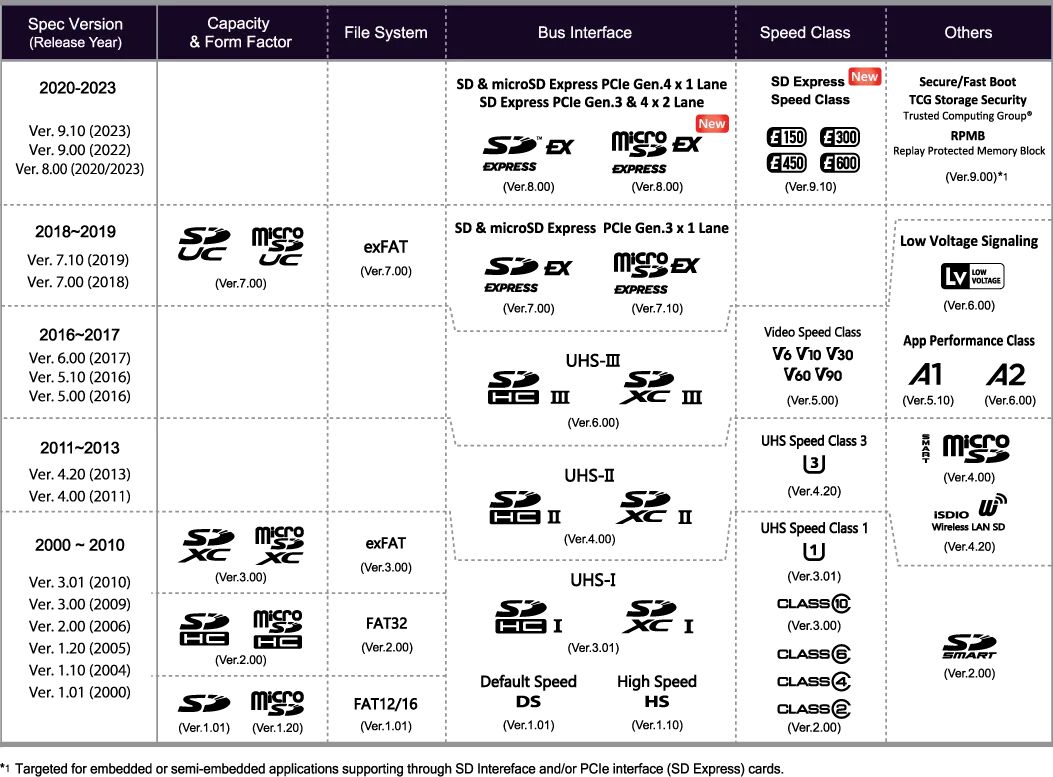 Image Source: https://www.sdcard.org/developers/sd-standard-overview/
First Major Revision: Entering the High Capacity Era (SDHC)
-
Standard Version: SD 2.0 (2006)
-
Core Changes:
-
Capacity Breakthrough of 2GB: Introduced the SDHC (High Capacity) standard, increasing the maximum capacity from 2GB to 32GB.
-
Change in Addressing Method: Changed from Byte Addressing to Block Addressing, to efficiently manage larger capacity space.
-
Mandatory Use of FAT32: Specified that SDHC cards must use the FAT32 file system.
Industry Impact: This was the first major leap in the history of SD card development, laying the storage foundation for the popularization of high-definition photos and videos. Older devices that do not support SDHC cannot read this new card.
Second Major Revision: Expanding Capacity and the First High-Speed Bus (SDXC & UHS-I)
-
Standard Version: SD 3.0 (2009)
-
Core Changes:
-
Capacity Leap Again: Introduced the SDXC (eXtended Capacity) standard, significantly increasing the theoretical maximum capacity from 32GB to 2TB.
-
Introduction of UHS-I Bus: First introduced the UHS (Ultra High Speed) bus interface, with a theoretical speed limit of 104 MB/s, far exceeding the previous High Speed mode (25 MB/s).
-
Mandatory Use of exFAT: Specified that SDXC cards must use Microsoft’s exFAT file system to support partitions larger than 32GB and single files larger than 4GB.
Industry Impact: This version achieved significant breakthroughs in both capacity and speed, marking a key step for SD cards into the professional photography and videography field.
Third Major Revision: High-Speed Serial Interface Revolution (UHS-II)
-
Standard Version: SD 4.0 (2011)
-
Core Changes:
-
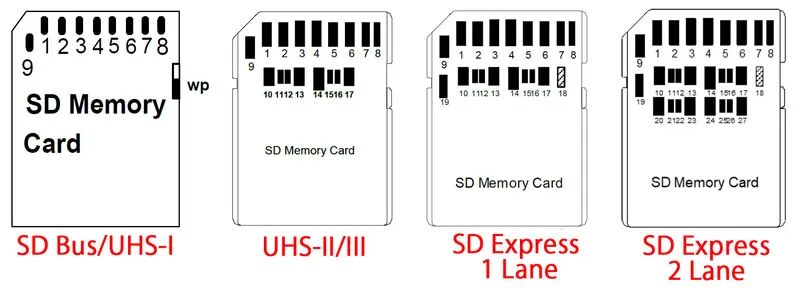
Change in Physical Interface: For the first time, a second row of physical pins was added to the SD card for high-speed differential signal transmission.
-
Introduction of Serial Bus: Shifted from traditional parallel bus to high-speed serial bus architecture, marking a fundamental change in SD card interface technology.
-
Significant Speed Increase: The theoretical speed of UHS-II reaches 312 MB/s, three times that of UHS-I.
-
Industry Impact: It completely broke the speed bottleneck of the parallel bus, making real-time recording of 4K and even higher specification videos possible. Although UHS-II cards can be backward compatible with older devices, they can only perform at their full potential on devices that support UHS-II.
Fourth Major Revision: Ultra Capacity (SDUC)
-
Standard Version: SD 6.0 (2018)
-
Core Changes:
-
Defining Capacities to Meet Future Needs: Introduced the SDUC (Ultra Capacity) standard, increasing the theoretical maximum capacity from 2TB to an astonishing 128TB.
-
File System Remains Unchanged: Continued to use the exFAT file system.
Industry Impact: This is a forward-looking layout for massive data storage in the coming decades (such as 8K/16K video, VR/AR content, professional data archiving).
Fifth Major Revision: Embracing PCIe/NVMe Standards (SD Express)
-
Standard Version: SD 7.0 (2018)
-
Core Changes:
-
Protocol Overhaul: Abandoned the traditional SD protocol, integrating the mature PCI Express (PCIe) bus and NVMe protocol into the SD card for the first time.
-
Reusing UHS-II Pins: Cleverly reused the second row of UHS-II pins as PCIe data channels.
-
Speed Comparable to SSD: Utilizing PCIe 3.0 x1 channel, the theoretical speed limit reaches 985 MB/s.
Industry Impact: This is the most revolutionary upgrade in the history of SD cards, transforming them from a “storage card” into a “removable micro SSD,” providing powerful performance support for handling ultra-high-resolution video, RAW format continuous shooting, and running large applications directly on the card.
Table of SD Standard Release Years
| Release Year | Standard Version | Core Changes | Representative Cards/Technologies |
|---|---|---|---|
| 2000 | SD 1.0/1.1 | Basic specification, maximum 2GB | SDSC |
| 2006 | SD 2.0 | Major Revision 1: Capacity increased to 32GB | SDHC |
| 2009 | SD 3.0 | Major Revision 2: Capacity increased to 2TB, UHS-I bus introduced | SDXC, UHS-I |
| 2011 | SD 4.0 | Major Revision 3: Introduced second row of pins and serial bus | UHS-II |
| 2016 | SD 5.0 | Enhanced: Introduced V speed and A performance classes | V30/V60/V90, A1/A2 |
| 2018 | SD 6.0 | Major Revision 4: Capacity increased to 128TB | SDUC |
| 2018 | SD 7.0 | Major Revision 5: Integrated PCIe/NVMe protocols | SD Express |
| 2020 | SD 8.0 | Enhanced: SD Express speed doubled | SD Express (PCIe 4.0) |
| 2023 | SD 9.1 | Enhanced: Optimized SD Express performance guarantee mechanism | SD Express speed class E |
Size Specifications
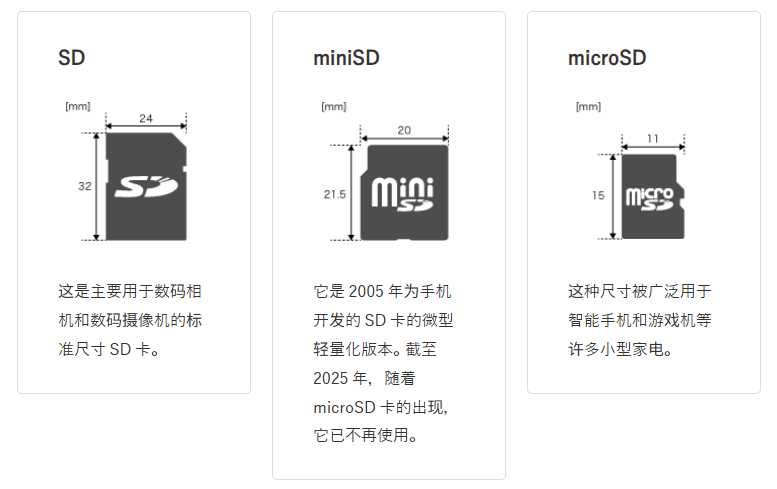
SD cards come in three sizes, with two sizes currently being the most commonly used. In addition to the standard size SD card, smaller miniSD and microSD cards have also been defined.
Capacity Specifications
The capacity specifications of SD cards are the most intuitive indicators of their development history. With the explosive growth of data demand, the capacity standards of SD cards have also undergone four major iterations. As of 2025, SD cards are primarily classified by capacity into SDSC, SDHC, SDXC, and SDUC four levels.
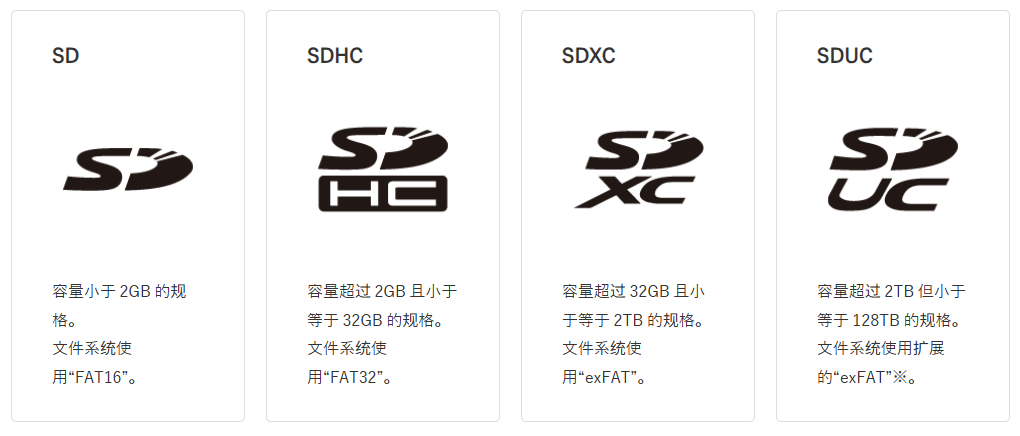
As shown in the table below, the naming of SD cards is strictly bound to their capacity range and technical specifications. This evolution is not only a numerical increase but also involves fundamental changes in the underlying addressing methods and file systems, which is also the root cause of compatibility issues between new and old devices.
Table: SD Cards Classified by Capacity into 4 Levels
| Name | Full English Name | Logo | Maximum Capacity | Addressing Method | Default File System |
|---|---|---|---|---|---|
| SDSC | Standard Capacity | S | 2GB | Byte Addressing | FAT12/16 |
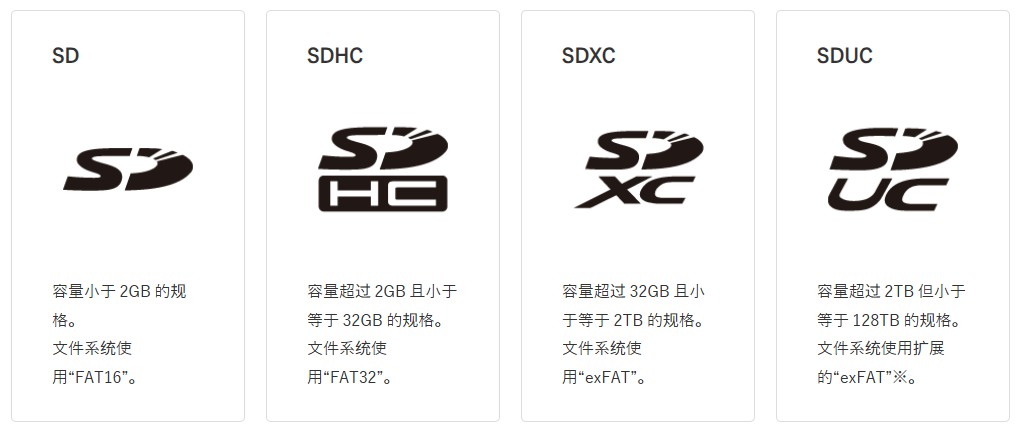
| SDHC | High Capacity | S HC | 32GB | Block Addressing | FAT32 |
| SDXC | eXtended Capacity | S XC | 2TB | Block Addressing | exFAT |
| SDUC | Ultra Capacity | S UC | 128TB | Block Addressing | exFAT |
Interface Specifications
The interface of the SD card is the absolute core of its performance, defining how wide and fast the “highway” for data transfer between the card and the host device is. To meet the growing data transfer demands—from high-definition photos to 8K professional video recording, and even running large applications directly—SD card interfaces have undergone three revolutionary leaps from traditional parallel bus, to high-speed serial bus, and finally to integrated PCIe/NVMe architecture.
Phase One: Parallel Bus Era (Traditional SD Interface)
Early SD card interfaces were based on parallel bus technology, with data transmitted synchronously through multiple data lines (DAT0-DAT3).
-
Standard Speed (Default Speed, DS): The basic mode of early SD cards, with a maximum speed of 12.5 MB/s.
-
High Speed (HS): With the release of the SD 1.1 standard, the clock frequency doubled, increasing the maximum speed to 25 MB/s.
-
UHS-I (Ultra High Speed I): This is the pinnacle of parallel bus technology. By introducing higher clock frequencies (up to 208 MHz) and more efficient data transfer modes (SDR/DDR), UHS-I raised the theoretical maximum speed to 104 MB/s. It significantly reduced power consumption and electromagnetic interference (EMI) by lowering the signal voltage from 3.3V to 1.8V, and remains the most mainstream and cost-effective interface type on the market today.
Phase Two: Transition from Parallel to Serial (UHS-II & UHS-III)
Parallel bus technology faced physical bottlenecks of signal synchronization (clock skew) and interference at higher frequencies. To address this, the SD 4.0 standard introduced the revolutionary UHS-II interface, marking the official entry of SD cards into the high-speed serial era.
Fundamental Changes in Physics and Technology
-
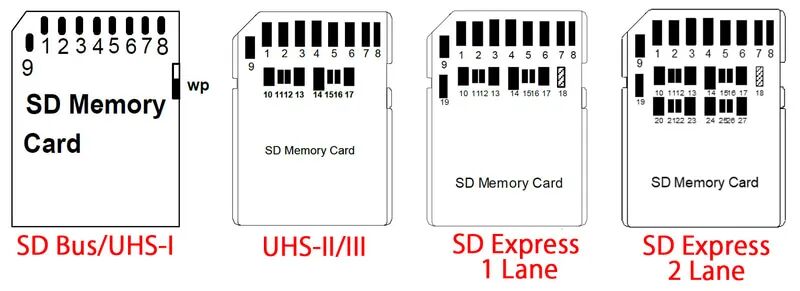
New Physical Pins: As shown in the figure, UHS-II cards retain the traditional interface pins (for backward compatibility) while adding a second row of pins. These new pins are used for differential signal transmission, where signals are transmitted through a pair of positive and negative lines (e.g., D0+/D0-), greatly enhancing anti-interference capability and allowing stable operation at higher frequencies.
-
Working Modes:
-
Full Duplex (FD156): One pair of differential pins is used for sending, while another pair is used for receiving, allowing simultaneous read and write operations, with a maximum speed of 156 MB/s.
-
Half Duplex (HD312): Two pairs of differential pins are used for unidirectional transmission (read or write), doubling the bandwidth and achieving a maximum speed of 312 MB/s.
-
UHS-III: As a direct upgrade to UHS-II, UHS-III retains the same physical pin layout but optimizes electrical performance, doubling the speed again to a maximum of 624 MB/s.
Phase Three: Transition to PCIe Bus and NVMe Protocol (SD Express)
This is the most disruptive change in the history of SD cards. After the SD 7.0 standard, the SD Association no longer “closed the door to innovation” but directly introduced the highly mature and high-speed PCI Express (PCIe) bus and NVMe protocol into SD cards, making their performance comparable to built-in SSDs.
SD cards supporting the SD Express standard have similar pins to UHS-II and UHS-III, but the shape of the second row of pins is different. SD Express (SD7.0) specifies the use of “PCIe® Gen.3×1” and “PCIe® Gen.4×1” transmission standards, while SD Express (SD8.0) adds additional pins (a third row) and uses “PCIe® Gen.3×2” and “PCIe® Gen.4×2” transmission standards.
The maximum transmission speed for “PCIe® Gen.3×1” is 985MB/s, for “PCIe® Gen.4×1” it is 1,970MB/s, and for “PCIe® Gen3x2” and “PCIe® Gen.4×2” it can reach up to 3,940MB/s, significantly enhancing the transmission speed of SD cards.
The high-speed data transfer characteristics of SD Express have begun to be applied in devices with stringent external storage performance requirements.
SD Express cards maintain compatibility with the UHS-I interface. When inserted into devices that do not support SD Express, they automatically downgrade to UHS-I mode, ensuring basic usability.
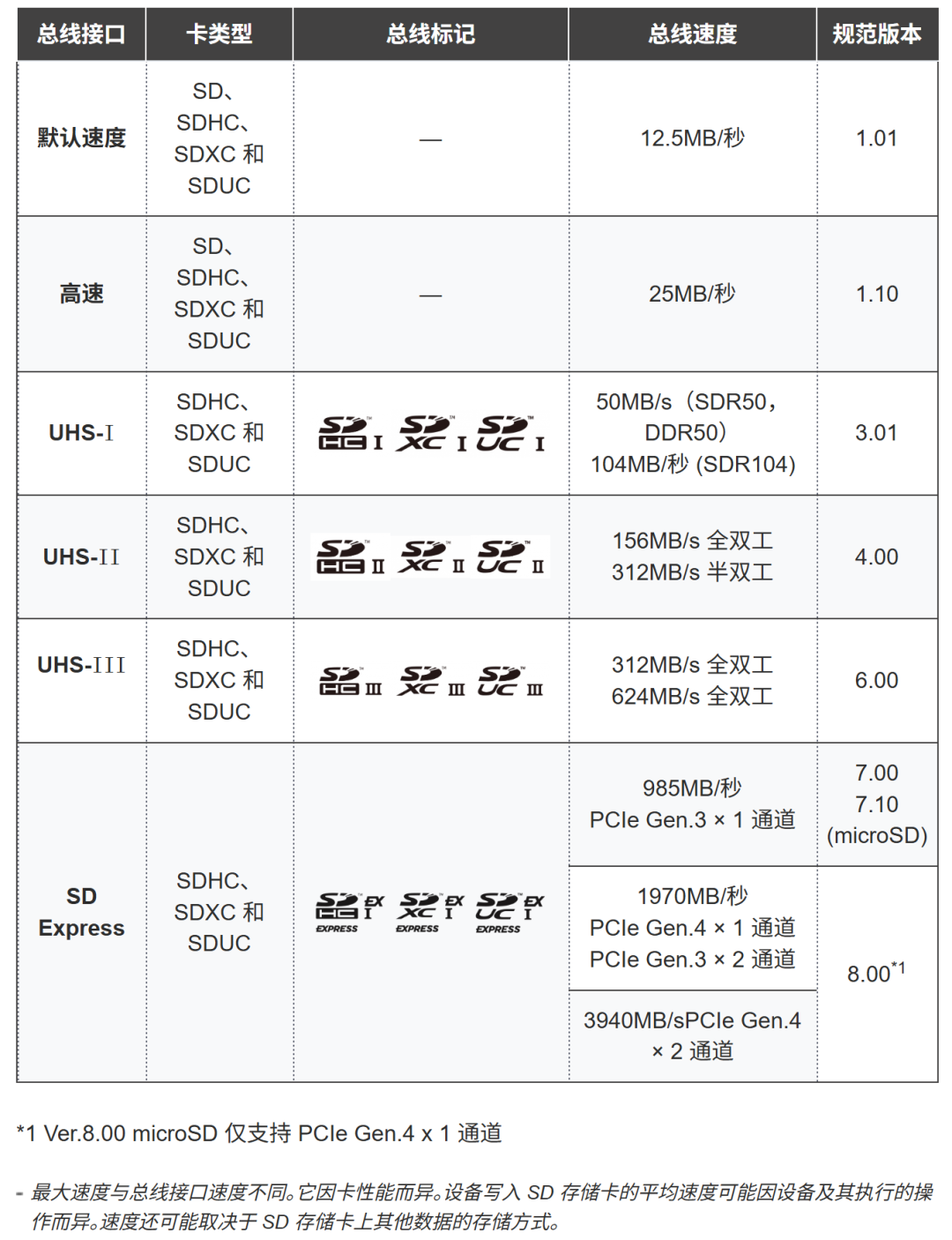 Correctly matching the card with the host device’s interface logo is key to unleashing the full performance potential of the SD card. For example, inserting a UHS-II card into a camera that only supports UHS-I will limit its speed to within 104 MB/s. Similarly, only using a reader or device that supports SD Express can experience speeds comparable to SSDs.
Write Speeds
For SD cards, the “maximum read speed” indicated on the packaging is often only achievable under ideal conditions, while the true determinant of performance in video recording, high-speed continuous shooting, and application running is the minimum sustained write speed. A momentary drop in speed can lead to interruptions in video recording or application stuttering.
To address this, the SD Association has established a multi-dimensional, multi-version performance rating system to meet the precise needs of different application scenarios. This system has evolved from the initial simple Speed Class (C), to UHS Speed Class (U) for high-definition video, and Video Speed Class (V), and finally to Application Performance Class (A) for measuring random read and write performance, as well as the latest E Class defined for SD Express.
1. Speed Class (Speed Class – ‘C’)
This is the earliest performance standard, mainly targeting cards using standard/high-speed interfaces. It guarantees the minimum write speed considering file fragmentation, making it very reliable, but with lower values.
-
C2, C4, C6, C10: Guarantees minimum write speeds of 2, 4, 6, and 10 MB/s, respectively.
-
Core Features: The testing of C2/C4/C6 levels considers the worst-case scenario, i.e., writing data in non-contiguous flash memory (fragmentation). This operation triggers the complex “read-modify-write” internal process of NAND flash, leading to performance degradation. Therefore, the guaranteed values for this level are relatively conservative and have largely been phased out in the market.
2. UHS Speed Class (UHS Speed Class – ‘U’) – Standard for HD Video
With the popularity of the UHS-I bus, the UHS Speed Class was introduced to meet the needs of HD (1080p) and early 4K video recording. Its testing premise is continuous writing, which is more in line with the writing pattern of video streams.
-
U1: Guarantees a minimum write speed of 10 MB/s (equivalent to C10).
-
U3: Guarantees a minimum write speed of 30 MB/s.
The U3 level has long been the gold standard for 4K video recording and is still the recommended specification for many consumer-grade drones and cameras.
3. Video Speed Class (Video Speed Class – ‘V’) – Born for 4K/8K Professional Imaging
As video resolution, frame rates, and bit rates continue to rise, U3’s 30MB/s can no longer meet professional needs. To address this, the SD 5.0 standard introduced the Video Speed Class, providing a broader performance ladder and ensuring support for larger data block writes to accommodate high-spec video streams.
-
V6, V10: Corresponding to C6 and C10, guaranteeing minimum speeds of 6MB/s and 10MB/s.
-
V30: Guarantees a minimum speed of 30 MB/s (equivalent to U3).
-
V60: Guarantees a minimum speed of 60 MB/s.
-
V90: Guarantees a minimum speed of 90 MB/s.
Application Scenarios: V30 is the foundation for mainstream 4K video recording; V60 and V90 are designed for professional applications such as 8K video, high frame rate 4K video (e.g., 4K 120fps), high bitrate RAW video, or 360° panoramic video.
4. Application Performance Class (Application Performance Class – ‘A’) – Key Considerations for Running Games and Applications
All the above levels focus only on sequential write performance. However, when SD cards are used as extended storage for smartphones and portable gaming consoles (such as Nintendo Switch, Steam Deck), directly running applications makes random read and write performance crucial. Applications and operating systems frequently read and write large amounts of fragmented small files, which is a weakness of traditional SD cards. Therefore, the A class was introduced.
-
A1:
-
Minimum Random Read: 1500 IOPS (Input/Output Operations Per Second)
-
Minimum Random Write: 500 IOPS
-
Minimum Sustained Sequential Write: 10 MB/s
-
A2:
-
Minimum Random Read: 4000 IOPS
-
Minimum Random Write: 2000 IOPS
-
Minimum Sustained Sequential Write: 10 MB/s
-
Technical Requirements: A2 standard requires both the card and host to support Command Queuing and Cache and other advanced features to handle multiple random I/O requests more efficiently, far exceeding A1 performance.
5. SD Express Speed Class (SD Express Speed Class – ‘E’) – SSD-Level Performance
This is the latest performance level defined for SD Express cards in the SD 9.1 standard. Due to the PCIe/NVMe architecture of SD Express, its performance has reached SSD levels, requiring a completely new guarantee system.
-
E150, E300, E450, E600: Guarantees minimum sustained write speeds of 150, 300, 450, 600 MB/s when using the PCIe bus.
This level is primarily aimed at professional applications requiring extremely high bandwidth and stability, such as simultaneous recording of multiple 8K video streams and high-speed data acquisition systems.
Performance Level Overview and Selection Guide
| Indicator System | Logo | Minimum Sustained Write Speed | Core Application Scenarios | Key Technologies/Assumptions |
|---|---|---|---|---|
| Speed Class | C2, C4, C6, C10 | 2-10 MB/s | Early Standard Definition/High Definition Recording | Considering File Fragmentation |
| UHS Speed Class | U1, U3 | 10, 30 MB/s | Full HD, Mainstream 4K Video | Sequential Writing |
| Video Speed Class | V6 to V90 | 6-90 MB/s | High Specification 4K, 8K, RAW Video | Sequential Writing (Supports Large Blocks) |
| Application Performance Class | A1, A2 | 10 MB/s | Smartphone/Game Console Running Applications | Random Read/Write (IOPS) |
| SD Express Speed Class | E150 to E600 | 150-600 MB/s | Professional Multi-Channel 8K Recording, Data Acquisition | PCIe/NVMe Mode |
SD Card Logos and Specifications
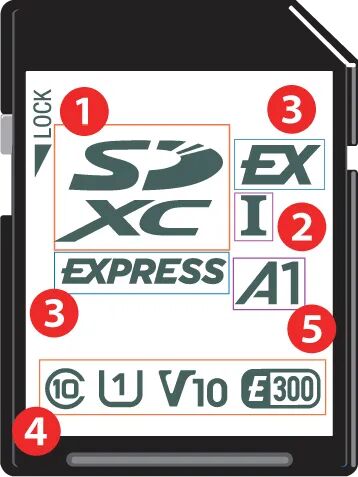
 SD logos and data capacity classified by file system standards
 UHS bus interface specifications for large capacity data transfer

 SD Express / Innovative SD card standards

 Speed class specifications for video recording
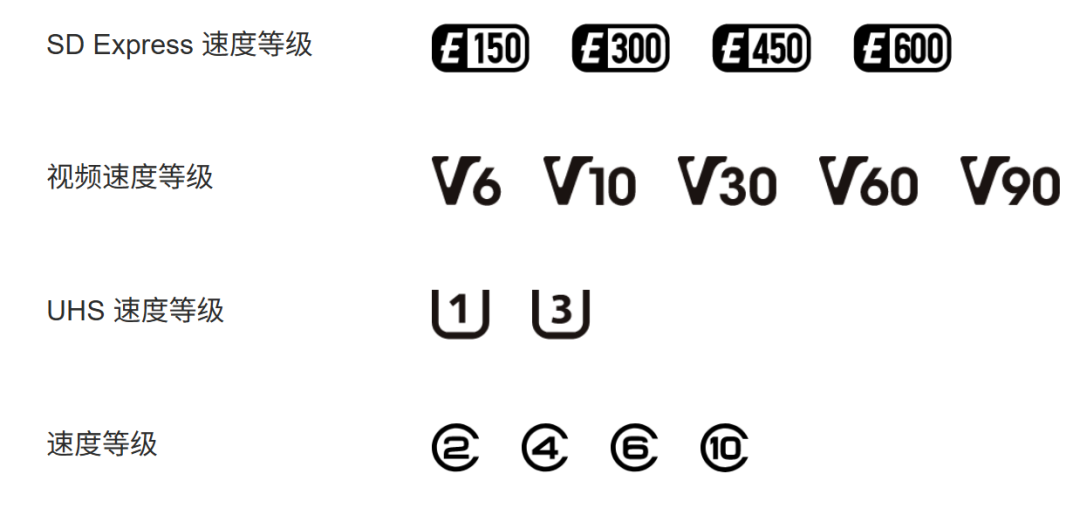
All speed classes ensure that the required minimum continuous card access performance is achieved under specified conditions during video recording and other applications.
 Application performance class standards for running smartphone applications
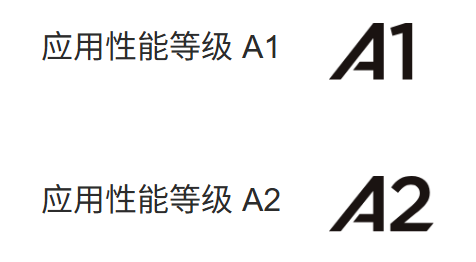
This standard specifies the minimum processing speeds required for random and sequential read/write during application execution.
References
https://www.sdcard.org/