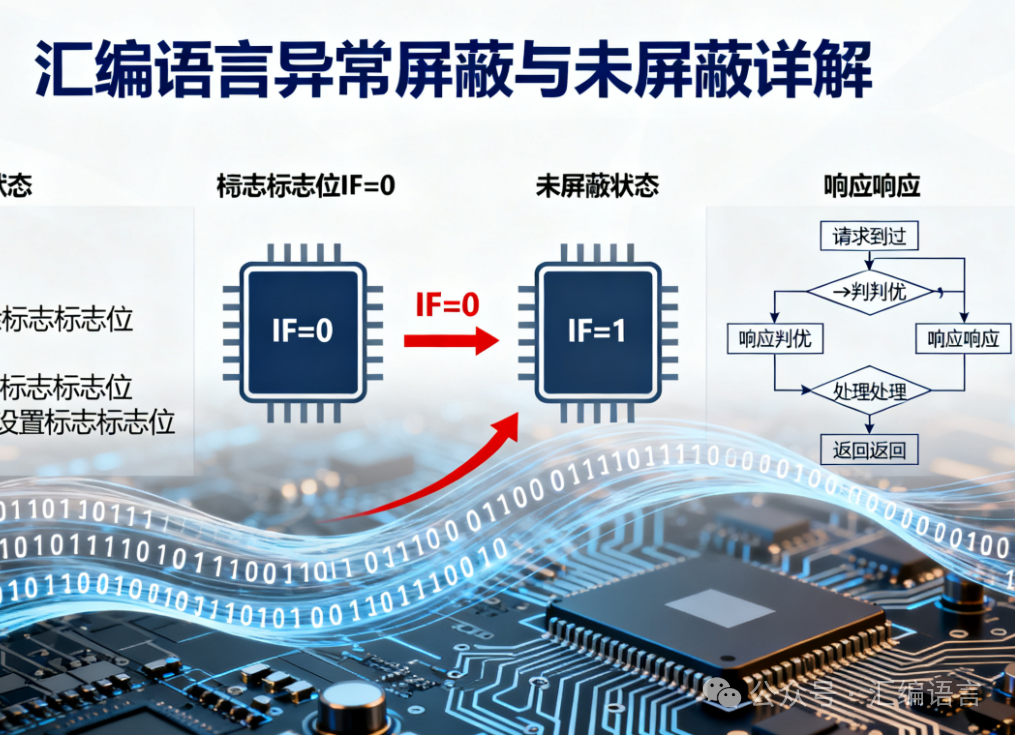
Overview of Exception Masking
In the x86 architecture, the Floating Point Unit (FPU) provides a set of exception handling mechanisms. By default, all floating-point exceptions are masked, which means that when an exception occurs, the processor provides a default result and continues execution without interrupting the program flow.
FPU Control Word Structure
The FPU control word is a 16-bit register that controls the behavior of floating-point operations:
Bit  Function                Bit  Function
0   Invalid Operation Exception Mask     5   Precision Exception Mask
1   Denormal Operand Exception Mask    8-9 Precision Control Bits
2   Divide by Zero Exception Mask       10-11 Rounding Control Bits
3   Overflow Exception Mask             12  Infinity Control Bit
4   Underflow Exception Mask
Code Example
Divide by Zero Operation in Default Masked State
.data
val1 DWORD 1
val2 REAL8 0.0
result REAL8 ?

.code
; In the default state, exceptions are masked, and divide by zero results in infinity without interrupting the program
fild val1        ; Load integer 1 into ST(0)
fdiv val2        ; ST(0) = positive infinity
fstp result      ; Store result
Unmasked Divide by Zero Exception
.data
ctrlWord WORD ?
val1 DWORD 1
val2 REAL8 0.0

.code
; Step 1: Get the current control word
fstcw ctrlWord

; Step 2: Clear bit 2 (divide by zero exception mask bit)
and ctrlWord, 1111111111111011b

; Step 3: Load the modified control word back to FPU
fldcw ctrlWord

; Now executing divide by zero will trigger an exception
fild val1
fdiv val2        ; Trigger divide by zero exception
fst val2         ; This instruction will display an error message
Masking Divide by Zero Exception
.data
ctrlWord WORD ?

.code
; Mask divide by zero exception
fstcw ctrlWord       ; Get control word
or ctrlWord, 100b    ; Set bit 2 (mask divide by zero exception)
fldcw ctrlWord       ; Load result back to FPU
Overview of Mixed Mode Operations
x86 assembly supports mixed operations with different data types:
.data
intVal DWORD 10
realVal REAL8 3.14

.code
; Mixed operations between integer and floating-point
fild intVal      ; Load integer to floating-point stack
fld realVal      ; Load floating-point number
fadd             ; ST(1) + ST(0), result stored in ST(0)
Overview of x86 Instruction Encoding
x86 instructions use a variable-length encoding format:
[Prefix] [Opcode] [ModR/M] [SIB] [Displacement] [Immediate]
Example:
; Instruction: ADD EAX, 42h
; Encoding: 83 C0 42
; 83 - Opcode
; C0 - ModR/M byte (EAX register)
; 42 - Immediate value
Summary of Exception Types
| Exception Type | Default Behavior When Masked | Behavior When Unmasked |
|---|---|---|
| Invalid Operation | Returns QNaN | Triggers exception handler |
| Divide by Zero | Returns infinity | Triggers exception handler |
| Overflow | Returns maximum finite value | Triggers exception handler |
| Underflow | Returns denormal number | Triggers exception handler |
| Precision | Returns rounded result | Triggers exception handler |
Practical Application Recommendations
- Development Phase: It is recommended to unmask exceptions to detect errors promptly
- Production Environment: Exceptions are usually masked to ensure program stability
- Critical Calculations: Enable precision exception detection in critical sections
- Performance Considerations: Exception handling incurs overhead, requiring careful consideration
This exception handling mechanism allows developers to flexibly control the strictness of floating-point operations based on specific needs.