Detailed Explanation of Operand Size Prefix in Assembly Language
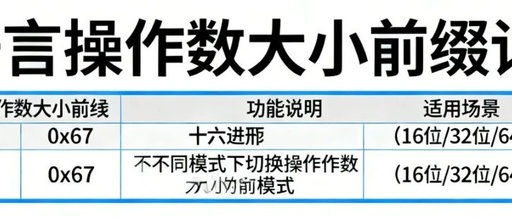
Detailed Explanation of Operand Size Prefix in Assembly Language

Function and Significance of Operand Size Prefix Historical Background and Design Principles The x86 processor family has evolved from 16-bit to 32-bit and then to 64-bit. To maintain backward compatibility, Intel introduced the operand size prefix mechanism: During the 8086/8086 Era: 256 opcodes were almost entirely used for 8-bit and 16-bit operands During the 80386 … Read more

Detailed Explanation of Single-Byte Instructions and Immediate Operands in Assembly Language

Detailed Explanation of Single-Byte Instructions and Immediate Operands in Assembly Language

1. Overview of Single-Byte Instructions 1.1 Basic Concepts A single-byte instruction refers to an instruction that contains only the opcode field and has no explicit operands. These instructions typically have the following characteristics: The operand is implicit in the instruction The instruction length is fixed at 1 byte High execution efficiency 1.2 Common Examples of … Read more

Detailed Explanation of Exception Masking and Unmasking in Assembly Language

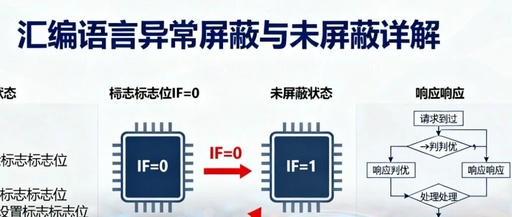
Detailed Explanation of Exception Masking and Unmasking in Assembly Language

Overview of Exception Masking In the x86 architecture, the Floating Point Unit (FPU) provides a set of exception handling mechanisms. By default, all floating-point exceptions are masked, which means that when an exception occurs, the processor provides a default result and continues execution without interrupting the program flow. FPU Control Word Structure The FPU control … Read more

Understanding Assembly Language: The MUL Multiplication Instruction

Understanding Assembly Language: The MUL Multiplication Instruction

In assembly language, the <span>mul</span> instruction is used to perform unsigned multiplication operations. It is one of the basic arithmetic instructions in the x86 architecture, used for handling 8-bit, 16-bit, and 32-bit multiplication operations.<span>mul</span> instruction is characterized by its operands being implicitly specified, with the result stored in fixed registers. Basic Rules of the MUL … Read more

A Historic Reconciliation in the Chip Industry: NVIDIA and Intel Transform from Rivals to Allies, Facing Strong Challenges from AMD and TSMC

A Historic Reconciliation in the Chip Industry: NVIDIA and Intel Transform from Rivals to Allies, Facing Strong Challenges from AMD and TSMC

CPUs and GPUs are like a pair of noisy roommates, one responsible for logical processes (CPU) and the other for crazy parallel computations (GPU). The data exchange between them (PCIe channels) is like a narrow hallway at the door, often becoming a performance bottleneck. Now, imagine this pair of roommates suddenly announcing: “We’ve decided to … Read more

Technical Explanation of 16-bit and 32-bit Segments in Assembly Language

Technical Explanation of 16-bit and 32-bit Segments in Assembly Language

1. Core Concepts: 16-bit Segments vs. 32-bit Segments In the x86 architecture, the length and characteristics of a “segment” depend on the operating mode of the processor. 16-bit Segment: Maximum Length:64KB (<span>0FFFFh</span>). Typical Modes:Real Mode and Virtual 8086 Mode. This is the only option for 8086/8088 and is a requirement for 80386+ in real mode. … Read more

The Rise of Arm Servers: Is x86 Facing Its Downfall? Can AMD’s Bold Moves Change the Game?

The Rise of Arm Servers: Is x86 Facing Its Downfall? Can AMD's Bold Moves Change the Game?

The Rise of Arm Servers: Is x86 Facing Its Downfall? Can AMD’s Bold Moves Change the Game? 1. Arm Architecture: The Dark Horse in the Server and PC Market (1) Server Market: From “Invisible” to “Guest of Honor” We all know that the server market used to be dominated by the x86 architecture, with Intel … Read more

Understanding Virtualization: A Comprehensive Overview

Understanding Virtualization: A Comprehensive Overview

Sponsored by With the rise of technologies such as virtualization and cloud computing,IT has once again redefined virtualization technology, which has a history of several decades, expanding its scope. However, to date, there is no universally accepted standard definition of virtualization; most definitions are based on its applications. Generally, virtualization can be summarized and described … Read more

Detailed Explanation of Function Return Value Mechanism in Assembly Language under Windows Environment

Detailed Explanation of Function Return Value Mechanism in Assembly Language under Windows Environment

Return Value Rules in Windows Calling Conventions In programming on the x86 architecture of the Windows platform, regardless of the calling convention used (<span>__cdecl</span>, <span>__stdcall</span>, <span>__fastcall</span>, etc.), the return value of a function is typically passed through the EAX register. This unified rule simplifies interoperability between different calling conventions. Basic Return Value Mechanism Returning Integers … Read more

High-Performance Edge Computing with X86 Architecture

High-Performance Edge Computing with X86 Architecture

2025 Edge Computing Frontier Station High-Performance Edge Computing with X86 Architecture Working Together for a Connected World · Greetings from Ark · Dear family of Ark Academy, hello! I am your Ark partner, Xiao Zhou. Today, we will discuss the high-performance edge computing capabilities of X86 architecture. 01 High Performance of X86 Architecture In today’s … Read more