 To build a global highland for the future ADC/RDC industry, Chengdu Medical City plans to hold the first Future XDC New Drug Conference from April 18 to 19, 2024! The conference, themed “Co-creating the Future of the Conjugated Drug Industry,” is organized by Tongxi Yi Planning, featuring a main forum and nine thematic forums. Experts from various fields, including government, industry, academia, research, finance, and media, will be invited to engage in a diversified organizational format of “results release, keynote speeches, hot dialogues, awards, and exhibitions” to spark more new technologies, new business formats, and new models in the XDC industry, building a new ecology for the XDC industry and touching the pulse of the future pharmaceutical industry.
Antibody-Drug Conjugates (ADC) are a new type of drug that utilizes monoclonal antibodies to selectively target cells expressing specific antigens and deliver cytotoxic payloads, aiming to minimize off-target toxicity of chemotherapy drugs. Recent successful trials of ADCs in breast cancer and other malignancies indicate that ADCs can effectively kill tumor cells and limit toxicity, potentially replacing traditional chemotherapy in some cases. Although these drugs have achieved significant success, especially in metastatic settings, almost all advanced patients receiving ADC treatment develop resistance.
The potential mechanisms of resistance can be categorized based on the complex structure of antibody-drug conjugates. They can be divided into preclinical and clinical resistance mechanisms related to changes in antigen expression, processing of ADCs, and variations in payloads. This classification of resistance mechanisms provides direction for future research to further understand these mechanisms and new drug development targets, thereby expanding the efficacy of ADCs.
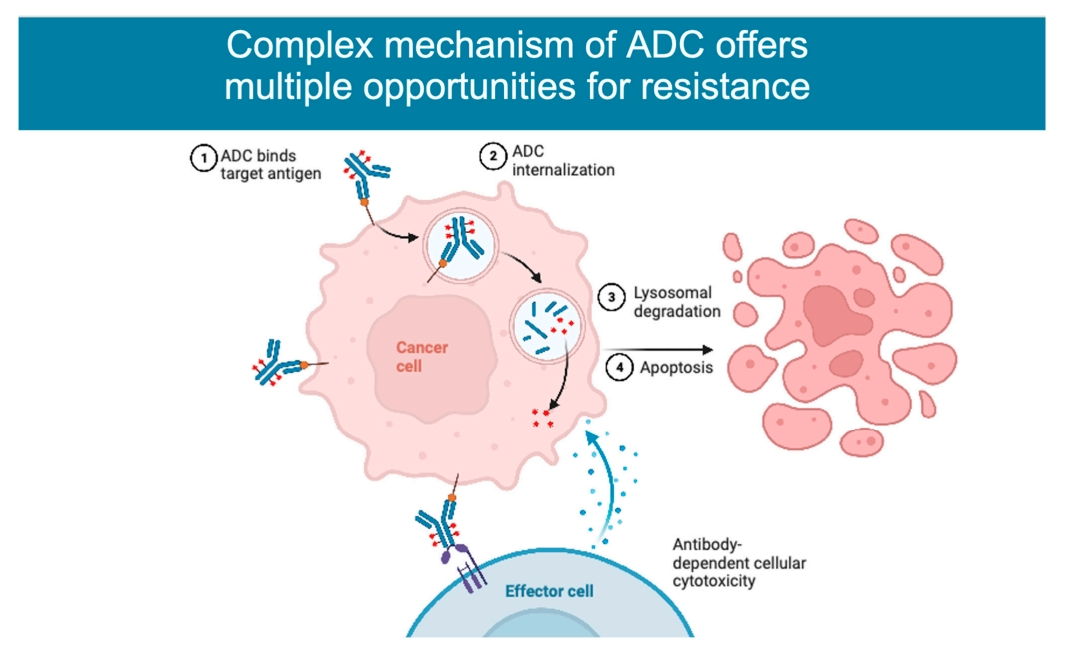 Changes in Antigen Expression1
 Changes in Antigen Expression In early trials of T-DM1, tumors with higher and more uniform HER2 expression were observed to be more likely to respond to treatment. Given that HER2 may have considerable heterogeneous expression, drugs requiring consistently higher HER2 expression may encounter resistance when there are any changes in HER2 levels. Further evidence supporting this hypothesis includes observations that HER2+ tumors exhibited lower HER2 expression post-treatment, and greater heterogeneous expression was associated with higher recurrence rates and lower survival rates. A study of early HER2+ breast cancer patients receiving neoadjuvant T-DM1 and Pertuzumab found that pre-existing HER-2 heterogeneity was negatively correlated with treatment response. Among patients with heterogeneous pre-treatment biopsies, none achieved pathological complete response (pCR), while 55% of non-heterogeneous patients achieved pCR under the combined effect of T-DM1 and Pertuzumab. In addition to abnormal antigen expression levels, dimerization of the antigen with another cell surface receptor may mediate resistance to ADCs. NRG-1β, a ligand known to induce HER2/HER3 heterodimerization, inhibited the cytotoxic activity of TDM-1 in subpopulations of HER2-amplified breast cancer cell lines. This resistance can be overcome by adding Pertuzumab, a monoclonal HER2 antibody that blocks HER2/HER3 dimerization and downstream signaling. The combination of TDM-1 and Pertuzumab has shown synergistic effects in both in vitro and in vivo tumor xenograft studies. Considering the impact of antigen heterogeneity on mediating ADC resistance, future strategies to address this resistance may include drugs with dual antibodies (bispecific ADCs) and combination therapies that enhance antigen expression.2ADC Uptake and Processing Another hypothesis for ADC resistance involves changes in intracellular uptake and processing. The complexity of ADCs, particularly compared to small molecules, provides many potential opportunities for resistance to arise. One proposed mechanism is a reduction in permeability to cells due to some barriers, such as increased cellular basement membranes. Another proposed mechanism comes from recent preclinical studies, where a mechanism ensuring specificity of ADCs is through clathrin-mediated endocytosis in cells expressing target antigens. In the N89-TM cell line, which developed resistance to T-DM1, another uptake mechanism was discovered, where cells utilized caveolin-1 (CAV1)-coated vesicles, potentially leading to reduced efficiency. A recent study found a negative correlation between tumor CAV1 levels and T-DM1 tumor uptake. Genetic or pharmacological inhibition of CAV1 increased T-DM1 uptake and showed synergistic effects with T-DM1 in various xenograft models. Additionally, the JIMT1-TM cell line, which is resistant to T-DM1, also showed increased levels of proteins including Rab5B, ATG9a, and HTT, which mediate lysosomal processing and vesicle transport. In the JIMT1-TM cell line, both cleavable and non-cleavable linker ADCs co-localized in lysosomes for longer periods than in parental cells. Compared to parental cells, the metabolite of the linker-payload in resistant cell lines was reduced.3Payload Some observed resistance mechanisms involve the payload itself and can be overcome by using ADCs with alternative payloads. For instance, resistance to ADCs containing topoisomerase inhibitors as payloads may be driven by changes in topoisomerase expression or downstream signaling mechanisms.
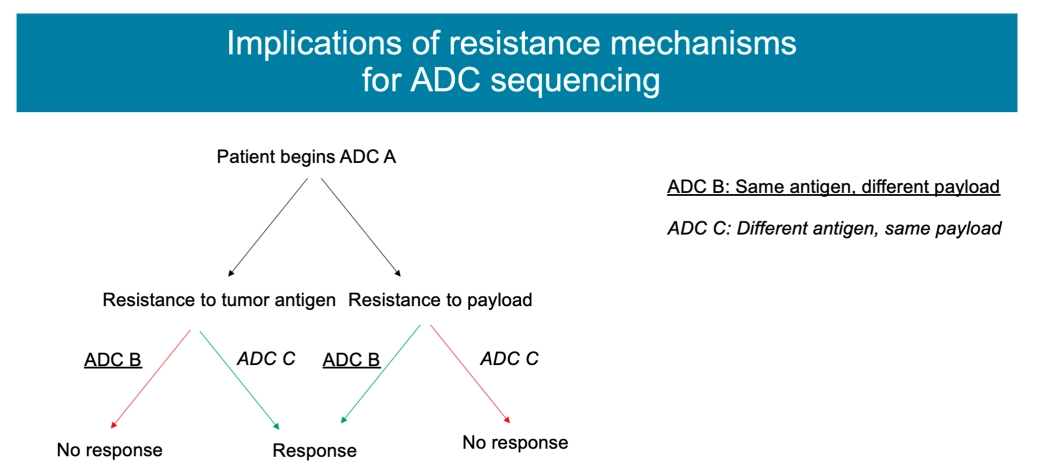 This was observed in tumor models of non-Hodgkin lymphoma, where changing ADCs containing auristatin payloads to ADCs containing anthracycline payloads led to increased treatment response. Similarly, in cancer cells resistant to T-DM1, these cells remained sensitive to DS-8201a (T-DXd). Increased efflux of ADC payloads mediated by ATP-binding cassette transporters is another proposed mechanism of resistance. Compared to parental cells, the expression of transporters in cells resistant to T-DM1 increased by up to 20-50 times. This is a mechanism of resistance for gemtuzumab ozogamicin (GO), where patients with lower levels of the ABCB1 gene encoding ATP-binding cassette had better responses to GO.— Conclusion— Although the widespread application of ADCs provides new treatment options for patients, most tumors eventually develop resistance to these drugs. Given the complexity of ADCs, different components targeting ADCs may involve different resistance mechanisms. Mechanisms such as reduced antigen expression, decreased ADC transport and processing, resistance to cytotoxic payloads, and increased drug efflux from cells are all potential target processes for future drug development. Research optimizing the sequential and combination therapies of ADCs is expected to provide more clues for overcoming resistance and promote new treatment options, expanding the clinical efficacy of these therapies.
References:
1. Mechanisms of Resistance to Antibody-Drug Conjugates. Cancers (Basel). 2023 Feb 17; 15(4):1278
 For more quality content, please follow↓↓↓