The Rockchip RK3576 chip platform enables a demonstration of multi-channel AHD high-definition camera input, based on the Touch Intelligence RK3576 development board Purple Pi OH2.


Introduction to AHD
- Introduction to AHD
AHD stands for Analog High Definition, a high-definition video technology based on analog transmission. Its core advantage lies in the ability to transmit uncompressed high-definition signals over coaxial cables up to 500 meters, supporting 1080P resolution, and employing bright color separation, analog filtering, and 3D noise reduction technologies to enhance image quality.
- Application Scenarios
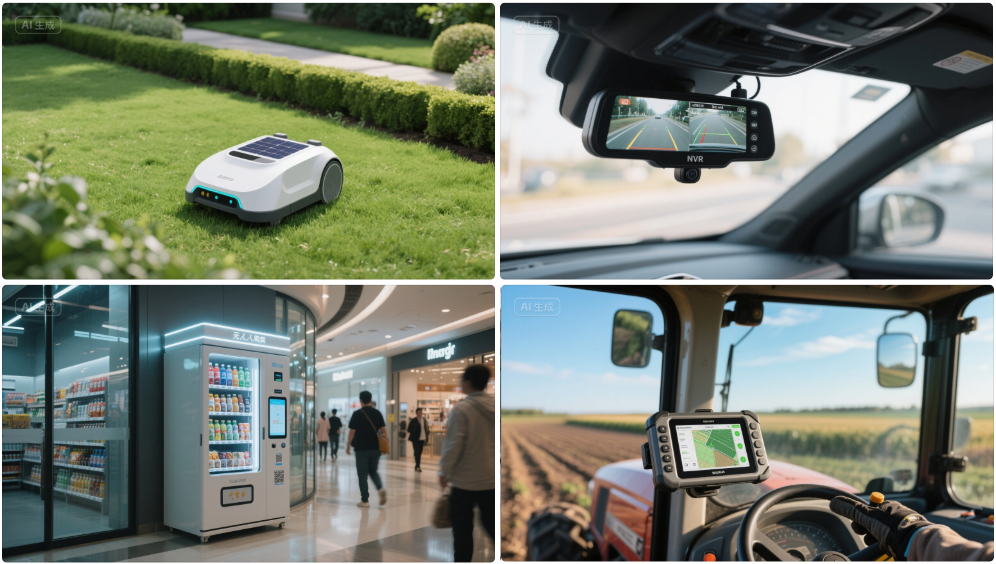
The Touch Intelligence RK3576 core board, as a high-performance AIoT module, boasts powerful performance with its 8-core CPU, 16M ISP, and 6 Tops computing power NPU. When combined with AHD high-definition cameras, it can be applied in the following fields: robotics (such as smart lawn mowers), in-vehicle NVRs (dashcam/monitoring systems), new retail smart terminals (vending machines, smart retail kiosks, advertising machines), elevator intercom and access control systems, agricultural machinery tablets, etc.
- Demonstration Environment
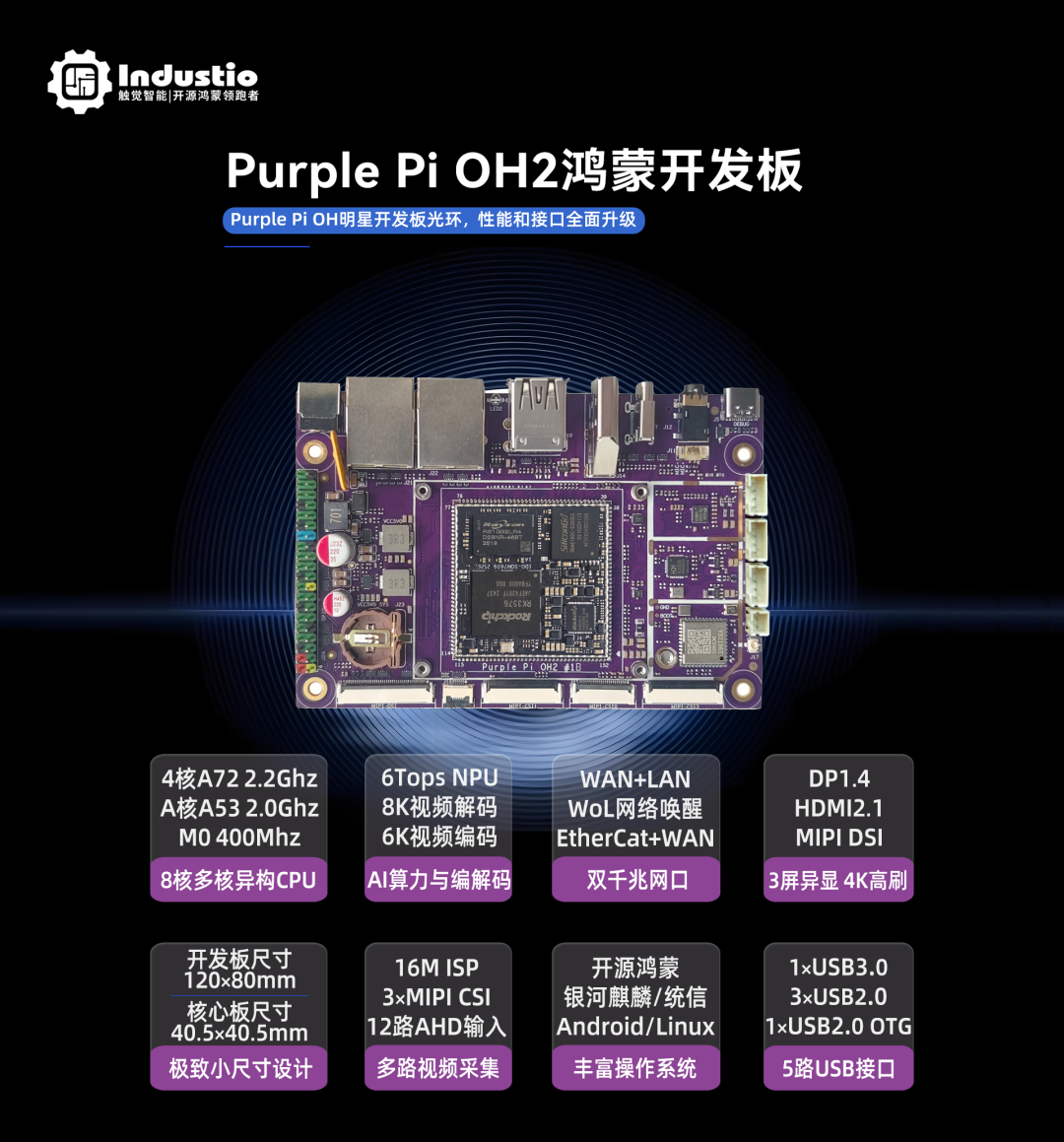
The demonstration device is the Touch Intelligence RK3576 development board Purple Pi OH2, with the system firmware being Debian 12. Its accompanying core board, with an ultra-compact size of 40.5×40.5mm, supports LPDDR4 or LPDDR5 high-speed memory, and is the first to adapt to the open-source HarmonyOS OpenHarmony 5.0, fully domestically produced, supporting industrial-grade environments from -40 to 85℃.


Analysis of Software and Hardware System Framework
- Hardware Connection Framework
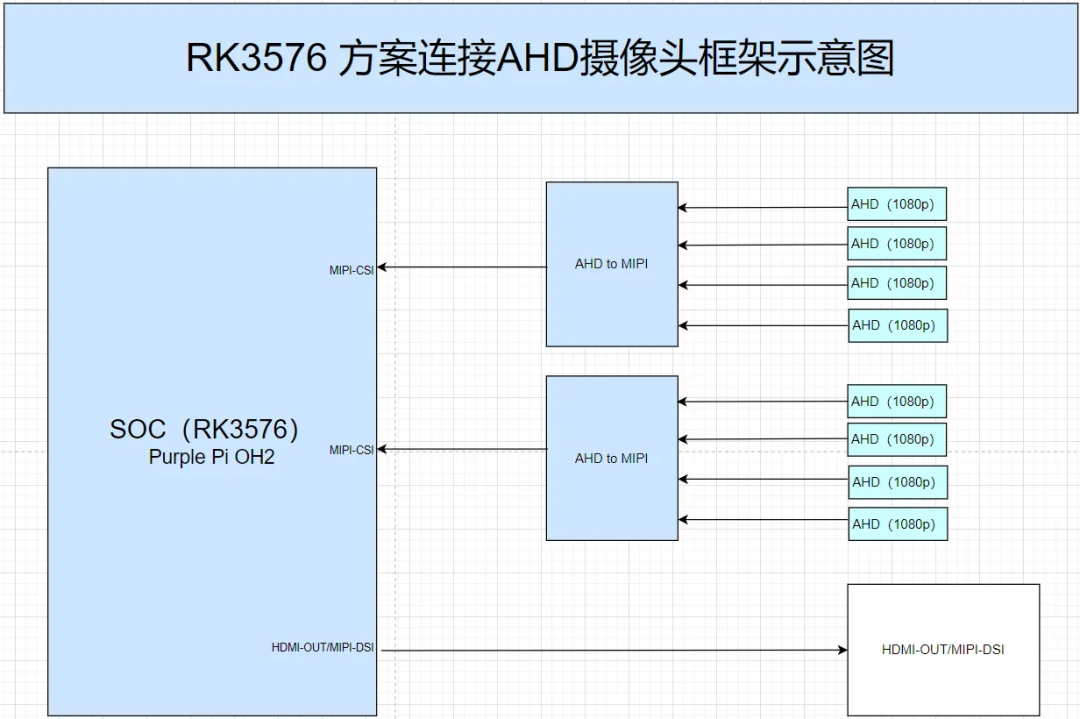
The AHD camera connection scheme used by the Touch Intelligence RK3576 series products (core board/development board/industry mainboard) is designed with a layered structure, dividing the entire hardware connection framework into four layers: camera layer, conversion layer, processing layer, and display layer:
(1) The camera layer consists of multiple AHD cameras arranged at different positions to capture video data from multiple angles.
(2) The conversion layer is implemented by an AHD adapter board, responsible for converting analog signals into digital signals.
(3) The processing layer centers around the Touch Intelligence RK3576 series products (core board/development board/industry mainboard), responsible for encoding, decoding, analyzing, and synthesizing video streams.
(4) The display layer outputs video through various display interfaces, such as HDMI, DP, or MIPI-DSI interfaces.
- Software Architecture
Taking the Linux system as an example, the GStreamer framework is utilized for video capture, processing, and pushing. The software architecture mainly includes the device driver layer, middleware layer, and application layer. The device driver layer manages hardware devices, such as AHD adapter boards and display interfaces; the middleware layer provides video processing, encoding/decoding, AI analysis, and other functions; the application layer implements specific business logic, such as video monitoring, behavior analysis, and facial recognition.
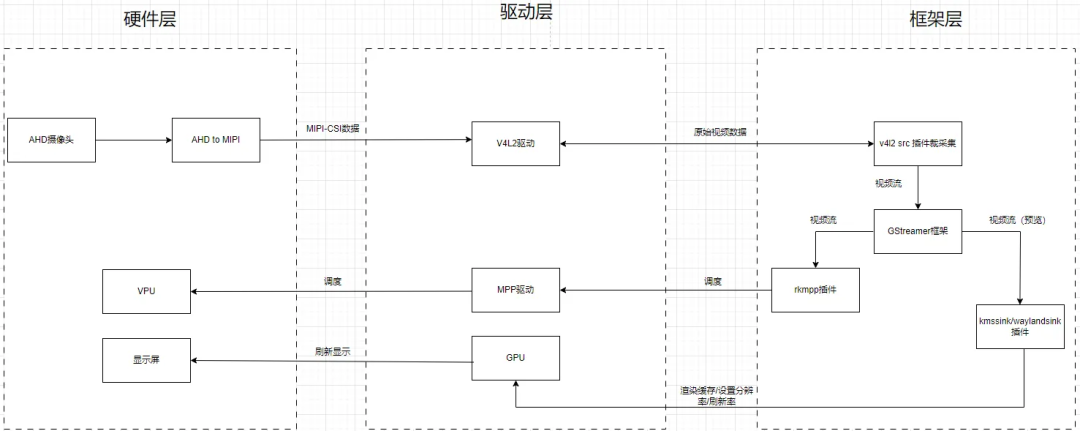
For AI vision applications, the software architecture can also leverage the powerful 6 Tops computing power NPU of the RK3576 to integrate AI inference frameworks, such as RKNN (Rockchip Neural Network SDK). RKNN is a neural network inference framework launched by Rockchip, supporting model conversion and optimization from various deep learning frameworks and running efficiently. Through RKNN, developers can implement AI functions such as facial recognition, vehicle detection, and behavior analysis, integrating these functions into the GStreamer pipeline for real-time analysis of video streams.



Testing Methods & Demonstration
- 4-channel AHD camera (4×1080P@30FPS input)
Preview command:
gst-launch-1.0 v4l2src device=/dev/video3 ! video/x-raw, format=NV12, width=1280, height=720, framerate=30/1 ! videoconvert ! xvimagesink render-rectangle="<960,540,960,540>" sync=false &gst-launch-1.0 v4l2src device=/dev/video0 ! video/x-raw, format=NV12, width=1280, height=720, framerate=30/1 ! videoconvert ! xvimagesink render-rectangle="<0,0,960,540>" sync=false &sleep 2gst-launch-1.0 v4l2src device=/dev/video1 ! video/x-raw, format=NV12, width=1280, height=720, framerate=30/1 ! videoconvert ! xvimagesink render-rectangle="<960,0,960,540>" sync=false &sleep 2gst-launch-1.0 v4l2src device=/dev/video2 ! video/x-raw, format=NV12, width=1280, height=720, framerate=30/1 ! videoconvert ! xvimagesink render-rectangle="<0,540,960,540>" sync=false &sleep 2- 8-channel AHD camera (4×720P@30FPS + 4×1080P@30FPS input)
Preview command:
gst-launch-1.0 v4l2src device=/dev/video0 ! video/x-raw, format=NV12, width=1920, height=1080, framerate=30/1 ! videoconvert ! xvimagesink render-rectangle="<0,0,480,360>" sync=false &sleep 2gst-launch-1.0 v4l2src device=/dev/video1 ! video/x-raw, format=NV12, width=1920, height=1080, framerate=30/1 ! videoconvert ! xvimagesink render-rectangle="<480,0,480,360>" sync=false &sleep 2gst-launch-1.0 v4l2src device=/dev/video2 ! video/x-raw, format=NV12, width=1920, height=1080, framerate=30/1 ! videoconvert ! xvimagesink render-rectangle="<960,0,480,360>" sync=false &sleep 2gst-launch-1.0 v4l2src device=/dev/video3 ! video/x-raw, format=NV12, width=1920, height=1080, framerate=30/1 ! videoconvert ! xvimagesink render-rectangle="<1440,0,480,360>" sync=false &sleep 2gst-launch-1.0 v4l2src device=/dev/video11 ! video/x-raw, format=NV12, width=1280, height=720, framerate=30/1 ! videoconvert ! xvimagesink render-rectangle="<0,400,480,360>" sync=false &sleep 2gst-launch-1.0 v4l2src device=/dev/video12 ! video/x-raw, format=NV12, width=1280, height=720, framerate=30/1 ! videoconvert ! xvimagesink render-rectangle="<480,400,480,360>" sync=false &sleep 2gst-launch-1.0 v4l2src device=/dev/video13 ! video/x-raw, format=NV12, width=1280, height=720, framerate=30/1 ! videoconvert ! xvimagesink render-rectangle="<960,400,480,360>" sync=false &sleep 2gst-launch-1.0 v4l2src device=/dev/video14 ! video/x-raw, format=NV12, width=1280, height=720, framerate=30/1 ! videoconvert ! xvimagesink render-rectangle="<1440,400,480,360>" sync=false &- 8-channel AHD camera (8×1080P@30FPS input)
Preview command:
gst-launch-1.0 v4l2src device=/dev/video0 ! video/x-raw, format=NV12, width=1920, height=1080, framerate=30/1 ! videoconvert ! xvimagesink render-rectangle="<0,0,480,360>" sync=false &sleep 2gst-launch-1.0 v4l2src device=/dev/video1 ! video/x-raw, format=NV12, width=1920, height=1080, framerate=30/1 ! videoconvert ! xvimagesink render-rectangle="<480,0,480,360>" sync=false &sleep 2gst-launch-1.0 v4l2src device=/dev/video2 ! video/x-raw, format=NV12, width=1920, height=1080, framerate=30/1 ! videoconvert ! xvimagesink render-rectangle="<960,0,480,360>" sync=false &sleep 2gst-launch-1.0 v4l2src device=/dev/video3 ! video/x-raw, format=NV12, width=1920, height=1080, framerate=30/1 ! videoconvert ! xvimagesink render-rectangle="<1440,0,480,360>" sync=false &sleep 2gst-launch-1.0 v4l2src device=/dev/video11 ! video/x-raw, format=NV12, width=1920, height=1080, framerate=30/1 ! videoconvert ! xvimagesink render-rectangle="<0,400,480,360>" sync=false &sleep 2gst-launch-1.0 v4l2src device=/dev/video12 ! video/x-raw, format=NV12, width=1920, height=1080, framerate=30/1 ! videoconvert ! xvimagesink render-rectangle="<480,400,480,360>" sync=false &sleep 2gst-launch-1.0 v4l2src device=/dev/video13 ! video/x-raw, format=NV12, width=1920, height=1080, framerate=30/1 ! videoconvert ! xvimagesink render-rectangle="<960,400,480,360>" sync=false &sleep 2gst-launch-1.0 v4l2src device=/dev/video14 ! video/x-raw, format=NV12, width=1920, height=1080, framerate=30/1 ! videoconvert ! xvimagesink render-rectangle="<1440,400,480,360>" sync=false &<span><span>To stop the preview, enter the following command:</span></span>
killall gst-launch-1.0- Measured Data
Thanks to its powerful configuration, the Touch Intelligence RK3576 development board achieved millisecond-level latency for multi-channel AHD high-definition camera input!
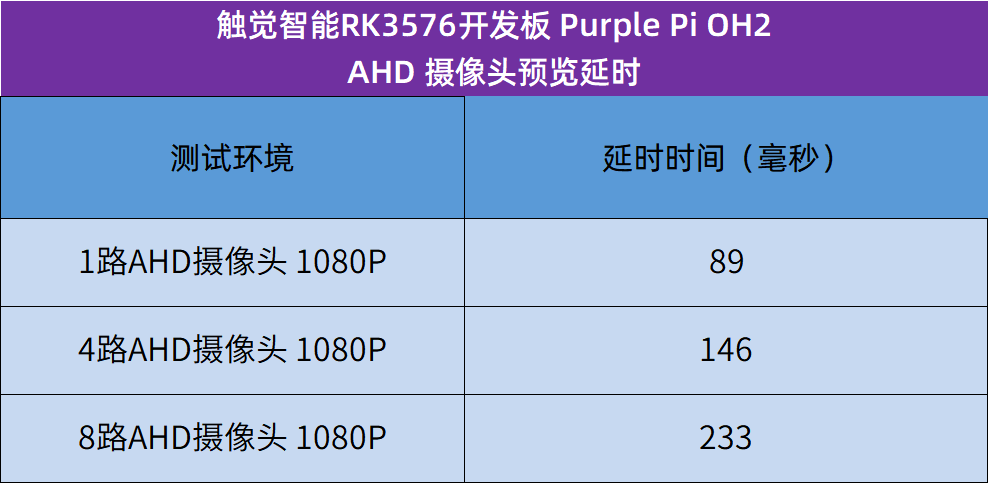
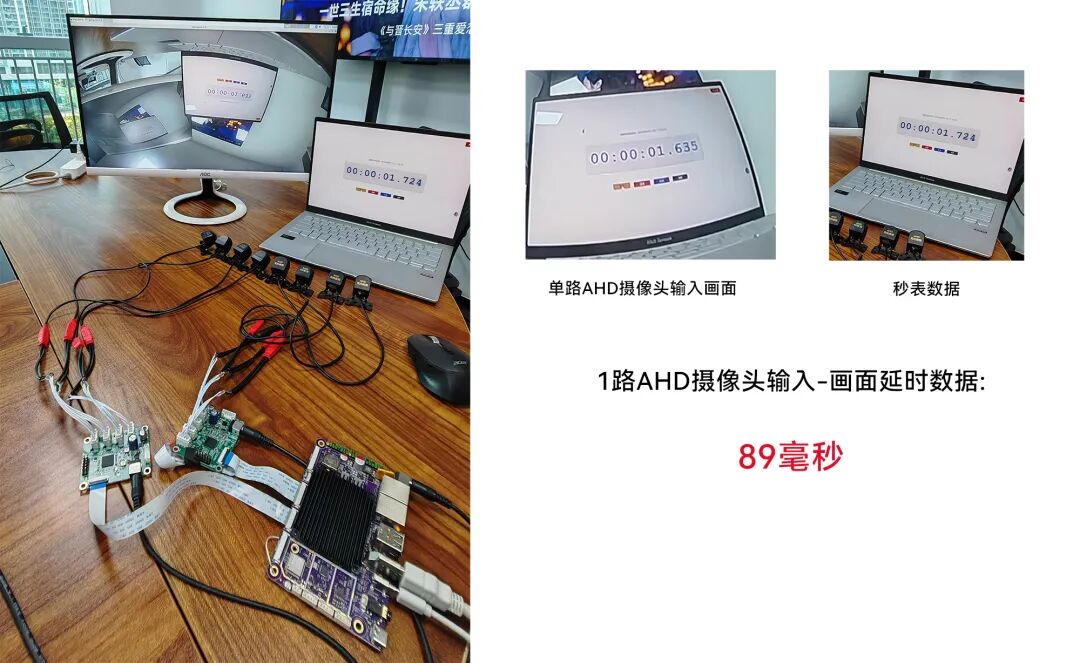
1-channel camera 1080P@30FPS input latency was measured at 89 milliseconds, with the actual photo:
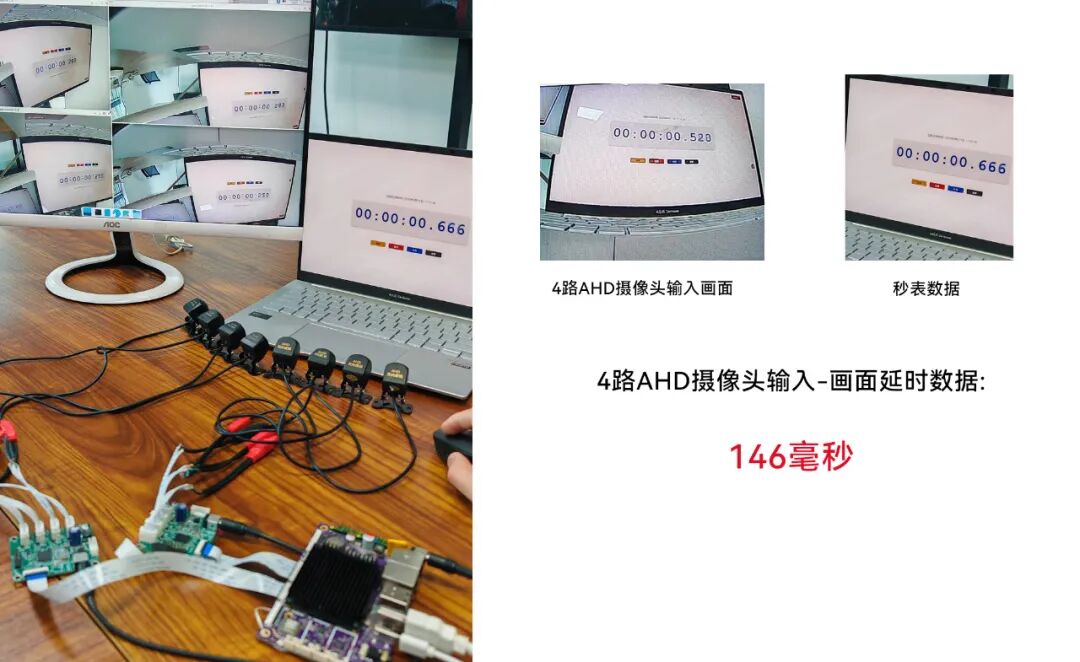
4-channel camera 1080P@30FPS input latency was measured at only 146 milliseconds, with the actual photo:
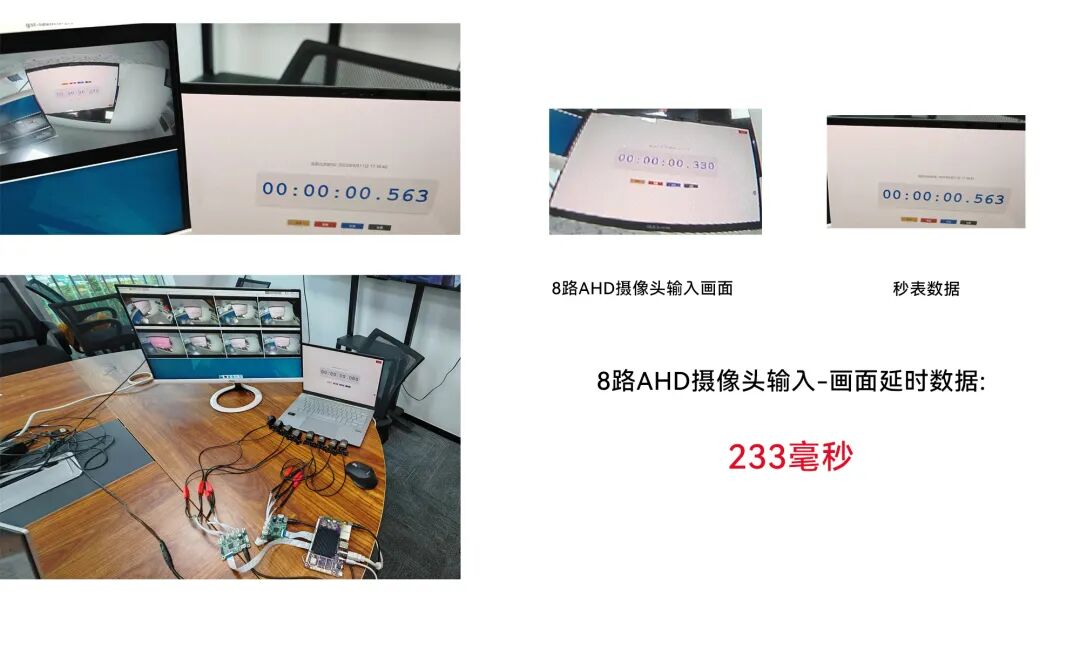
8-channel camera 1080P@30FPS input latency was measured at only 233 milliseconds, with the actual photo:
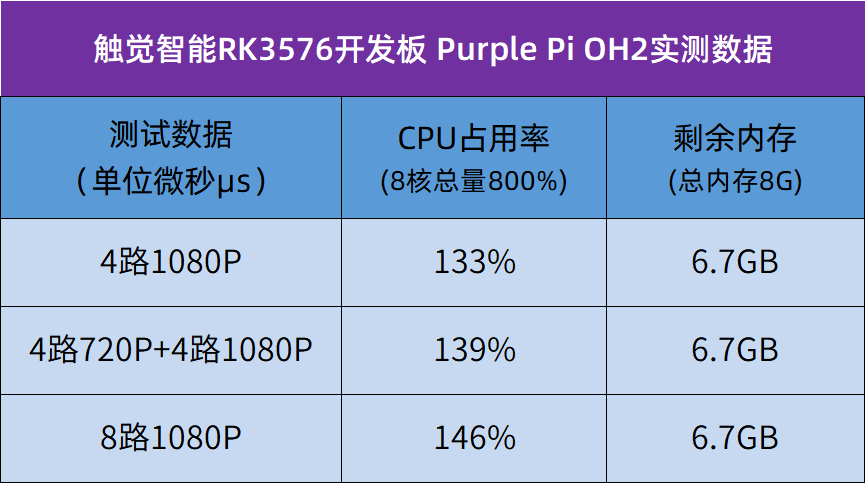
Memory CPU usage:
- Demonstration Video

 Product IntroductionThe Touch Intelligence Purple Pi OH2 Harmony Development Board, based on Rockchip’s second-generation 8nm high-performance AIOT platform RK3576, will be launched soon, with priority shipping for likes and follows! It is equipped with a stamp hole packaged core board, rich supporting materials, 100% domestically produced, and an ultra-compact size of 40.5×40.5mm, empowering the next generation of AIOT smart hardware!END