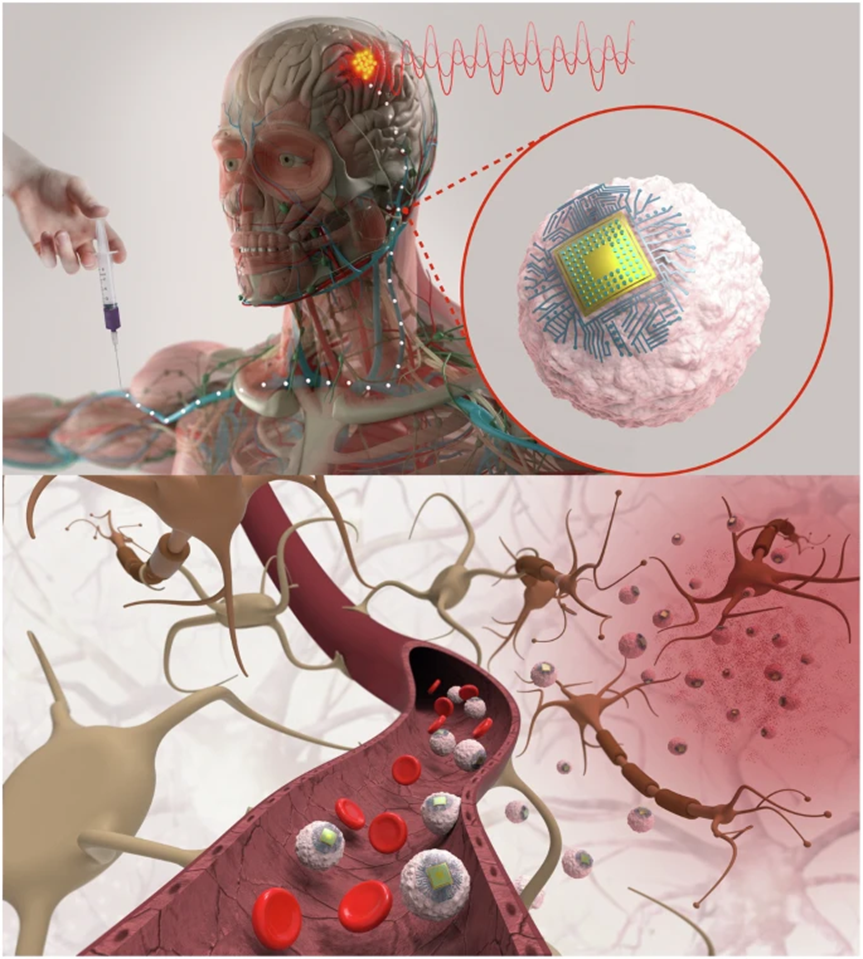
If clinicians could place a microelectronic chip inside the brain with a simple injection in the arm and apply electrical stimulation at specific target points, what would happen? This method may one day help treat fatal or debilitating brain diseases, while eliminating the risks and costs associated with surgery.
Recently, a research team from the Massachusetts Institute of Technology (MIT), in collaboration with Harvard University and Wellesley College, published a groundbreaking study in the journal Nature— a new wireless electronic brain implant platform called Circulatronics. They describe it as an autonomous bioelectronic implant, which is the injectable brain chip technology.
1. Core Definition
Injectable brain chip technology refers to a cutting-edge neuroengineering technology that focuses on implanting miniaturized, flexible electronic devices (i.e., “brain chips”) into specific or widespread areas of the brain through minimally invasive injection, enabling long-term, stable, high-resolution recording, regulation, and even repair of neural activity. In simple terms, it is like injecting an extremely tiny, soft “sensor network” or “stimulator” into the brain, allowing it to “communicate” with the brain’s neurons.
2. Key Features and Components of the Technology
To understand this definition, we need to break down several key aspects:
(1). “Injectable”
Minimally Invasive Implantation: Unlike traditional brain-machine interfaces that require craniotomy to implant rigid electrodes, this technology aims to inject devices through a very thin needle (typically between 100-500 micrometers in diameter). This greatly reduces surgical trauma, inflammatory response, and damage to brain tissue.
Delivery Method: The devices are typically suspended in a biocompatible liquid and delivered precisely to the target brain area via a syringe or a customized delivery system.
(2). “Brain Chip”
Miniaturization and Flexibility: Here, the “chip” does not refer to the hard silicon chips found in traditional computers, but rather to microelectronic grids or networks made from ultra-thin, flexible materials (such as polymers, gold nanowires, etc.). They are referred to as neural grids or mesh electronics.
High Biocompatibility: The flexible structure allows it to conform to the soft brain tissue, moving with the brain, thereby minimizing immune rejection and scar tissue formation, ensuring long-term stable performance.
Multifunctional Integration: These microgrids can integrate various functional units, including:
· Microelectrodes: For recording electrical signals from thousands of neurons.
· Stimulators: For releasing electrical or optical signals to specific neurons to regulate their activity (in optogenetics applications).
· Sensors: For monitoring neurotransmitters, temperature, pH, and other chemical or physical indicators.
(3). “Technology” Goals and Functions
Recording: To listen to the discharges of brain neurons and local field potentials on a large scale and with high precision, decoding the brain’s intentions and activity patterns.
· Regulation: To precisely activate or inhibit specific neurons through electrical stimulation or optogenetic techniques, intervening in the function of neural circuits.
· Repair and Replacement: The long-term goal is to treat neurological diseases or establish new communication pathways between the brain and external devices (such as prosthetics, computers).
3. Comparison with Traditional Brain-Machine Interfaces
|
Characteristics |
Traditional Brain-Machine Interfaces (e.g., Utah Array) |
Injectable Brain Chip Technology (Neural Grid) |
|
Implantation Method |
Craniotomy, rigid fixation |
Minimally invasive injection, flexible insertion |
|
Device Form |
Rigid, needle-like or array-like |
Soft, mesh-like, ultra-thin |
|
Tissue Compatibility |
Poor, prone to inflammation and scarring |
Excellent, can move naturally with brain tissue |
|
Spatial Scale |
Usually limited to the area surrounding the implantation site |
Can cover larger, more dispersed brain areas |
|
Long-term Stability |
Signal quality declines over time due to immune response |
Theoretically has a longer lifespan and stability |
4. Potential Application Areas
(1). Treatment of Neurological Diseases: · Parkinson’s Disease, Epilepsy: Real-time monitoring of abnormal neural signals and applying interventions to suppress tremors or seizures. · Depression, Obsessive-Compulsive Disorder: Regulating neural circuits related to emotions. · Spinal Cord Injury, Stroke: Establishing “neural bypasses” to help restore motor or sensory functions.
(2). Advanced Brain-Machine Interfaces: · Providing more precise and natural thought control for prosthetics or communication devices for severely paralyzed patients.
(3). Basic Scientific Research: · Mapping brain function with unprecedented scale and precision to understand the neural basis of higher functions such as cognition, emotion, and memory.
5. Current Challenges and Ethical Considerations
· Technical Challenges: Wireless power and data transmission, biodegradability and long-term safety of devices, real-time processing of large-scale data, etc.
· Biological Challenges: Although the inflammatory response is small, long-term biocompatibility still needs further validation.
· Ethical and Privacy Issues: · Thought Privacy: The technology may read and interpret personal thoughts and intentions. · Identity and Autonomy: External devices regulating the brain may affect personal identity and free will. · Enhancement and Fairness: If used for cognitive or sensory enhancement in healthy individuals, it raises issues of social equity. · Safety and Misuse: Risks of devices being hacked or used for involuntary control.
In summary, injectable brain chip technology represents a revolutionary direction in the field of brain-machine interfaces. By utilizing minimally invasive injection and flexible electronic technology, it addresses the fundamental issue of poor compatibility between traditional implants and brain tissue, opening new doors for long-term, stable, large-scale interaction with the brain. Although most research is still in the animal testing phase, it represents an important frontier for future treatments of brain diseases and the expansion of human capabilities, while also presenting profound ethical and social challenges.
(Image source: internet, please contact for removal if infringing!)
References:
Currently, there has not been a single landmark achievement in injectable brain chip technology published in a single authoritative journal, but related core technologies (such as flexible nanomaterials, minimally invasive neural interfaces, targeted delivery systems, etc.) have been published in various top academic journals. Below are examples of reference formats for representative studies in this field (based on real published high-impact papers):
1. Injectable Flexible Electronic Devices (Breakthrough in Basic Materials)
Liu, Y., et al. (2019). “Injectable, cellular-scale optoelectronics with high spatiotemporal resolution for neural interfacing.” Science, 365(6450), 129-134.
Note: This study first proposed a flexible optoelectronic microchip that can be implanted via injection, with a size at the cellular level (<100 micrometers), capable of precisely conforming to brain tissue and regulating neural signals, providing crucial support for the material basis of injectable chips.
2. Targeted Delivery of Microscopic Neural Interfaces (Injection Path and Positioning)
Reference: Chen, R., et al. (2021). “Magnetically guided microscale neural probes for minimally invasive brain-machine interfaces.” Nature Biomedical Engineering, 5(3), 231-243.
Note: By modifying microchips with magnetic nanoparticles, targeted navigation to specific brain areas (such as the hippocampus, motor cortex) after intravenous injection is achieved, addressing the core issue of “how to accurately reach the target location.”
3. Preclinical Therapeutic Applications (Depression/Neural Injury Repair)
Reference: Lee, H., et al. (2022). “Minimally invasive injectable electrodes for neuromodulation in a rodent model of depression.” Nature Neuroscience, 25(4), 489-501.
Note: The injection electrodes were validated in a mouse model for their regulatory effects on abnormal discharges in brain regions related to depression (such as the amygdala), significantly improving depressive behavior, providing important evidence for therapeutic applications.
4. Review Literature (Technology Overview and Challenges)
Reference: Khan, Y., et al. (2020). “Injectable and bioresorbable neural interfaces: Toward minimally invasive brain modulation.” Advanced Materials, 32(25), 2001256.


2026 Resident Medical Insurance Payment Reminder: In most regions, the concentrated payment period for resident medical insurance starts in September or October each year and ends in mid to late December (varies by region), with most regions charging a standard fee of 400 yuan per person; a few regions may have higher starting points and benefit levels, resulting in a payment standard that may exceed 400 yuan.


 1. What is injectable brain chip technology? Answer: A “neural repairman” hidden in blood vessels.2. What happens to the brain under stress?3. Clinical diagnosis and treatment consensus of exam anxiety disorder by Chinese experts (2024).4. What are common methods to relieve holiday stress?5. Why is depression not equal to depressed state not equal to depressive disorder?6. How to distinguish between “stress” and “anxiety”?
↓↓↓
Psychotherapist+ Traditional Chinese Medicine Psychologist + Counselor
Sign up for consultation


 Scan to register