Global AI chip giant NVIDIA has announced a strategic investment of $5 billion in its long-time rival Intel, along with a deep technical collaboration.
The two companies will jointly develop chips for personal computers and data centers, deeply integrating NVIDIA’s graphics processing technology with Intel’s x86 architecture.
This unexpected collaboration marks a significant shift in the semiconductor industry landscape.
Once competitors, they have now become partners, reflecting the challenges and opportunities faced by traditional chip giants in the wake of the AI wave.
01
A Strategic Partnership: Strong Alliance, Mutual Benefits
According to the agreement announced by both parties, NVIDIA will purchase Intel common stock at a price of $23.28 per share, with a total investment of $5 billion, representing a discount of about 6.5% compared to Intel’s closing price the previous day.
Upon completion of the transaction, NVIDIA will hold less than 5% of Intel’s shares, becoming one of the important shareholders of this established chip giant.
The collaboration covers two key areas:
In the data center sector, Intel will customize x86 CPUs for NVIDIA, integrating them into AI infrastructure platforms.
In personal computing, Intel will produce and launch x86 system-on-chip solutions integrated with NVIDIA’s RTX GPU chips to power various PCs..
02
Stock Prices Surge: Market Optimistic About Collaboration Prospects
Following the announcement, Intel’s stock price experienced a surge, rising by as much as 30% in pre-market trading and closing with a gain of 22.8%, marking the largest single-day increase in recent years.
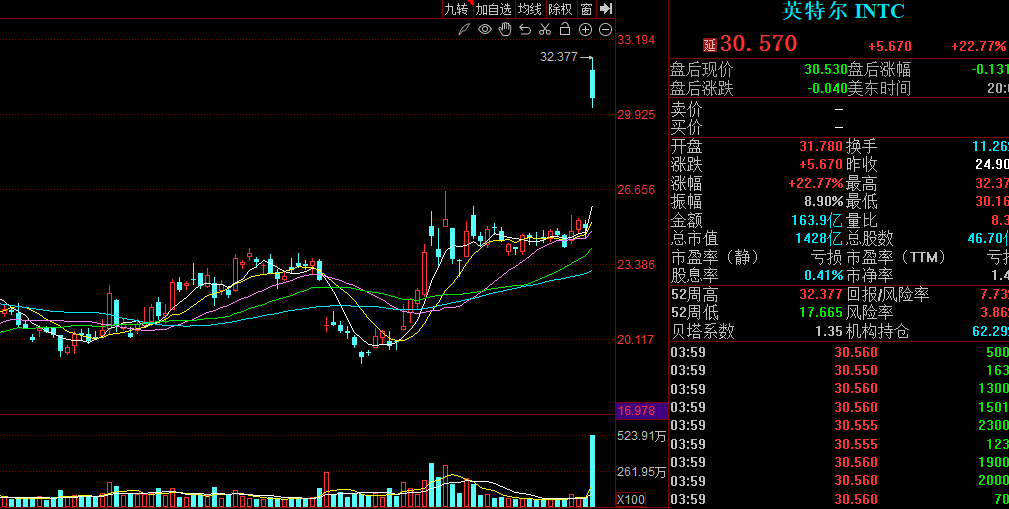
Not only Intel, but NVIDIA’s stock price also saw an increase of about 2%. In stark contrast, their common competitor AMD’s stock price fell by over 4%.
The market reaction clearly indicates investor optimism regarding this collaboration.
Jensen Huang, during the press conference, predicted that the return on this investment in Intel would be substantial, with the partnership addressing market opportunities worth between $25 billion and $50 billion.
03
Strategic Value: Beyond Financial Investment
For Intel, this capital injection is significant. In recent years, Intel has been losing ground in the high-performance chip market and cannot independently bear the enormous costs of advanced process R&D with its existing business.
In the past few months, Intel has received approximately 10% shareholding support from the U.S. government and a strategic investment of $2 billion from Japan’s SoftBank.
NVIDIA’s investment further solidifies the funding chain of this established chip giant. More importantly, gaining recognition from an industry leader may be more valuable than the capital itself.
For NVIDIA, with an investment that accounts for only about 2% of its market value, it has secured customized x86 chips for NVLink systems and client PCs without bearing the risks of foundry or schedule delays.
04
Industry Impact: Reshaping the Competitive Landscape
This collaboration will inevitably change the competitive landscape of the semiconductor industry, with AMD being the first to feel the impact.
In the data center sector, the Intel-NVIDIA NVLink CPU will strengthen NVIDIA’s accelerator empire’s moat; in the PC market, Intel’s x86 RTX chips will squeeze AMD’s market share in the gaming laptop APU sector.
For TSMC, there are no immediate concerns, but long-term risks exist. Although TSMC remains the primary manufacturer of NVIDIA’s flagship chips, if Intel’s process nodes and advanced packaging technologies catch up, some orders may shift to Intel in the future.
05
Risks and Challenges: Execution Remains a Key Variable
The close coupling of CPU and GPU requires customized silicon, coherent memory semantics, coordinated firmware, and relentless thermal management. Past industry attempts to fit desktop-level performance into a laptop framework have often been limited by thermal issues, bandwidth, or driver fragility.
This is not the first attempt to integrate chips. In 2017, Intel’s Kaby Lake-G packaged its CPU with AMD Radeon graphics, but despite the good concept, execution was poor. Responsibilities for drivers were unclear, updates were delayed, and the product line was short-lived.
Additionally, NVIDIA’s own CPU roadmap complicates the situation. Grace and its subsequent products promote the ARM architecture, making the collaboration with Intel seem like a supplement: in a market where ecosystem and software inertia are crucial, x86 is the branch choice.
In summary, this collaboration not only injects much-needed capital into Intel but also provides it with an opportunity to return to the competition.
For NVIDIA, this is a strategically limited-risk investment with potentially high returns. The competitive landscape of the semiconductor industry is being reshaped, with former rivals becoming allies, and new alliances forming. In this multi-trillion-dollar chip war, flexible strategies and timely partnerships may be more important than the technology itself.
This article is based on publicly available information and is solely a personal opinion sharing, not intended as investment advice. The market carries risks, and investments should be made cautiously.
Recommended Reading
HUOXIANG /
Reflections from Seventeen Years of Trading: Wanting Both is the Poison of Trading
The Fire Plan Account Has Been Significantly Upgraded, with Subsidies Up to 90%, Empowering Trading Growth
Understanding Polysilicon in One Article: Market Reversal and Investment Logic Under Policy RescueFollow “Fire Element” to Get Financial News Instantly and Stay Updated with Fire Element and Financial Information