Decoupling Li+ and pH Effects: Unveiling the “Golden Rule” of PAA Binders for Silicon Anodes
1. Introduction:
In the pursuit of alleviating “range anxiety” and achieving “fast charging” for electric vehicles, our thirst for battery energy density has never ceased. However, when we turn our attention to the next generation of high-capacity anode materials—**Silicon (Si)**—a technical pain point looms like a “ticking time bomb”: volume expansion. Silicon anodes can experience a staggering volume change of up to 400% during charge and discharge cycles, leading not only to the pulverization of silicon particles but also to the detachment of the entire electrode from the current collector, ultimately causing rapid capacity decay and rendering the vision of high capacity a mere illusion.
The key to solving this problem lies not in silicon itself, but in the often-overlooked “binder”—Binder. It acts as the “skeleton” and “glue” of the electrode, needing to be sufficiently robust to maintain the structural integrity of the electrode amidst silicon’s “brutal growth”. Polyacrylic acid (PAA), due to its abundant carboxyl groups that can form strong hydrogen bonds with the silicon surface, is considered one of the most promising binders currently available. However, there has been intense debate in the industry regarding whether PAA should be neutralized with lithium hydroxide (LiOH), with even contradictory experimental results. The reason behind this is that the addition of LiOH introduces two variables: additional lithium ions (Li+) and increased pH, whose effects have been confounded.
This research published in the Journal of The Electrochemical Society acts like a meticulous scientific detective, cleverly decoupling the two variables of Li+ and pH, clearly revealing their respective contributions to the performance of silicon anodes for the first time. This study not only resolves long-standing controversies but also identifies the **”Golden Rule”** for the formulation of PAA binders.
This “Golden Rule” is expected to help us design silicon anodes that combine high capacity, long lifespan, and excellent processability, thereby elevating the lifespan and reliability of power batteries to a new level.
2. Performance Breakthrough:
To determine whether a technology has truly made a breakthrough, we must ultimately look at its performance in the electrochemical cycling performance, the “ultimate battlefield”. This study provides irrefutable “ironclad evidence” through a series of ingenious comparative experiments.
1. Core Performance Comparison: The Victory of LiOH-PAA(4.5)
The researchers compared various binder formulations, with the most critical comparison being between: original PAA (pH 2), high pH LiOH-PAA (pH 7), and their discovered optimal formulation LiOH-PAA (pH 4.5).
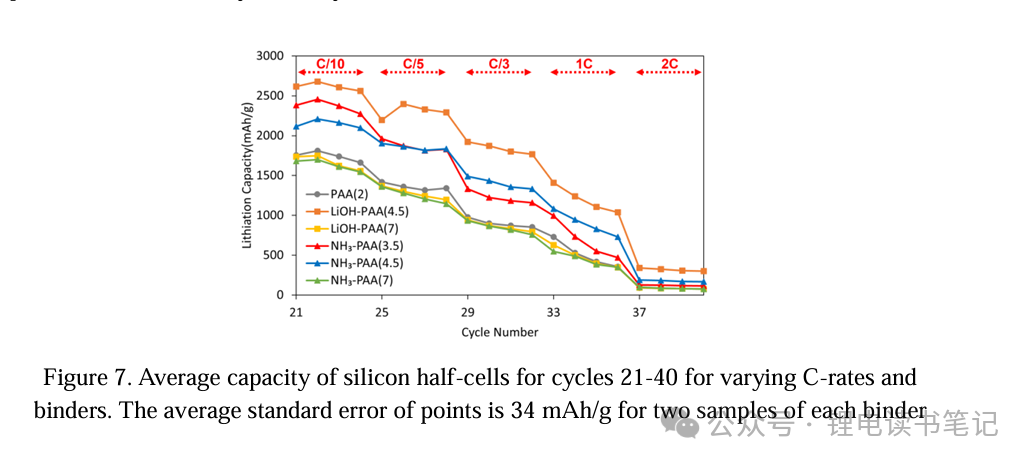
After 40 cycles at different rates, the performance differences among the various formulations were astonishing:
| Binder Formulation | Key Indicator | Performance | Conclusion |
|---|---|---|---|
| PAA(pH 2) | Capacity Retention Rate | Fastest decay, worst performance | Good mechanical properties, but poor slurry rheology and prone to cracking, insufficient ionic conductivity. |
| LiOH-PAA(pH 7) | Capacity Retention Rate | Better than PAA(pH 2), but not as good as LiOH-PAA(pH 4.5) | High ionic conductivity, but mechanical integrity severely compromised by high pH. |
| LiOH-PAA(pH 4.5) | Capacity Retention Rate | Highest, best performance | Achieved the best balance between ionic conductivity and mechanical integrity. |
Surprisingly, LiOH-PAA(4.5) not only leads in capacity retention but also has the highest capacity after C/20 activation cycles among all formulations. This strongly demonstrates that the performance of PAA binders is not always better with higher values, but rather there exists a “sweet spot” near pH 4.5.
2. Ionic Transport “Accelerator”: Contribution of Li+
Before revealing the final performance, the researchers first addressed the first variable—the effect of Li+. They directly measured the ionic conductivity of the binder film through cyclic voltammetry (CV) and electrochemical impedance spectroscopy (EIS).
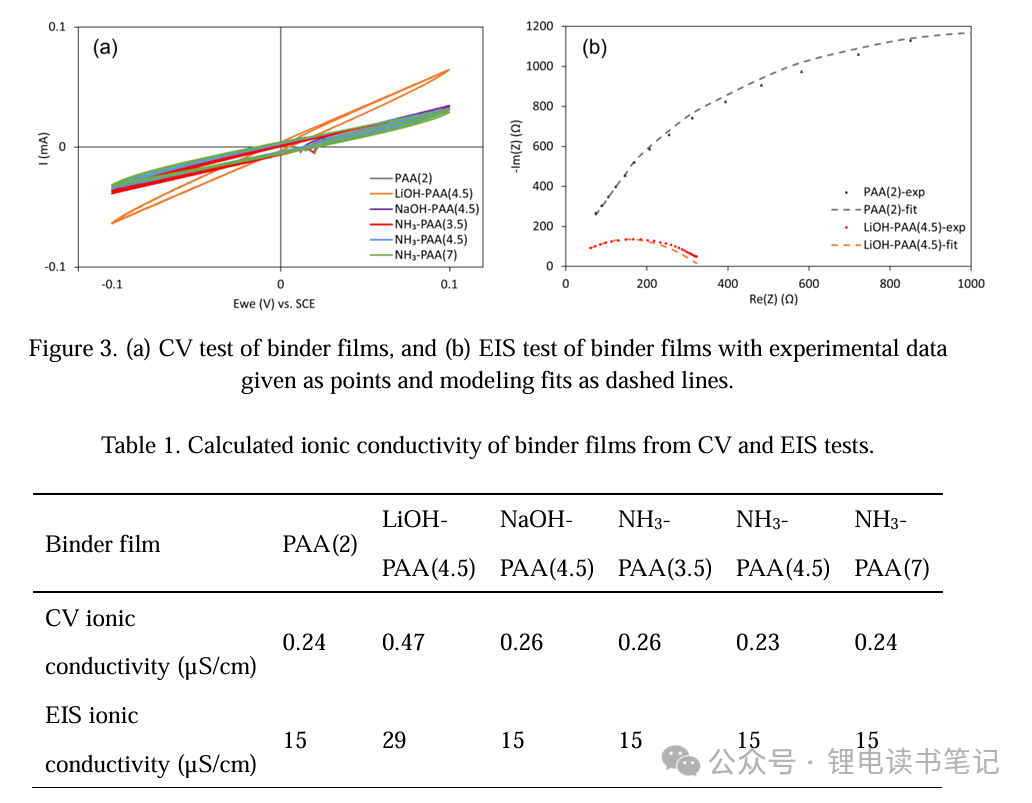
At the same pH (pH 4.5), the ionic conductivity of LiOH-PAA(4.5) (0.52 µS/cm) is twice that of NH3-PAA(4.5) (0.26 µS/cm), which was neutralized with other cations (such as NH4+)!
It must be noted that this enhancement is not coincidental. The researchers speculate that the additional Li+ can migrate rapidly through a “structural transport” mechanism similar to the Grotthuss mechanism within the -COOLi bond network of PAA, which is more efficient than traditional “carrier transport”. This finding is crucial as it demonstrates that the addition of LiOH acts primarily as an “ionic transport accelerator”, significantly reducing the interfacial resistance of the electrode, laying the foundation for high-rate performance and low polarization of the battery.
3. Mechanical Integrity’s “Double-Edged Sword”: The Trade-off of pH
Next, the researchers, like surgeons, dissected the second variable—the impact of pH on the physical properties of the electrode.
- • Processability (Rheology): Viscosity tests showed that as pH increased from 2 to 7, the viscosity of the slurry significantly increased and exhibited stronger shear-thinning behavior. This means that high pH (such as pH 7) slurries are more uniform during coating and less prone to sedimentation, resulting in better processability. In contrast, low pH (pH 2) slurries are too thin, which is not conducive to industrial coating.
- • Adhesion (Peel Test): However, concerningly, the results of the peel test were completely opposite to the viscosity trend. The PAA binder at pH 2 exhibited the highest peel strength (approximately 13 N/m), while the strength of LiOH-PAA at pH 7 was the lowest (approximately 5 N/m). This indicates that high pH severely damages the adhesion strength between the binder and the current collector (copper foil), which is undoubtedly a fatal flaw for the structural stability of the electrode.
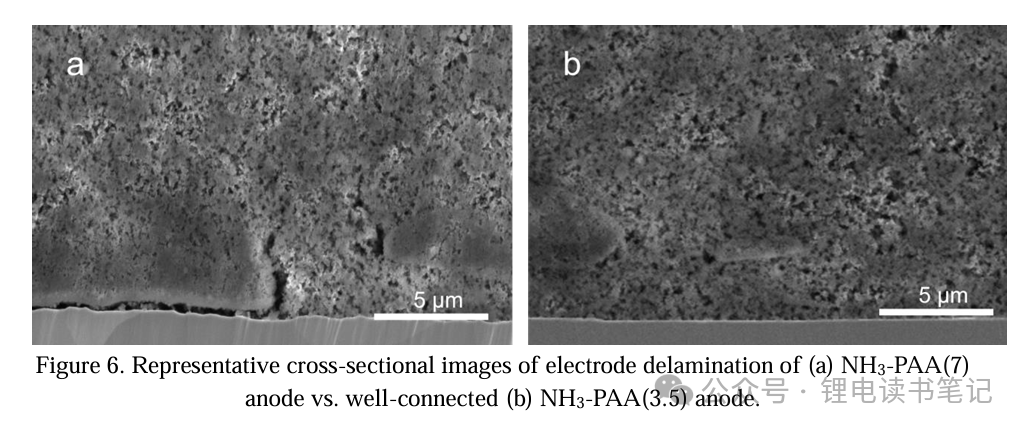
- • Structural Stability (SEM): Through scanning electron microscopy (SEM) analysis of the electrode cross-section, the researchers found the most direct evidence. The cross-section of the electrode at low pH (pH 2) showed significant cracking after drying, explaining its poor cycling performance. Although the high pH (pH 7) electrode was uniformly coated, it also exhibited structural defects after cycling due to poor adhesion. Only the LiOH-PAA(pH 4.5) electrode maintained the most intact structure before and after cycling.
3. Mechanism Revelation:
Now that we have gathered all the “evidence”: Li+ accelerates ionic transport, while pH plays a “double-edged sword” role between processability and mechanical integrity. It is time to “solve the case”.
1. System Metaphor: The Binder as a “Transport Hub” and “Urban Planning”
We can imagine the silicon anode electrode as a rapidly expanding **”future city”**.
- • Silicon Particles: The main buildings of this city, which experience intense “earthquakes” (volume expansion) during charge and discharge.
- • Binder (PAA): The city’s **”skeleton” and “transport hub”**. It must firmly anchor all buildings (silicon particles) to the ground (current collector) while ensuring smooth “logistics” (lithium ion transport) within the city.
In this study, the researchers were essentially searching for an optimal **”urban planning scheme”**:
- 1. Contribution of Li+: Optimizing the “Logistics System”. The addition of LiOH is akin to introducing a **”highway”** to the city. This “structural transport” allows lithium ions to move more quickly and efficiently through the binder network, reducing “logistics costs” (interfacial resistance). This is a prerequisite for the efficient operation of the city.
- 2. Contribution of pH: Balancing “Building Quality” and “Construction Difficulty”.
- • High pH (pH 7): Equivalent to using **”easy-to-work-with but insufficiently strong glue”**. Although the slurry has high viscosity and is easy to coat (low construction difficulty), the adhesion is poor (poor building quality), making the city prone to collapse during “earthquakes”.
- • Low pH (pH 2): Equivalent to using **”extremely strong glue”, but the slurry is too thin, making it difficult to coat (high construction difficulty), and prone to stress after drying, leading to internal “foundation cracks” (electrode cracking).
2. Illustrated Truth: The “Golden Balance Point” at pH 4.5
Using **【Figure 3: SEM Image of Electrode Cross-section】** as a “microscope”, we can clearly see the ultimate fate of different “urban planning” schemes.
- • Electrode at pH 2: Although it has strong adhesion, the poor rheology of the slurry leads to uneven internal structure, concentrating stress after drying, resulting in significant macro-cracking. This causes the electrode to fail rapidly in the early cycles.
- • Electrode at pH 7: Although it is uniformly coated, the weak adhesion cannot withstand the volume expansion of silicon particles, leading to the destruction of the bond between the electrode and the current collector, resulting in rapid capacity decay.
- • Electrode of LiOH-PAA(pH 4.5): This formulation is precisely near the pKa value (4.5) of PAA, achieving partial deprotonation.
The more ingenious design is that, the pH 4.5 formulation achieves the following “golden balance”:
- 1. Sufficient Mechanical Strength: It retains most of the strong adhesion between PAA and copper foil at low pH, sufficient to withstand the volume expansion of silicon.
- 2. Optimized Ionic Transport: The addition of LiOH ensures high ionic conductivity, reducing the internal resistance of the battery.
- 3. Acceptable Processability: Although its viscosity is not as high as pH 7, its rheology is sufficient to meet the needs of laboratory preparation and pilot-scale production, avoiding the severe cracking issues seen at pH 2.
In conclusion: Ultimately, the greatness of this research lies not in simply “choosing” PAA, but in precisely decoupling variables to find the **”optimal pH window that maintains mechanical integrity while ensuring high ionic transport efficiency”**. This is the true “Golden Rule” guiding material design.
4. Industry Outlook:
The gap between laboratory “breakthroughs” and industrial “success” is often vast. The findings of this research undoubtedly illuminate a path for the industrialization of silicon anodes, but we must remain calm in conducting a “feasibility assessment”.
1. Application Scenarios: The Perfect Combination of High Energy Density and Long Lifespan
The core value of this technological breakthrough lies in **”balancing”. It resolves the long-standing contradiction between ionic transport (determining rate capability and internal resistance) and mechanical strength** (determining cycle life) in silicon anode binder formulations.
- • Electric Vehicles (EV): The LiOH-PAA(pH 4.5) formulation can significantly enhance the cycling stability of silicon anodes, meaning that batteries equipped with silicon-carbon anodes can achieve over 20% increase in energy density while also meeting automotive-grade requirements of over 1000 cycles. This is highly attractive for high-end electric vehicles and long-range models.
- • Energy Storage Systems (ESS): Energy storage systems have extremely stringent requirements for cost and lifespan. The formulation optimization provided by this research can help extend the lifespan of storage batteries without significantly increasing costs, thereby reducing the total lifecycle cost.
2. Facing Challenges: The “Three Mountains” from Laboratory to Factory
Despite the clear principles, industrialization still faces the following challenges:
| Challenge Dimension | Specific Issues | Impact Analysis |
|---|---|---|
| Cost and Process | Precise addition of LiOH and pH control | In industrial production, precisely controlling the pH of the slurry (especially in the sensitive region near pKa) requires more sophisticated online monitoring and adjustment systems, increasing process complexity and costs. |
| Supply Chain | Molecular weight and batch stability of PAA binder | The molecular weight of PAA used in the laboratory (MW = 450 kDa) needs to ensure batch stability in industrial procurement; otherwise, it will affect the final viscosity, rheology, and adhesion. |
| Safety Certification | Impact of binder on SEI film | Although this paper mainly focuses on the binder itself, the chemical environment of the binder (such as pH) may indirectly affect the formation and stability of the SEI film on the silicon anode surface, requiring longer and stricter safety and thermal stability tests. |
3. Rational Path: From “Golden Rule” to “Golden Product”
We can make the following rational predictions about the industrialization path of this technology:
- 1. Laboratory Verification (Completed): Demonstrated the superiority of LiOH-PAA(pH 4.5) in half-cell systems.
- 2. Pilot Scale-up (Next 1-2 Years): Focus on solving the issues of continuous and precise pH control of the slurry and stability of large-scale coating. At the same time, apply the formulation to full-cell systems to verify its performance under actual working conditions.
- 3. Automotive-grade Mass Production (Next 3-5 Years): Achieve automotive-grade standards in all indicators such as cost, safety, and cycle life, and ensure compatibility with existing battery production lines.
The value of this research lies in providing a clear optimization direction, allowing the industry to no longer blindly oscillate between “adding LiOH” and “not adding LiOH”, but rather focus on **”how to precisely control the pH around 4.5″**, thereby accelerating the commercialization process of silicon anodes.
5. Conclusion:
This research on PAA binders, seemingly focused on a minor chemical detail—Li+ and pH—has monumental significance. It employs rigorous scientific methods to resolve the long-standing debate in the silicon anode field, shifting the design of binders from “empiricism” to **”precise science”**.
The researchers have cleverly decoupled the two variables, clearly demonstrating that the success of silicon anodes is a result of the intricate balance between high ionic conductivity and high mechanical integrity. Li+ is responsible for “accelerating logistics”, while pH 4.5 is responsible for “reinforcing the foundation”. Only by balancing both can we create truly stable and long-lasting high-capacity silicon anodes.
Looking to the future, this “Golden Rule” is not only applicable to PAA binders; its **”decoupling variables and finding balance points”** scientific thinking will profoundly influence the design concepts of next-generation battery materials. We have reason to believe that with more in-depth basic research, the day of large-scale application of silicon anodes will come sooner than we imagine.
6. Original Information Module
Original Information
- • Title: The Effects of Lithium Ions and pH on the Function of Polyacrylic Acid Binder for Silicon Anodes
- • Authors: Fei Sun and Dean R. Wheeler
- • Journal: Journal of The Electrochemical Society, 170 (8), 080502 (2023)
- • DOI: 10.1149/1945-7111/ace84e