In the previous articles, we mainly covered pointer algorithms, pointer arrays and array pointers, function pointers, void generic pointers, and linked lists. This article serves as a supplement, adding some common usage patterns and precautions for C pointers.
1. Pointer Swapping: An Efficient Way to Exchange Values
By directly manipulating memory addresses through pointers, we can efficiently swap variable values: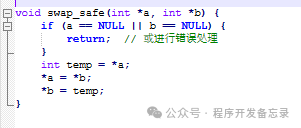 This method directly manipulates memory addresses through pointers, avoiding the large data copy overhead that occurs during traditional value swapping (pass by value). This approach is particularly suitable for improving performance when swapping large structures or arrays.
Common Pitfalls:
-
Null Pointer Dereference: Passing a null pointer will cause the program to crash. The entry function must check for null pointers, and if it is a structure, the pointers within the structure must also be checked for null before use.
-
Type Mismatch: Incorrect pointer types may lead to data corruption. Pay attention to pointer types during assignment and function calls.
2. Multi-level Pointers: Pointers to Pointers
Multi-level pointers can point to other pointers, useful for handling pointer arrays or modifying pointers themselves: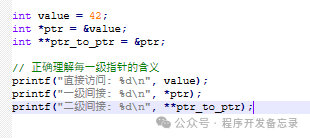
Multi-level pointers are very useful for dynamically allocating multi-dimensional arrays and modifying pointer parameters in functions.
Common Pitfalls:
-
Confusion from Multi-level Indirection: Reduces code readability
-
Incorrect Dereference Level: Leads to incorrect memory access
When using multi-level pointers, it is essential to understand the meaning of each level of pointer. Use multi-level pointers with caution
3. Pointer and String Traversal
Using pointers to traverse strings is more efficient than using array indexing:
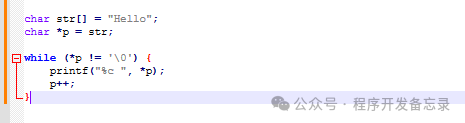
Common Pitfalls:
-
Modifying String Literals: Attempting to modify string literals will lead to undefined behavior


-
Out-of-Bounds Access: Forgetting to check for the string terminator
4. Various Combinations of const and Pointers
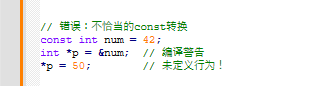
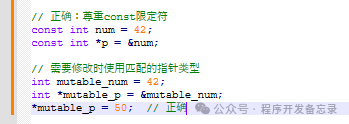
There are three main forms of combining const with pointers, providing different levels of protection: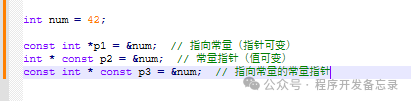
Common Pitfalls:
-
Improper const Conversion: Violates const protection
-
Confusing const Placement: Leads to different levels of protection
5. Structure Pointers: Efficiently Handling Complex Data Structures
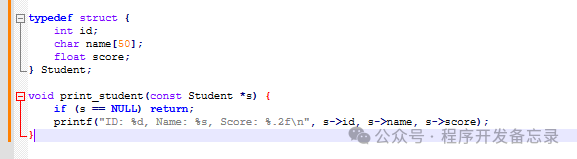
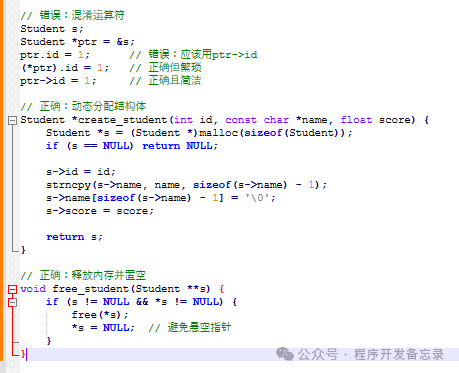
Structure pointers allow us to efficiently manipulate complex data structures, avoiding the overhead of copying entire structures
Common Pitfalls:
-
Misuse of Arrow Operator: Confusing
<span>.</span>and<span>-></span>operators -
Memory Alignment Issues: Size changes due to structure padding
-
Uninitialized Pointers: Accessing unallocated memory with structure pointers
6. Using typedef to Simplify Complex Pointer Declarations
Using typedef to create aliases for complex pointer types improves code readability: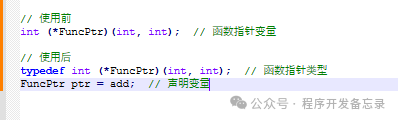
Common Pitfalls:
-
Overuse: May lead to confusion in the type system
-
Hiding Pointer Characteristics: Newcomers may not realize this is a pointer type
typedef in C language is essentially giving a name to some complex declarations, but there is a limit to everything. The principle of moderation applies in practice, and how to grasp this limit must be explored gradually in actual projects.Summary:After writing intermittently for about a month, I feel that I have covered most of the aspects of C language pointers. C pointers are an essential skill for C programming; they are prone to errors but can be very useful when used correctly.Good programming habits are a crucial prerequisite for effectively using C pointers:
-
Always initialize pointers: Uninitialized pointers can be very dangerous.
-
Check pointer validity before use: After function parameters or complex conditions, always check pointer validity before using it.
-
Use const modifiers appropriately: Maintain a certain respect for the const modifier.
-
Ensure pointer arithmetic is within valid ranges: Pointer validity is a prerequisite for pointer arithmetic; going out of bounds can lead to serious issues.
-
Check return values after dynamic memory allocation: Remember that dynamic memory is not always available for everyone; sometimes, you may find that it has run out.
-
Release memory in a timely manner and avoid dangling pointers: Like a warehouse, if you take things out of your box, remember to move the box as well; otherwise, there will come a day when you can’t fit everything.
-
Use typedef for complex pointers: This is straightforward; just use it appropriately.
-
Adopt defensive programming strategies: