Comprehensive In-Depth Analysis of Linux TLB Management Mechanism: From Principles to Practice
1 TLB Basic Concepts and Background Introduction
1.1 What is TLB and Its Importance in Memory Management
Translation Lookaside Buffer (TLB) is a specialized cache in the Memory Management Unit (MMU) used to accelerate the translation process from virtual addresses to physical addresses. Essentially, the TLB stores the most recently used Page Table Entries (PTEs), which contain the mapping from virtual addresses to physical addresses along with relevant permission control information. In systems without a TLB, every memory access requires querying the page table stored in physical memory to complete the address translation. Since page tables typically use a multi-level structure (such as the four-level page table in x86-64 systems), a single address translation may require multiple memory accesses, leading to significant performance degradation.
The operation of the TLB is based on the principle of locality, which includes temporal locality and spatial locality. Temporal locality refers to the likelihood that recently accessed addresses will be accessed again in the near future; spatial locality indicates that accessing a certain address is likely to be followed by accesses to nearby addresses. Due to the presence of these two types of locality during program execution, the TLB can achieve a high hit rate, typically over 95%, which greatly reduces the average memory access time.
We can understand the importance of the TLB through a simple analogy: imagine a huge library (representing physical memory) where books are arranged according to a complex coding system (representing the virtual address space). Without a catalog (equivalent to having no TLB), finding a book would require searching the entire library, which is highly inefficient. With a catalog stored in a distant office (equivalent to having only the page table), looking up a book is still slow. The TLB acts like a portable list of frequently borrowed books (TLB cache), recording the locations of recently borrowed books, allowing for quick retrieval of needed books.
1.2 TLB from the Perspective of Hardware and Software Collaboration
TLB management involves close collaboration between hardware and the operating system, and this collaborative relationship is implemented differently across various architectures. In hardware-managed TLB (common in CISC architectures like x86), when a TLB miss occurs, the hardware automatically traverses the page table to find the corresponding translation and fills it into the TLB. The advantage of this approach is low software complexity, but it lacks flexibility.
In contrast, in software-managed TLB (common in RISC architectures like MIPS, Alpha, and LoongArch), a TLB miss triggers an exception, and the operating system’s exception handler is responsible for traversing the page table and explicitly inserting the translation into the TLB. Although this method has higher software complexity, it provides greater flexibility and control, allowing the operating system to adopt more refined TLB management strategies.
As a cross-platform operating system, Linux needs to work efficiently under both management modes. To this end, the kernel provides a set of abstract TLB management interfaces that shield the underlying hardware differences, allowing the upper memory management code to manage the TLB in a unified manner.
Example of TLB flush instructions in x86 architecture:
// Flush a single TLB entry - using INVLPG instruction
void __flush_tlb_one(unsigned long addr) {
    asm volatile("invlpg (%0)" ::"r" (addr) : "memory");
}

// Flush all TLB entries - by reloading CR3 register
void __flush_tlb_all(void) {
    unsigned long cr3;
    asm volatile("mov %%cr3, %0" : "=r" (cr3));
    asm volatile("mov %0, %%cr3" : : "r" (cr3));
}
Table: Comparison of TLB Management Characteristics Across Different CPU Architectures
| Architecture Type | TLB Management Method | Advantages | Disadvantages | Typical Representatives |
|---|---|---|---|---|
| CISC | Hardware Management | Simple and efficient, automated | Poor flexibility, fixed strategy | x86, x86-64 |
| RISC | Software Management | Flexible and controllable, optimizable | Complex software, high development difficulty | MIPS, Alpha, LoongArch |
2 Detailed Explanation of Linux TLB Management Mechanism
2.1 TLB Flush Interfaces and Usage Scenarios
The Linux kernel provides a series of TLB flush interfaces with varying granularity to meet the needs of different usage scenarios. These interfaces form the core of Linux TLB management, allowing the kernel to invalidate corresponding stale entries in the TLB promptly when the page table content changes. Understanding the semantics and usage scenarios of these interfaces is crucial for a deep understanding of Linux memory management.
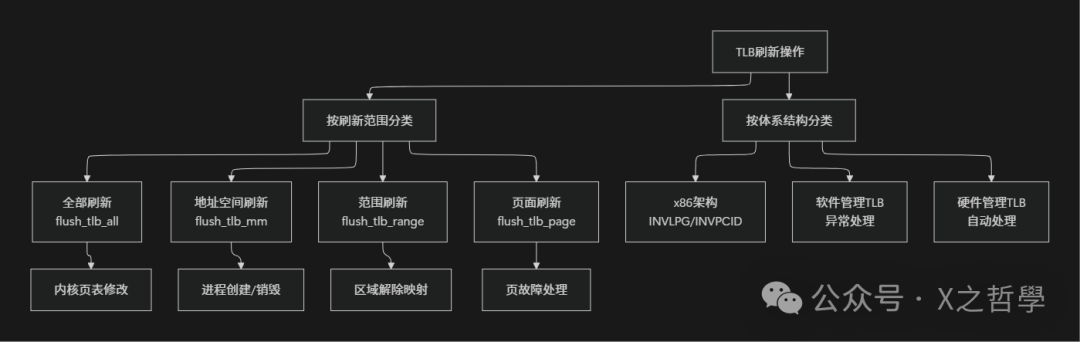
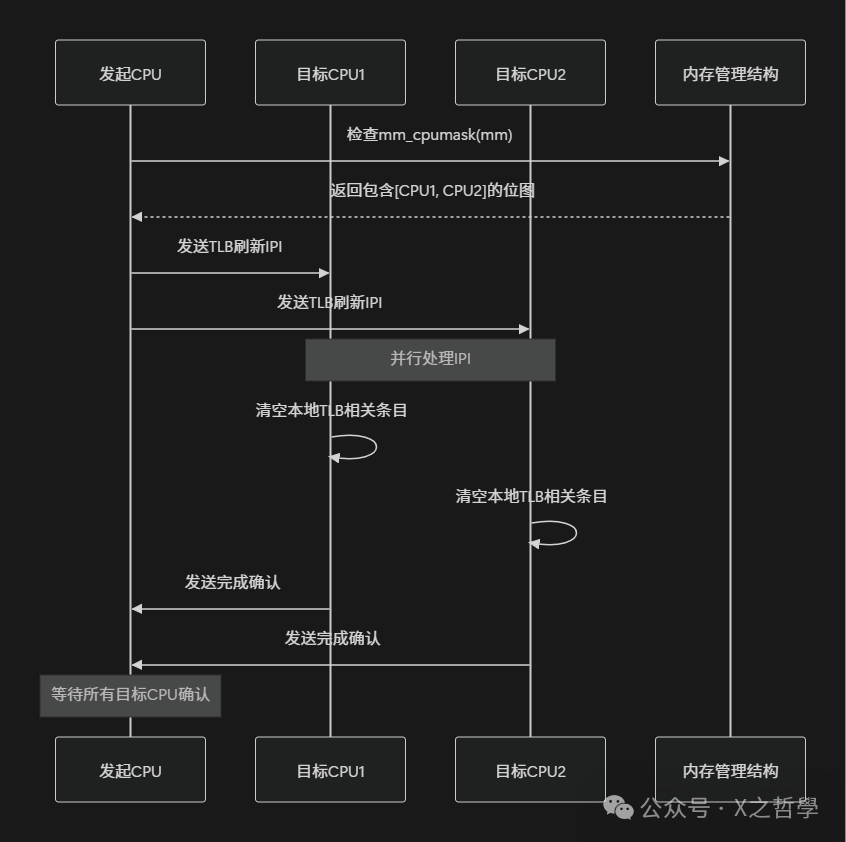
The coarsest flush interface is <span>flush_tlb_all()</span>, which unconditionally invalidates all TLB entries on all CPUs in the system. This is a relatively expensive operation, typically used only during global page table modifications, such as when the kernel page table is changed, because the kernel space mappings are globally shared. In SMP systems, executing this operation requires notifying all CPUs to perform TLB flush via Inter-Processor Interrupt (IPI), which incurs significant performance overhead.
<span>flush_tlb_mm(struct mm_struct *mm)</span> interface provides TLB flushing at the granularity of the process address space. It flushes all TLB entries corresponding to the specified memory descriptor <span>mm</span>. This interface is commonly used in process-level operations, such as during <span>fork()</span> and <span>exec()</span><span>, when a complete replacement of the address space is required, this interface is used to ensure that the new address space starts from a clean state. In SMP systems, the kernel intelligently determines which CPUs have cached TLB entries for that address space by checking </span><code><span>mm_cpumask(mm)</span>, sending IPI only to those CPUs, thus optimizing performance.
For range-based TLB flushing, Linux provides the <span>flush_tlb_range(struct vm_area_struct *vma, unsigned long start, unsigned long end)</span> interface. This interface flushes TLB entries within the specified virtual address range <span>[start, end)</span>, mainly used for <span>munmap()</span> type operations. When unmapping a large memory area, using this interface can be more efficient than flushing page by page.<span>vma</span> parameter provides supporting information about the area, including the associated address space and access permissions.
The finest granularity TLB flush interface is <span>flush_tlb_page(struct vm_area_struct *vma, unsigned long addr)</span>, which only flushes the TLB entry for a single page (PAGE_SIZE). This interface is mainly used for page fault handling and some special cases of single page attribute modification. Although the granularity is fine, frequent calls to this interface in scenarios requiring modification of many discrete pages may lead to performance issues.
2.2 TLB Flush Mechanism and Underlying Implementation
The underlying implementation of TLB flushing is highly dependent on the hardware architecture, and different architectures provide different TLB flush instructions. In x86 architecture, common TLB flush instructions include <span>INVLPG</span>, reloading the <span>CR3</span> register, and <span>INVPCID</span>, etc.
<span>INVLPG</span> instruction is used to invalidate the TLB entry corresponding to the specified virtual address. If the corresponding TLB entry has a global flag (indicating that the entry may be shared by multiple processes), it will also be flushed. In Linux, this instruction corresponds to the <span>__flush_tlb_one()</span> function, used for flushing the TLB for a single address.
Reloading the <span>CR3</span> register (<span>mov to CR3</span>) can flush all TLB entries on the current CPU except those with the global flag. This is the most commonly used TLB flushing method in Linux, corresponding to the <span>__native_flush_tlb()</span> function. Compared to the <span>INVLPG</span> instruction, this method is more efficient when a large number of TLB entries need to be flushed.
<span>INVPCID</span> instruction is a newer extension in x86 architecture that allows specifying the Address Space Identifier (ASID) when flushing the TLB, providing finer control over TLB operations. By using <span>INVPCID</span>, specific address space entries can be flushed without flushing the entire TLB, significantly reducing TLB flush overhead in large SMP systems.
Example of TLB flush operation calling sequence:
// Basic sequence for page table modification
flush_cache_mm(mm);                    // Step 1: Flush cache
change_all_page_tables_of(mm);         // Step 2: Modify page tables
flush_tlb_mm(mm);                      // Step 3: Flush TLB

// Range-based flush sequence
flush_cache_range(vma, start, end);    // Flush cache for specified range
change_range_of_page_tables(mm, start, end);  // Modify page tables for specified range
flush_tlb_range(vma, start, end);      // Flush TLB for specified range

// Single page flush sequence
flush_cache_page(vma, addr, pfn);      // Flush cache for single page
set_pte(pte_pointer, new_pte_val);     // Set page table entry
flush_tlb_page(vma, addr);             // Flush TLB for single page
It is worth noting that cache flushing always occurs before TLB flushing, as some CPU architectures (such as HyperSparc) require that a valid virtual-to-physical address translation must exist when flushing virtual addresses from the cache. This order ensures the correctness of the system.
2.3 ASID and PCID Optimization Techniques
To reduce the performance loss caused by TLB flushing, modern CPU architectures have introduced Address Space Identifier (ASID) and Process Context Identifier (PCID) technologies. These techniques allow the TLB to simultaneously contain translation entries for multiple processes without causing conflicts by marking the belonging address space in TLB entries.
ASID assigns a unique identifier to each process address space, which is stored in the TLB entry. When performing address translation, the MMU checks both virtual address matching and ASID matching. Thus, even if different processes use the same virtual address, they will map to different physical addresses due to different ASIDs, avoiding TLB flushing. The entire TLB only needs to be flushed when ASID resources are exhausted and need to be reclaimed.
PCID is the implementation of the ASID concept in x86 architecture, introduced in Intel Westmere and later CPUs. PCID is a 12-bit identifier that allows for up to 4096 different address space identifiers. The Linux kernel utilizes the PCID feature through the <span>INVPCID</span> instruction, providing finer control over TLB operations.
Basic principles of ASID/PCID management:
// Simplified ASID management data structure
struct asid_info {
    atomic64_t generation;      // Generation counter for ASID reclamation
    unsigned long *map;         // ASID allocation bitmap
    atomic64_t *ids;            // ASID information for each MM structure
};

// ASID-related information in MM structure
struct mm_struct {
    // ...
    u64 pasid;                  // Process Address Space ID
    // ...
};
By using ASID/PCID technologies, context switching no longer requires flushing the entire TLB; instead, only the identifier for the current address space needs to be updated. This greatly reduces the frequency of TLB flushing, especially in scenarios with a large number of processes and large working sets, significantly improving system performance.
The following flowchart illustrates the basic classification and usage scenarios of TLB flush operations:
3 TLB-Related Data Structures and Code Analysis
3.1 Core Data Structure Analysis
The core data structures related to TLB management in the Linux kernel mainly include <span>mm_struct</span>, <span>vm_area_struct</span>, and architecture-specific TLB descriptor structures. These data structures together form the foundational framework for Linux memory management and TLB control.
<span>mm_struct</span> is the core data structure that describes the process address space, containing all the information needed to manage the process’s virtual memory. Key fields related to TLB management include:
struct mm_struct {
    // ...
    // Pointer to the process's page global directory for address translation
    pgd_t *pgd;

    // Records the current address space's ASID/PCID information
    u64 pasid;

    // Mask that records which CPUs have cached TLB entries for this address space
    cpumask_t cpu_bitmap;

    // Linked list and red-black tree of memory areas
    struct vm_area_struct *mmap;       // List of virtual memory areas
    struct rb_root mm_rb;              // Root of the red-black tree for virtual memory areas

    // Reference count
    atomic_t mm_count;

    // ...
};
<span>vm_area_struct</span> structure describes a contiguous memory area in the process address space, with each area having uniform access permissions and attributes. In TLB flush operations, this structure provides necessary area information:
struct vm_area_struct {
    // ...
    // Pointer to the associated address space descriptor
    struct mm_struct *vm_mm;

    // Start and end addresses of the area
    unsigned long vm_start;
    unsigned long vm_end;

    // Access permissions and flags
    pgprot_t vm_page_prot;
    unsigned long vm_flags;

    // Links in the address space linked list and red-black tree
    struct vm_area_struct *vm_next;
    struct rb_node vm_rb;

    // ...
};
In architectures with software-managed TLB (such as LoongArch and MIPS), TLB entries are typically described by a dedicated <span>tlb_entry</span> structure. For example, in LoongArch, its TLB entries contain rich control information:
// Simplified representation of LoongArch TLB entry
struct tlb_entry {
    unsigned long entry;        // TLB entry content
    unsigned long vppn;         // Virtual Page Frame Number
    unsigned long asid;         // Address Space Identifier
    unsigned long ppn;          // Physical Page Frame Number
    unsigned long ps;           // Page size
    unsigned long g;            // Global bit
    unsigned long plv;          // Privilege level
    unsigned long mat;          // Memory access type
    unsigned long d;            // Dirty bit
    unsigned long v;            // Valid bit
};
3.2 Code Framework of TLB Flush Interfaces
The TLB flush interfaces in the Linux kernel adopt a layered design, with the upper layer being architecture-independent generic interfaces and the lower layer being architecture-specific implementations. This design provides a unified abstraction while allowing different architectures to optimize based on their characteristics.
Architecture-independent layer provides a unified TLB flush API, which is called by other parts of the memory management subsystem:
// Flush the entire TLB
void flush_tlb_all(void)
{
    __flush_tlb_all();
}

// Flush the TLB for the specified address space
void flush_tlb_mm(struct mm_struct *mm)
{
    // If the address space is not active on other CPUs, optimize to skip flushing
    if (atomic_read(&mm->mm_users) == 1 && current->mm == mm) {
        return;
    }
    __flush_tlb_mm(mm);
}

// Flush the TLB for the specified address range
void flush_tlb_range(struct vm_area_struct *vma, unsigned long start,
                     unsigned long end)
{
    // Calculate the number of pages to flush
    unsigned long nr_pages = (end - start) >> PAGE_SHIFT;

    // Choose the optimal flushing strategy based on the range size
    if (nr_pages > TLB_FLUSH_RANGE_THRESHOLD) {
        flush_tlb_mm(vma->vm_mm);
    } else {
        __flush_tlb_range(vma, start, end);
    }
}

// Flush the TLB for a single page
void flush_tlb_page(struct vm_area_struct *vma, unsigned long addr)
{
    __flush_tlb_page(vma, addr);
}
Specific Implementation for x86 Architecture fully utilizes the TLB control instructions provided by x86 CPUs. Below are implementations of some key TLB flush functions in x86:
// TLB flush implementation in x86
void __flush_tlb_all(void)
{
    // For CPUs supporting PCID, use a more refined flushing method
    if (cpu_feature_enabled(X86_FEATURE_PCID)) {
        __flush_tlb_global();
    } else {
        // Traditional method: flush TLB by reloading CR3
        native_write_cr3(native_read_cr3());
    }
}

void __flush_tlb_mm(struct mm_struct *mm)
{
    // Get the active MM state of the current CPU
    if (this_cpu_read(cpu_tlbstate.loaded_mm) == mm) {
        // If the specified MM is currently active, perform TLB flush
        if (cpu_feature_enabled(X86_FEATURE_INVPCID)) {
            // Use INVPCID instruction to flush the TLB for the specified address space
            invpcid_flush_all(mm);
        } else {
            // Fall back to reloading CR3
            __flush_tlb();
        }
    }
    // If not the currently active MM, no immediate flush is needed,
    // as the TLB entries for that MM will not be on the current CPU.
}

void __flush_tlb_range(struct vm_area_struct *vma, unsigned long start,
                       unsigned long end)
{
    unsigned long addr;

    // For large ranges, consider flushing the entire TLB
    if ((end - start) > TLB_FLUSH_ALL_THRESHOLD) {
        __flush_tlb_mm(vma->vm_mm);
        return;
    }

    // Flush TLB page by page
    for (addr = start; addr < end; addr += PAGE_SIZE) {
        __flush_tlb_one(addr);
    }
}

// Flush TLB for a single address
void __flush_tlb_one(unsigned long addr)
{
    if (cpu_feature_enabled(X86_FEATURE_INVPCID)) {
        // Use INVPCID instruction to flush a single address
        invpcid_flush_one(current->active_mm, addr);
    } else {
        // Use INVLPG instruction
        __native_flush_tlb_one(addr);
    }
}
3.3 Exception Handling for Software-Managed TLB
In architectures with software-managed TLB, handling TLB miss exceptions is a critical aspect. When the CPU cannot find a valid address translation in the TLB, it triggers a TLB refill exception, and the operating system’s exception handler is responsible for looking up the page table and filling the TLB.
The following is a simplified TLB refill exception handling flow for LoongArch:
// TLB refill exception handling entry
asmlinkage void do_tlb_refill(unsigned long addr, unsigned long type,
                              struct pt_regs *regs)
{
    pgd_t *pgd;
    p4d_t *p4d;
    pud_t *pud;
    pmd_t *pmd;
    pte_t *pte;
    struct mm_struct *mm;
    unsigned long pfn;

    // Get the current process's address space
    mm = current->mm;

    // Handle kernel space addresses
    if (addr >= TASK_SIZE) {
        mm = &init_mm;
    }

    // Start multi-level page table traversal
    pgd = pgd_offset(mm, addr);
    if (pgd_none(*pgd)) {
        goto bad_tlb;
    }

    p4d = p4d_offset(pgd, addr);
    if (p4d_none(*p4d)) {
        goto bad_tlb;
    }

    pud = pud_offset(p4d, addr);
    if (pud_none(*pud)) {
        goto bad_tlb;
    }

    pmd = pmd_offset(pud, addr);
    if (pmd_none(*pmd)) {
        goto bad_tlb;
    }

    pte = pte_offset_map(pmd, addr);
    if (!pte_present(*pte)) {
        goto bad_tlb;
    }

    // Get the physical page frame number and fill the TLB
    pfn = pte_pfn(*pte);
    fill_tlb(addr, pfn, mm);
    return;

bad_tlb:
    // Handle TLB refill failure, trigger page fault
    handle_page_fault(addr, type, regs);
}

// TLB fill function
static void fill_tlb(unsigned long vaddr, unsigned long pfn,
                     struct mm_struct *mm)
{
    struct tlb_entry entry;
    unsigned long asid;

    // Construct TLB entry
    entry.vppn = vaddr >> PAGE_SHIFT;
    entry.ppn = pfn;
    entry.asid = mm->context.asid;
    entry.ps = PAGE_SHIFT - 12;  // Standard page size
    entry.g = 0;                 // Non-global entry
    entry.plv = current_plv();   // Current privilege level
    entry.mat = MAT_CACHE;       // Cache attribute
    entry.d = pte_dirty(pte);    // Dirty bit
    entry.v = 1;                 // Valid bit

    // Write to TLB
    write_tlb_entry(&entry);
}
The following sequence diagram illustrates the execution flow of TLB flush operations in an SMP environment, particularly the handling of the IPI mechanism:
4 TLB Performance Optimization and Tool Debugging
4.1 TLB Performance Optimization Techniques
TLB performance has a direct impact on overall system performance, especially for memory-intensive applications. The Linux kernel and modern CPUs provide various TLB performance optimization techniques, and understanding and effectively utilizing these techniques is crucial for high-performance system design.
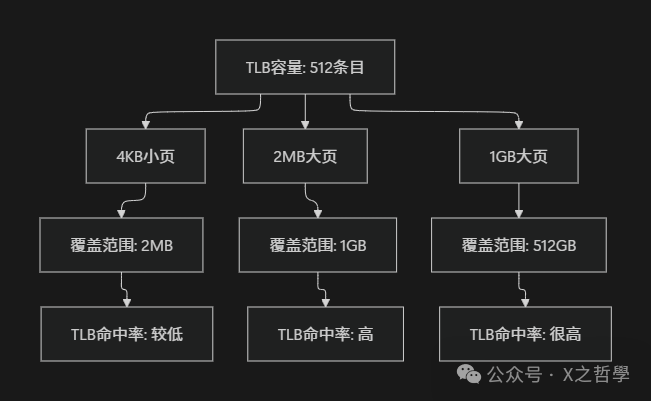
Huge Pages technology is one of the most effective means to optimize TLB performance. Traditional 4KB small pages can lead to limited TLB coverage; for example, a TLB with 512 entries can only cover 2MB of memory (512 * 4KB = 2MB). Using 2MB huge pages, the same TLB can cover 1GB of memory (512 * 2MB = 1GB), significantly improving the TLB hit rate.
Linux supports two usage modes for transparent huge pages (THP) and explicit huge pages. Transparent huge pages are managed automatically by the system, while explicit huge pages require explicit requests from applications:
// Example of using explicit huge pages
#include <sys/mman.h>
#include <fcntl.h>

#define HUGE_PAGE_SIZE (2 * 1024 * 1024)  // 2MB
#define HUGE_PAGE_ENTRIES 512

int main() {
    char *huge_buffer;
    int shm_fd;

    // Create a huge page shared memory region
    shm_fd = shm_open("/huge_region", O_CREAT | O_RDWR, 0666);
    ftruncate(shm_fd, HUGE_PAGE_SIZE * HUGE_PAGE_ENTRIES);

    // Map huge page memory
    huge_buffer = mmap(NULL, HUGE_PAGE_SIZE * HUGE_PAGE_ENTRIES,
                       PROT_READ | PROT_WRITE, MAP_SHARED, shm_fd, 0);

    // Use huge page memory...
    munmap(huge_buffer, HUGE_PAGE_SIZE * HUGE_PAGE_ENTRIES);
    return 0;
}
Page Merging and Fragmentation Control are also important TLB optimization techniques. Through <span>ksm</span> (Kernel Samepage Merging) and <span>memory compaction</span> mechanisms, the kernel can merge identical pages, reducing the actual number of physical pages used, indirectly improving TLB coverage.
Prefetch Optimization can also enhance TLB performance in certain scenarios. Some advanced CPUs support TLB prefetching capabilities, which can predict the memory access patterns of programs and load the corresponding TLB entries in advance. Applications can leverage this feature through conscious memory access patterns:
// Optimize data layout to improve TLB performance
struct optimized_data {
    int frequently_accessed_field1;
    int frequently_accessed_field2;
    // ...
    int rarely_accessed_field1;
    int rarely_accessed_field2;
    // ...
};

// Sequentially access array, utilizing spatial locality
void process_array(int *array, size_t size) {
    for (size_t i = 0; i < size; i++) {
        array[i] = process_element(array[i]);
    }
}
4.2 TLB Performance Monitoring and Debugging Tools
Monitoring TLB performance and behavior is crucial for diagnosing system performance issues. Linux provides a series of tools to monitor TLB-related performance metrics.
<span>perf</span> tool can directly monitor TLB-related events, including TLB hit rates, TLB flush counts, etc.:
# Monitor TLB events
perf stat -e dTLB-loads,dTLB-load-misses,iTLB-loads,iTLB-load-misses <command>

# Monitor TLB flush events
perf stat -e dTLB-flushes,tlb-flush.all,tlb-flush.one <command>

# Real-time monitoring of TLB performance
perf record -e dTLB-load-misses -c 10000 -a sleep 10
perf report
<span>/proc/cpuinfo</span> provides basic information about CPU TLB capabilities, including TLB size, associativity, etc.:
# View CPU TLB information
grep -i tlb /proc/cpuinfo

# Example output
tlb_size: 64 4K entries
tlb_assoc: 4 way
l1_tlb_info: 64 4K entries, 4 way
l2_tlb_info: 2048 4K entries, 8 way
Page Table Traversal Debugging tools can help diagnose complex TLB issues. Tools like <span>page-table-walker</span> can simulate the page table traversal process, helping to understand the details of address translation:
// Simple page table traversal debugging function
void debug_page_table_walk(unsigned long addr) {
    pgd_t *pgd;
    p4d_t *p4d;
    pud_t *pud;
    pmd_t *pmd;
    pte_t *pte;

    printk("Page table walk for address: 0x%lx\n", addr);

    pgd = pgd_offset(current->mm, addr);
    printk("PGD: %p, value: 0x%lx\n", pgd, pgd_val(*pgd));

    if (!pgd_present(*pgd)) {
        printk("PGD not present\n");
        return;
    }

    p4d = p4d_offset(pgd, addr);
    printk("P4D: %p, value: 0x%lx\n", p4d, p4d_val(*p4d));

    pud = pud_offset(p4d, addr);
    printk("PUD: %p, value: 0x%lx\n", pud, pud_val(*pud));

    pmd = pmd_offset(pud, addr);
    printk("PMD: %p, value: 0x%lx\n", pmd, pmd_val(*pmd));

    pte = pte_offset_map(pmd, addr);
    printk("PTE: %p, value: 0x%lx\n", pte, pte_val(*pte));

    if (pte_present(*pte)) {
        printk("Physical address: 0x%lx\n", pte_val(*pte) & PAGE_MASK);
    } else {
        printk("Page not present\n");
    }
}
TLB Stress Testing tools can be used to evaluate system performance under TLB-intensive workloads:
// TLB stress testing program
#include <stdlib.h>
#include <stdio.h>
#include <sys/mman.h>

#define PAGE_SIZE 4096
#define NUM_PAGES (1024 * 1024)  // 4GB working set

void tlb_pressure_test() {
    char **pages = malloc(NUM_PAGES * sizeof(char*));
    volatile char force_read;
    int i, j;

    // Allocate a large number of scattered pages
    for (i = 0; i < NUM_PAGES; i++) {
        pages[i] = mmap(NULL, PAGE_SIZE, PROT_READ | PROT_WRITE,
                        MAP_PRIVATE | MAP_ANONYMOUS, -1, 0);
        pages[i][0] = 0;  // Touch the page to ensure physical memory is allocated
    }

    // Random access pattern to maximize TLB pressure
    for (j = 0; j < 1000; j++) {
        for (i = 0; i < NUM_PAGES; i++) {
            int random_index = rand() % NUM_PAGES;
            force_read = pages[random_index][0];
        }
    }

    // Cleanup
    for (i = 0; i < NUM_PAGES; i++) {
        munmap(pages[i], PAGE_SIZE);
    }
    free(pages);
}
4.3 TLB Performance Benchmarking and Analysis
Establishing TLB performance benchmarks helps quantify the effects of TLB optimizations and identify performance bottlenecks. Below are key TLB performance metrics and testing methods:
Table: Key TLB Performance Metrics
| Metric Name | Description | Ideal Range | Monitoring Tool |
|---|---|---|---|
| TLB Hit Rate | Proportion of memory accesses that hit in the TLB | >95% | <span>perf stat</span> |
| TLB Miss Penalty | Time taken to handle each TLB miss | <100 cycles | Microarchitecture analysis |
| TLB Flush Frequency | Number of TLB flushes per unit time | As low as possible | <span>perf stat</span> |
| Page Table Traversal Depth | Number of page table accesses on TLB miss | 2-4 accesses | Code analysis |
Systematic TLB performance analysis should include working set size scans to determine the impact of TLB capacity on performance:
#!/bin/bash
# TLB working set scan script

echo "WorkSetSize,TLB_Misses,Time"

for size in 1 2 4 8 16 32 64 128 256 512 1024; do
    # Run tests and collect TLB miss data
    result=$(perf stat -e dTLB-load-misses ./tlb_test $size 2>&1 | \
             grep dTLB-load-misses | awk '{print $1}' | tr -d ',')
    echo "${size},${result}"
done
By comprehensively analyzing these metrics, one can gain a thorough understanding of the system’s TLB behavior, identify performance bottlenecks, and implement targeted optimization measures.
The following chart illustrates the impact of different page sizes on TLB coverage, highlighting the importance of huge page technology:
5 Conclusion
This article provides a comprehensive and in-depth analysis of the working principles, implementation mechanisms, and optimization techniques of Linux TLB management. Starting from the basic concepts of TLB, we explored its critical role in modern computer systems, and detailed the TLB management framework in the Linux kernel, including the semantics and usage scenarios of various flush interfaces. By analyzing core data structures and code implementations, we revealed the close coupling between TLB management and hardware architecture, as well as the implementation strategies under both software-managed and hardware-managed TLB modes. We particularly discussed how modern CPU features like ASID/PCID help reduce TLB flush overhead and enhance system performance. In terms of performance optimization, we systematically summarized various TLB performance enhancement methods such as huge page technology, prefetch optimization, and data layout optimization, and provided corresponding monitoring and debugging tools and usage methods. These optimization techniques are significant for memory-intensive applications and high-performance computing scenarios. TLB management, as a key component of the memory subsystem, reflects the Linux kernel’s fine balance between performance and complexity. With the development of new storage technologies and computing architectures, TLB management will continue to face new challenges and opportunities, such as optimization for Non-Uniform Memory Access (NUMA) systems and maintaining TLB consistency in heterogeneous computing environments.