Safran Landing Systems has been producing carbon-carbon (C/C) brake discs for aircraft for decades, continuously innovating processes to integrate multiple steps to save time and costs while reducing emissions and energy consumption during market share expansion.
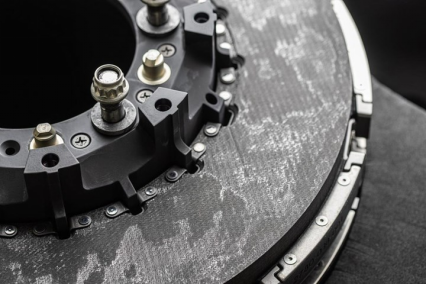
Safran Landing Systems manufactures carbon-carbon (C/C) brake discs for aircraft.
This blog compiles information on carbon fiber reinforced carbon (C/C) brake discs for aircraft publicly released by the Safran Group (Paris, France). Earlier this year, the company released a video (see below) that gradually demonstrates its manufacturing steps. C/C brake discs remain one of the highest volume applications of ceramic matrix composites (CMC), but this status is changing with the growing demand from industrial and aerospace end uses. After visiting Brembo’s factory near Bergamo, Italy—where C/C brakes are produced for racing cars—I thought it would be interesting to see Safran’s production base, output and processing innovations, and current initiatives to enhance sustainability.
With over 40 years of experience—having introduced carbon fiber reinforced C/C brake systems for the Airbus A310 as early as 1985—Safran Landing Systems (Vélizy-Villacoublay, France) claims to be the global leader in carbon-carbon brakes for over 100 aircraft types. The company reportedly supplies equipment for 55% of such commercial aircraft worldwide, servicing over 500 airlines and more than 1,500 military projects. The company has carbon brake production bases in three locations: Villeurbanne near Lyon, France; Walton, Kentucky, south of Cincinnati, Ohio, USA; and Sendayan, Negeri Sembilan, Malaysia. The company is also building a fourth factory about 30 minutes east of Lyon, expected to be operational by 2030.
Carbon brakes are lighter, more efficient, and have a durability that is two to three times greater than steel brakes, helping operators reduce fuel consumption, costs, and carbon dioxide emissions. Safran reports that the reduction in carbon dioxide emissions during flight due to carbon-carbon brakes is ten times the emissions produced during the brake manufacturing process, potentially reducing the total emissions of the entire fleet by hundreds of tons annually.
Global Production
Safran Group announced that its historic Messier-Bugatti-Dowty factory in Villeurbanne will produce 5,000 wheels and 6,000 brake sets in 2023.
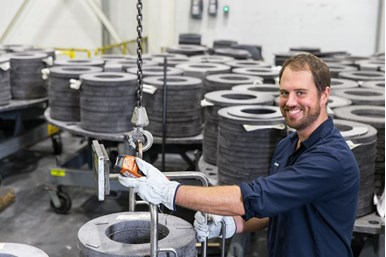
Source | Safran Group
The Walton factory in Kentucky, which opened in 1999, reportedly produces nearly 140,000 carbon brake discs and over 9,500 wheels and brake components annually. The 350 employees at this factory support Boeing 737, 777, and 787 aircraft, Airbus A320 series, as well as military aircraft C-17 and KC-135. The company announced an expansion plan in 2023 that will add 92 jobs and introduce new equipment and automation technology to increase output.
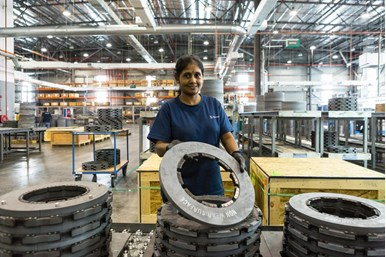
Source | Safran Group
The Sendayan production base in Malaysia will celebrate its tenth anniversary in January 2025, producing 350 tons of C/C composites annually, including approximately 80,000 brand new carbon brake discs. It also refurbishes over 15,000 heat packs (which consist of multiple brake discs) each year and provides comprehensive support to 100-150 airlines in the region.
Carbon Brake Configuration
Each wheel of the aircraft landing gear is equipped with a brake device. A common configuration for carbon brakes uses four rotating discs (rotors) alternating with three or four stationary discs (stators) in a thermal stack or heat pack. The rotors engage through the wheel’s drive keys, rotating with the wheel. The stators include outward-facing end plates and a pressure plate located at the other end of the stack (see image below).
During braking, hydraulic fluid from the brake piston pushes the pressure plate to compress the rotor against the stator, pressing it against the end plate. The resulting friction converts kinetic energy into thermal energy, thereby reducing the wheel’s rotational speed. During landing, the C/C material rotors and stators can withstand temperatures of 700°C, while C/C brake discs can easily endure temperatures exceeding 1000°C. This heat resistance allows carbon brakes to avoid failure or performance degradation (such as brake fade) while maintaining structural integrity.
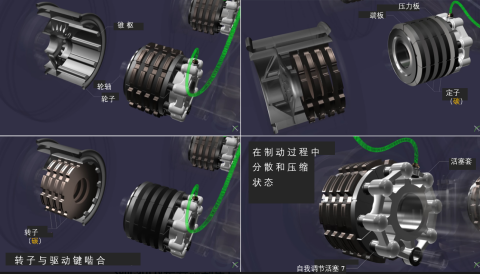
“Landing Gear Operation Principles—Part One: Brakes”
SepCarb IV Long-Life Brake Pads
In April 2018, Safran collaborated with Airbus to install a new long-life carbon brake on the A320neo aircraft. The SepCarb IV brake is the first C/C brake to be put into service since the Sepcarb III was released 15 years ago. This new “long-life” brake features two significant innovations: the SepCarb IV carbon material and Anoxy 360 (a new system to prevent oxidation of the brake disc). These innovations not only improve performance during use but also address the challenges of increasing productivity in the A320neo manufacturing process.
Safran Group’s C/C brake equipment production base in Villeurbanne, near Lyon, has developed a unique manufacturing method for producing SepCarb IV under conditions of industrial scale expansion. This method integrates the solvent impregnation step of carbon fiber preforms with either damping or drying, which were previously independent processes, into the same equipment, thereby avoiding intermediate operations, shortening production time, and reducing costs.
SepCarb IV also incorporates ceramic particles to enhance the wear resistance of C/C brakes, reducing brake usage by 30%. This not only benefits aircraft operators but also further supports meeting the production rate of the A320neo. Safran has also improved the process to reduce nitrogen consumption during heat treatment and eliminated atmospheric emissions, collecting process waste in liquid form.
A second impregnation unit was added in 2019, and this process was subsequently rolled out to other factories.
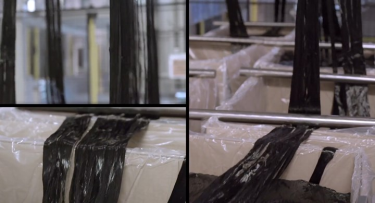
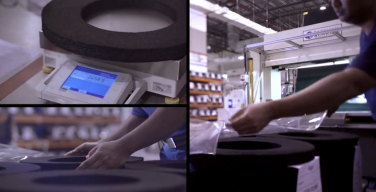
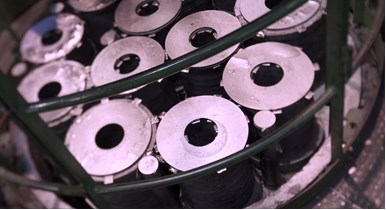
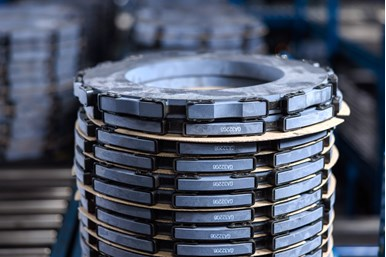
Carbon fiber (top) is used to make needle-punched preforms (middle), which are then carbonized and impregnated with a carbon matrix, ultimately forming carbon discs (bottom).
As described in its July 2025 video, the manufacturing process for C/C brake discs adopted by Safran includes four main steps:
• Production of carbon fiber preforms, including needle punching of continuous fiber layers.
• High-temperature carbonization of the preform and densification of the carbon matrix through chemical vapor infiltration (CVI).
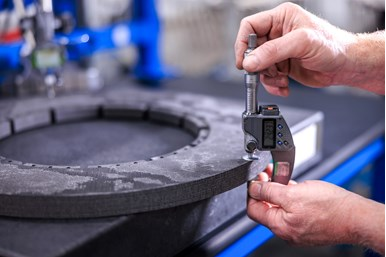
• Processing of discs and quality assurance, including dimensional checks.
• Final treatment including spraying and heat treatment with oxidation protection coating, followed by assembling multiple discs into a C/C brake unit.
Lyon New Production Base, Environmental Goals
Source | Safran Group
Safran Group is constructing a carbon brake manufacturing plant in the PIPA industrial park near Lyon, which is scheduled to start production in 2030. This new carbon-carbon brake production base will increase the company’s total output by 25% by 2037. The 30,000 square meter factory will achieve high levels of automation, initially employing about 100 people, with the workforce expected to double at full capacity.
The company has positioned the Lyon factory as a zero-emission facility (Scope 1 and 2). Since energy costs can account for 30% of the total cost of carbon brake manufacturing, Safran chose the Lyon site based on the availability of low-carbon electricity. The factory will also use biomethane as a precursor for the carbon matrix, injected during the CVI process. As a result, the electricity and fuel consumption at this facility will be reduced by nearly 30%, and water usage will decrease by 80%. Additionally, the heat generated during the C/C production process will be recovered for use in the heating network. Some of these technologies will also be implemented in other Safran Group C/C brake facilities.
Safran Group has committed to reducing its carbon emissions from business activities by approximately 50% by 2030 compared to 2018 levels. In its 2025 ESG report, the company reported a 35% reduction in direct emissions across all operations by 2025 compared to 2018.
Safran Landing Systems’ factory in Sendayan, Malaysia, has reduced its carbon dioxide emissions by 27% since 2018, with measures including recycling waste gases emitted during the production of carbon discs to meet 20% of the facility’s electricity needs, and extensive use of variable frequency drives—technology that adjusts motor speed (and energy consumption) according to the actual needs of the machinery. The factory also plans to implement a new power management system to monitor and optimize the facility’s overall energy consumption (including electricity, fuel, and water resources). According to communications from July 2024, the Sendayan facility has signed a 21-year agreement with a local solar power company, effective in 2026, which will increase the share of renewable energy in the current electricity mix by an additional 10%. This move complements a partnership agreement signed in 2023 with a local biomass power company, which has already met 30% of the facility’s electricity needs.
Extending the Life of C/C Brake Discs, Reusing Waste Resources
A refurbishment process for carbon brake discs developed by Safran Landing Systems over 30 years ago is another key initiative for achieving emissions reductions through circularity. Currently, about 30% of the brake discs delivered to airlines are refurbished using this method.
While the average lifespan of Safran carbon brake discs varies depending on aircraft type and operating conditions, it is not uncommon for them to undergo 2,000 to 2,500 landings between major overhauls. These brake discs endure temperatures exceeding 1000°C daily, and will eventually wear out—though they are much more durable than steel brake discs—and are retired once they reach a set limit (before being completely worn out).
Source | Safran Group
“By refurbishing two worn brake discs, we get two half discs, which are then reused to make a new disc,” explained Jean-Luc Noirjean, product strategy manager at Safran Landing Systems. “The performance of these refurbished discs is identical to that of newly manufactured ones. Airlines provide heat packs that have reached regulatory limits. In return, we send them a refurbished brake disc, which is what we call a standard exchange.”
Jean-Baptiste Lassalle, head of the wheels and brakes division at Safran Landing Systems, pointed out that 30% of the delivered brake discs are refurbished, which means a 30% reduction in carbon dioxide emissions. “We established this process in the mid-1990s for the Airbus A300, A310, and A320 programs to reduce manufacturing costs… but it has also sparked a virtuous cycle of economic dynamics in our operations.”
In the future, Safran Landing Systems will explore new methods to recycle these refurbished aircraft brake discs for use in other industries after their lifespan ends. The company has also implemented several waste reduction projects. “We developed a manufacturing process that uses unused fibers from production (which account for about half of our fiber procurement) to make felt,” Lassalle stated, “this felt, produced by partner companies, can be used as insulation material for our furnaces. We have also established a system to recycle the processing dust generated during the production of carbon discs [for use] in cement manufacturing. More broadly, the projects we are undertaking aim to minimize material waste throughout the entire production cycle.”
Lassalle noted that these environmental initiatives and the acceleration of the circular economy are increasingly becoming systematic and structured within the organization. “Last year, we established a dedicated position to integrate product lifecycle and carbon emissions assessment methods. This position is also focused on enhancing the recyclability of products. The more initiatives we develop in this regard, the more we pave the way for a new economic model fully integrated with the principles of the circular economy.”
Digital Transformation, Future Growth
Safran Group has also implemented a series of digital transformation initiatives, including using RPA (Robotic Process Automation) software to handle repetitive daily tasks, and employing collaborative robots, augmented reality, and automated equipment to accelerate production. The company has also integrated health monitoring and predictive maintenance technologies into its brake product systems while continuously exploring applications of AI technology. For example, Safran Landing Systems collaborated with its machine programming partner MHAC Technologies (Éguilles, France) to standardize and automate the 3D measurement and processing of carbon brake discs. By utilizing machine learning technology, the team reduced the number of processing programs required for different brake discs from over 100 to several dozen, further enhancing production efficiency.
Global CMC Market Report published by the Ceramic Composites Network
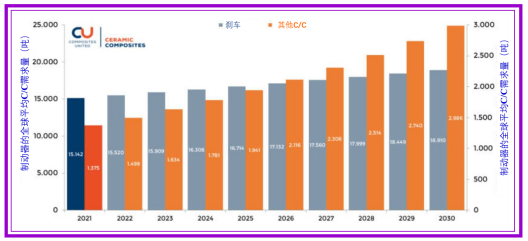
As the modernization of fleets continues to drive demand for high-performance, low-fuel consumption, and low-emission solutions, the demand for carbon brakes is also increasing, necessitating continuous improvements in production capacity. This growth trend is evident in the forecast presented in the 2023 Global CMC Market Report published by the Ceramic Composites Network. Denny Schüppel, managing director of the Ceramic Composites Network, noted that Safran Landing Systems is just one of several manufacturers of carbon-carbon (C/C) brake pads for aircraft, and the application of carbon-carbon materials in non-aerospace braking fields is also rapidly growing.
The 2023 CMC market report also includes a table showing the number of heat packs for each aircraft model, noting that most aircraft replace new heat packs every 4-18 months based on daily landing counts, with about 50% of all C/C aircraft brake systems experiencing a second life. Schüppel indicated that an updated version of the global CMC market report is planned for release in March 2026.
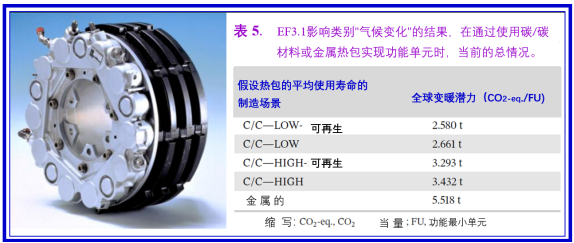
Carbon Fiber Reinforced Carbon Heat Packs (reprinted with permission from SGL Carbon SE) and Table 5 from the “Greenhouse Gas Emission Reduction Potential Life Cycle Assessment of Medium Aircraft Carbon/Carbon Wheel Brakes”
Schüppel is also a co-author of a November 2025 article that further explores the production and refurbishment processes of C/C heat packs, comparing their significant weight reduction and fuel savings benefits through life cycle assessment (LCA). The report states: “Even in the most unfavorable C/C application scenario combinations, the carbon dioxide equivalent emissions are lower than those of the most favorable metal material application scenarios.”
—— End ——
Original Article: “Safran carbon-carbon aircraft brakes: New process, production sites, environmental achievements”
Yang Chaofan
This article is published with the consent of the translator.