Limited by the failure of Moore’s Law and Andy’s Law, the semiconductor industry has to find new ways to develop chips. The RFSoC chip from XILINX’s UltraScale++ ZYNQ series is a typical representative, integrating RF ADC, DAC, ARM, FPGA, and more. This is currently the mainstream in the chip industry, and everyone is working on such heterogeneous chips. Why develop heterogeneous chips?
First, non-heterogeneous chips are nearing their limits, such as CPUs, where increasing the clock frequency is difficult, and adding more than 16 cores is challenging, so new development paths must be opened.
Secondly, heterogeneous chips have a significant market; many applications require miniaturization and low power consumption. Tasks that used to require a circuit board can now be solved with a single chip, so major chip companies are tirelessly developing heterogeneous chips, with SoCs being the most representative, showcasing the highest technology content.
XILINX is also impressive; it used to be just an FPGA chip company. Although it was a leader, it was merely a chip manufacturer. But now, if you check their official website, look at their product list:
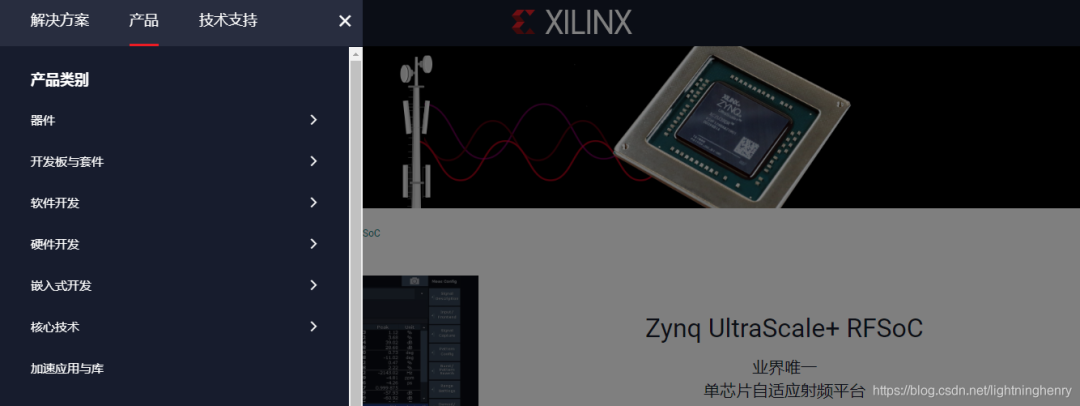
This is no longer just selling chips; they have successfully transformed into a platform and service provider. Chips like RFSoC have long transcended the FPGA category and are now referred to as single-chip adaptive RF platforms. The newly launched ACAP chip for AI is named Adaptive Acceleration Platform. (XILINX employees, remember to pay up if you see this)
Returning to RFSoC itself, it can be said that RFSoC is the leader among SoC chips. Released in 2017, I heard about it in 2018 and was shocked at the time. A chip integrating RF direct sampling + FPGA + ARM is simply a boon for the radar and communications industries. I finally got my hands on the official development board ZCU111.
In the past two years, the domestic chip industry has been extremely hot, with many companies that previously did not make chips crossing over to the chip industry, just like in real estate years ago. The country is also pouring money into the chip industry; one can only say, where were they earlier? Being pressured by the US might be good; adversity breeds innovation. Technology shouldn’t just be seen as a means of production. Technologists are not the new laborers of the era; we need to break out of the traditional mindset of farmer, worker, merchant, and scholar, and genuinely prioritize people. Technologists should come first, not entertainers.
In summary, I hope domestic chips can soon produce high-end chips like RFSoC. Now, let’s officially start introducing RFSoC.
First, let’s talk about where RFSoC can be used:
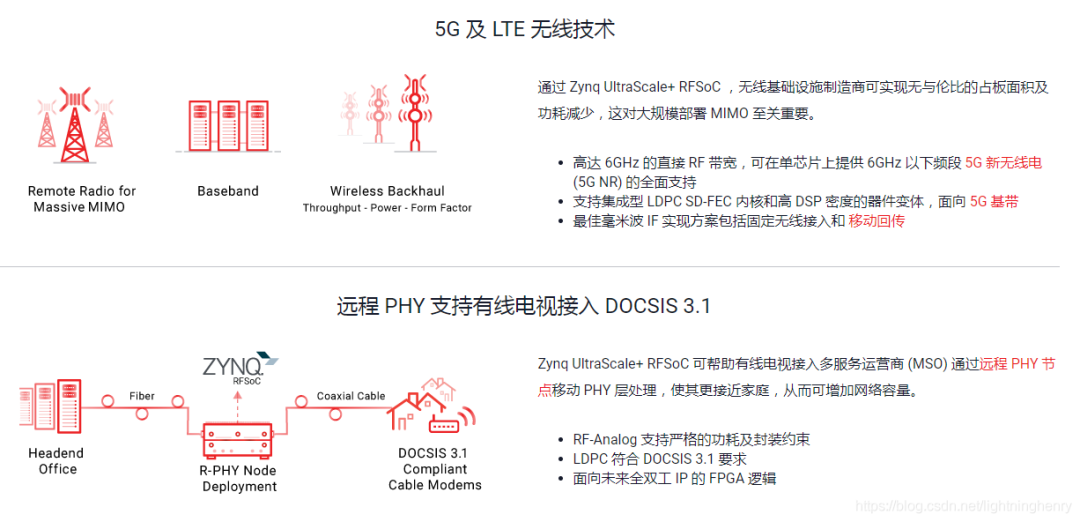
The main applications are communications and radar. First, regarding communications, I am not from the communications industry and only know a bit. This chip can be used in 5G base stations. Current base stations have numerous FPGAs and many ADC/DAC devices, which are board-level components. Those in communications are very eager to use it, especially for MASSIVE MIMO, but it’s hard to obtain. Furthermore, the current frequency bands of 5G (centimeter wave band) are not high; if bandpass sampling is used, the sampling rate does not need to be so high, but in the future, it will be different. The reason everyone rushes towards millimeter waves is that the frequency is high, allowing the bandwidth to increase significantly, thus greatly increasing the information capacity. However, the higher bandwidth also demands higher sampling rates from ADCs, which is where RFSoC can be useful.
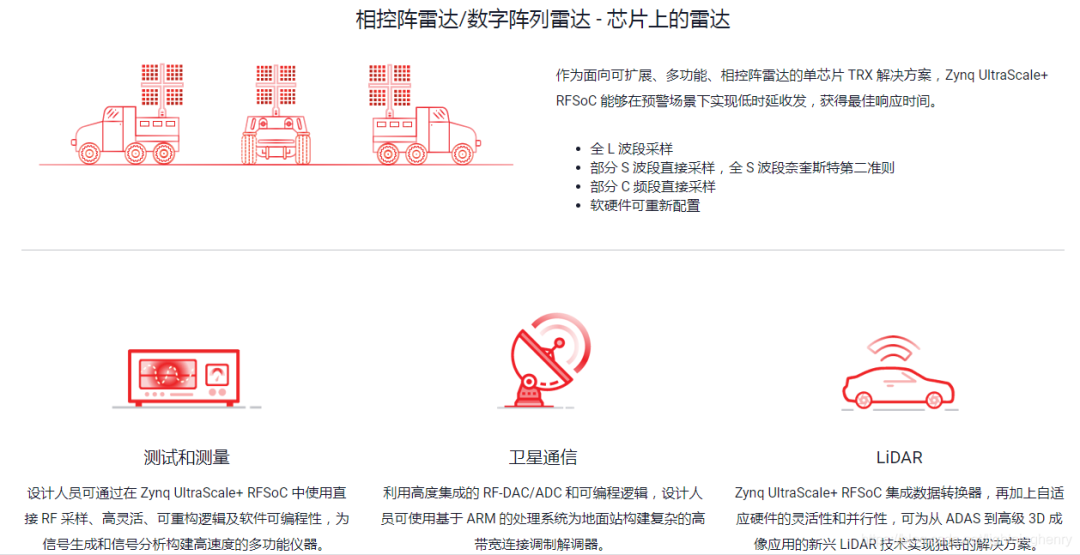
Now, regarding radar, the hardware processing platform is not much different from the communication baseband processing platform; it is also composed of ADC + FPGA + DSP/ARM and other circuit boards. If a single chip can handle it, the cost and energy consumption savings would be significant. Particularly, radar has always had high requirements for ADC sampling rates. If RF direct sampling is possible, it could significantly enhance radar combat performance. Especially now that radar is moving towards MIMO and digital array directions, the demand for ADC channel numbers and sampling rates is surging. If RFSoC can be utilized, it could even trigger a revolution in military radar hardware architecture. Many countries have not fully deployed 5G; using RFSoC in 4G would be a waste of resources. Therefore, the XILINX chip was essentially made for the US Army; I wonder how many US Army weapons already utilize this chip. Various domestic weapons probably use many imported chips, and the core chips of missiles are all imported. Now that imported chips cannot be used, I wonder how much performance will decline, how much costs will increase, and how much the R&D cycle will extend…
Next, let’s take a look at what this chip contains:
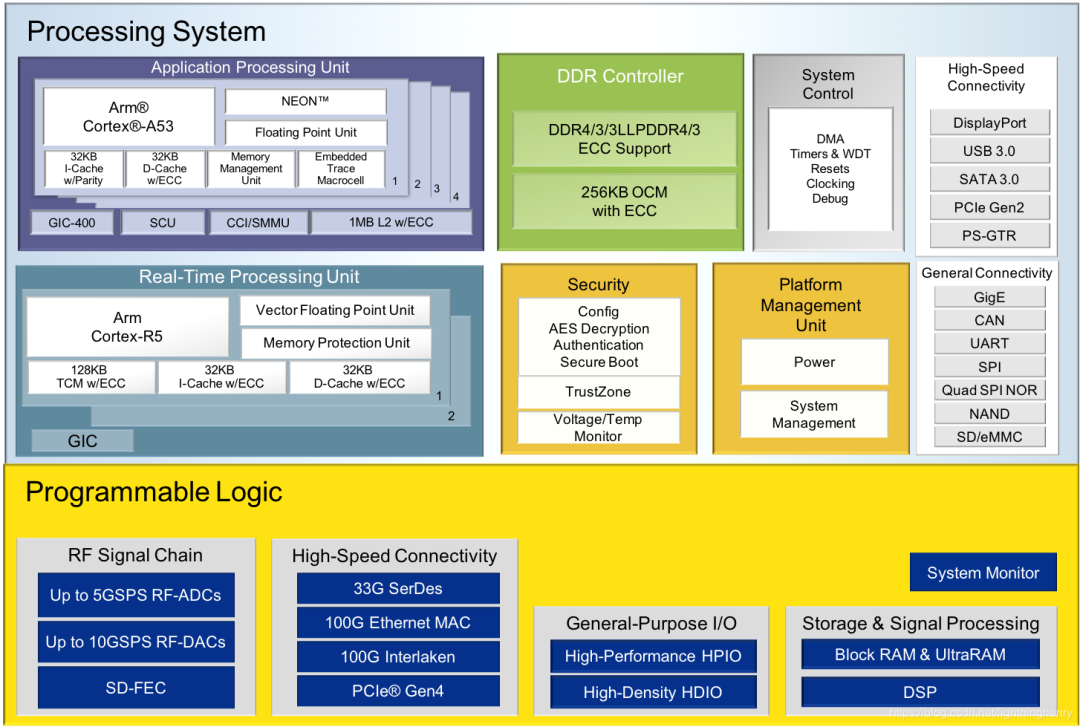
In the upper left corner of the image are 4 Cortex-A53 and 2 Cortex-R5; the rest in the upper half are hardware drivers, interfaces, etc., supporting ARM.
In the lower left corner, the ADC with the highest 5G sampling rate, the DAC with a maximum of 10GSPS, and the SD-FEC fiber optic interface;
At the bottom is a 33G SerDes, 100G Ethernet, and PCIe Gen 4;
In the lower right corner, there are also UltraRAM and DSP resources.
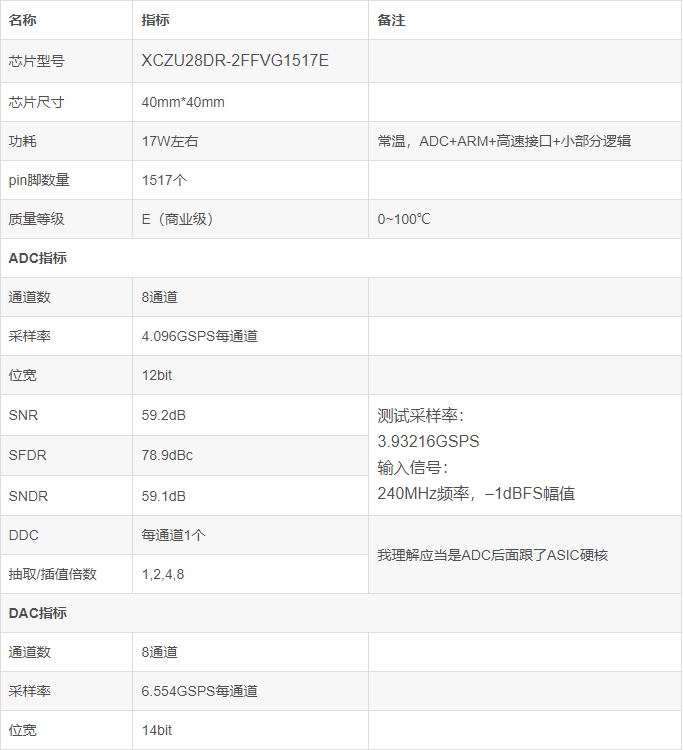
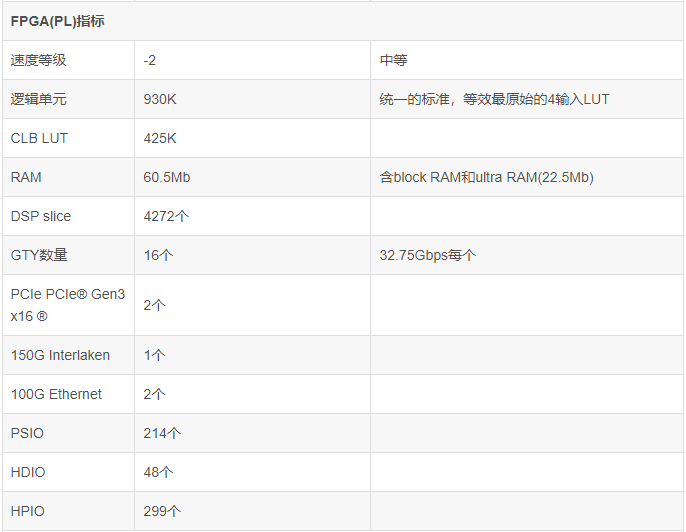
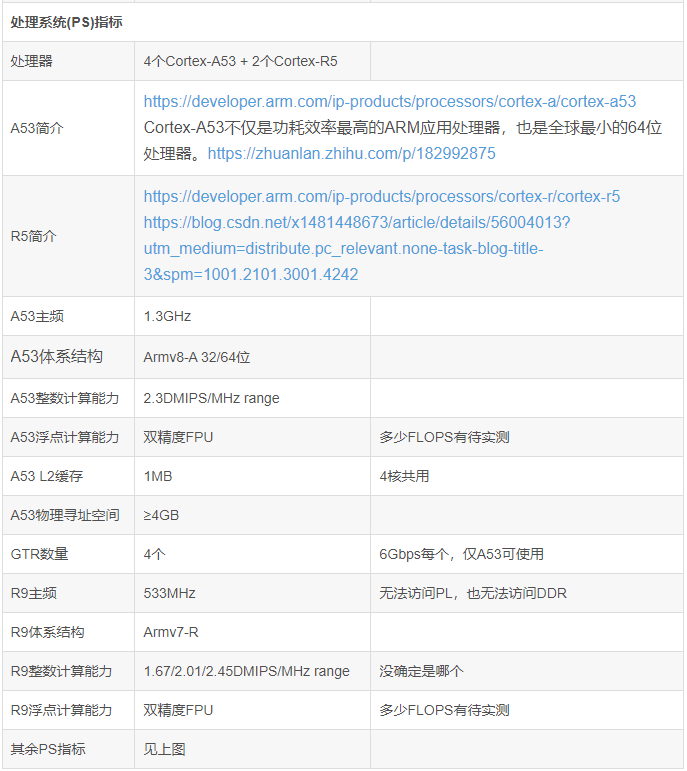
After seeing all this, you can understand how advanced this chip is. The official price of the ZCU111 development board is nearly $9000, and the chip price is not available, but it is estimated that commercial-grade ones start at $1000. This is truly a turning sand into gold technique (the main component of the chip is silicon, and the same weight of gold may not be worth the same weight of sand (chip)).Finally, let’s take a look at the specific specifications of this chip. The ZCU111 I received is the first generation of RFSoC, and I will only list the specifications for this model; for others, please refer to the selection manual:https://download.csdn.net/download/lightninghenry/12881047
RFSoC Performance Specifications
Source: CSDN Author:lightninghenry
Disclaimer:
This account maintains neutrality regarding all original and reprinted articles’ statements and viewpoints. The articles pushed are for readers’ learning and communication purposes only. The copyright of the articles, images, etc., belongs to the original authors.
For submissions/recruitment/promotion/advertising, please add WeChat: 15989459034