
ISOC
Cybersecurity Construction
Intelligent Upgrade Path

01
Construction Background
In the current wave of digitalization sweeping the globe, the dependence of business operations on information technology is deepening. Core data, business processes, customer information, etc., are all stored and circulated in digital form, which greatly enhances operational efficiency but also leads to an exponential increase in cybersecurity risks. Meanwhile, the explosive development of large model technologies such as ChatGPT has brought new opportunities and challenges to the cybersecurity field.
The traditional security construction system has played an important role in resisting cyber threats for a long time. It has built a multi-layered security defense line through various security devices and tools such as firewalls, intrusion detection systems (IDS), and antivirus software. However, as the network environment becomes increasingly complex, the limitations of traditional security construction are gradually becoming apparent. On one hand, new types of cyber attack methods are emerging, such as Advanced Persistent Threats (APT) attacks, which are highly covert and targeted, making it difficult for traditional rule-based and static policy security mechanisms to effectively identify and respond; on the other hand, during the digital transformation process of enterprises, business boundaries are constantly expanding, and the widespread application of new technologies and applications such as cloud computing, the Internet of Things, and mobile office has significantly increased the attack surface, making it difficult for traditional security systems to achieve comprehensive coverage and real-time protection.
Large model technologies, with their powerful data analysis, pattern recognition, and intelligent decision-making capabilities, inject new vitality into the cybersecurity field. Against this backdrop, deeply integrating traditional security construction with large model technologies to upgrade traditional Security Operation Centers (SOC) into Intelligent Security Operation Centers (ISOC) has gradually become an inevitable choice to cope with the current complex cybersecurity environment.
02
Necessity
01
Responding to New Complex Attacks
Traditional SOCs mainly rely on human experience and preset rules to detect and respond to cyber threats. Faced with complex and variable attack methods such as ransomware variants and new types of attacks, traditional methods often fall short. For example, new ransomware may use encryption obfuscation techniques, making its characteristics difficult to detect with traditional rule matching. The ISOC platform can leverage the machine learning and deep learning capabilities of large models to perform real-time analysis of massive network data, automatically identify abnormal behaviors and potential threats, effectively enhancing the detection and prevention capabilities against new complex attacks.
02
Adapting to Rapid Business Changes
Business development is rapid, with new business models, application systems, and network architectures constantly emerging. Traditional SOCs often lag in adjusting security policies in response to business changes, failing to adapt to new security needs in a timely manner. The ISOC platform can possess greater flexibility and adaptability, using large models to perceive business changes in real-time and automatically adjust security policies, ensuring that security protection is always in place while business develops rapidly. For example, the ISOC platform can quickly formulate and implement targeted security protection strategies based on the traffic characteristics and user behaviors of new businesses.
03
Enhancing Security Operation Efficiency
In the traditional SOC operation process, security analysts need to spend a lot of time and effort processing massive alert information, most of which may be false positives, leading to real security threats being easily overlooked. According to statistics, in a traditional SOC environment, security analysts may have to handle thousands of alerts daily, with the proportion of effective alerts being less than 10%. The ISOC platform utilizes large models for intelligent correlation analysis and filtering of alerts, quickly and accurately identifying high-risk events, freeing security analysts from tedious alert processing, allowing them to focus on addressing real security threats, greatly enhancing security operation efficiency.
04
Meeting Compliance Requirements
In today’s strict legal and regulatory environment, there are many cybersecurity compliance requirements, such as data protection regulations and industry security standards. The ISOC platform can more accurately meet compliance requirements through intelligent security management and monitoring, promptly identifying and rectifying security vulnerabilities, thereby reducing compliance risks for enterprises.
|
Dimension |
Traditional SOC |
ISOC (Intelligent Security Operation Center) |
|
Core Capability |
Rule-based alerts, manual analysis |
AI-driven analysis, automated response, proactive hunting |
|
Efficiency |
Alert fatigue, delayed response |
Intelligent noise reduction, rapid correlation, minute-level response |
|
Coverage |
Primarily known threat detection |
Unknown threat discovery, behavioral anomaly analysis |
|
Resource Demand |
Highly dependent on human resources and experience |
Human-machine collaboration, AI-assisted decision-making |
|
Value Output |
Incident response reports |
Risk prediction, tactical optimization, business resilience assurance |
03
Construction Ideas
01
Data-Driven Intelligent Analysis
Data is key to success. By centering on data, integrate various security-related data from the network, including network traffic data, log data, asset data, endpoint data, behavioral data, etc. Utilize large model technologies to deeply mine and analyze this data, establishing a comprehensive and accurate security situational awareness model. By analyzing anomalies and potential threats in real-time, achieve real-time assessment and prediction of the network security status.
02
Automated and Intelligent Response
Build an automated security response mechanism. When the ISOC platform detects a security event, it can automatically take corresponding response measures based on preset strategies and intelligent decisions from large models, such as blocking attack traffic, isolating infected hosts, and initiating emergency response processes. At the same time, utilize large models to predict the development trends of security events, proactively formulate response plans, and achieve proactive defense. For example, when detecting an IP address making an unusually high number of connection requests, the platform automatically blocks access from that IP and uses large models to analyze potential subsequent attack behaviors, strengthening protection in relevant areas in advance and establishing a real-time dynamic policy adjustment mechanism.
03
Continuous Learning and Optimization
Large models possess self-learning capabilities. The ISOC platform should fully utilize this feature, continuously learning from new security events and network data to optimize security detection and protection models. Regularly evaluate the operational effectiveness of the platform, adjusting parameters and updating strategies based on evaluation results to ensure the platform maintains efficient security protection capabilities. For example, conduct reviews of security events detected by the platform in real-time, inputting new attack patterns and response methods into the large model to create a positive feedback loop, continuously enhancing detection and handling capabilities for similar threats.
04
Human-Machine Collaborative Security Operations
Establish a human-machine collaborative working model, where security analysts closely cooperate with the ISOC platform. The platform provides intelligent decision support for security analysts, such as interpreting security alerts, analyzing the impact of security events, mapping attack chains, and suggesting response measures. Security analysts then use their professional knowledge and experience to validate and supplement the information provided by the platform, jointly enhancing the effectiveness of security operations. When dealing with complex APT attack events, the platform analyzes and provides information on the approximate source of the attack and key assets involved, allowing security analysts to further investigate and develop detailed response plans.
04
Architecture Design
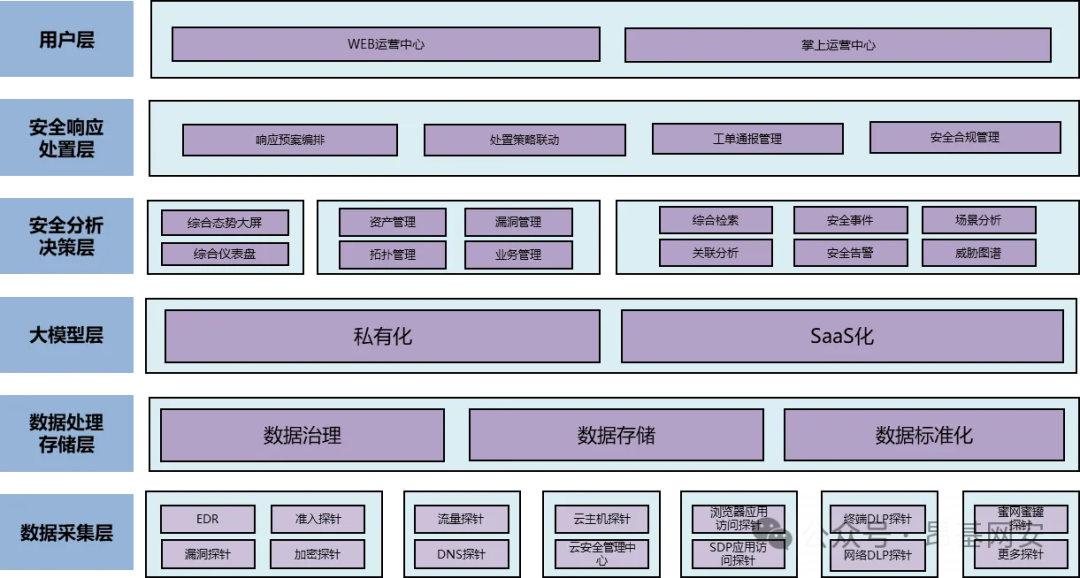
(1) Data Collection Layer
Responsible for collecting security-related data from various levels of the enterprise network. This includes data from network devices, probe traffic data collected through mirroring, log data from security devices (firewalls, IPS, antivirus, DNS, bastion hosts, etc.) collected via protocols like syslog; operating system logs and application logs from servers and endpoint devices obtained through agent software or remote collection techniques; and also collecting enterprise asset information, personnel information, and business data to provide comprehensive data support for subsequent analysis and decision-making.
(2) Data Processing and Storage Layer
Clean, transform, and preprocess the massive data collected, standardizing it into a format suitable for analysis. Utilize big data storage technologies for efficient data storage. Additionally, integrate and organize the data for easier querying and analysis. During the data processing phase, employ data mining and machine learning algorithms to build a data hub, performing preliminary feature extraction and analysis to provide foundational data for training large models.
(3) Large Model Layer
This is the core layer of the ISOC platform, deploying advanced large models based on the Transformer architecture. The large model is trained on a large scale using historical security data, threat intelligence, and attack cases, learning various patterns and rules in the cybersecurity field. It possesses capabilities such as alert interpretation, anomaly detection, threat prediction, and event correlation analysis. During operation, it receives real-time data from the data processing and storage layer for online analysis and prediction, providing intelligent support for security decision-making.
(4) Security Analysis and Decision Layer
Based on the analysis results from the large model, combined with the enterprise’s security policies and business needs, conduct a comprehensive assessment and analysis of the network security situation. Through a visual interface, present security management personnel with multi-dimensional and clear security situation maps, including security event situation maps, asset security situation maps, intelligent analysis situation maps, comprehensive security situation maps, and operational monitoring situation maps. At the same time, provide security analysts with multi-dimensional analysis and operational tools: comprehensive search capabilities, allowing for quick filtering of logs, alerts, and security events based on custom query commands; and multi-dimensional dashboard analysis capabilities, enabling rapid generation of operational analysis data based on common table view types in the market, allowing for quick filtering and generation of measurable security data.
(5) Security Response and Handling Layer
Execute specific security response and handling operations based on instructions from the security analysis and decision layer. This includes blocking attack traffic, isolating infected devices, and patching vulnerabilities. It supports both automated and manual response methods, allowing security management personnel to choose the appropriate response method based on the actual situation. Additionally, feedback the results of responses and handling to the data collection layer and security analysis and decision layer for evaluating and optimizing the platform’s operational effectiveness. Provide an internal operational ticketing page for the full process of handling internal security events and vulnerabilities, allowing the enterprise to generate ticket processing data quarterly and annually.
(6) User Interface Layer
Provide convenient operational interfaces for different users such as security management personnel and operational staff. Create models such as large-screen SOC, terminal SOC, and mobile SOC, allowing users to easily log into the platform, view security situations, manage security policies, and handle security events. Offer personalized user interface customization features, displaying different information and operational functions based on different user roles and needs, enhancing user efficiency in using the platform.
05
Construction Content
01
Selection and Training of Large Models
Based on the enterprise’s network scale, security needs, and data characteristics, select pre-trained security large models, such as those from leading security companies. Only by having a vast amount of professional security data, cleaning it into security knowledge, and training it can a high-level security large model be derived. At the same time, collect historical security data from within the enterprise and external threat intelligence data to build a normalized training dataset. Utilize deep learning frameworks for multiple rounds of training and optimization of the large model, enabling it to accurately identify various security threats and abnormal behaviors within the enterprise network.
02
Construction of Security Data Governance System
Establish a complete data governance process and standards to ensure the accuracy, completeness, and consistency of security data. Classify and manage data based on its sensitivity and importance, formulating different protection strategies. Strengthen data quality management, regularly cleaning and repairing data to ensure its reliability. Additionally, establish a data sharing mechanism to break down data barriers between different departments within the enterprise, enabling the circulation and sharing of security data, providing strong data support for the efficient operation of the ISOC platform.
03
Integration of Security Tools and Platforms
Integrate various existing security tools within the enterprise, such as firewalls, intrusion prevention systems, antivirus software, and vulnerability scanning tools, with the ISOC platform. Achieve data sharing and collaborative work between security tools through unified interfaces and data formats. For example, when a vulnerability scanning tool detects a security vulnerability in the system, it automatically synchronizes the vulnerability information to the ISOC platform, which then triggers the corresponding remediation process or strengthens protection in that area based on the risk level of the vulnerability and related security policies.
04
Optimization of Security Operation Processes
Based on the functions and characteristics of the ISOC platform, optimize and reconstruct the existing security operation processes of the enterprise. Establish standardized security incident handling processes, including detection, reporting, response, and handling of incidents. Clearly define the responsibilities and divisions of labor of each department and personnel in the security operation process, strengthening communication and collaboration between departments. Introduce automated workflow engines to achieve automation and intelligence in security operation processes, improving the efficiency and quality of security operations.
05
Personnel Training and Capability Enhancement
The construction and operation of the ISOC platform require personnel with professional knowledge and skills. Organize training for security management personnel, operational staff, and other relevant personnel to familiarize them with the functions and operational methods of the ISOC platform, mastering the application knowledge of large model technologies in the cybersecurity field. Regularly conduct security drills and training activities to enhance personnel’s ability to respond to sudden security events and emergency handling capabilities. At the same time, encourage employees to continuously learn and update their knowledge to adapt to the development and changes in cybersecurity technologies.
06
Future Outlook
01
Stronger Intelligent Protection Capabilities
With the continuous development and innovation of large model technologies, the ISOC platform built on the “model-driven” concept will possess stronger intelligent protection capabilities. It will be able to identify and respond to various new and complex cyber attacks in real-time and accurately, achieving “zero false positives” and “zero missed detections” for cybersecurity threats. For example, by monitoring and analyzing the global cybersecurity situation in real-time, it can proactively predict potential security threats that may affect enterprises and take targeted protective measures to achieve proactive defense.
02
Deep Integration with Business Scenarios
In the future, the ISOC platform will achieve deeper integration with the business scenarios of enterprises, no longer being just an independent security protection system, but becoming an important support for business operations. Based on the security needs of different business scenarios, it will automatically generate customized security policies and protection plans to ensure the secure and stable operation of the business.
03
Cross-Enterprise and Cross-Industry Security Collaboration
In the future cybersecurity environment, the security protection of a single enterprise will struggle to cope with complex and variable threats. The ISOC platform is expected to achieve cross-enterprise and cross-industry security collaboration by sharing threat intelligence, security resources, etc., forming a broader security protection network. For example, enterprises within the same industry can share attack cases and prevention experiences through the ISOC platform to jointly address common security threats; enterprises from different industries can also collaborate on critical infrastructure protection, enhancing the overall cybersecurity level of society.
Click the blue text
Follow us