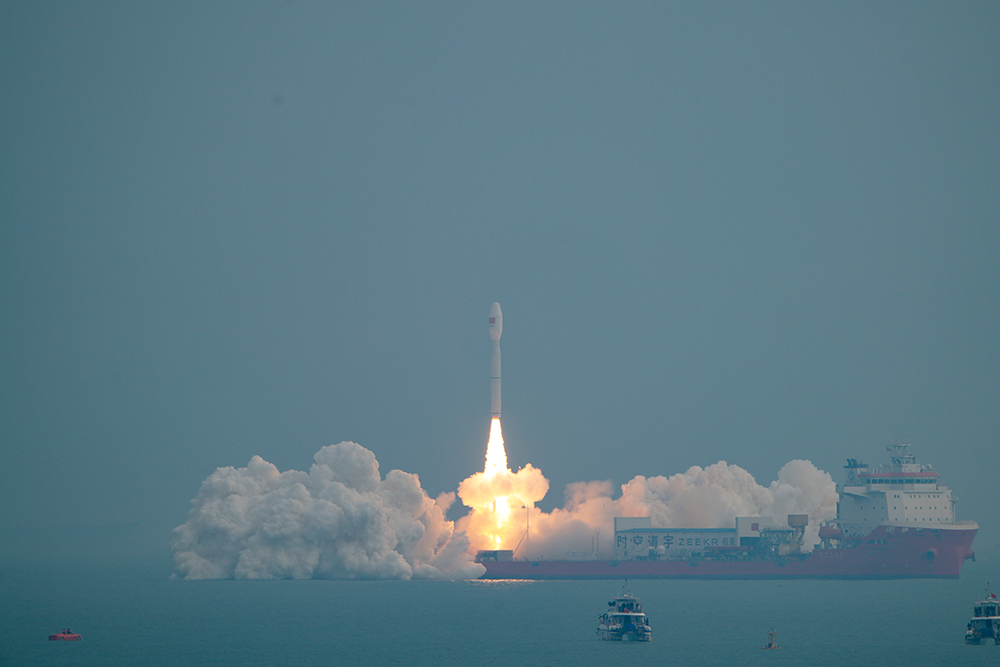
September24, the waters off Rizhao, Shandong, witnessed a spectacular aerospace event. The Jielong-3 carrier rocket took off from the sea, successfully completing the final phase of the constellation’s first network deployment with the launch of the sixth satellite of the Geely Constellation in a “one rocket, twelve satellites” manner. This marks the third network launch in two months, with the commercial aerospace company, Time Space Path, astonishingly weaving a global low-orbit satellite IoT network in space at a remarkable Chinese speed.
The global satellite IoT is entering a rapid development window, with satellite IoT having a first-mover advantage in application deployment compared to satellite internet. Looking globally, traditional satellite operators like Iridium are expanding from basic communication to satellite IoT scenarios. Now, with the precise orbit insertion of the sixth satellite of the Geely Constellation, this satellite network, entirely designed, developed, built, and operated by a private Chinese commercial aerospace company, is about to enter the stage of large-scale commercial deployment, marking China’s commercial aerospace officially stepping into a new era of global satellite IoT commercialization.

Satellite IoT is set to experience a rapid outbreak period.
The global space race has entered a heated stage, with Musk’s “Starlink” rapidly claiming territory, making low-orbit satellite constellations a hot topic. In China, the countdown for satellite internet licensing is underway, gradually opening the door to commercialization.
As the global satellite internet enters a “preparation period,” another network—satellite IoT—is entering its “outbreak period.”
What are the differences between “satellite internet” and “satellite IoT”? If we simplify this question to the difference between the internet and the IoT, most people can understand the regional differences between these two networks: the former can be understood as “fiber optics in space,” providing broadband data internet services to human users, allowing them to “connect to the network”; the latter can be understood as “WeChat in space,” providing narrowband data links for a vast number of machines, sensors, and control terminals, supporting the transmission of text messages, voice messages, images, and other types of services, allowing things to “connect to the network,” while also accommodating some “human networking” scenarios.
When you are watching a movie or having a video conference on an ocean cruise, you need satellite internet. When you want to know the location of a cargo ship or the data from a remote weather station, you need satellite IoT.
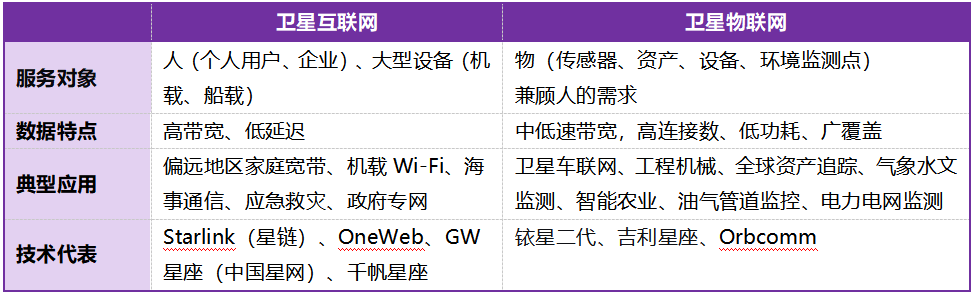
Satellite IoT will land faster than satellite internet. There are four reasons:
First, the construction speed is faster, and costs are controllable. Low-orbit satellite IoT constellations do not have high bandwidth requirements, and typically require less than a hundred satellites to achieve global coverage, making the investment return cycle more controllable; in contrast, low-orbit satellite internet constellations often require thousands of satellites for network scale. For example, SpaceX’s Starlink currently has over 8,000 satellites in orbit.
Second, the service costs are lower. The communication service fees for satellite IoT are significantly lower than traditional satellite communication, expected to be only one percent of traditional satellite communication, greatly reducing the threshold for public use.
Third, the demand in the industry is more rigid. Industries such as logistics, energy, agriculture, fisheries, and emergency services urgently need low-cost, low-power, and wide-coverage communication infrastructure. As the IoT develops globally, the inadequacy of traditional cellular networks in covering oceans, deserts, and mountainous areas is becoming increasingly prominent. Low-orbit satellite IoT, with its low latency, wide coverage, and flexible networking characteristics, has become an important means for various industries to compensate for the shortcomings of terrestrial networks.
Fourth, the push from policies and ecosystems. The government is vigorously promoting new infrastructure such as industrial internet, vehicle networking, and smart agriculture, which aligns closely with satellite IoT, making it easier to form an industrial value closed loop and accelerate commercialization.

On par with Iridium
Becoming the new generation of global low-orbit satellite IoT constellation
Among global commercial satellite IoT constellations, the Geely Constellation ranks second in the number of satellites in orbit, on par with Iridium’s second generation.
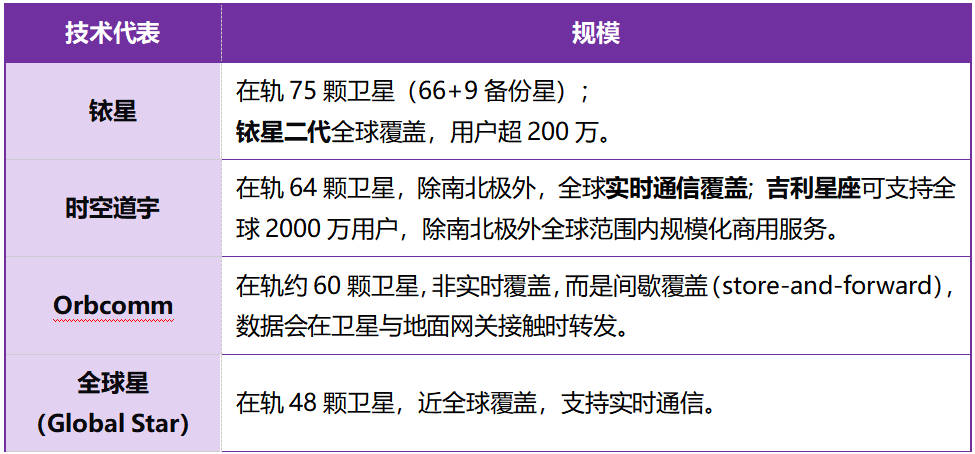
The completion of the first phase of the Geely Constellation network makes Time Space Path the second operator globally, after Iridium’s second generation, capable of providing real-time satellite IoT communication services worldwide, with a user scale expected to exceed that of Iridium. In addition to building the constellation, Time Space Path also covers the entire chain from satellite communication chips, modules to various terminal types, with clear positioning and comprehensive services, possessing the strength to compete with mainstream international commercial aerospace companies. This not only marks that Chinese commercial satellite communication companies have entered the global first tier but also provides a new strategic infrastructure for the global industrial digitalization and intelligent transformation.

Serving20 million usersAchieving global real-time communication coverage
As of now, including the previously deployed experimental satellites, Time Space Path has a total of 64 satellites in orbit, weaving a satellite IoT network that covers the globe. All satellites have an in-orbit reliability of 100%, and network reliability is nearly 100%, achieving real-time communication coverage for any location on the Earth’s surface, except for the polar regions.
In the main areas between latitudes 60°N and 60°S, the Geely Constellation can achieve 1 to 2重 real-time coverage. The entire system’s daily communication capacity has exceeded 340 million times, providing stable services for 20 million users worldwide, including 5 million high-frequency users and 15 million medium and low-frequency users. The single communication capacity is 1,900 characters per second, supporting the transmission of text messages, voice messages, images, and other service types, meeting diverse IoT application needs.
Securityand reliability are also core advantages of this constellation network. The constellation payload and terminals are equipped with a fully self-developed adaptive anti-jamming algorithm, with an anti-jamming capability of 50dB. The signals have strong interception resistance, fully ensuring the security of communication information. At the same time, the service frequency used has excellent diffraction characteristics and low link loss, allowing the system to maintain excellent communication availability and reliability even in complex environments, far exceeding similar international systems.
Based on mid-low speed data communication services, Time Space Path can combine different application scenarios to set real-time settings, priority allocation, confirmation mechanisms, message length settings, service frequency selections, and other dimensions of satellite IoT communication as needed, supporting the definition of diverse application services according to user needs. For example, in emergency communication, higher communication priority can be set to ensure timely emergency response. In satellite vehicle networking scenarios, real-time location confirmation and short message sending and receiving are supported to ensure vehicle interconnectivity. In applications of satellite IoT communication devices in industries such as engineering machinery, low-frequency low-power mode settings are suitable to meet the needs of low-cost, ultra-low power consumption, and long-duration service.
In the future, once the planned 72 satellites of Time Space Path are fully deployed, the entire constellation system will achieve 3 to 4重 real-time coverage in global coverage areas, and communication capacity and service reliability will be further enhanced. As a new generation of satellite IoT constellation built by Chinese commercial aerospace for global commercial use, the Geely Constellation will provide solid support for the global industrial digitalization and intelligent transformation.

Developedin 3 years, deployed in 4 years
Creating a rapid commercial closed loop for global satellite IoT
The Geely Constellation project was launched in 2019, taking 7 years to complete the first phase of the network by 2025. During this period, the design and development of the constellation took about 3 years, and the satellite launch and deployment took about 4 years, achieving a rapid closed loop from project initiation to operation.
During the constellation construction phase, the Geely Constellation project progressed rapidly, with a high-density and efficient satellite deployment rhythm. The first satellite was launched into orbit in 2022, the second and third orbits were completed in 2024, and the fourth, fifth, and sixth satellites were densely networked within two months in 2025, completing the first phase of the constellation network construction.
In terms of products and services, Time Space Path has also made key breakthroughs. In March 2023, it completed the research and development and tape-out of satellite communication chips based on its own constellation; from 2024 to 2025, it will successively complete the research and testing of communication modules and various types of satellite communication terminals; in June 2024, the Geely Constellation completed its first overseas commercial verification test in Oman, with a communication success rate of 99.15% and network availability exceeding 99.97%; it has completed commercial verification tests with several domestic industry partners, including China Unicom, China National Heavy Duty Truck Group, Geely Automobile, and Cao Cao Mobility.
At the same time, the Geely Constellation is actively promoting global market applications. Between 2024 and 2025, it successively signed cooperation agreements with telecom operators in more than 20 overseas countries, including Oman, Malaysia, Saudi Arabia, Morocco, Kenya, and Argentina, to promote the landing of satellite IoT services globally.
With commercial closed-loop capabilities
Joining the global commercial satellite constellation competition
In the competition of the global satellite communication industry, business closed-loop and self-control are important standards for measuring enterprise capabilities. Time Space Path has built a complete business closed loop of “space segment (satellite) – ground system – application products” and achieved full-chain self-research capabilities. From constellation system design verification, payload platform self-research, satellite mass production, satellite constellation operation control, application communication chips to various types of module terminals, all have achieved independent research and mass production, forming a sustainable and replicable commercial closed-loop capability.
This capability has also been validated in global cooperation. Time Space Path promotes the integration and innovation of “satellite IoT + industry,” with commercial verification tests in scenarios such as “satellite + intelligent networking,” “satellite + marine fisheries,” “satellite + engineering machinery,” and “satellite + transportation logistics,” with test success rates close to 100%, effectively promoting the cross-integration of satellite IoT with new generation information infrastructure such as industrial internet, vehicle networking, and low-altitude intelligent networking.
Relying on the global satellite IoT service capabilities of the Geely Constellation, Time Space Path can provide stable and reliable real-time satellite IoT communication services for diverse scenarios such as intelligent networking, marine fisheries, engineering machinery, low-altitude travel, emergency communication, transportation logistics, public facilities, energy, water conservancy, and agriculture and animal husbandry.
After six consecutive successful launches, the first phase of the Geely Constellation network has been successfully completed, forming global coverage capabilities, which not only allows Chinese commercial aerospace to enter the ranks of international leaders but also provides reliable support for the commercial application development of global satellite IoT, accelerating the landing of satellite services in the industrial sector.