The core technology of future automotive products is the electronic and electrical architecture. The automotive electronic and electrical architecture is gradually evolving from a decentralized, embedded system to a centralized, integrated one. The ultimate ideal state should be to form a “central brain” for the vehicle, unifying the management of various functions.The electronic and electrical architecture is similar to a “central government”, which can coordinate and manage various functions of the vehicle, avoiding “feudal lords’ fragmentation and inconsistent policies”. Initially, this “central government” may manage less, with “local lords” still retaining some control, but eventually, the “central government” will manage more, and local administrative bodies will only receive directives from the “central government” and execute them efficiently to ensure optimal overall vehicle performance.
In the past, controllers in vehicles were independent of each other, and the software was embedded, allowing for final hardware integration of the entire vehicle. In the future, as the burden on ECUs decreases, the originally highly decentralized functions will be integrated into domain controllers. Automakers must master the central control system themselves; otherwise, they will lose control over their automotive products. Therefore, the gradual integration of originally highly decentralized control functions is a new essential course for traditional car manufacturers, and their mastery of electronic and electrical architecture will be stepwise and incremental.The Tesla Model 3 has initiated a significant transformation in electronic and electrical architecture, introducing a central computing prototype and position domain, shortening the vehicle’s wiring harness by 50%. The future goal is to reduce the entire vehicle’s wiring harness to 100 meters, with Tesla leading traditional car manufacturers by more than six years in electronic architecture. Except for Tesla, most automotive companies are still in the early stage of functional domain controller architecture, where some functions have been concentrated into functional domain controllers but still retain many distributed modules, i.e., a transitional solution of “distributed ECU + domain controller”, to avoid additional risks and costs due to excessive transformation.Most companies plan to mass-produce the next generation of cross-domain integrated electronic and electrical architectures by 2022, aiming to achieve high software concentration in domain controllers and gradually reduce distributed ECUs.By 2025, some car manufacturers will implement electronic and electrical architectures with central computing + regional controllers, further integrating software and hardware, gradually consolidating software ownership back to the automakers. The process of evolving towards a “central computing + regional control” architecture could take 5-10 years.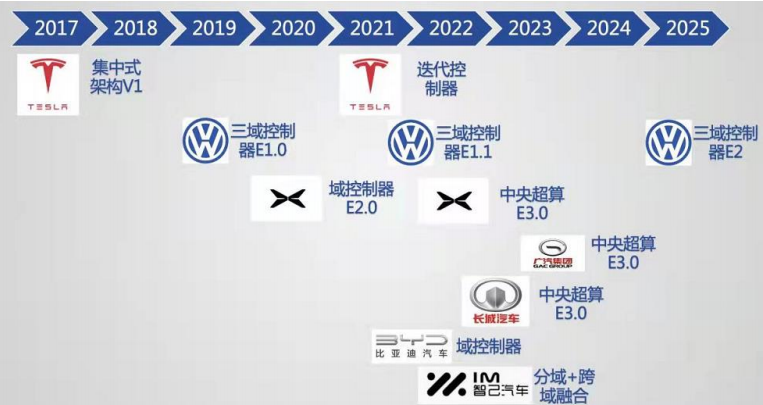 The evolution pace of electronic and electrical architecture among mainstream automakers varies. Source: Automotive Electronics Design
1. Audi A8 Takes a Small Step
The Audi A8, launched in 2018, was the first to achieve integrated control of driver assistance functions, replacing the distributed driver assistance system with independent ECUs.Besides the integration of the autonomous driving domain, the other four domains—chassis + safety, power, body, and entertainment—still adopt a distributed architecture.The autonomous driving domain controller consists of four chips: Mobileye EyeQ3 for visual perception computing, such as traffic signal recognition, pedestrian monitoring, collision alerts, lane line recognition, and light detection. NVIDIA K1 is responsible for image fusion computing, such as driver monitoring and processing images from 360-degree cameras. Intel Cyclone V handles target fusion, map fusion, parking assistance, and pre-brake lights. Infineon’s Aurix TC297 is responsible for communication processing. The software development for this autonomous driving domain controller was completed by the Austrian software company TTTech, and Delphi provided hardware integration.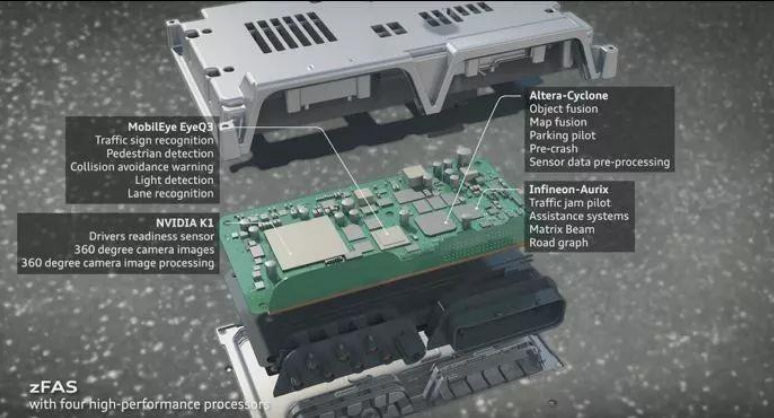 2018 Audi A8 domain controller, Source: Audi
2. Tesla Model 3 Initiates Comprehensive Transformation of Electronic and Electrical Architecture
Tesla is a comprehensive transformer of automotive electronic and electrical architecture. The Model S in 2012 had a relatively clear functional domain division, including power domain, chassis domain, and body domain, with the ADAS module spanning both the power and chassis domains. As the traditional domain architecture could not meet the development of autonomous driving technology and the demands of software-defined vehicles, decoupling hardware and software required a transformation of the electronic and electrical architecture. Therefore, in 2017, Tesla launched the Model 3, breaking through the framework of functional domains and achieving a framework of central computing + regional controllers. By building a cross-domain integration architecture + self-developed software platform, Tesla not only realized software-defined vehicles but also effectively reduced overall vehicle costs and improved efficiency.1) The Model 3 has three controllers, effectively lowering material costs;2) Hardware integration serves software, providing a foundation for deep control and maintenance of the vehicle;3) The self-developed software platform supports modular expansion and reuse.The Tesla Model 3 has basically realized the prototype of a centralized architecture, but it is still quite far from a truly centralized architecture: the communication architecture primarily relies on the CAN bus, and the central computing module merely integrates the multimedia MCU, autonomous driving FSD, and vehicle-to-internet modules onto a single board, with each module independently running its own operating system. Nevertheless, the Model 3 has already implemented the framework concept of central computing + regional control, leading traditional automakers by about six years.The evolution of Tesla’s electronic and electrical architecture across three generations of vehicles essentially involves reclaiming vehicle functions from suppliers for self-development. The autonomous driving module, entertainment control module, other regional controllers, and thermal management of the Model 3 are all self-designed and developed, achieving autonomy in the main vehicle modules without relying on Tier 1 suppliers. Even for modules not fully autonomous, Tesla has engaged in joint development with suppliers; for instance, Tesla incorporated its software into the iBooster provided by Bosch, achieving shorter braking distances through software updates.Through the evolution of three models, Tesla’s new electronic and electrical architecture not only significantly reduces the number of ECUs and shortens the wiring harness (the Model S’s wiring harness is 3000 meters, while the Model 3 reduces it by more than half) but also breaks the traditional automotive industry’s old component supply system (where software and hardware are deeply coupled and sold as a package to OEMs, limiting their bargaining power and complicating subsequent functional adjustments). Tesla has truly realized software-defined vehicles, with its OTA updates capable of changing braking distances, activating seat heating, and providing personalized user experiences. By breaking through functional domains, Tesla’s domain controllers span body, cabin, chassis, and power domains, making vehicle function iterations more flexible, allowing users to experience a vehicle that feels constantly new. In stark contrast, most traditional automakers’ OTA updates are limited to in-car infotainment functions.Tesla has also self-developed the core intelligent hardware for the autonomous driving main control chip, believing that specialized chip design allows for more efficient software operation. This means that future upgrades and function deployments of Tesla vehicles will no longer depend on external SOC chip suppliers, truly placing the vehicle’s soul in its own hands.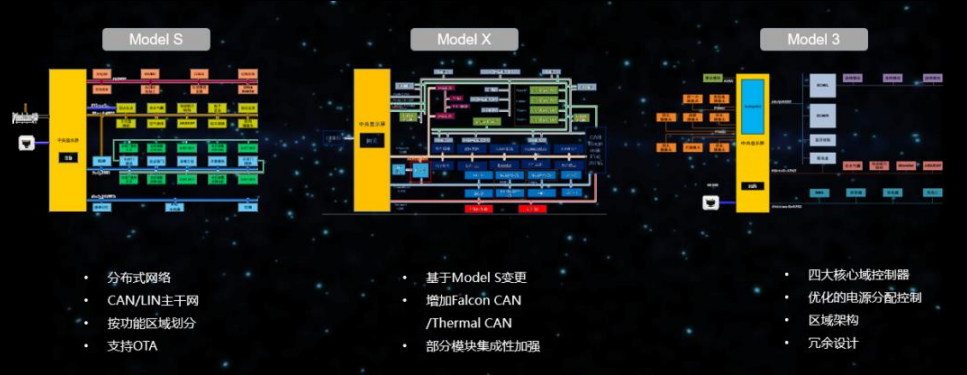 The evolution history of Tesla’s electronic and electrical architecture, Source: Huang Shaotang “Software Defined Vehicles, Architecture Defines Software”The Model 3 comprises four controllers: the Central Computing Module (CCM), the Left Body Control Module (BCM LH), the Right Body Control Module (BCM RH), and the Front Body Control Module (BCM FH).The Left Body Control Module is responsible for convenience control of the left body, steering, braking, and assistance. The Right Body Control Module handles convenience control of the right body, chassis safety systems, power systems, and thermal management. The Central Computing Module includes the autonomous driving module, infotainment module, and internal/external communication connections, sharing a liquid cooling system. The autonomous driving and entertainment control modules take over sensors related to assisted driving—cameras and millimeter-wave radars—placing high-computational-demand intelligent driving and infotainment together for continuous upgrades of intelligent hardware. In 2019, Tesla launched its self-developed FSD chip, replacing the NVIDIA Drive PX2 chip, achieving a 21-fold increase in AI computing performance. As Tesla has realized self-development of the most critical computing hardware for autonomous driving, it has significantly enhanced its competitive advantage over rivals. The operating system is customized based on open-source Linux and self-developed middleware, achieving autonomy in both software and hardware, accelerating the iteration speed of vehicle function updates, and reducing overall vehicle development costs.
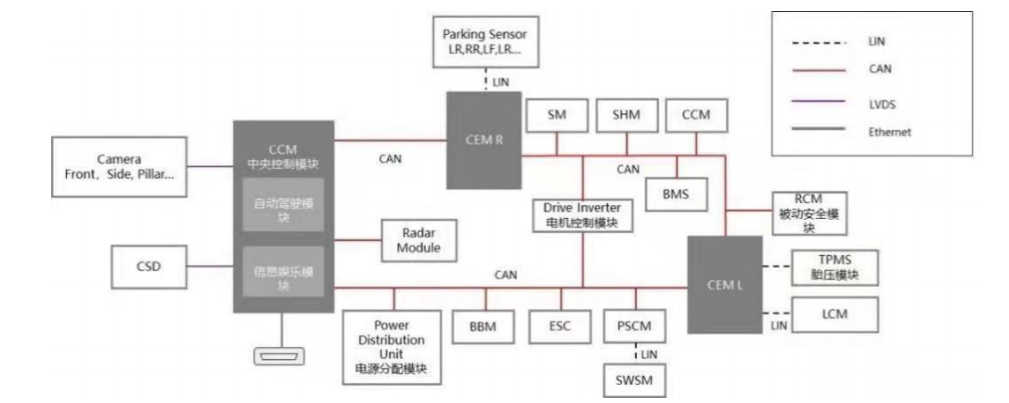 Tesla Model 3 electronic and electrical architecture, Source: Tesla
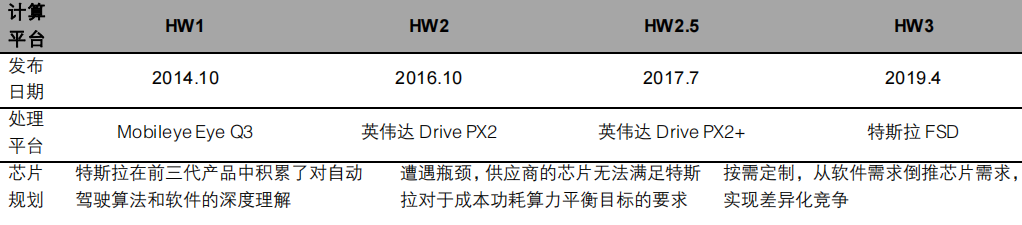 Tesla’s autonomous driving main control chip development history, Source: Tesla, Horizon
3. Volkswagen ID Series Electronic and Electrical Architecture
Volkswagen has upgraded from the distributed electronic and electrical architecture of the MQB platform models to the three functional domain electronic and electrical architecture used in the MEB platform ID series models.According to the plan, the ID series electronic and electrical architecture based on the Volkswagen MEB platform will be version E³1.1, mass-produced in 2023 with E³1.2 on the PPE platform, evolving to version E³2.0 after 2025.Volkswagen’s E3 architecture mainly consists of three domains: vehicle control domain (ICAS1), intelligent driving domain (ICAS2), and intelligent cockpit domain (ICAS3). The intelligent driving domain ICAS2 is still under development, and the mass-produced models still use a distributed architecture scheme. Although the ID series electronic and electrical architecture has three functional domains, it still retains many distributed modules. The domestic ID4’s autonomous driving function is realized by a Mobileye monocular camera + front long-range radar + two rear corner radars. As an affordable electric vehicle, it has temporarily chosen not to compete with Tesla and Chinese new forces in the autonomous driving domain controller.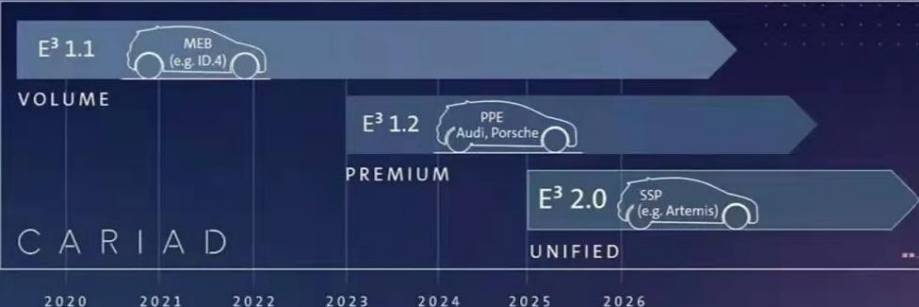 Volkswagen electronic and electrical architecture timeline, Source: Volkswagen
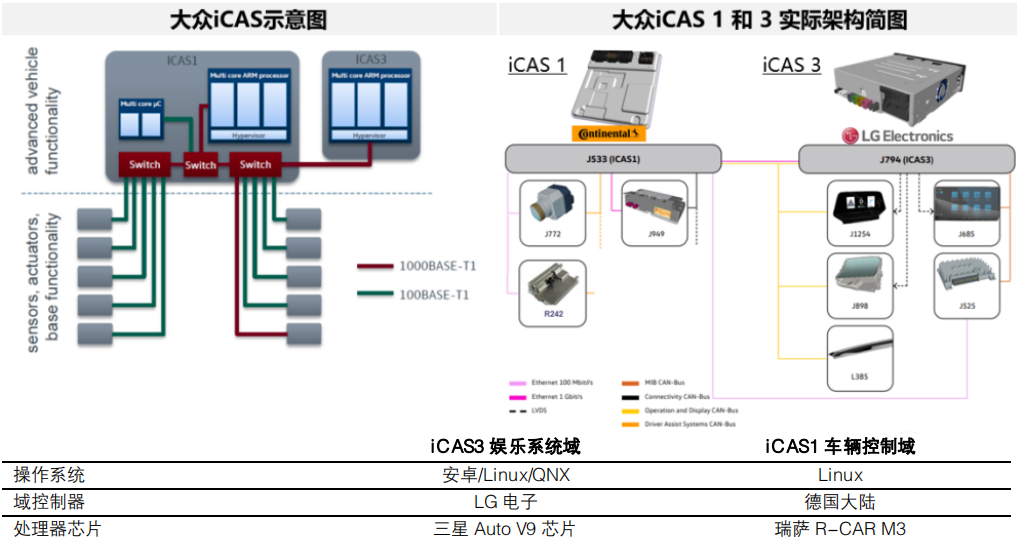 Volkswagen ID4 vehicle control domain and infotainment domain controllers, Source: Volkswagen, Zosi Automotive Research
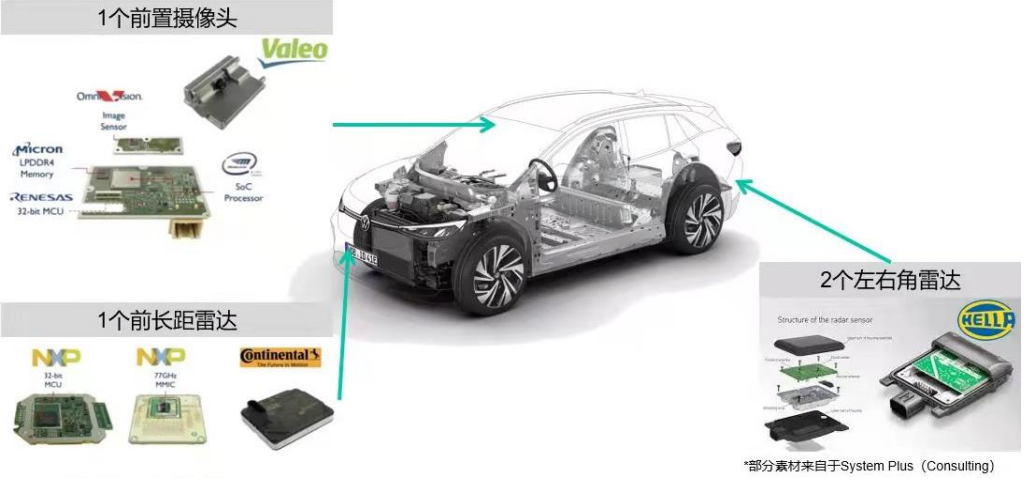 Volkswagen MEB platform current intelligent driving solution is distributed, Source: Volkswagen, VehicleThe Volkswagen ID series models completed a delivery volume of 70,000 units in 2021, which is lower than the initial plan. China, as Volkswagen’s most important single market, is also accelerating its pursuit of intelligence. In 2022, Volkswagen’s software company CARIAD established a subsidiary in China. According to the CEO of its Chinese subsidiary, the company’s core business is software development for the MEB platform, with OTA functions starting in the second half of 2022, and the second focus is on localization and digital products for high-end platforms (the first vehicle on the PPE platform will be produced in China in 2024), including advanced driver assistance systems, and its intelligent networking system must be integrated with China’s infrastructure construction; the third focus is software development for the SSP platform after 2025. In line with Volkswagen’s 2030 NEW auto plan, the proportion of self-developed software is expected to rise to 60%. The benefits of maintaining autonomy in software development include achieving agility (including development and maintenance) and reflecting product differentiation, with localization being a necessary and key aspect for foreign companies to enhance intelligence in China. The ultimate goal is to create competitive products that attract Chinese consumers.Let’s look at a comparison of the electronic and electrical architectures of three electric vehicles launched at the same time. Although the Volkswagen ID series claims to replace the past 70+ distributed ECUs with three domain controllers, it still retains a considerable number of ECUs. The ID3 was delayed in delivery due to widespread software bugs, reflecting that traditional automakers, even when choosing to undergo a significant transformation in electronic and electrical architecture, still heavily rely on external suppliers if their talent structure and software capabilities are insufficient, leading to additional risks from taking too large steps. Therefore, most OEMs choose a gradual approach, gradually reclaiming software leadership as their software capabilities improve.In mid-2021, Munro & Associates Engineering compared the differences between Tesla Model Y, Ford Mach-E, and Volkswagen ID.4 electric architectures, involving the number of ECUs, the number of CAN buses, the use of Ethernet, LIN buses, LVDS (Low-Voltage Differential Signaling), audio, fuses, and relays. Tesla Model Y has significantly higher integration, with half the number of ECUs compared to ID4, while Ford and Volkswagen still retain many existing distributed ECUs. Tesla’s number of LIN (Local Interconnect Network) is also only half that of Volkswagen ID4 and Ford Mach-E.Tesla has a higher number of CAN (Controller Area Network) buses, and due to the increase in the number of cameras, Tesla’s use of low-voltage differential signaling (LVDS) is more than three times that of Ford and Volkswagen. Volkswagen uses more Ethernet. Since the Model 3, Tesla’s low-voltage electrical part does not use any fuse boxes or relays.Comparison of electronic and electrical architectures of Volkswagen ID4, Model Y, and Ford Mach E
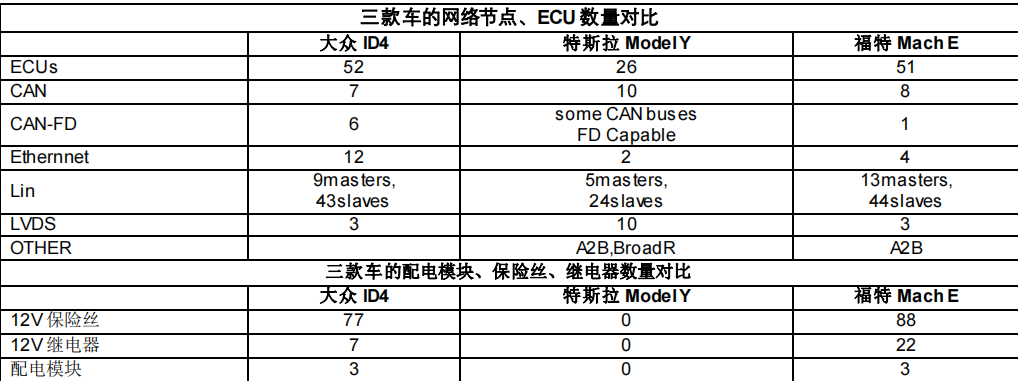 Source: Munro & Associates, 3IS
4. Xpeng Motors G9 Electronic and Electrical Architecture Leads
Among the three new forces, Xpeng Motors is relatively advanced in electronic and electrical architecture. With the iteration of models from G3, P7, and P5 to G9, the X-EEA3.0 electronic and electrical architecture has entered a centralized electronic and electrical architecture.With its leading-generation architecture, equipped with higher computing power SOC chips and higher computing power utilization, the Xpeng G9 may become the first mass-produced vehicle supporting the XPILOT 4.0 intelligent driving assistance system.The Xpeng P7 is equipped with Xpeng’s second-generation electronic and electrical architecture, featuring a hybrid characteristic:1) Layered domain control. Functional domain controllers (intelligent driving domain controller, body domain controller, power domain controller, etc.) coexist with the central domain controller;2) Cross-domain integration—domain controllers cover multiple functions while retaining some traditional ECUs;3) Hybrid design—traditional signal interaction and service interaction coexist in design.Thus, CAN buses and Ethernet buses coexist, ensuring both big data/real-time interaction; with fewer Ethernet nodes, the requirements for gateways are low.Xpeng’s second-generation electronic and electrical architecture has achieved a reduction of approximately 60% in the number of traditional ECUs, with hardware resources highly integrated. Most vehicle body functions have migrated to domain controllers, and the central processor can support most functions related to dashboards, infotainment systems, and intelligent body control, while also integrating a central gateway, compatible with V2X protocols, supporting communication between vehicles and local area networks, and connecting vehicles with cloud services and remote digital terminals. Xpeng’s intelligent driving domain controller integrates high-speed NGP, urban GNP, and parking functions.Xpeng’s assisted driving adopts a laser radar-vision fusion scheme, which differs from Tesla’s pure vision scheme. This leads to different hardware architectures, requiring different communication bandwidth and computing capabilities.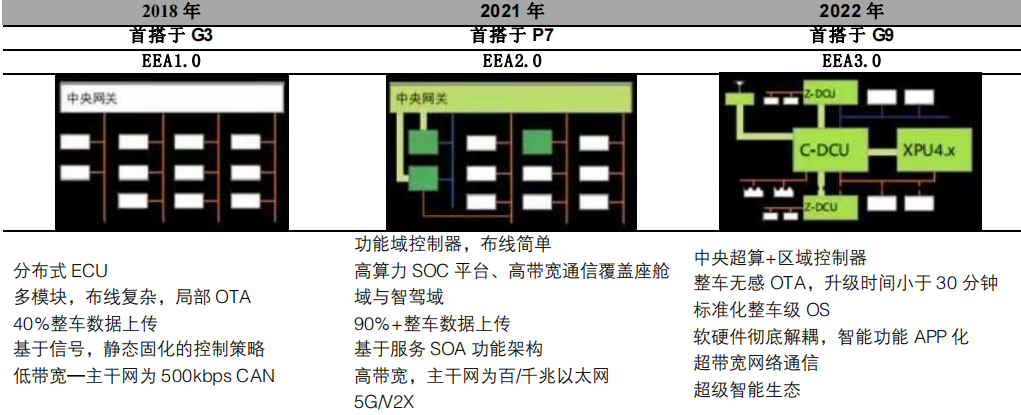 Xpeng Motors electronic and electrical architecture evolution history. Source: Xpeng Motors
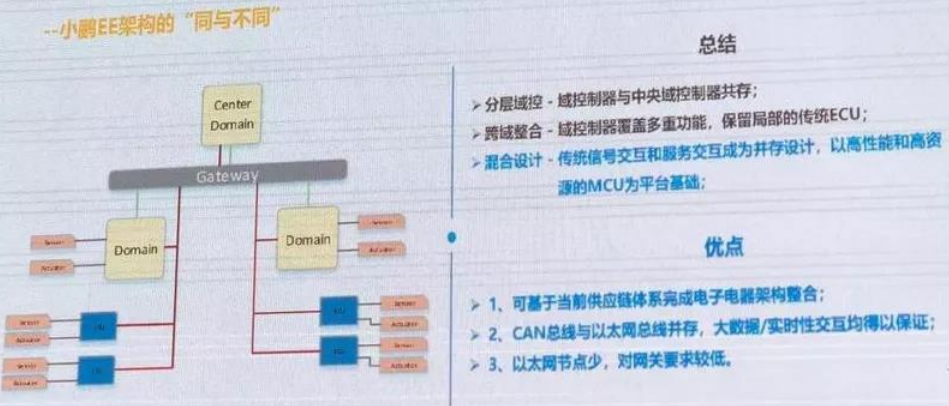 Xpeng Motors second-generation electronic and electrical architecture features, Source: Xpeng MotorsXpeng Motors refers to its X-EEA3.0 electronic and electrical architecture as “the secret to keeping intelligent vehicles relevant in the future.” According to the information disclosed by the company, the electronic and electrical architecture first equipped on the G9 has significant potential for upgrades and optimizations in the future.The X-EEA 3.0 hardware architecture adopts a central supercomputer (C-DCU) + regional control (Z-DCU) hardware architecture. The central supercomputer includes three domain controllers: vehicle control, intelligent driving, and cabin. The regional controllers are left and right domain controllers, partitioning more control components based on proximity configuration, significantly reducing wiring harnesses.Thanks to Xpeng Motors’ full-stack self-development capability, the new architecture achieves deep integration of hardware and software, decoupling both hardware and software layers. It allows for layered iteration of system software platforms, basic software platforms, and intelligent application platforms, separating the vehicle’s underlying software and basic software from application software related to intelligence, technology, and performance. When developing new functions, only the top-level application software needs to be researched and iterated, shortening the R&D cycle and technical barriers, allowing users to enjoy rapid iterations of the vehicle.✔ System software platform: partially customized development based on purchased code, frozen with the vehicle’s basic software platform, reusable for different models;✔ Basic software platform: multiple vehicle basic function software form standardized service interfaces and are frozen before vehicle mass production, reusable for different models;✔ Intelligent application platform: features such as autonomous driving, intelligent voice control, and smart scenarios can be rapidly developed and iterated.The X-EEA 3.0 data architecture sets memory partitions for domain controllers, allowing for upgrades to run without interference, enabling vehicle-side upgrades that can be completed in 30 minutes.In terms of communication architecture, X-EEA3.0 for the first time in the country implements a communication architecture based on gigabit Ethernet as the backbone, while supporting multiple communication protocols, allowing for faster data transmission in vehicles. The new generation electronic and electrical architecture equipped on the G9 shows that Xpeng has started early in building backbone networks and moving towards SOA.In terms of power architecture, it can achieve scene-based precise power distribution, supplying power according to different driving and third-space scenarios. For example, when waiting by the roadside, it can only supply power to functions like air conditioning, seat adjustment, and music, cutting power to other parts, thus achieving energy savings and extending range. The vehicle performs regular self-diagnosis to proactively identify issues and guide maintenance, empowering after-sales services through technology.
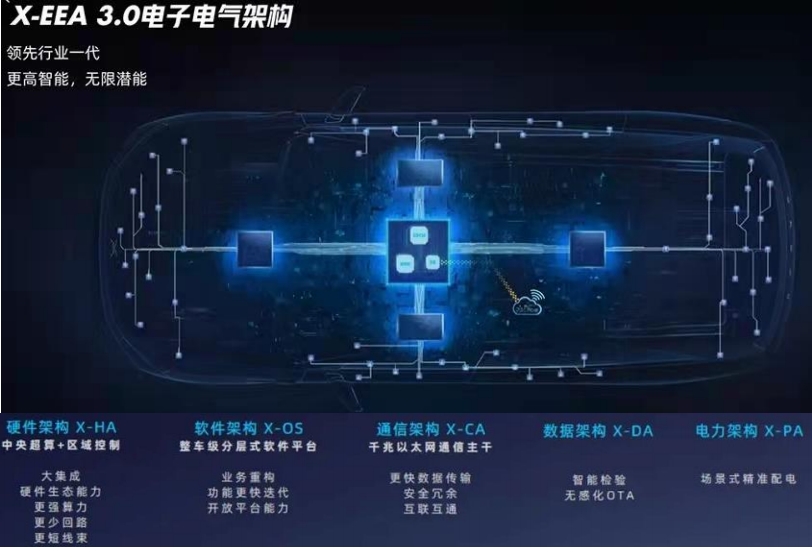 Xpeng’s third-generation electronic and electrical architecture achieves gigabit Ethernet + central computing + regional control, Source: Xpeng Motors
5. Great Wall Motors Electronic and Electrical Architecture Development Roadmap
Great Wall Motors’ third-generation electronic and electrical architecture developed in 2020 includes four functional domain controllers—body control, power chassis, intelligent cockpit, and intelligent driving. The application software is self-developed and has been mass-produced and applied to all Great Wall Motors models, optimizing material costs, such as the new Haval H6 optimizing the wiring harness by 300 meters, with a total length of 1.6 kilometers, close to that of the Tesla Model 3, reducing weight by over 2 kilograms.Starting from GEEP3.0, Great Wall Motors has achieved full self-development capabilities for all application layer software. The upper application software of the four domain controllers, and even some lower-level integration software, is also self-developed by Great Wall Motors.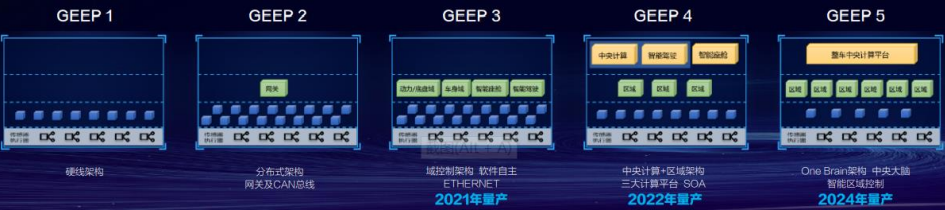 Great Wall Motors electronic and electrical architecture mass production roadmap, Source: Great Wall Motors
The fourth-generation electronic and electrical architecture to be launched in 2022 will further centralize vehicle control software, achieving efficient integrated management, high safety and reliability, and faster response to demands.
The fourth-generation architecture includes three computing platforms: central computing, intelligent cockpit, and high-level autonomous driving, plus three regional controllers (left, right, front). The fourth-generation architecture will first be equipped on Great Wall Motors’ new electric and hybrid platforms and will gradually expand to all models.The central computing unit of the fourth-generation architecture integrates body, gateway, air conditioning, power/chassis control, and ADAS functions. Its main control chip has a computing power of 30KDMIPS, efficiently ensuring system control and response. The GEEP 4.0 architecture features mature visual processing chip solutions, with 18 CAN FD lines, 4 LIN lines, 11 vehicle Ethernet lines, and configurations of 64GB storage and 1GB memory to meet the demands of future function integration in terms of computing and communication. The three regional controllers serve as standardized control units responsible for integrating surrounding MCUs, with most software algorithms for the three regional controllers already migrated to the central computing unit, developed by Great Wall’s software team.This architecture introduces SOA design concepts and methodologies, creating a foundational infrastructure platform for layered software, providing modular standard service interfaces, with the advantage of offering a building block assembly and decoupling hardware and software platforms, enhancing software reusability, enabling functional iteration and upgrades throughout the vehicle’s lifecycle, allowing users to subscribe to vehicle service functions dynamically based on their preferences without waiting for software upgrade batches. Additionally, SOA enables flexible deployment of intelligent scenarios, with standardized interfaces allowing for open services, building an ecosystem for Great Wall Motors to collaborate with developers to provide comprehensive intelligent mobility services.GEEP 4.0 supports firmware over-the-air upgrades, software over-the-air upgrades, and remote diagnostics; it also supports OTA functions for all ECUs in the vehicle, including power chassis systems, audio-visual entertainment systems, body systems, and intelligent driving systems. The new architecture’s cloud diagnosis method brings convenience to after-sales services, enabling remote diagnosis of vehicle fault information based on vehicle-side and cloud-side function deployment, allowing for remote vehicle repairs. While ensuring the timeliness of diagnosis and repairs, the diagnostic knowledge base can intelligently identify, analyze, and match the optimal repair solutions, effectively addressing the shortcomings of insufficient personnel and technical limitations at 4S shops, truly alleviating users’ concerns quickly.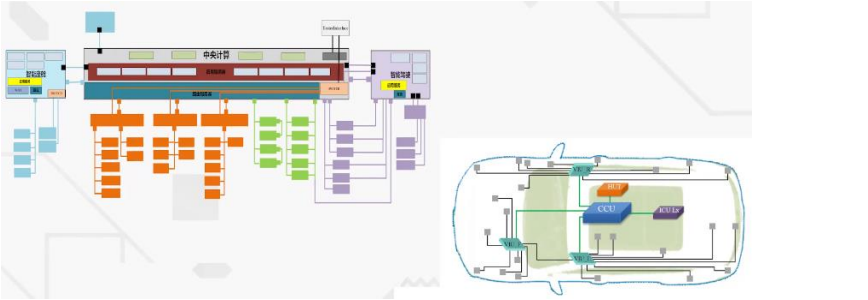 Great Wall Motors fourth-generation electronic and electrical architecture, Source: Great Wall MotorsThe development of Great Wall Motors’ fifth-generation electronic and electrical architecture will start simultaneously with the fourth generation. The fifth-generation architecture will concentrate the vehicle’s software entirely into a central brain (one brain), planned for release in 2024. It will achieve 100% SOA, completing the construction of a standardized software platform for the entire vehicle.Currently, the central computing modules for Tesla’s vehicles separate cabin chips and intelligent driving chips, and it is not yet a one-brain solution. According to trends from leading intelligent chip manufacturers globally, the integration of intelligent driving chips and cabin chips into a single chip is an inevitable trend, but the one-brain solution requires very high software capabilities from OEMs.
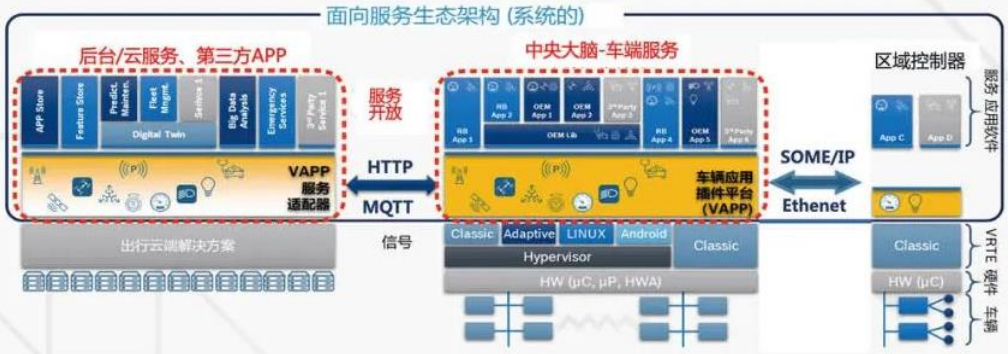 Great Wall Motors next-generation vehicle-cloud integrated intelligent ecological architecture, Source: Great Wall MotorsThe rapid iteration speed of Great Wall Motors’ electronic and electrical architecture will provide a “foundation” for the implementation of self-developed intelligent core technologies. The rapid iteration of electronic and electrical architecture is also closely related to the company’s goal of maintaining a leading position in intelligence.In terms of intelligence, Great Wall’s typical winning weapons include:1) The fully self-developed automatic driving technology of Haomo Intelligent Driving.2) The line control steering technology to be commercially applied in 2023.Full-stack self-development in autonomous driving solutions:Great Wall Motors’ Haomo Intelligent Driving is expected to achieve urban navigation assistance driving functions by 2022, possibly competing with Xpeng Motors in the pace of urban navigation function implementation.In terms of hardware,HPilot3.0 has a powerful computing power of 360TOPS, and the vehicle is equipped with 12 cameras and 2 laser radars, 5 millimeter-wave radars, and 12 ultrasonic radars.One reason for Haomo Intelligent Driving’s urban navigation function’s early implementation is the use of a heavy perception scheme rather than a heavy mapping scheme, which is not limited by high-precision maps of cities.The urban navigation plan of Haomo Intelligent Driving is expected to start SOP in June 2022, and can be effectively deployed in over 100 cities nationwide, providing a significant geographical advantage.Haomo Intelligent Driving has a wide deployment range with numerous models and quantities, allowing for high-speed continuous iterations based on more data.In 2022, it undertook the development tasks for high-level assisted driving for 34 upcoming models from Great Wall Motors, accounting for nearly 80% of the models scheduled for launch that year, with 30% being standard and the rest being high-spec models.In terms of autonomous driving execution:The upgrade of automotive intelligence and the centralization of electronic and electrical architecture also require upgrading traditional automotive chassis to adapt to development. The chassis control systems are closely related to the execution of autonomous driving.The line control chassis mainly includes line control steering, line control braking, line control shifting, line control throttle, and line control suspension, with line control steering and line control braking being the core products aimed at the execution end of autonomous driving. Currently, the main line control braking manufacturers globally include Bosch, Continental, and ZF, with high entry barriers.In mid-2021, Great Wall Motors first released its intelligent line control chassis, with all core hardware, including electronic mechanical line control brakes, steering gears, motors, simulators, and controllers, being self-designed by Great Wall Motors.This is the country’s first line control steering technology that supports L4+ autonomous driving, which will be officially applied commercially in 2023.
6. SAIC Zero-Loss Electronic and Electrical Architecture
SAIC’s chief engineer, Zu Zijie, believes that the most critical technology in automotive products is the electronic and electrical architecture, which must be mastered by the vehicle manufacturer.As the core of the vehicle, the electronic and electrical architecture will define many standards that are completely different from the past, as automobiles were previously a closed system, while future vehicles will be an open system. After the popularization of autonomous driving vehicles, automakers will have to bear responsibility for driving safety accidents, and safety technology can only be mastered internally. From this perspective, automakers must firmly grasp the electronic and electrical architecture and the central control system, including the vehicle operating system, basic applications, and service software architecture above the electronic and electrical architecture, and fully understand and integrate them.From the perspective of overall product control, Zu Zijie believes that the controllers on automotive products were previously independent and embedded, and it would not be a significant issue for automakers to delegate some of them to suppliers. However, in the future, the control systems on automotive products will move towards unification, and automakers must master the central control system themselves, or they will lose control over their automotive products. Gradually integrating and unifying the originally highly decentralized control functions is a correct yet challenging path that automakers must take.SAIC has equipped its high-end pure electric intelligent vehicle brands, Zhiji and Feifan, with the full-stack version 1.0 electronic and electrical architecture. The full-stack version 1.0 electronic and electrical architecture includes three domain controllers: central computing (vehicle control and data fusion), intelligent driving, and intelligent cockpit, while still retaining many distributed modules. In July 2021, it launched the “Zero-Loss Galaxy Full-Stack 3.0 Technical Solution” for independent research and development, further centralizing control to support L4-level and above autonomous driving, planned to be equipped on SAIC’s Zhiji and Feifan brands in 2024.The Zero-Loss Galaxy Full-Stack 3.0 electronic and electrical architecture uses two high-performance computing units, HPC1 and HPC2, to achieve intelligent driving, intelligent cockpit, intelligent computing, and intelligent driving backup functions, along with four regional controllers to achieve different functions in their respective areas, fully supporting L4 and above intelligent driving technologies.The underlying narrow operating system (OS) has been upgraded from heterogeneous to homogeneous; the backbone communication bandwidth has been expanded to gigabit and even ten gigabits; the intelligent vehicle data factory has fully achieved digital twin mirroring, continuously solidifying the intelligent vehicle network security protection system for cloud, pipe, and end, accelerating the intelligent vehicle’s self-learning, self-growth, and self-evolution, making the vehicle a carrier and entry point directly connected to users, a mobile AIoT platform, and a digital experience space.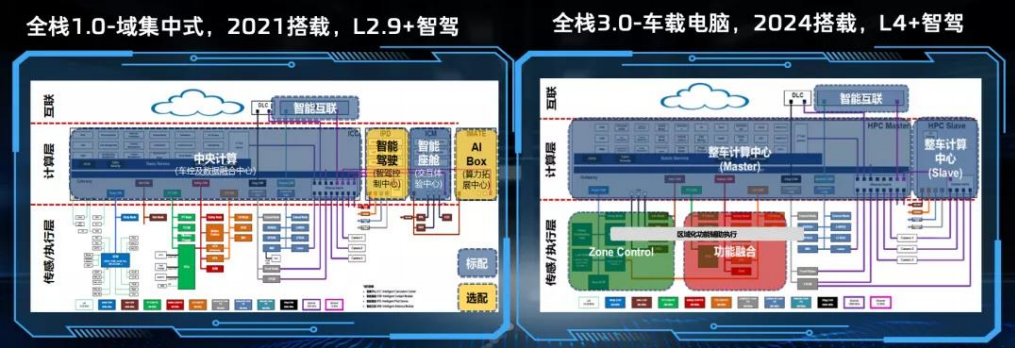 Zero-Loss Technology Galaxy Full-Stack 3.0 Solution to be implemented in 2024, achieving central computing + regional controllers, supporting L4+ intelligent driving, Source: Zero-Loss Technology
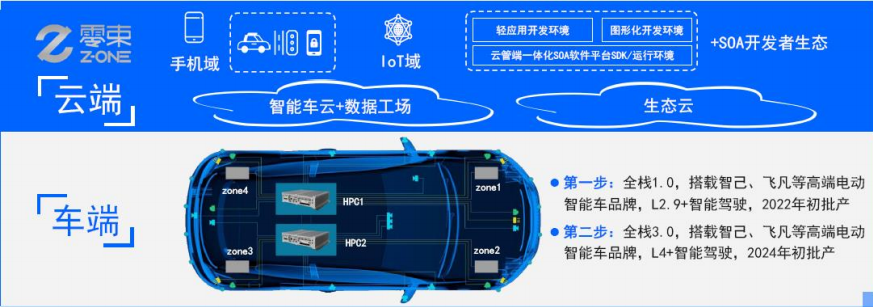 SAIC Group Zero-Loss Technology Galaxy Full-Stack Architecture, Source: SAIC Group
7. GAC Starling Electronic and Electrical Architecture
The GAC Starling electronic and electrical architecture is planned to be equipped on GAC’s new model in 2023. It consists of three core computing clusters: automotive digital mirror cloud, central computer, intelligent driving computer, and infotainment computer, along with four regional controllers, integrating gigabit Ethernet, 5G, information security, and functional safety technologies.Compared to GAC’s previous generation electronic and electrical architecture, the computing power of the new architecture has increased 50 times, the data transmission rate has increased 10 times, wiring harness loops have reduced by about 40%, and the number of controllers has decreased by about 20.In terms of hardware architecture, the three functional domain controllers + four regional controllers distributed at the front, rear, left, and right are similar to Great Wall Motors’ fourth-generation electronic and electrical architecture. The central computing unit (body control + new energy control) is equipped with the NXP S32G399 high-performance gateway computing chip; the cockpit domain is equipped with Qualcomm 8155/8295 chips; the intelligent driving domain is equipped with Huawei Ascend 610 high-performance chips, with a computing power of 400TOPS. The four regional controllers distributed around the vehicle primarily handle power supply and execute instructions from the central control unit, connected to the central computing unit via Ethernet. In terms of software structure, the “Starling” architecture adopts a SOA software architecture to replace the traditional software architecture, achieving component service, atomization, and standardization, allowing new application modules to realize new scenarios.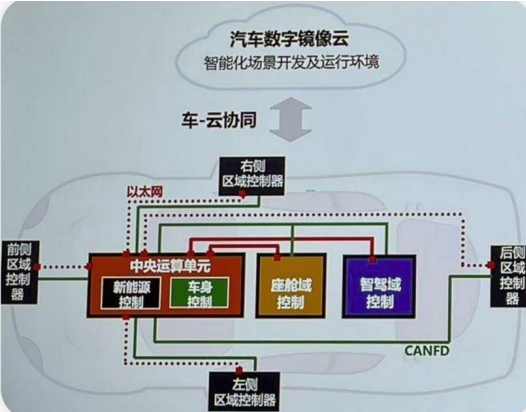 GAC Starling electronic and electrical architecture, Source: GAC Group
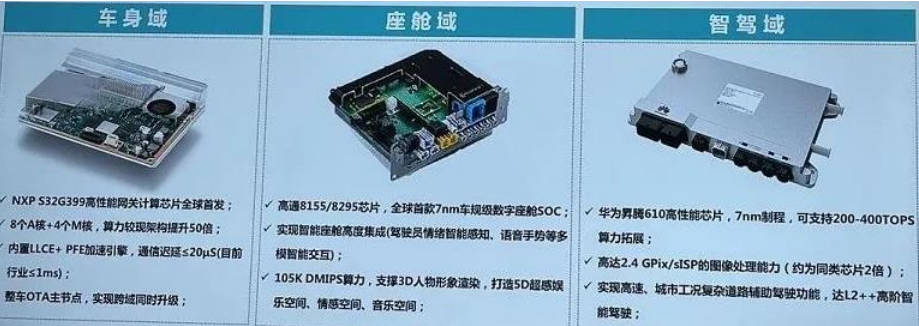 GAC Starling architecture three functional domain controllers, Source: GAC Group
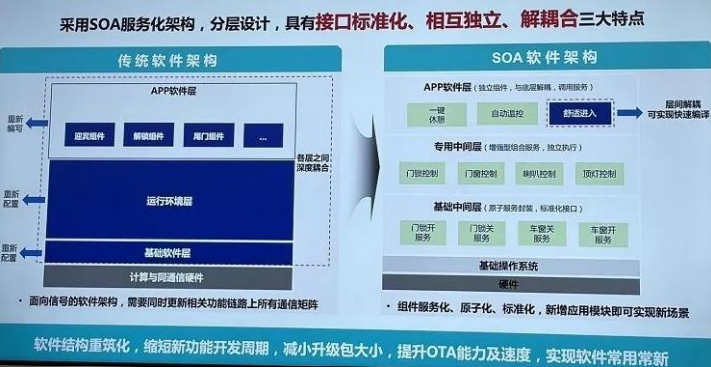 GAC Starling software architecture, Source: GAC GroupA good electronic and electrical architecture:First, it can save costs, including manufacturing costs and operating costs. The production side can save materials, simplify assembly, and enhance development and manufacturing efficiency. In cases where surface functions are similar, consumers using vehicles with a higher integration of electronic architecture may have lower energy consumption.Second, it can quickly provide rich and diverse functions. OEMs can develop various functions for different scenarios, such as Tesla’s seat heating and holiday mode, and function updates should be controllable by the OEMs, eliminating the need for complex supply chain organization for changing a function as in the past.If there is no upgrade to the underlying architecture, no matter how many intelligent functions are superficially present, it cannot be considered a true intelligent vehicle. For example, a distributed electronic and electrical architecture can also achieve automatic parking and L2 intelligent driving functions, but due to architectural limitations, it cannot connect sensors to a single intelligent driving domain controller, requiring two independent control units—parking controller and driving controller—leading to resource waste and constraints in subsequent function upgrades.Product definition is the premise for architecture development, and automakers will make trade-offs based on their brand image, product positioning, target customers, and internal resources. For example, automakers may prioritize integration in the intelligent cockpit while adopting a low-cost distributed solution for the assisted driving part. They may also prioritize high integration in chassis and body control.Different automakers have differences in brand matrices and model structures, and the architecture also needs to consider platform commonality and continuity.Summary table of major requirements for intelligent automotive electronic architecture
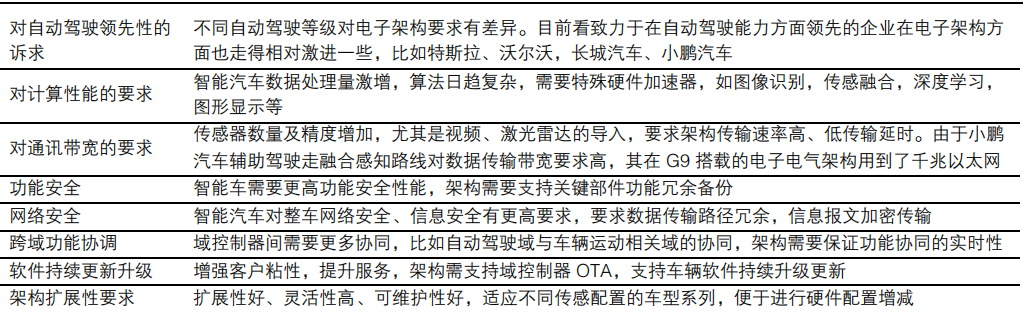 Source: Beijing New Energy Vehicle Technology Innovation Center Co., Ltd.
Welcome to all angel round and A round enterprises in the entire automotive industry chain (including dynamic battery industry chain)to join the group(which will be recommended to 800 automotive investment institutions including top-tier institutions);There are communication groups for leaders of science and technology innovation companies, automotive industry complete vehicles, automotive semiconductors, key components, new energy vehicles, intelligent connected vehicles, aftermarket, automotive investment, autonomous driving, vehicle networking, and dozens of other groups. Please scan the administrator’s WeChat to join the group (Please indicate your company name)