What specifications should we pay attention to when selecting accelerometers?
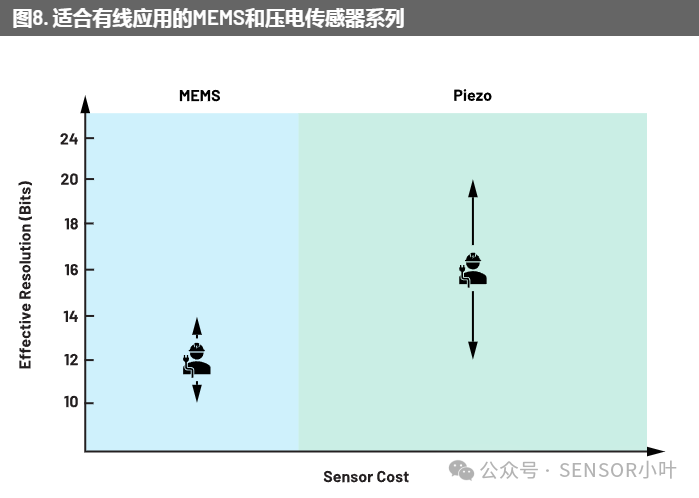
Although there are currently no official standards for classifying vibration sensors, they can be categorized based on their effective resolution, as shown in Figure 8. It is evident that the coverage area of MEMS accelerometers is smaller than that of piezoelectric sensors. MEMS accelerometers are suitable for many specific application areas, such as airbag collision detection, vehicle rollover detection, robotic arm positioning, platform stabilization, precise tilt detection, and more. MEMS manufacturers have only recently developed sensors that can compete with IEPE vibration sensors, so this technology is still in its infancy, with a smaller coverage area for Condition-Based Monitoring (CbM) devices, as shown on the left side of Figure 8. However, as more MEMS suppliers invest in developing condition monitoring vibration sensor solutions, an expansion in coverage is expected in the coming years.
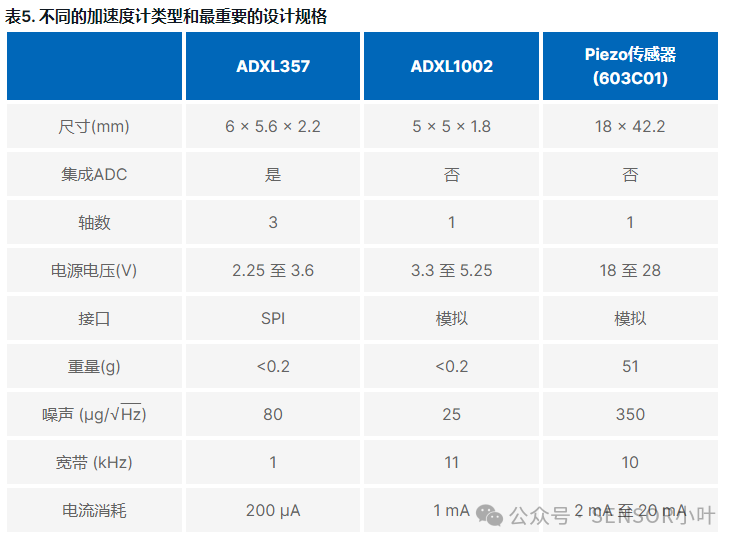
Many advantages of MEMS sensors are gradually having a significant impact in the field of vibration sensors. For example, the vast majority of MEMS sensors on the market have the following characteristics: three axes, integrated ADC, digital filtering, excellent linearity, low cost, low weight, and dimensions smaller than piezoelectric sensors or IEPE/ICP sensors, as shown in Table 5. While IEPE sensors will continue to be used for very critical equipment, maintenance and facility management personnel are also seeking deeper insights from non-critical equipment to improve productivity, efficiency, and sustainability, minimizing unplanned downtime and extending equipment lifespan. In this case, lower-cost and lower-performance sensors (whether MEMS or IEPE) will be used, raising the question: is a single-axis IEPE sensor with excellent noise and bandwidth performance always a better choice compared to a three-axis MEMS sensor?
How do three-axis MEMS sensors compare to IEPE vibration sensors?
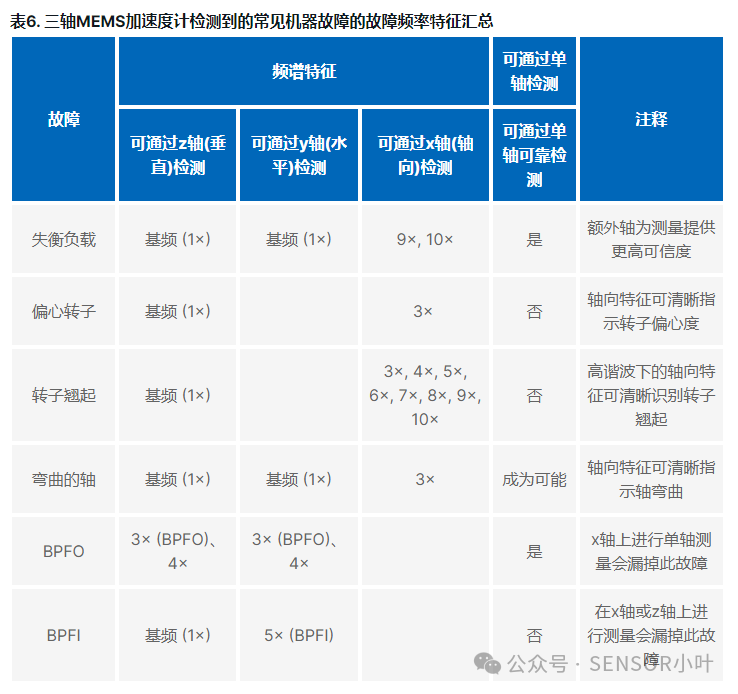
Testers have conducted extensive testing on the ability of three-axis MEMS accelerometers to reliably identify specific faults, which are often undetectable by higher-performing single-axis or dual-axis IEPE vibration sensors, as shown in Table 6. Unless certain measures are taken before installation to understand specific anomalies, single-axis vibration sensors cannot definitively detect faults such as shaft bending, unbalanced rotors, bearing issues, and rotor lift. When only single-axis vibration sensors are available, it may be necessary to use other CbM sensors (such as motor current or magnetic field sensors) to more reliably identify certain faults.There is a trade-off between single-axis sensors with excellent noise and bandwidth performance and three-axis sensors, as these additional axes can alleviate installation location challenges by providing comprehensive detection of vertical, horizontal, and axial vibrations, offering deeper insights into equipment operation. According to the results shown in Table 6, while single-axis sensors exhibit superior noise and bandwidth performance compared to three-axis MEMS sensors, they cannot reliably identify most faults without redirection and retesting.
What other vibration sensor products are available on the market? How do they compare?
So, how do three-axis MEMS sensors fit into the spectrum of vibration sensors? Figure 9 shows the current profile of MEMS vibration sensors on the market (based on noise and bandwidth). IEPE sensors are marked for reference, and the exact position of MEMS sensors in the vibration sensor spectrum is highlighted. It is clear that different types of MEMS sensors naturally form clusters, which we can leverage to allocate potential use cases. For example, the lowest-cost sensors (MEMS three-axis) can be used for lower criticality devices, while the highest-cost sensors (IEPE) are used for the most critical devices. Single-axis IEPE sensors have been in use for decades, covering all critical applications from low to high, and are widely accepted in terms of cost and performance, as shown in Figure 9. It is easy to see that three-axis IEPE sensors have similar performance to three-axis MEMS sensors, but at a much higher cost. For clusters of low-criticality devices, using expensive three-axis IEPE sensors is less feasible, further highlighting that three-axis MEMS sensors can match the noise and bandwidth performance of certain three-axis IEPE sensors.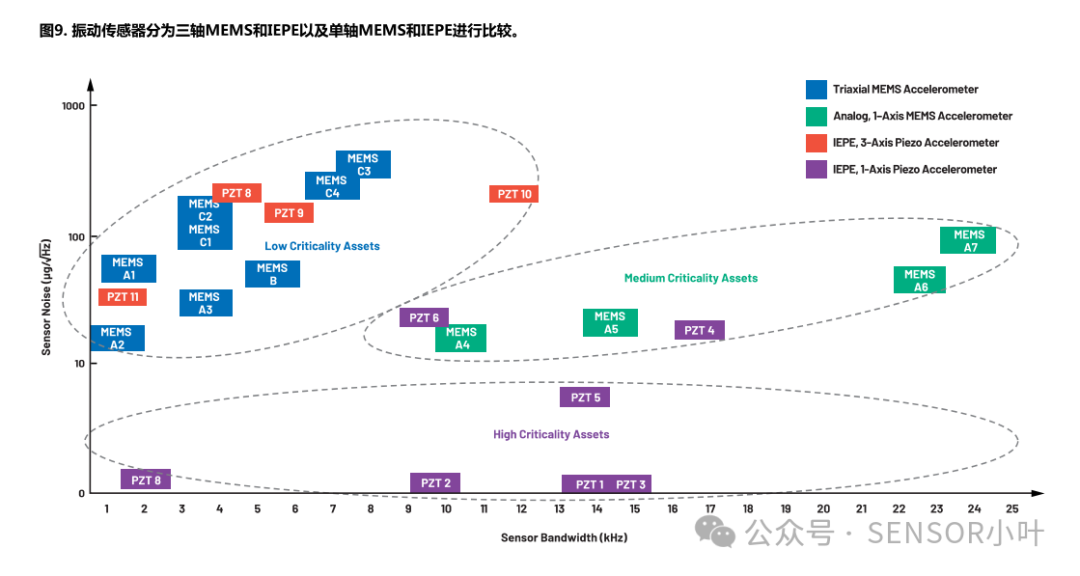 This article is excerpted from:Deployable 10BASE-T1L Single-Pair Ethernet Condition Monitoring Vibration Sensor Design